Canadian Mortgage Calculator
Year Opening Principal Interest Ending
Find out your exact commission in seconds with our fast and reliable Commission Calculator
Table of Contents
- Introduction
- How Canadian Mortgages Work
- What Is a Canadian Mortgage Calculator?
- Canada’s Unique Mortgage Rules You Must Know
- How to Use a Canadian Mortgage Calculator Step by Step
- Understanding CMHC Mortgage Insurance
- The Canadian Mortgage Stress Test Explained
- Amortization Periods — Choosing the Right One
- Payment Frequency Options and Their Impact
- GDS and TDS Ratios — What Lenders Evaluate
- Real-Life Examples Using a Canadian Mortgage Calculator
- Benefits of Using a Canadian Mortgage Calculator
- Common Mistakes First-Time Buyers Make
- Tips to Reduce Your Mortgage Cost Over Time
- Frequently Asked Questions
- Conclusion
Introduction
Buying a home in Canada is one of the biggest financial decisions of your life — and the mortgage attached to it will shape your finances for the next 25 to 30 years. Before you sign anything, before you walk into a bank, and before you make an offer on a property, you need to understand exactly what you can afford and what your monthly payments will look like. That is precisely what a Canadian Mortgage Calculator is built to do.
A Canadian Mortgage Calculator is not just a generic payment estimator — it is a specialized tool designed around Canada’s unique mortgage rules, including semi-annual compounding, CMHC insurance, the federal stress test, and multiple payment frequency options. These features make it fundamentally different from American mortgage calculators and general financial tools.
In this complete guide, you will learn how Canadian mortgages work, how to use our tool step by step, how CMHC insurance and the stress test affect your qualification, how to choose the right amortization period, and how to use real numbers to plan your home purchase with confidence.
Whether you are a first-time buyer in Toronto, a growing family upgrading in Calgary, or an investor purchasing a rental property in Vancouver — a Canadian Mortgage Calculator will be your most valuable tool throughout the entire process.
How Canadian Mortgages Work
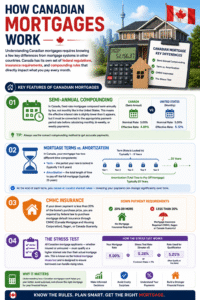
Understanding Canadian mortgages requires knowing a few key differences from mortgage systems in other countries. Canada has its own set of federal regulations, insurance requirements, and compounding rules that directly impact what you pay every month.
Key Features of Canadian Mortgages:
Semi-Annual Compounding In Canada, fixed-rate mortgages compound semi-annually by law, not monthly like in the United States. This means the effective interest rate is slightly lower than it appears, but it must be converted to the appropriate payment-period rate before calculating monthly, bi-weekly, or weekly payments.
Mortgage Terms vs. Amortization In Canada, your mortgage has two different time components:
- Term — the period your rate is locked in (typically 1 to 5 years)
- Amortization — the total length of time to pay off the full mortgage (typically 25 years)
At the end of each term, you renew at current market rates — meaning your payment can change significantly over time.
CMHC Insurance If your down payment is less than 20% of the home’s purchase price, you are required by federal law to purchase mortgage default insurance through CMHC (Canada Mortgage and Housing Corporation), Sagen, or Canada Guaranty.
The Stress Test All Canadian mortgage applicants — whether insured or uninsured — must qualify at a higher interest rate than their actual mortgage rate. This is known as the federal mortgage stress test and is designed to ensure borrowers can handle rising rates.
What Is a Canadian Mortgage Calculator?
A Canadian Mortgage Calculator is a digital tool specifically built to compute mortgage payments, total interest costs, amortization schedules, and qualification parameters according to Canadian mortgage law and lending rules.
Unlike a basic loan calculator, a proper tool accounts for:
- Semi-annual compounding (required for Canadian fixed-rate mortgages)
- CMHC premium auto-calculation based on your loan-to-value ratio
- Mortgage stress test qualification at the higher qualifying rate
- Multiple payment frequencies — monthly, bi-weekly, and weekly
- Full cost breakdown — including property taxes, heating costs, condo fees, and home insurance
- GDS/TDS ratio calculation — to determine whether a lender will approve your application
Our tool is built for Canadians, by Canadians, with Canadian rules baked in from the ground up. It gives you the complete picture of your mortgage cost — not just the basic payment amount.
Canada’s Unique Mortgage Rules You Must Know
Before using this tool effectively, you need to understand the rules that govern Canadian mortgages. These rules are set by the federal government and enforced by OSFI (the Office of the Superintendent of Financial Institutions).
Minimum Down Payment Requirements:
| Purchase Price | Minimum Down Payment |
|---|---|
| Under $500,000 | 5% of purchase price |
| $500,000 to $999,999 | 5% on first $500K + 10% on remainder |
| $1,000,000 and above | 20% minimum (no CMHC available) |
Maximum Amortization Periods:
- Insured mortgages (less than 20% down): maximum 25 years amortization
- Uninsured mortgages (20%+ down): maximum 30 years amortization
The 2024 Rule Change:
As of August 2024, first-time buyers purchasing new builds can access 30-year amortizations on insured mortgages — expanding affordability for a new generation of Canadian homebuyers.
These rules change regularly, which is why using an up-to-date Canadian Mortgage Calculator that reflects current regulations is critical for accurate planning.
How to Use a Canadian Mortgage Calculator Step by Step
Our Canadian Mortgage Calculator is designed to be simple to use while delivering professional-grade results. Here is a detailed walkthrough of every input field:
Step 1: Enter the Property Price Input the full purchase price of the home you are buying or considering. This is the total amount you are paying to the seller.
Step 2: Enter Your Down Payment Enter your planned down payment amount. The tool will automatically determine your loan-to-value (LTV) ratio, which affects both your CMHC premium and your interest rate qualification.
Step 3: Enter the Interest Rate Input your current mortgage rate or the rate quoted by your lender. If you are shopping around, try multiple rates to compare your monthly payment at different scenarios.
Step 4: Select the Amortization Period Choose from 10, 15, 20, 25, or 30 years. A longer amortization reduces monthly payments but significantly increases total interest paid.
Step 5: Choose Your Payment Frequency Select monthly (12 payments/year), bi-weekly (26 payments/year), or weekly (52 payments/year). More frequent payments reduce your total interest cost.
Step 6: Select the Compounding Rule For Canadian fixed-rate mortgages, select Semi-Annual (CA Fixed). For variable-rate mortgages, select Monthly (CA Variable).
Step 7: Enter the Stress Test Rate The default stress test rate is the Bank of Canada’s qualifying rate — typically your contracted rate plus 2%, or 5.25%, whichever is higher. This determines if you qualify based on lender requirements.
Step 8: Enter Additional Costs Fill in your annual property tax, heating costs, monthly condo fees (if applicable), and home insurance. These are used to calculate your GDS and TDS ratios.
Step 9: Click Calculate Mortgage Our tool instantly generates:
- Your regular payment amount
- Total principal and interest over the full amortization
- CMHC premium (if applicable)
- Stress test qualification result
- GDS and TDS ratios
- A full amortization table showing year-by-year balance, interest paid, and principal repaid
Understanding CMHC Mortgage Insurance
CMHC (Canada Mortgage and Housing Corporation) insurance is mandatory for any home purchase with less than a 20% down payment in Canada. It protects the lender — not the borrower — against mortgage default, but the cost is paid entirely by the homebuyer.
CMHC Premium Rates (2025):
| Loan-to-Value Ratio | CMHC Premium |
|---|---|
| Up to 65% (35%+ down) | 0.60% |
| 65.01% to 75% (25–35% down) | 1.70% |
| 75.01% to 80% (20–25% down) | 2.40% |
| 80.01% to 85% (15–20% down) | 2.80% |
| 85.01% to 90% (10–15% down) | 3.10% |
| 90.01% to 95% (5–10% down) | 4.00% |
Important: CMHC premiums are added to your mortgage principal and amortized over the life of your loan — you do not pay them upfront (though provincial sales tax on the premium may be due at closing in some provinces).
Example: On a $600,000 home with a $60,000 down payment (10%):
- Loan amount: $540,000
- CMHC rate: 3.10%
- CMHC premium: $16,740
- Total insured mortgage: $556,740
Our Canadian Mortgage Calculator auto-calculates your CMHC premium based on your purchase price and down payment — no manual lookup required.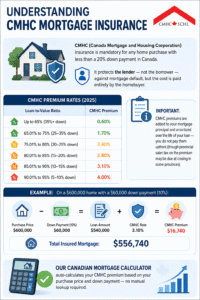
The Canadian Mortgage Stress Test Explained
The mortgage stress test is one of the most important and most misunderstood parts of the Canadian home-buying process. Introduced by OSFI in 2018 and updated in 2021, it requires all mortgage applicants to qualify at the greater of:
- Their contracted mortgage rate plus 2%, OR
- 5.25% (the minimum qualifying rate)
This means if your actual mortgage rate is 4.85%, you must prove you can afford payments at 6.85% before a federally regulated lender will approve your application.
Why the Stress Test Exists:
The stress test protects the Canadian housing market — and individual borrowers — from the risk of rising interest rates. If you can only afford your mortgage at the current low rate, you would be in serious financial trouble when your term renews at a higher rate.
Stress Test Impact Example:
| Scenario | Monthly Payment | Max Qualifying Income Required |
|---|---|---|
| At actual rate: 4.85% | $2,900/month | Lower |
| At stress test rate: 6.85% | $3,500/month | Higher |
You must qualify at the higher payment — even though you will actually pay the lower amount.
Our Canadian Mortgage Calculator automatically runs both calculations side by side, showing you your actual payment and your qualifying requirement — so you know exactly where you stand before talking to a lender.
Amortization Periods — Choosing the Right One
Your amortization period is one of the most impactful financial decisions in your mortgage. It determines how long you will carry the debt, how much interest you will pay over the lifetime of the loan, and how large your monthly payments will be.
Comparison — $540,000 Mortgage at 4.85%:
| Amortization | Monthly Payment | Total Interest Paid |
|---|---|---|
| 10 Years | $5,631 | $135,720 |
| 15 Years | $4,182 | $212,760 |
| 20 Years | $3,497 | $299,280 |
| 25 Years | $3,087 | $386,100 |
| 30 Years | $2,840 | $482,400 |
The difference between a 25-year and 30-year amortization is nearly $100,000 in additional interest — a number that surprises most first-time buyers.
Use our Canadian Mortgage Calculator to test different amortization scenarios with your specific numbers. Choose the shortest amortization your monthly budget can comfortably support — every extra year costs you thousands in interest.
Payment Frequency Options and Their Impact
How often you make mortgage payments has a direct effect on how quickly you pay down your principal and how much interest you pay overall. Canada offers three common payment frequencies:
Monthly (12 Payments/Year)
The standard option. You make 12 equal payments per year. Most straightforward to budget, aligns with monthly income cycles for salaried workers.
Bi-Weekly (26 Payments/Year)
You make a payment every two weeks — which results in 26 half-payments, equivalent to 13 full monthly payments per year. The extra payment goes entirely to principal, reducing your total interest and shortening your amortization by approximately 3 years.
Weekly (52 Payments/Year)
The most aggressive standard option. Like bi-weekly, it results in slightly more than 12 full monthly payments annually, saving even more in interest and shaving additional months off your amortization.
Pro Tip: If you are paid bi-weekly, choosing bi-weekly mortgage payments aligns your cash flow perfectly and automatically accelerates your payoff without requiring any extra effort.
Use our Canadian Mortgage Calculator to compare monthly vs. bi-weekly payments on your exact mortgage — the interest savings may surprise you.
GDS and TDS Ratios — What Lenders Evaluate
Canadian lenders use two key ratios to determine whether you can afford a Canadian mortgage calculator : the Gross Debt Service (GDS) ratio and the Total Debt Service (TDS) ratio.
Gross Debt Service (GDS) Ratio
GDS = (Monthly housing costs ÷ Gross monthly income) × 100
Housing costs include: mortgage payment + property taxes + heating costs + 50% of condo fees
Maximum GDS: 39% for insured mortgages (some lenders allow up to 44% for uninsured)
Total Debt Service (TDS) Ratio
TDS = (All monthly debt payments ÷ Gross monthly income) × 100
All debt includes GDS costs + car loans + student loans + credit card minimums + other obligations
Maximum TDS: 44% for insured mortgages (some lenders allow up to 50% for uninsured)
Example:
Gross monthly income: $8,000
- Mortgage payment: $2,900
- Property taxes: $267/month
- Heating: $100/month
- GDS = (3,267 ÷ 8,000) × 100 = 40.8% — slightly above insured limit
Our tool automatically calculates your GDS and TDS ratios so you can see exactly how a lender will evaluate your application before you ever walk into a bank.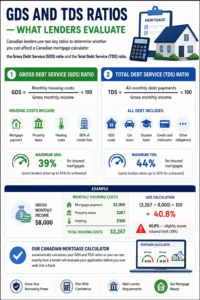
Real-Life Examples Using a Canadian Mortgage Calculator
Example 1: First-Time Buyer in Toronto
Scenario:
- Home Price: $750,000
- Down Payment: $75,000 (10%)
- Rate: 4.85% | Amortization: 25 years | Monthly
Results:
- CMHC Premium: $20,925
- Total Mortgage: $695,925
- Monthly Payment: $3,970/month
- Total Interest Over 25 Years: $495,075
Example 2: Upgrading Family in Calgary
Scenario:
- Home Price: $600,000
- Down Payment: $120,000 (20% — no CMHC)
- Rate: 4.85% | Amortization: 25 years | Bi-Weekly
Results:
- Total Mortgage: $480,000
- Bi-Weekly Payment: $1,355
- Estimated interest savings vs. monthly: $18,200 over 25 years
Example 3: Investor in Vancouver
Scenario:
- Home Price: $1,200,000
- Down Payment: $300,000 (25% — above $1M threshold, no CMHC)
- Rate: 5.20% | Amortization: 30 years | Monthly
Results:
- Total Mortgage: $900,000
- Monthly Payment: $4,900/month
- Total Interest: $864,000
Running these numbers in our Canadian Mortgage Calculator takes 30 seconds and gives you the complete picture before making any decisions.
Benefits of Using a Canadian Mortgage Calculator
1. Instant Accuracy with Canadian Rules Our tool is built specifically for Canada — semi-annual compounding, CMHC, stress test, and GDS/TDS ratios are all calculated automatically. No generic tool can do this correctly.
2. Complete Cost Picture Beyond the basic payment, you see property taxes, heating, condo fees, insurance, and CMHC premiums all factored in — the real total cost of homeownership.
3. Stress Test Clarity Know immediately whether you qualify at the stress test rate — before your lender tells you that you don’t.
4. Scenario Comparison Test 25 vs. 30 years. Monthly vs. bi-weekly. 4.85% vs. 5.5%. Make informed decisions based on real numbers, not guesses.
5. Amortization Table See exactly where your money goes every year — how much goes to principal, how much to interest, and what your remaining balance will be.
6. Free and Instant Our Canadian Mortgage Calculator is available online at no cost, with no registration required — use it as many times as you need.
Common Mistakes First-Time Buyers Make
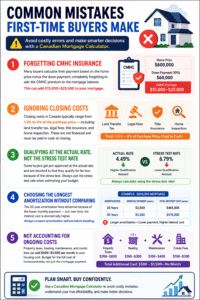
Mistake 1: Forgetting CMHC Insurance Many buyers calculate their payment based on the home price minus the down payment, completely forgetting to add the CMHC premium to the mortgage balance. This can add $15,000–$25,000 to your mortgage.
Mistake 2: Ignoring Closing Costs Closing costs in Canada typically range from 1.5% to 4% of the purchase price — including land transfer tax, legal fees, title insurance, and home inspection. These are not financed and must be paid in cash at closing.
Mistake 3: Qualifying at the Actual Rate, Not the Stress Test Rate Some buyers get pre-approved at the actual rate and are shocked to find they qualify for far less because of the stress test. Always use the stress test rate when estimating your budget.
Mistake 4: Choosing the Longest Amortization Without Comparing The 30-year amortization feels attractive because of the lower monthly payment — but over time, the interest cost is dramatically higher. Always compare amortization options before deciding.
Mistake 5: Not Accounting for Ongoing Costs Property taxes, heating, maintenance, and condo fees can add $500–$1,500 per month to your housing cost. Budget for the full cost of homeownership, not just the mortgage payment.
Tips to Reduce Your Mortgage Cost Over Time
1. Make Lump Sum Prepayments Most Canadian mortgages allow annual lump-sum prepayments of 10–20% of the original principal. Even one extra payment of $5,000 per year can save tens of thousands in interest over your amortization.
2. Increase Your Regular Payment Many lenders allow you to increase your regular payment by 10–20% above the minimum. Every extra dollar goes directly to principal.
3. Choose Bi-Weekly Over Monthly Switching from monthly to bi-weekly payments effectively makes one extra mortgage payment per year. Over a 25-year amortization, this can cut 2–3 years off your mortgage and save significant interest.
4. Shop for the Best Rate Do not automatically accept your bank’s first offer. A difference of even 0.25% on a $500,000 mortgage saves approximately $20,000 in interest over 25 years. Use mortgage brokers to access competitive rates from multiple lenders.
5. Renew Strategically When your term expires, use our Canadian Mortgage Calculator to evaluate whether to renew, refinance, or switch lenders. Rate shopping at renewal time is one of the highest-value financial decisions you can make.
Frequently Asked Questions
Q: Why does Canada use semi-annual compounding for mortgages? It is required by the Interest Act of Canada for mortgages with fixed rates. This means interest is compounded twice per year, which results in a slightly lower effective rate compared to monthly compounding.
Q: How is the CMHC premium calculated? The premium is based on your loan-to-value ratio. The lower your down payment (relative to the home price), the higher the premium. Rates range from 0.60% to 4.00% of the insured loan amount.
Q: What happens if I fail the mortgage stress test? You have several options: increase your down payment, reduce the purchase price, apply with a co-signer, extend your amortization, or work with a credit union (which is not federally regulated and may apply different criteria).
Q: Can I use this tool for mortgage renewals? Yes — enter your current remaining balance as the “property price,” set your down payment to zero (or the equity already paid), and enter the new rate and remaining amortization to instantly see your new payment.
Q: Is a 30-year amortization a good idea in Canada? It depends on your situation. A 30-year amortization reduces monthly payments by about 8–10% compared to 25 years — but costs significantly more in total interest. It is best used when cash flow is tight and you plan to make prepayments to accelerate payoff.
Conclusion
Buying a home in Canada is a major commitment — and understanding your mortgage is the foundation of making that commitment wisely. From CMHC insurance and the stress test to semi-annual compounding and GDS/TDS ratios, Canadian mortgages have layers of complexity that a generic calculator simply cannot handle.
Our Canadian Mortgage Calculator was built specifically to address every one of these layers — giving you accurate, regulation-compliant results that reflect how Canadian lenders actually evaluate your application and calculate your payments.
We covered every key aspect of the Canadian mortgage system: the rules that govern it, how to use our tool step by step, how CMHC insurance adds to your total mortgage, how the stress test determines your qualification, why amortization period choice matters enormously, and how payment frequency silently saves or costs you tens of thousands of dollars.
Use our Canadian Mortgage Calculator before you meet with any lender. Know your numbers. Know your ratios. Know what you qualify for. Walk into the bank with confidence — not questions.
Your dream home is within reach. The right mortgage strategy will help you get there — and keep you financially secure for decades to come.