Depreciation Calculator
Instantly estimate bond value and returns With Our Bond Calculator
Table of Contents- Introduction
- What Is Depreciation and Why It Matters
- How a Depreciation Calculator Works
- Key Inputs You Need Before You Start
- Understanding Depreciation Methods
- Straight Line Method Explained
- Declining Balance Method (200%) Explained
- Sum-of-the-Years’ Digits Method Explained
- Half-Year vs Full Month Convention
- Role of Salvage Value and Useful Life
- Tax Rate, Tax Shield, and Cash Flow Benefits
- Real-World Example with Step-by-Step Calculation
- Common Mistakes to Avoid
- Benefits for Small Businesses and Accountants
- Tips to Get Accurate Results Every Time
- Frequently Asked Questions
- Conclusion
Introduction
Every business that owns equipment, vehicles, machinery, furniture, or buildings eventually faces the same accounting reality: assets lose value over time. Capturing that loss accurately is not just a bookkeeping formality — it directly impacts profit margins, tax liability, and long-term financial planning. This is exactly where a Depreciation Calculator becomes indispensable. Instead of struggling with manual formulas, switching between spreadsheets, or risking costly errors, you can generate a precise year-by-year schedule in seconds.
This comprehensive guide walks you through everything you need to know about using a modern Depreciation Calculator effectively. We will explore the core methods, the inputs that drive accuracy, the conventions accountants rely on, and the strategic decisions that can save your business thousands of dollars. Whether you are a small business owner, a CPA, a finance student, or simply someone trying to understand how an asset’s value erodes over its useful life, this article gives you a clear, structured roadmap.
What Is Depreciation and Why It Matters
Depreciation is the systematic allocation of an asset’s cost over its useful life. When you purchase a piece of equipment for $50,000, you don’t expense the full amount in year one. Instead, you spread that cost across the years the asset actively generates revenue. This concept aligns with the matching principle in accounting, which states that expenses should be recognized in the same period as the revenue they help produce.
Without proper depreciation tracking, financial statements become misleading. Profits appear inflated, taxes are miscalculated, and asset values on the balance sheet drift away from reality. A reliable Depreciation Calculator removes that uncertainty by automating the math and presenting clean, auditable schedules.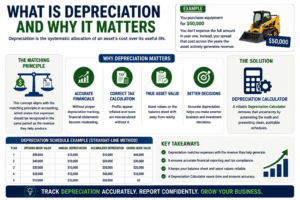
How a Depreciation Calculator Works
At its core, a Depreciation Calculator takes a handful of inputs — asset cost, salvage value, useful life, purchase date, depreciation method, and convention — and applies the correct formula to generate a complete schedule. It then outputs the beginning value, annual depreciation, accumulated depreciation, and ending book value for every year of the asset’s life.
The best tools also factor in tax rate, allowing you to see the tax shield generated by each year’s depreciation expense. This transforms a simple accounting exercise into a strategic planning tool for cash flow management.
Key Inputs You Need Before You Start
Accuracy in any Depreciation Calculator depends entirely on the quality of your inputs. Before you click Calculate, gather the following:
- Asset Cost: the total purchase price including shipping, installation, and setup fees.
- Salvage Value: the estimated resale or scrap value at the end of useful life.
- Useful Life: the number of years the asset is expected to remain productive.
- Purchase Year and Month: essential for prorating the first year.
- Depreciation Method: straight line, declining balance, or sum-of-the-years’ digits.
- Convention: full month or half-year.
- First Year Percentage: used when partial-year rules apply.
- Tax Rate: for calculating after-tax savings.
Missing or sloppy inputs are the number one reason depreciation schedules turn out wrong.
Understanding Depreciation Methods
The method you choose dramatically changes the shape of your expense curve. Some methods front-load the deduction, while others spread it evenly. A modern depreciation calculator lets you switch methods instantly and compare outcomes side by side — a feature that used to require hours of manual recalculation.
Each method has its own logic, ideal use case, and tax implication. Choosing the right one is a strategic decision, not just a technical one.
Straight Line Method Explained
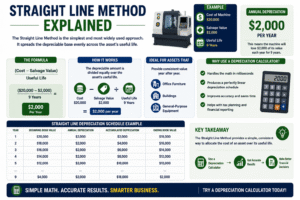
The Straight Line Method is the simplest and most widely used approach. It spreads the depreciable base evenly across the asset’s useful life.
Formula: (Cost − Salvage Value) ÷ Useful Life
If you buy a $20,000 machine with a $2,000 salvage value and a 9-year life, the annual depreciation is exactly $2,000 per year. This method is ideal for assets that provide consistent value year after year, such as office furniture, buildings, or general-purpose equipment. A Depreciation Calculator handles this in milliseconds and produces a perfectly linear schedule.
Declining Balance Method (200%) Explained
Also called Double Declining Balance, this method accelerates depreciation by applying twice the straight-line rate to the asset’s book value each year. It front-loads the expense, recognizing that many assets lose more value early in their life.
Formula: Book Value × (2 ÷ Useful Life)
This method is perfect for technology, vehicles, and machinery — items that depreciate quickly due to wear, obsolescence, or rapid innovation. The advantage is a bigger tax deduction in the early years, improving short-term cash flow. A high-quality depreciation calculator automatically switches to straight line in the final years to ensure the book value never drops below salvage value.
Sum-of-the-Years’ Digits Method Explained
The Sum-of-the-Years’ Digits (SYD) method is another accelerated approach but smoother than declining balance. It uses a fraction where the numerator decreases each year and the denominator is the sum of the digits of the useful life.
For a 5-year asset, the denominator is 1 + 2 + 3 + 4 + 5 = 15. Year one uses 5/15, year two uses 4/15, and so on. This produces a gradual, predictable acceleration that many accountants prefer for manufacturing equipment or specialized tools.
Half-Year vs Full Month Convention
Tax authorities rarely allow a full year of depreciation in the year of purchase. Instead, they require a convention to prorate the first and last years.
- Half-Year Convention: treats the asset as if it was purchased exactly in the middle of the year, allowing 6 months of depreciation in year one regardless of the actual purchase date.
- Full Month Convention: prorates based on the actual month of purchase, offering more precision.
A reliable Depreciation Calculator applies these conventions automatically, ensuring your schedule complies with both GAAP and IRS guidelines.
Role of Salvage Value and Useful Life
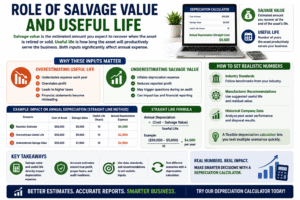
Salvage value is the estimated amount you expect to recover when the asset is retired or sold. Useful life is how long the asset will productively serve the business. Both inputs significantly affect annual expense.
Overestimating useful life understates expense and overstates profit. Underestimating salvage value inflates depreciation and may trigger questions during an audit. Use industry standards, manufacturer recommendations, and historical company data to set realistic numbers. A flexible depreciation calculator lets you test multiple scenarios quickly.
Tax Rate, Tax Shield, and Cash Flow Benefits
Depreciation is a non-cash expense, but it creates a very real tax shield. The formula is straightforward:
Tax Shield = Depreciation Expense × Tax Rate
If your business depreciates $10,000 in a year and the tax rate is 25%, you save $2,500 in taxes. Over a 10-year asset life, those savings compound into meaningful capital that can be reinvested into growth. A modern Depreciation Calculator displays this tax benefit alongside the schedule, helping leaders make smarter capital allocation decisions.
Real-World Example with Step-by-Step Calculation
Let’s walk through a complete example using a depreciation calculator with the following inputs:
- Asset Cost: $50,000
- Salvage Value: $5,000
- Useful Life: 5 years
- Method: Straight Line
- Tax Rate: 25%
- Convention: Full Month, purchased in January
Step 1: Depreciable Base = $50,000 − $5,000 = $45,000 Step 2: Annual Depreciation = $45,000 ÷ 5 = $9,000 Step 3: Annual Tax Shield = $9,000 × 25% = $2,250
Across the full 5-year life, total depreciation reaches $45,000 and total tax savings hit $11,250. Switching to the Declining Balance Method would shift more of that benefit into years one and two — a key insight only a depreciation calculator can reveal instantly.
Common Mistakes to Avoid
Even experienced bookkeepers stumble on the same recurring errors. Avoid these pitfalls:
- Forgetting the salvage value — leads to over-depreciation and book value going negative.
- Mixing up useful life and warranty period — these are rarely the same.
- Ignoring the convention rules — the IRS will reject improperly prorated schedules.
- Switching methods mid-life without justification — creates audit risk.
- Using the wrong tax rate — federal, state, and local rates can differ.
- Skipping accumulated depreciation tracking — book value becomes meaningless without it.
A trustworthy Depreciation Calculator acts as a guardrail against these mistakes by validating inputs and producing transparent, line-by-line schedules.
Benefits for Small Businesses and Accountants
For small business owners, time is the most precious resource. Manually building schedules in Excel is slow, error-prone, and frustrating. A purpose-built depreciation calculator turns a 30-minute task into a 5-second click, freeing owners to focus on growth instead of bookkeeping.
For accountants and CPAs, the tool standardizes outputs across clients, reduces review time, and produces client-ready reports. The ability to switch methods and instantly compare results also supports advisory conversations — helping clients understand the long-term tax impact of each decision.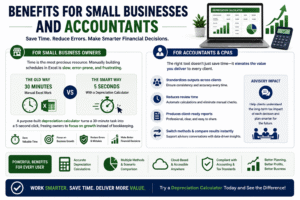
Tips to Get Accurate Results Every Time
To squeeze maximum accuracy and value out of any Depreciation Calculator, adopt these habits:
- Always include all capitalizable costs — shipping, taxes, installation, training.
- Document your useful life assumptions in case of audit.
- Re-evaluate salvage value every few years for long-life assets.
- Run side-by-side scenarios before committing to a method.
- Save and archive every schedule for compliance and continuity.
- Match your tax rate to the jurisdiction where the asset operates.
These small disciplines compound into cleaner books, fewer surprises, and stronger financial decisions.
Frequently Asked Questions
Q: Can a depreciation calculator handle partial-year purchases? Yes. By selecting the correct purchase month and convention, the tool prorates the first year automatically.
Q: Which method gives the biggest tax deduction in year one? The Double Declining Balance method front-loads the most depreciation, producing the largest early tax shield.
Q: Is depreciation the same as amortization? No. Depreciation applies to tangible assets like equipment, while amortization applies to intangible assets like patents or software.
Q: What happens when book value reaches salvage value? Depreciation stops. The asset remains on the books at salvage value until it is sold or scrapped.
Q: Can I change depreciation methods later? Yes, but it usually requires formal approval from tax authorities and disclosure in financial statements.
Conclusion
Mastering asset accounting no longer requires endless spreadsheets, complex formulas, or hours of trial and error. A modern Depreciation Calculator delivers speed, accuracy, and strategic insight in a single interface — exactly what today’s businesses need to thrive in a competitive environment. By understanding the inputs, choosing the right method, applying the correct convention, and respecting tax implications, you transform a routine accounting task into a powerful financial planning advantage.
Whether you are tracking a single vehicle or managing a portfolio of industrial machinery, the right depreciation calculator ensures every dollar of asset cost is allocated wisely, every tax benefit is captured, and every financial statement reflects the true economic reality of your business. Use it consistently, document your assumptions, and let the numbers work in your favor — year after year.
A Depreciation Calculator is an essential financial tool for businesses and individuals who want to understand the true declining value of their assets over time. It helps you accurately measure how much your equipment, vehicles, machinery, or property loses value each year, making financial planning more precise and reliable.
Instead of manual calculations and complex formulas, this tool provides instant and accurate results in seconds. It allows users to make better investment decisions, manage accounting records, and plan future purchases with confidence. Whether you are a business owner tracking company assets or an individual managing personal investments, understanding depreciation is very important for long-term financial stability.
By using a depreciation calculator, you can avoid estimation errors and improve your budgeting strategy. It gives a clear picture of asset performance and helps in tax planning, resale decisions, and financial reporting.
In today’s fast-paced financial world, having quick access to accurate data is crucial. A Depreciation Calculator not only saves time but also ensures that your financial decisions are based on real and reliable values rather than guesswork.
Overall, this tool is a smart and practical solution for anyone who wants to stay financially organized and make informed decisions about asset value management.