Estate Tax Calculator
Get instant retirement benefit estimates using Social Security Calculator
Table of Contents- Introduction
- What Is Capital Gain Tax on Real Estate?
- How the Estate Tax Calculator Works
- Short-Term vs Long-Term Capital Gains
- Federal vs State Tax Rates Explained
- The Substantial Presence Test for Property Owners
- Key Inputs in the Estate Tax Calculator
- How Estate Tax and Capital Gains Interact
- Exemptions, Deductions & the Step-Up in Basis
- Common Mistakes Property Owners Make
- Smart Strategies to Reduce Your Tax Liability
- Who Should Use This Calculator
- Frequently Asked Questions
- Conclusion
Introduction
Real estate is a unique asset class because it’s simultaneously an investment, a home, and a piece of your legacy. When you sell appreciated property, the IRS expects a share of the profit. When you die owning property, your estate may owe additional taxes before heirs receive anything. Together, these two layers — income-side and estate-side — define the true cost of holding and transferring real estate.
The Capital Gain Tax on Real Estate is the tax you pay on the profit from selling property — not the sale price itself. If you bought a rental home for $200,000 and sold it for $500,000, your gain is $300,000, and that’s what gets taxed. Pair this with potential federal estate taxes (currently triggered above ~$13.61 million per individual in 2024, with state thresholds often much lower), and you can see why proactive planning matters.
Our calculator was built to demystify this process. Instead of guessing, you can enter every component of your estate — primary residence, investment properties, business interests, cash, retirement accounts, debts — and see a clear projection of what your heirs would actually inherit.
What Is Capital Gain Tax on Real Estate?
The Capital Gain Tax on Real Estate is a federal (and often state) tax assessed on the profit realized when you sell property for more than your adjusted cost basis. Your adjusted basis includes the original purchase price, plus capital improvements (a new roof, kitchen remodel, addition), minus depreciation if it was a rental.
There are two key categories:
- Primary Residence: You may qualify for the Section 121 exclusion — up to $250,000 of gain tax-free for single filers, or $500,000 for married couples filing jointly — if you’ve lived in the home as your main residence for at least 2 of the last 5 years.
- Investment / Rental Property: No exclusion. The full gain is taxable, plus you may face depreciation recapture taxed at up to 25%.
Understanding this distinction is the first step toward smart real estate tax planning.
How the Estate Tax Calculator Works
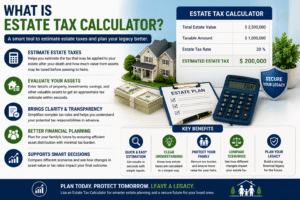
The Estate Tax Calculator pulls together every variable that affects your final tax bill in one clean interface. You enter the value of your primary residence, other real estate, cash & savings, stock portfolio, business value, retirement accounts, life insurance, and personal property. You then subtract liabilities like mortgages, other debts, administrative and legal costs, and charitable bequests.
The tool then applies the current federal exemption threshold, your state tax rate, and an expected growth rate to project the future value of your estate. The result is a clear breakdown showing your gross estate, taxable estate, and estimated tax liability — giving you the exact numbers you need to plan.
When combined with awareness of the Capital Gain Tax on Real Estate, this calculator becomes one of the most powerful estate planning tools you can use.
Short-Term vs Long-Term Capital Gains
Holding period changes everything:
- Short-term gains (property held one year or less) are taxed as ordinary income, with rates as high as 37%.
- Long-term gains (held more than one year) enjoy preferential rates of 0%, 15%, or 20%, depending on your taxable income.
For most real estate investors, holding for at least 12 months is non-negotiable — the tax savings can be enormous. A high-bracket investor selling a $300,000 gain could pay $111,000 short-term versus just $60,000 long-term.

Federal vs State Tax Rates Explained
Federal capital gains rates are uniform across the U.S., but state taxes vary dramatically. California taxes capital gains as ordinary income (up to 13.3%), while states like Florida, Texas, Nevada, Washington, and Tennessee impose zero state income tax. New York, New Jersey, and Oregon also tax gains aggressively.
This is why our calculator includes a dedicated State Tax Rate field — your total tax bill could swing by 10–13% just based on where the property sits.
The Substantial Presence Test for Property Owners
If you’re a non-U.S. citizen who owns U.S. real estate, the substantial presence test determines whether the IRS treats you as a U.S. tax resident for the year. The test counts days physically present in the United States:
- 31 days or more in the current year, AND
- 183 days total using this formula: all days this year + ⅓ of days last year + ⅙ of days the year before.
If you meet the substantial presence test, you’re taxed on worldwide income, including capital gains from real estate sold anywhere in the world. If you fail it, you’re typically taxed only on U.S.-source income, but FIRPTA withholding (15% of the sale price) still applies to U.S. property sales.
For estate purposes, non-resident aliens face a brutally low federal estate tax exemption of just $60,000 on U.S.-situs assets — making the substantial presence test and proper structuring critical for international investors.
Key Inputs in the Estate Tax Calculator
Each field directly impacts your projection:
- Primary Residence & Other Real Estate: Largest assets for most Americans; subject to Capital Gain Tax on Real Estate if sold during your lifetime.
- Cash & Savings, Stock Portfolio: Liquid assets fully included in your gross estate.
- Business Value: Closely held businesses often qualify for valuation discounts.
- Retirement Accounts: IRAs and 401(k)s are included in the estate AND taxed as income to heirs.
- Life Insurance: Included if you own the policy — use an ILIT to remove it.
- Mortgages & Debts: Reduce your taxable estate dollar-for-dollar.
- Charitable Bequests: 100% deductible from the estate.
- Tax Year, State Rate, Growth Rate: Project forward realistically.
How Estate Tax and Capital Gains Interact
Here’s where things get interesting. During your lifetime, selling property triggers the Capital Gain Tax on Real Estate. But if you hold the property until death, your heirs receive a step-up in basis — meaning the cost basis resets to the fair market value on the date of death. The embedded capital gain effectively disappears.
Example: You bought a building for $100,000. It’s worth $1,000,000 today. If you sell, you owe capital gains on $900,000. If you die owning it and your child inherits, their new basis is $1,000,000 — they could sell the next day with zero capital gains tax.
This is the single most important interaction in real estate estate planning, and the Capital Gain Tax on Real Estate rules are the reason it exists.
Exemptions, Deductions & the Step-Up in Basis
Beyond the step-up, key tax-saving provisions include:
- Section 121 Exclusion: $250K/$500K on primary home sales.
- 1031 Like-Kind Exchange: Defer Capital Gain Tax on Real Estate indefinitely by reinvesting in another investment property.
- Opportunity Zones: Defer and partially eliminate gains by investing in QOFs.
- Marital Deduction: Unlimited transfers between U.S.-citizen spouses.
- Annual Gift Exclusion: $18,000 per recipient (2024).
- Lifetime Federal Exemption: $13.61M per person (sunsets in 2026).
Common Mistakes Property Owners Make- Selling too soon and getting hit with short-term rates.
- Forgetting depreciation recapture on rental sales.
- Ignoring state estate taxes in places like Oregon ($1M threshold) or Massachusetts ($2M).
- Holding life insurance personally instead of through an ILIT.
- Failing the substantial presence test analysis when traveling extensively.
- Not tracking capital improvements that increase basis and reduce tax.
- Skipping the calculator and discovering the bill too late.
Smart Strategies to Reduce Your Tax Liability- Use 1031 exchanges to defer the Capital Gain Tax on Real Estate across multiple properties.
- Hold appreciating property until death to capture the step-up in basis.
- Gift property gradually using the annual exclusion.
- Establish irrevocable trusts (ILIT, QPRT, GRAT) to remove assets from your estate.
- Donate appreciated property to charity for a double benefit.
- Time your sales around retirement when you’re in a lower bracket.
- Document every improvement — receipts increase basis.
- Consider domicile planning — moving to a no-tax state before a major sale.
Who Should Use This Calculator- Homeowners planning to sell or downsize
- Real estate investors with multiple properties
- High-net-worth families approaching the federal exemption
- Business owners with significant illiquid wealth
- International investors navigating the substantial presence test
- Retirees structuring legacy gifts
- Financial advisors and CPAs running client scenarios

Frequently Asked Questions
- Use 1031 exchanges to defer the Capital Gain Tax on Real Estate across multiple properties.
- Hold appreciating property until death to capture the step-up in basis.
- Gift property gradually using the annual exclusion.
- Establish irrevocable trusts (ILIT, QPRT, GRAT) to remove assets from your estate.
- Donate appreciated property to charity for a double benefit.
- Time your sales around retirement when you’re in a lower bracket.
- Document every improvement — receipts increase basis.
- Consider domicile planning — moving to a no-tax state before a major sale.
Who Should Use This Calculator- Homeowners planning to sell or downsize
- Real estate investors with multiple properties
- High-net-worth families approaching the federal exemption
- Business owners with significant illiquid wealth
- International investors navigating the substantial presence test
- Retirees structuring legacy gifts
- Financial advisors and CPAs running client scenarios
Frequently Asked Questions

Q: How is the Capital Gain Tax on Real Estate calculated? Sale price minus adjusted basis (purchase price + improvements − depreciation) = gain. Apply 0/15/20% federal + state rate.
Q: Does the substantial presence test apply to green card holders? No — green card holders are automatically U.S. tax residents regardless of days present.
Q: Can I avoid capital gains by reinvesting? Yes, via a properly structured 1031 exchange for investment property only.
Q: What’s the 2024 federal estate tax exemption? $13.61 million per individual; $27.22M per married couple.
Q: Does the calculator account for future law changes? It uses current law; the exemption is scheduled to drop by ~50% in 2026.
Conclusion
The Capital Gain Tax on Real Estate isn’t just a line item — it’s a force that shapes how, when, and to whom you transfer your property. Combined with federal and state estate taxes, the substantial presence test for international owners, and the powerful step-up in basis at death, your decisions today will echo for generations.
Use the Capital Gain Tax on Real Estate to model every scenario, plug in realistic growth assumptions, and stress-test your plan against different state rates and exemption levels. Then sit down with a qualified estate attorney and CPA to put the strategy into action. The families that build lasting wealth aren’t the ones who earn the most — they’re the ones who keep the most, legally and intelligently.
Plan early. Plan often. And let the numbers — not surprise tax bills — guide your real estate decisions.
Capital Gain Tax on Real Estate is an important part of managing long-term wealth and ensuring that assets are transferred smoothly to future generations. Without proper planning, a significant portion of wealth may be reduced due to taxes and legal obligations. This makes it essential to understand how estate values and potential tax responsibilities are calculated.
A tool like this helps simplify complex financial information and turns it into clear, easy-to-understand insights. It allows individuals to see how their assets may be impacted in different scenarios and helps them make more informed decisions about their financial future.
By using such a calculator, users can better prepare for wealth distribution, reduce uncertainty, and avoid unexpected financial challenges for their family members. It also encourages smarter planning strategies such as asset allocation, gifting decisions, and long-term investment structuring.
One of the biggest advantages of this approach is improved financial awareness. Many people do not realize how estate-related taxes work until it becomes a real issue. Having early estimates helps in building a more secure and organized financial plan.
Additionally, it supports better decision-making by showing how different factors affect the final estate value. This allows individuals to take proactive steps instead of reactive ones, ensuring more control over their financial legacy.
Overall, this tool is designed to make estate planning simpler, clearer, and more effective. It helps users stay prepared, reduce stress, and build a strong financial foundation for future generations with confidence and clarity.