Social Security Calculator
Calculate your future income easily using the Annuity Payout Calculator online
Table of Contents- Introduction
- What Is a Social Security Calculator?
- Why You Need a Social Security Calculator Today
- How Social Security Benefits Are Calculated
- Key Inputs Explained Step by Step
- Understanding Full Retirement Age (FRA)
- Early vs Delayed Retirement: Which Pays More?
- Role of COLA, Inflation, and Tax Rate
- Spousal, Survivor, and Pension Adjustments
- Comparing Social Security Calculator With Nerd Wallet Retirement Calculator
- Common Mistakes to Avoid
- Smart Strategies to Maximize Your Benefits
- Who Should Use This Tool?
- Frequently Asked Questions
- Conclusion
Introduction
Planning for retirement is one of the most important financial decisions you will ever make, and understanding how much money you will receive from the government every month after you stop working is the foundation of that plan. A social security calculator is a powerful digital tool that helps you estimate your future monthly benefits based on your current age, salary, retirement age, life expectancy, and several other personal financial factors. Instead of guessing or relying on outdated rules of thumb, you can use a social security calculator to get a realistic, number-based picture of your retirement income.
In today’s economy, where inflation, taxes, and cost-of-living adjustments (COLA) constantly shift the value of money, having a reliable estimate is no longer optional — it is essential. Whether you are 25 and just starting your career, 45 and entering your peak earning years, or 60 and preparing to file your benefits, this guide will walk you through everything you need to know about using a social security calculator effectively. We will also compare it with other popular tools like the nerd wallet retirement calculator, explain every input field, and share strategies to maximize your monthly check.
By the end of this article, you will understand exactly how a social security calculator works, why it matters, and how to use it to build a secure, stress-free retirement.
What Is a Social Security Calculator?
A social security calculator is an online financial planning tool designed to estimate the monthly retirement benefit you will receive from the Social Security Administration (SSA) once you stop working. It takes inputs such as your current age, retirement age, annual salary, salary growth rate, years worked, filing status, and life expectancy, and uses formulas similar to the SSA’s own benefit calculation method to project your future income.
The biggest advantage is speed and accessibility. Instead of filling out government forms or waiting for your annual SSA statement, you get instant results. Modern calculators also factor in COLA (Cost of Living Adjustment), inflation, investment ROI, pension income, spouse benefits, and post-retirement tax rates — giving you a much more accurate, real-world picture of your retirement.

Why You Need a Social Security Calculator Today
Many Americans underestimate how much retirement actually costs. Studies show that the average couple needs $300,000 or more just for healthcare in retirement, and that doesn’t include housing, food, travel, or emergencies. A social security calculator helps you avoid this trap by showing you exactly where you stand.
Here is why it matters:
- Accurate forecasting – know your monthly check before you retire.
- Decision support – compare retiring at 62, 67, or 70.
- Tax planning – see how much of your benefit will be taxed.
- Inflation protection – understand purchasing power over time.
- Family planning – include spouse and survivor benefits.
Without a tool like this, you are essentially flying blind into one of the longest financial chapters of your life.
How Social Security Benefits Are Calculated
The SSA uses a formula based on your 35 highest-earning years, adjusted for inflation. These earnings are converted into your Average Indexed Monthly Earnings (AIME), which is then plugged into a bend-point formula to calculate your Primary Insurance Amount (PIA) — the monthly benefit you would receive at full retirement age.
A good social security calculator mimics this process by asking for your annual salary, expected salary increase, and total years worked. It then projects your AIME forward, applies COLA adjustments, and outputs your estimated monthly benefit at the retirement age you choose.
Key formula components:
- AIME – average of top 35 indexed earnings years
- PIA – your base monthly benefit at FRA
- Adjustment factor – reduction for early filing or credit for delayed filing
- COLA – yearly inflation-based increase
Key Inputs Explained Step by Step
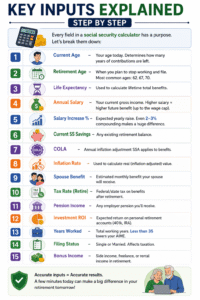
Every field in a social security calculator has a purpose. Let’s break them down:
- Current Age – Your age today. Determines how many years of contributions are left.
- Retirement Age – When you plan to stop working and file. Most common ages: 62, 67, 70.
- Life Expectancy – Used to calculate lifetime total benefits.
- Annual Salary – Your current gross income. Higher salary = higher future benefit (up to the wage cap).
- Salary Increase % – Expected yearly raise. Even 2–3% compounding makes a huge difference.
- Current SS Savings – Any existing retirement balance.
- COLA – Annual inflation adjustment SSA applies to benefits.
- Inflation Rate – Used to calculate real (inflation-adjusted) value.
- Spouse Benefit – Estimated monthly benefit your spouse will receive.
- Tax Rate (Retire) – Federal/state tax on benefits after retirement.
- Pension Income – Any employer pension you’ll receive.
- Investment ROI – Expected return on personal retirement accounts (401k, IRA).
- Years Worked – Total working years. Less than 35 lowers your AIME.
- Filing Status – Single or Married. Affects taxation.
- Bonus Income – Side income, freelance, or rental income in retirement.

Understanding Full Retirement Age (FRA)
Your Full Retirement Age is the age at which you can claim 100% of your benefit. For most people born in 1960 or later, FRA is 67. Filing earlier reduces your check, while filing later increases it.
- Age 62 – about 30% reduction
- Age 67 (FRA) – 100% of your PIA
- Age 70 – about 24–32% bonus through delayed retirement credits
A social security calculator lets you test all three scenarios in seconds.
Early vs Delayed Retirement: Which Pays More?
This is the million-dollar question. The math says delaying pays more per month, but if you don’t live long enough, you may collect less in total.
- Retire at 62 – more years of payments, smaller checks
- Retire at 67 – balanced approach
- Retire at 70 – biggest checks, fewer total years
Run all three through a social security calculator and compare lifetime totals based on your life expectancy.
Role of COLA, Inflation, and Tax Rate
COLA is the SSA’s way of protecting your benefit from inflation. Historically it averages 2–3% per year, though recent years saw spikes of 8.7% (2023).
Inflation silently erodes purchasing power. A $2,000 monthly check today may only feel like $1,200 in 20 years if inflation runs hot.
Taxes can take up to 85% of your benefit into taxable income depending on your combined income. A quality social security calculator factors all three so you see your real take-home amount.
Spousal, Survivor, and Pension Adjustments
Married couples have additional levers:
- Spousal benefit – up to 50% of the higher earner’s PIA
- Survivor benefit – widow/widower may collect the deceased spouse’s full benefit
- Pension offset – government pensions (WEP/GPO rules) can reduce SS
Including these in your social security calculator ensures the household income picture is complete.

Comparing Social Security Calculator With Nerd Wallet Retirement Calculator
The nerd wallet retirement calculator is one of the most popular general retirement planning tools online. It focuses on how much you need to save based on lifestyle goals, current savings, and expected returns. It is excellent for big-picture retirement readiness.
However, the nerd wallet retirement calculator does not specialize in calculating your exact monthly Social Security benefit the way a dedicated social security calculator does. Instead of replacing one with the other, use both together:
- Use the nerd wallet retirement calculator to estimate your total nest egg requirement.
- Use a social security calculator to estimate the government’s monthly contribution to that requirement.
The gap between the two is what your 401k, IRA, pension, and personal savings must cover. This combined approach gives you a bulletproof retirement plan.
Common Mistakes to Avoid
Even with a great tool, people still make costly errors:
- Using outdated salary numbers – always use your latest income.
- Ignoring COLA and inflation – they completely change real value.
- Forgetting spouse benefits – married couples leave thousands on the table.
- Filing too early without calculating – early filing locks in lower payments for life.
- Skipping tax estimation – taxes can shrink benefits up to 37% at federal level.
- Assuming 35 working years – fewer years = lower AIME = smaller checks.
Smart Strategies to Maximize Your Benefits
Use these proven strategies alongside your social security calculator:
- Work at least 35 years to avoid zero-earning years dragging down your AIME.
- Increase income in your final working years — they often replace lower-earning early years.
- Delay filing past FRA if you are healthy and have other income sources.
- Coordinate with spouse — one files early, the other delays.
- Plan tax-efficient withdrawals from 401k/IRA to keep combined income low.
- Reinvest your benefit if you don’t need it immediately.


Who Should Use This Tool?
A social security calculator is valuable for almost everyone:
- Young professionals planning long-term wealth
- Mid-career workers evaluating savings gaps
- Pre-retirees (55–65) finalizing retirement age decisions
- Couples coordinating dual filings
- Financial advisors building client roadmaps
- Divorcees and widows checking eligibility on ex/late spouse records
Frequently Asked Questions
Q: Is a social security calculator 100% accurate? It provides highly accurate estimates, but actual SSA payments depend on your final earnings record.
Q: At what age should I file? It depends on health, savings, and life expectancy. Use the calculator to model all scenarios.
Q: Are Social Security benefits taxed? Yes, up to 85% of benefits may be taxable depending on combined income.
Q: Can I work while collecting benefits? Yes, but earnings above the limit before FRA may temporarily reduce payments.
Q: How is this different from the nerd wallet retirement calculator? The nerd wallet retirement calculator estimates total savings needed; this tool estimates your monthly SS benefit specifically.
Conclusion
Retirement should be a chapter of freedom, not financial fear. A reliable social security calculator gives you the clarity, confidence, and control needed to make smart decisions about when to retire, how much you will receive, and how to coordinate benefits with savings, pensions, and your spouse. By combining it with a broader tool like the nerd wallet retirement calculator, you create a complete retirement strategy — one that accounts for monthly income, lifetime needs, inflation, taxes, and lifestyle goals.
Start early, run multiple scenarios, update your numbers yearly, and never file blindly. The few minutes you spend with a social security calculator today can translate into tens of thousands of extra dollars over your retirement lifetime. Take charge of your future now — your older self will thank you.
Planning for retirement is one of the most important financial steps in life, and having a clear understanding of future income can make a huge difference in financial stability. With proper planning, you can avoid uncertainty and build a secure future for yourself and your family. This tool helps you visualize your expected retirement income in a simple and effective way, making complex financial calculations easy to understand.
It allows you to explore different scenarios based on your earnings, savings, and expected benefits, so you can make informed decisions. By adjusting inputs such as retirement age, income level, and expected growth, you can see how your financial future may change over time. This helps you stay prepared for different possibilities and manage your expectations realistically.
One of the key advantages of using such a tool is better financial awareness. Many people underestimate how much they will need after retirement, which can lead to financial stress later in life. By using this calculator regularly, you can track your progress and adjust your savings strategy accordingly. It encourages disciplined planning and helps you stay focused on long-term goals.
Additionally, it supports smarter decision-making by giving you a clear picture of how different factors impact your future income. Whether you are just starting your career or nearing retirement, understanding these estimates can help you take better financial steps today. Small changes in savings and planning can lead to a big difference in future outcomes.
Overall, this tool is designed to simplify retirement planning and give users confidence about their financial future. It empowers individuals to take control of their income planning and prepare for a stress-free retirement with better clarity and understanding.