Student Loan Calculator
Simple Student Loan Calculator
Student Loan Repayment Calculator
Student Loan Projection Calculator
Calculate your monthly housing budget with our Rent Calculator
Table of Contents- Introduction
- Understanding Educational Loan Repayment
- Types of Student Loans You Should Know
- How a Student Education Loan Calculator Works
- Key Factors That Affect Your Monthly Payments
- Simple Student Loan Calculator Explained
- Student Loan Repayment Calculator: A Closer Look
- Student Loan Projection Calculator for Future Planning
- Smart Strategies to Pay Off Your Loan Faster
- Common Mistakes Borrowers Make
- Tips for Managing Loans After Graduation
- Refinancing and Consolidation Options
- The Role of Interest Rates in Repayment
- Budgeting and Financial Planning for Students
- FAQs
- Conclusion
Introduction
- Introduction
- Understanding Educational Loan Repayment
- Types of Student Loans You Should Know
- How a Student Education Loan Calculator Works
- Key Factors That Affect Your Monthly Payments
- Simple Student Loan Calculator Explained
- Student Loan Repayment Calculator: A Closer Look
- Student Loan Projection Calculator for Future Planning
- Smart Strategies to Pay Off Your Loan Faster
- Common Mistakes Borrowers Make
- Tips for Managing Loans After Graduation
- Refinancing and Consolidation Options
- The Role of Interest Rates in Repayment
- Budgeting and Financial Planning for Students
- FAQs
- Conclusion
Introduction
Higher education is one of the most valuable investments you can make in your future, but it often comes with a significant financial burden. Millions of students around the world rely on loans to fund their college dreams, and once graduation arrives, the real challenge begins — paying it all back. Educational loan repayment is not just about sending monthly checks to a lender; it’s about understanding interest, managing budgets, and making informed financial decisions that protect your long-term well-being.
This comprehensive guide will walk you through everything you need to know about educational loan repayment, including how to use a student education loan calculator effectively, the different types of loans available, strategies to pay them off quickly, and how to avoid common pitfalls. Whether you’re a current student planning ahead or a recent graduate juggling multiple loans, this article is designed to help you take control of your financial future.
Understanding Educational Loan Repayment
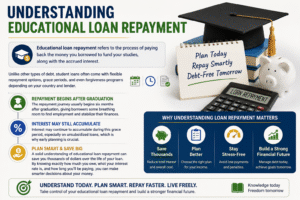
Educational loan repayment refers to the process of paying back the money you borrowed to fund your studies, along with the accrued interest. Unlike other types of debt, student loans often come with flexible repayment options, grace periods, and even forgiveness programs depending on your country and lender.
The repayment journey usually begins six months after graduation, giving borrowers some breathing room to find employment and stabilize their finances. However, interest may continue to accumulate during this grace period, especially on unsubsidized loans, which is why early planning is crucial.
A solid understanding of educational loan repayment can save you thousands of dollars over the life of your loan. By knowing exactly how much you owe, what your interest rate is, and how long you’ll be paying, you can make smarter decisions about your money.
Types of Student Loans You Should Know
Before diving into repayment strategies, it’s important to understand the different types of loans you may have:
- Federal Subsidized Loans: The government pays the interest while you’re in school.
- Federal Unsubsidized Loans: Interest accrues from the day the loan is disbursed.
- Private Student Loans: Offered by banks and credit unions, often with higher interest rates.
- PLUS Loans: Available to graduate students and parents of undergraduates.
Each loan type has its own rules for educational loan repayment, and knowing which loans you hold helps you choose the right repayment plan. A student education loan calculator can help you compare different scenarios across loan types so you can prioritize which to pay off first.
How a Student Education Loan Calculator Works
A student education loan calculator is a powerful online tool that takes the guesswork out of borrowing and repaying. By entering basic details such as principal amount, interest rate, loan term, and origination fees, the calculator instantly shows you:
- Your monthly payment
- The total interest you’ll pay
- The total cost of the loan
- A breakdown of how each payment is split between principal and interest
Using a student education loan calculator before signing any loan agreement is one of the smartest moves you can make. It gives you a realistic picture of what you’re committing to and helps you avoid borrowing more than you can comfortably repay.
Key Factors That Affect Your Monthly Payments
Several variables influence your monthly bill during educational loan repayment:
- Loan Principal: The original amount borrowed.
- Interest Rate: Fixed rates stay the same; variable rates can fluctuate.
- Loan Term: Longer terms mean smaller monthly payments but more interest overall.
- Origination Fee: A one-time fee charged when the loan is issued.
- Grace Period: The time between graduation and the start of repayment.
Understanding these factors empowers you to negotiate better terms or choose a plan that fits your budget. Tools like a student education loan calculator allow you to test different combinations and find the most affordable strategy for your educational loan repayment journey.
Simple Student Loan Calculator Explained
The Simple Student Loan Calculator is the easiest entry point for beginners. It requires only the basics — principal, interest rate, term, origination fee, and grace period — and produces a clear monthly payment estimate.
This tool is ideal for incoming freshmen who want to understand what their future obligations might look like. By experimenting with different loan amounts, you can see how borrowing $20,000 versus $40,000 dramatically changes your educational loan repayment burden.
Pro tip: Always include the origination fee in your calculation. Many borrowers forget this small percentage, but over a 10-year term, it can add hundreds of dollars to your total cost.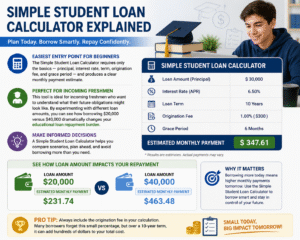
Student Loan Repayment Calculator: A Closer Look
The Student Loan Repayment Calculator is designed for borrowers who are already in repayment mode. It goes beyond the basics by including:
- Current balance instead of original principal
- Extra monthly payments to model accelerated payoff
- Tax rate to estimate deductions on interest
- Processing fees for accurate cost projections
- Payment frequency options (monthly or bi-weekly)
- Target payoff date for goal-oriented planning
By making bi-weekly payments instead of monthly ones, many borrowers can shave years off their loan and save thousands in interest. Even an extra $50 per month toward your principal can dramatically shorten your educational loan repayment timeline.
Student Loan Projection Calculator for Future Planning
The Student Loan Projection Calculator is for those who want to look at the bigger picture. It accounts for factors like:
- Starting salary and projected raises
- Annual inflation
- Living expenses
- Other debts
- School duration
- Variable vs. fixed interest rates
This calculator helps you understand whether your future income will comfortably support your monthly payments. If you’re considering an expensive degree, running a projection can reveal whether your educational loan repayment will leave room for savings, housing, and other life goals.
A student education loan calculator with projection features is especially useful for graduate students, medical students, and law students who often borrow large sums.
Smart Strategies to Pay Off Your Loan Faster
Speeding up educational loan repayment requires both discipline and strategy. Here are proven methods to crush your debt faster:
- Pay more than the minimum whenever possible.
- Apply windfalls like tax refunds or bonuses directly to the principal.
- Refinance to a lower interest rate if you have strong credit.
- Set up autopay — many lenders offer a 0.25% interest rate discount.
- Use the avalanche method by tackling the highest-interest loan first.
- Use the snowball method by paying off the smallest balance first for motivation.
Combining these tactics can significantly reduce the time and money spent on educational loan repayment. Even small, consistent extra payments compound into massive savings over time.

Common Mistakes Borrowers Make
Many students unintentionally sabotage their educational loan repayment by making avoidable errors:
- Ignoring the grace period and missing the first payment.
- Choosing the longest repayment term without realizing the interest cost.
- Skipping payments without applying for deferment first.
- Forgetting to update contact information with the loan servicer.
- Not exploring loan forgiveness programs.
- Failing to use a student education loan calculator before borrowing.
Each of these mistakes can cost thousands of dollars or damage your credit score. Awareness is the first step to avoiding them.
Tips for Managing Loans After Graduation
Once you graduate, your financial responsibilities multiply quickly. Rent, groceries, transportation, and educational loan repayment all compete for your paycheck. Here’s how to stay on top of it:
- Build a realistic budget that accounts for every dollar.
- Track your loans in one place using spreadsheets or apps.
- Establish an emergency fund before aggressive payoff strategies.
- Communicate with your loan servicer if you face hardship.
- Reassess your repayment plan annually as your income grows.
The first two years after graduation are critical for setting healthy financial habits. Treat your educational loan repayment like a non-negotiable bill — the same way you treat rent or utilities.
Refinancing and Consolidation Options
Refinancing means taking out a new loan with better terms to pay off your existing student loans. Consolidation combines multiple federal loans into one, simplifying your payment process.
Benefits of refinancing:
- Lower interest rates
- Reduced monthly payments
- Simplified payment schedule
Drawbacks of refinancing:
- Loss of federal protections like income-driven repayment
- May not qualify for forgiveness programs
Before making any decision, run the numbers through a student education loan calculator to make sure refinancing actually saves you money over the long term. Sometimes a slightly lower rate isn’t worth giving up federal benefits.
The Role of Interest Rates in Repayment
Interest is the silent enemy of every borrower. Even a 1% difference in your rate can mean thousands of dollars over a 10-year term. That’s why understanding your interest type — fixed or variable — is so important.
- Fixed rates offer predictability.
- Variable rates can start lower but may rise over time.
During your educational loan repayment journey, always know your effective rate and look for opportunities to lower it. Strong credit, steady income, and a healthy debt-to-income ratio all help you qualify for better refinancing offers.

Budgeting and Financial Planning for Students
Successful educational loan repayment starts with a solid budget. The popular 50/30/20 rule is a great framework:
- 50% Needs: Rent, food, utilities, loan payments
- 30% Wants: Entertainment, dining out, hobbies
- 20% Savings: Emergency fund, retirement, extra debt payments
Track every expense for at least one month to see where your money truly goes. Apps like Mint, YNAB, and PocketGuard can help automate this process. Combined with a student education loan calculator, you’ll have a complete financial picture that supports both short-term comfort and long-term goals.
Remember: paying off debt is a marathon, not a sprint. Consistency beats intensity every time.
FAQs
1. What is this calculator used for?
It helps estimate monthly payments, interest costs, and total repayment for an education loan.
2. How do I use this tool?
Simply enter your loan balance, interest rate, and payment details to get a repayment breakdown.
3. Does it show monthly payment amounts?
Yes, it provides an estimated monthly payment based on the values you enter.
4. Can I see how extra payments affect my loan?
Yes, adding extra payments shows how much time and interest you can save.
5. Why is the interest rate important?
A higher interest rate increases both total repayment and monthly payment amounts.
6. What does the payoff estimate mean?
It shows how long it may take to fully clear your debt based on your inputs.
7. Can I choose different payment frequencies?
Yes, you can select monthly or bi-weekly payment options.
8. Does this tool help with financial planning?
Yes, it helps you understand repayment structure and manage your budget better.
9. What is included in the repayment summary?
It includes payment estimates, interest cost, and overall loan balance progress.
10. Is this tool suitable for students?
Yes, it is designed to help students understand and plan their loan repayment easily
Conclusion
Educational loan repayment doesn’t have to feel like a lifelong burden. With the right tools, strategies, and mindset, you can pay off your loans faster, save money on interest, and build a strong financial foundation for the rest of your life.
Start by understanding the type of loans you have, then use a student education loan calculator to model different scenarios. Whether you choose the simple calculator for quick estimates, the repayment calculator for active payoff planning, or the projection calculator for long-term forecasting, each tool gives you valuable insights that help you make smarter decisions.
Stay disciplined, make extra payments when you can, avoid common mistakes, and reassess your strategy as your income grows. The path to becoming debt-free is paved with small, consistent actions that add up over time.
Your degree opened the door to opportunity — now it’s time to make sure your loans don’t hold you back. Master your educational loan repayment today, and tomorrow you’ll enjoy the freedom that financial independence brings.