Rent Calculator
Estimate your home buying power quickly using our free House Affordability Calculator
Table of Contents
Introduction
The Mechanics of a Modern Rent Calculator
The 30% Rule vs. Realistic Market Conditions
Breaking Down Gross vs. Net Income for Renting
Debt-to-Income Ratio: The Silent Approval Factor
The True Cost of Living: Beyond Monthly Rent
How to Use a Rent Calculator Prorated for Mid-Month Transitions
For Investors: Using a Rental Property Calculator for ROI
Hidden Fees: Parking, Pets, and Service Charges
Luxury vs. Necessity: Calculating the Trade-offs
Advanced Saving Strategies Integrated into Your Budget
FAQs
Conclusion
Introduction
Choosing a place to live is one of the most significant emotional and financial decisions you will ever make. It dictates your daily commute, your social circle, and, most importantly, your financial peace of mind. A rent calculator is not just a math tool; it is a lifestyle architect. Many people fall into the trap of “falling in love” with a property before checking their bank account. This lead to “rent stress,” where a beautiful balcony becomes a source of anxiety every time the 1st of the month rolls around.
By using a calculator, you detach emotion from the transaction. It allows you to look at the cold, hard facts of your income and expenses. Financial literacy starts with the realization that your home should serve your life, not consume your entire paycheck.
The Mechanics of a Modern Rent Calculator
An advanced calculator operates on a multi-variable algorithm. It doesn’t just subtract B from A. It looks at your Annual Gross Income, divides it by the standard twelve months, and then applies a tax-adjusted safety margin.
When you use a rent calculator, you are essentially performing a stress test on your finances. It asks: “Can you still afford to eat, travel, and save if you pay this much for housing?” The logic behind a rent calculator is to ensure that your ‘Net Remaining Balance’ is always positive. If the numbers don’t add up, the tool provides an immediate reality check, allowing you to adjust your expectations before you sign a legally binding lease.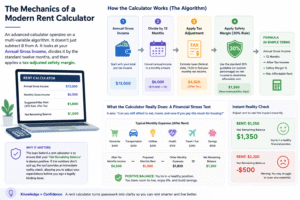
The 30% Rule vs. Realistic Market Conditions
For decades, the 30% rule has been the gold standard for financial health. This rule states that you should spend no more than 30% of your gross income on rent. Our rent calculator defaults to this logic because it is the safest way to build wealth.
However, in “High-Cost-of-Living” (HCOL) areas like New York or San Francisco, this rule is often challenged. In these cities, people might spend 40% or even 50% on rent. This is why a rent calculator is so vital. If you decide to go over 30%, the rent calculator will show you exactly which other parts of your life—like entertainment or savings—need to be cut to make ends meet. Sacrifice is easier to manage when it is calculated in advance.
Breaking Down Gross vs. Net Income for Renting
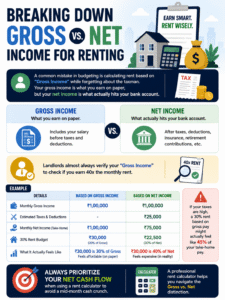
A common mistake in budgeting is calculating rent based on “Gross Income” while forgetting about the taxman. Your gross income is what you earn on paper, but your net income is what actually hits your bank account. A professional rent calculator helps you navigate this distinction.
Landlords almost always verify your “Gross Income” to check if you earn 40x the monthly rent. However, you should use the rent calculator to look at your “Net Pay.” If your taxes are high, a 30% rent based on gross pay might actually feel like 45% of your take-home pay. Always prioritize your net cash flow when using a rent calculator to avoid a mid-month cash crunch.
Debt-to-Income Ratio: The Silent Approval Factor
Your debt is a weight on your ability to rent a premium apartment. Whether it is student loans, credit card debt, or a car note, these obligations take priority in the eyes of a bank. The “Monthly Debt” field in a rent calculator is where many dreams meet reality.
Landlords look for a healthy Debt-to-Income (DTI) ratio. If you have $1,000 in monthly debt and you want to pay $2,000 in rent, you need a very high income to qualify. A rent calculator helps you visualize this ratio. By lowering your debt, you effectively “unlock” more rental power. Using a rent calculator to simulate debt repayment can show you how much better your lifestyle could be once those loans are gone.
The True Cost of Living: Beyond Monthly Rent
Rent is only the “admission fee” to an apartment; the actual cost of living is much higher. You must account for:
Utilities: Heating, cooling, and electricity.
Connectivity: High-speed internet and mobile plans.
Insurance: Protecting your belongings from theft or fire.
A comprehensive rent calculator includes these as mandatory fields. If you find an apartment that includes utilities in the rent, you can adjust the calculator to see how much extra “room” that gives you in your food or savings budget. Transparency in your utility costs is the only way to ensure the rent calculator provides a realistic result.
How to Use a Rent Calculator Prorated for Mid-Month Transitions
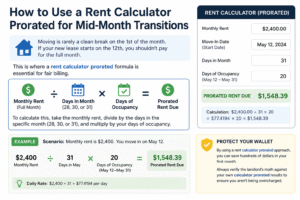
Moving is rarely a clean break on the 1st of the month. If your new lease starts on the 12th, you shouldn’t pay for the full month. This is where a rent calculator prorated formula is essential for fair billing.
To calculate this, take the monthly rent, divide by the days in the specific month (28, 30, or 31), and multiply by your days of occupancy. By using a rent calculator prorated approach, you can save hundreds of dollars in your first month. Always verify the landlord’s math against your own calculator prorated results to ensure you aren’t being overcharged.
For Investors: Using a Rental Property Calculator for ROI
If you are an aspiring landlord, your math is different from a tenant’s. You need to know if the property is a “Money Maker” or a “Money Pit.” A rental property calculator is the tool of choice for professional real estate investors.
A rental property calculator considers:
Mortgage Interest: The cost of borrowing.
Property Taxes: Which can vary wildly by zip code.
Maintenance CapEx: Setting aside 10% for repairs.
Using a rental property calculator ensures that your investment provides a positive yield. Without a rental property calculator, you are just guessing, and in real estate, guessing is expensive.
Hidden Fees: Parking, Pets, and Service Charges
Modern apartments are famous for “add-on” fees. You might find a great price on a calculator, only to realize parking is an extra $200 and pet rent is $50. These must be added to the “Other Expenses” section of your calculator.
Small fees add up to large yearly sums. $250 a month in extra fees is $3,000 a year. When you put these into the rent calculator, you might realize that the “expensive” apartment with inclusive amenities is actually cheaper than the “cheap” apartment with hidden fees.
Luxury vs. Necessity: Calculating the Trade-offs
Do you really need the in-unit laundry, or can you live with a basement facility? Every amenity has a price tag. A calculator allows you to run “What-If” scenarios.
Scenario A: Luxury apartment with a gym = $2,500 rent.
Scenario B: Basic apartment + $100 gym membership = $1,800 total.
The calculator shows you that Scenario B saves you $700 a month. That is $8,400 a year that could go into a down payment for a house. Use the calculator to decide if the “luxury” is worth the long-term cost.

Advanced Saving Strategies Integrated into Your Budget
A house is a temporary stop; wealth is a permanent goal. We suggest using the calculator to aim for a 20% savings rate. If your income is $5,000, try to set aside $1,000 before you even look at rent.
This “Pay Yourself First” model is the secret to financial freedom. When you enter your savings goal into the rent calculator, it forces you to find an apartment that fits your future goals, not just your current desires. A calculator is the best tool for disciplined wealth building.
FAQs
Q: What is the most important number in a calculator? A: The “Net Balance” or “Remaining Income.” This tells you if you can actually survive after paying rent.
Q: Can I trust a calculator for every city? A: Yes, but you must manually adjust the “Utilities” and “Other Expenses” fields to match local costs (e.g., higher heating costs in cold climates).
Q: How does a calculator prorated tool help me save money? A: It prevents you from paying for days you didn’t live in the apartment, which is common during mid-month moves.
Q: Why do landlords ask for 40x the rent? A: This is a simplified version of the 30% rule. If you earn 40x the monthly rent, your rent is exactly 30% of your gross income.
Q: What if the calculator says I can’t afford my dream home? A: You have three options: increase your income, find a roommate to share the cost, or look in a more affordable neighborhood.
Q: Should I include my partner’s income in the calculator? A: Only if you are signing the lease together. If only one person is on the lease, use only that person’s income for safety.
Q: Does a rental property calculator help tenants? A: Indirectly, yes. It helps you understand the landlord’s costs, which can give you leverage during price negotiations.
Q: How often should I update my calculator data? A: Every time you get a raise, pay off a debt, or experience a significant change in your monthly bills.
Q: What is a “Good” remaining balance in a calculator? A: Ideally, you should have at least 20-30% of your income left for savings and emergencies after all bills are paid.
Conclusion
Mastering your money starts with mastering your housing costs. The calculator is the compass that points you toward financial stability. By being honest with your data and disciplined with your spending, you can enjoy your home without the shadow of debt.
Whether you are calculating your first studio or using a rental property calculator for a complex investment, the principles remain the same: Math over Emotion. Use the calculator today and take control of your financial destiny. A well-planned life is a well-lived life.