Zakat Calculator
Find the Exact Day for Any Date with Fast and Accurate Results Using Our Free Day of the Week Calculator
Table of Contents
- Introduction
- What Is a Zakat Calculator?
- The Islamic Obligation of Zakat – A Brief Overview
- What Is Nisab and Why Does It Matter?
- How Our Zakat Calculator Works
- Assets Included in the Zakat Calculator
- How Debts and Liabilities Are Handled
- The 2.5% Zakat Rate – Where It Comes From
- Step-by-Step Guide to Using the Zakat Calculator
- Understanding the Results from the Zakat Calculator
- Who Is Required to Pay Zakat?
- Common Mistakes When Calculating Zakat
- Benefits of Using an Online Zakat Calculator
- Zakat vs. Sadaqah – What Is the Difference?
- Frequently Asked Questions (FAQs)
- Conclusion
Introduction
Every year, millions of Muslims around the world fulfill one of the most important pillars of Islam — the obligation of Zakat. Yet despite its spiritual importance, many Muslims struggle with the actual calculation. How much wealth counts? Which assets are included? How are debts handled? What is the correct rate? These are real questions that deserve clear, accurate answers — and that is exactly what a zakat calculator is designed to provide.
A zakat calculator removes the confusion and uncertainty from the process. Instead of manual arithmetic, guesswork, or relying on rough estimates, a zakat calculator lets you enter your actual financial figures and receive an accurate, instant calculation of your Zakat obligation. Whether you are calculating Zakat for the first time or reviewing your annual obligation, a zakat calculator ensures that you fulfill this religious duty correctly and with confidence.
Our free online zakat calculator is straightforward, user-friendly, and designed to reflect the most widely accepted scholarly principles for Zakat on wealth. It accounts for all major zakatable assets — cash, gold and silver, business stock, and investments — and correctly deducts liabilities before applying the 2.5% Zakat rate. In this comprehensive guide, we will explain how the zakat calculator works, what each field means, how to read your results, who is required to pay Zakat, and answer every common question about using a zakat calculator accurately.
What Is a Zakat Calculator?
A zakat calculator is a digital tool that helps Muslims determine how much Zakat they owe on their wealth. The user enters the value of their zakatable assets — such as cash savings, the monetary value of gold and silver, business inventory, and investment holdings — and subtracts outstanding debts. The zakat calculator then applies the standard 2.5% rate to the net wealth and displays the Zakat amount due.
A reliable zakat calculator does several things:
- Accepts multiple asset categories — cash, precious metals, business stock, and investments
- Subtracts liabilities — debts and financial obligations reduce the zakatable base
- Applies the 2.5% rate — the universally accepted annual Zakat rate on wealth
- Displays a clear result — total assets, total liabilities, net taxable wealth, Zakat due, and eligibility status
Our zakat calculator is designed for simplicity — five input fields, two buttons, and an instant result panel. No account needed, no registration, and no complicated steps. The zakat calculator is completely free to use and works on all devices.
The Islamic Obligation of Zakat – A Brief Overview
Zakat is one of the Five Pillars of Islam, alongside the declaration of faith (Shahada), prayer (Salah), fasting (Sawm), and pilgrimage (Hajj). It is a mandatory annual charitable contribution that every eligible Muslim must pay on their accumulated wealth. Zakat is not optional — it is a religious obligation (fard) for Muslims whose wealth meets or exceeds the Nisab threshold and has been held for one full lunar year.
The purpose of Zakat is deeply social and spiritual:
- It purifies wealth — Zakat is often described as a means of purifying one’s money and possessions
- It redistributes wealth — Zakat flows from those who have more to those in need, reducing inequality
- It builds community solidarity — by obligating the wealthy to support the poor, Zakat strengthens the bonds of the Muslim community (Ummah)
- It fosters gratitude and humility — the act of giving a portion of wealth acknowledges that all blessings come from Allah
The eight categories of Zakat recipients, as specified in the Quran (Surah At-Tawbah 9:60), are: the poor (fuqara), the needy (masakin), those employed to collect Zakat, those whose hearts are to be reconciled, those in bondage, those in debt, those in the cause of Allah, and travelers in need.
A proper zakat calculator helps you determine your contribution accurately so that your Zakat reaches those who truly need it.
What Is Nisab and Why Does It Matter?
Nisab is the minimum threshold of wealth that a Muslim must possess before Zakat becomes obligatory. If your net zakatable wealth is below the Nisab, you are not required to pay Zakat. If it meets or exceeds the Nisab, you must pay 2.5% of your total net zakatable wealth.
The Nisab is traditionally defined in two ways:
- Nisab of Gold — equivalent to 87.48 grams (7.5 tolas) of gold
- Nisab of Silver — equivalent to 612.36 grams (52.5 tolas) of silver
Because gold and silver prices fluctuate, the monetary value of Nisab changes over time. Most contemporary scholars recommend using the silver Nisab as it is more inclusive and protects more people who may be in need. Many Islamic finance authorities and Zakat organizations publish the current Nisab value in local currency, which you can use as your reference point before using the zakat calculator.
Why the Nisab matters for the zakat calculator: If your net zakatable wealth — as calculated by the zakat calculator — equals or exceeds the current Nisab, the tool will show your status as “Eligible to Pay.” If it falls below the Nisab, the status will show “Below Nisab” and no Zakat is due.
Note: Our zakat calculator currently calculates based on the amounts you enter. Compare the resulting net wealth against the current Nisab value in your currency to confirm eligibility before paying.
How Our Zakat Calculator Works
Our zakat calculator uses a simple but accurate formula to determine your annual Zakat obligation:
Formula:
Net Zakatable Wealth = Total Assets − Total Liabilities Zakat Due = Net Zakatable Wealth × 2.5%
The zakat calculator follows these steps:
Step 1 – Collect Asset Values The zakat calculator reads the values entered for Cash & Bank Balance, Gold & Silver Value, Business Stock, and Investments.
Step 2 – Sum Total Assets The zakat calculator adds all four asset values together: Total Assets = Cash + Gold/Silver + Business Stock + Investments
Step 3 – Subtract Liabilities The zakat calculator subtracts your debts and liabilities from the total assets: Net Taxable Wealth = max(0, Total Assets − Debts)
The max(0, ...) function ensures that if debts exceed assets, the net wealth does not go negative — Zakat cannot be negative.
Step 4 – Apply the 2.5% Rate The zakat calculator multiplies the net taxable wealth by 0.025: Zakat Due = Net Taxable Wealth × 0.025
Step 5 – Display Results The zakat calculator shows five result rows: Total Assets, Total Liabilities, Net Taxable Wealth, Zakat Due, and Eligibility Status.
Assets Included in the Zakat Calculator
Our calculator includes four categories of zakatable assets. Understanding what belongs in each field ensures your calculation is accurate.
Cash & Bank Balance This includes all physical cash you hold and all balances in bank accounts — savings accounts, current accounts, fixed deposits, and money market accounts. Include only the amount you actually own, not credit card limits or overdraft facilities.
Gold & Silver (Monetary Value) Enter the current market value (in dollars or your local currency) of all gold and silver you own — jewelry, bullion, coins, or any other form. Most scholars agree that gold and silver held for investment are fully zakatable. Gold jewelry worn regularly is a subject of scholarly difference, but for safety, many Muslims include it in their zakat calculator input.
Business Stock Enter the current market value of business inventory — goods you hold for sale or trade. This applies to merchants, retailers, wholesalers, and anyone holding goods for commercial purpose. The value should reflect the current market selling price, not the purchase cost.
Investments Include the value of stocks, mutual funds, shares, and other investment instruments. For stocks, many scholars advise using the market value of the share’s zakatable portion — typically the liquid assets per share of the underlying company. For simplicity, many Muslims enter the full current market value of their investment portfolio in the zakat calculator.
What is NOT included:
- Personal property (home you live in, personal car, clothing, household items)
- Professional equipment used for business (machinery, tools, office equipment)
- Illiquid assets not held for trade (land not intended for sale)
- Long-term fixed assets
How Debts and Liabilities Are Handled
The deduction of debts is a crucial part of any accurate calculator. Islamic jurisprudence allows Muslims to deduct genuine liabilities from their total assets before calculating Zakat. This is because Zakat is owed on net wealth — what you truly own after obligations.
What qualifies as a deductible liability in the zakat calculator:
- Short-term loans due within the year
- Credit card balances currently owed
- Bills and rent payments due imminently
- Business debts and payables that are currently due
What generally does NOT qualify as a deductible liability:
- Long-term mortgage installments (scholars differ — some allow only the current year’s installment, others allow none)
- Future liabilities not yet due
- Contingent liabilities
How the calculator handles debts: Enter the total value of your immediate, current debts in the Debts / Liabilities field. The zakat calculator subtracts this from your total assets to arrive at Net Taxable Wealth. If your liabilities exceed your assets, the zakat calculator correctly shows net wealth as $0, meaning no Zakat is due.
The 2.5% Zakat Rate – Where It Comes From
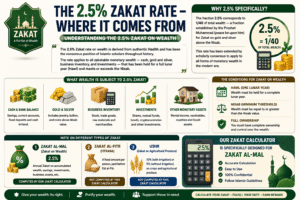
The 2.5% Zakat rate on wealth is derived from authentic Hadith and has been the consensus position of Islamic scholars throughout history. The rate applies to all zakatable monetary wealth — cash, gold and silver, business inventory, and investments — that has been held for a full lunar year (Hawl) and meets or exceeds the Nisab.
Why 2.5% specifically? The fraction 2.5% corresponds to 1/40 of total wealth — a fraction established by the Prophet Muhammad (peace be upon him) for Zakat on gold and silver above the Nisab. This rate has been extended by scholarly consensus to apply to all forms of monetary wealth in the modern era.
Note on different types of Zakat:
- Zakat al-Mal (Zakat on Wealth) — 2.5%, which our calculator computes
- Zakat al-Fitr (Fitrana) — a fixed amount per person, paid before Eid al-Fitr, NOT computed by this zakat calculator
- Ushr — 10% or 5% Zakat on agricultural produce — also not computed by this zakat calculator
Our calculator is specifically designed for Zakat al-Mal — the annual Zakat on accumulated wealth.
Step-by-Step Guide to Using the Zakat Calculator
Using our calculator takes less than two minutes. Here is the complete process:
Step 1 – Enter Cash & Bank Balance Enter the total amount of money you hold in cash and all bank accounts. Include savings, checking, and fixed deposits. Use the dollar symbol ($) field in the zakat calculator.
Step 2 – Enter Gold & Silver Value Enter the current market value of all gold and silver you own. Check the current spot price of gold and silver (per gram or ounce) and multiply by your holdings to get the dollar value to enter in the zakat calculator.
Step 3 – Enter Business Stock Value Enter the current market selling value of your business inventory. If you are not in business or trade, enter 0.
Step 4 – Enter Investments Value Enter the current market value of all stocks, funds, and other investment holdings.
Step 5 – Enter Debts / Liabilities Enter all current, immediate debts that are due. The zakat calculator will subtract this from your total assets.
Step 6 – Click Calculate Press the blue Calculate button. The zakat calculator instantly displays your results in the panel on the right.
Step 7 – Review Your Results Read your Total Assets, Total Liabilities, Net Taxable Wealth, Zakat Due, and Status. Compare your Net Taxable Wealth against the current Nisab to confirm obligation.
Step 8 – Clear and Recalculate if Needed Click Clear to reset all fields to zero and enter a revised set of values for another calculation.
Understanding the Results from the Zakat Calculator
After clicking Calculate, the calculator displays five rows of results:
Total Assets The sum of all four asset inputs — Cash, Gold/Silver, Business Stock, and Investments. This is your gross zakatable wealth before any deductions.
Total Liabilities The debts figure you entered. This is shown separately so you can confirm the zakat calculator has read your input correctly.
Net Taxable Wealth Total Assets minus Total Liabilities. This is the figure on which Zakat is calculated. It represents your true, net zakatable wealth.
Zakat Due (2.5%) Net Taxable Wealth multiplied by 0.025. This is the amount you owe in Zakat for the year. If this figure is zero, either your net wealth is zero or your assets are below the Nisab.
Status The zakat calculator shows one of two statuses:
- “Eligible to Pay” — your net zakatable wealth is greater than zero; compare against the current Nisab to confirm
- “Below Nisab” — your net zakatable wealth after liabilities is zero or negative; no Zakat is due
Who Is Required to Pay Zakat?
Zakat is obligatory (fard) on every Muslim who meets all four conditions:
Condition 1 – Muslim Zakat is a religious obligation applicable only to Muslims. Non-Muslims are not required to pay Zakat, though they are encouraged to engage in charity in other forms.
Condition 2 – Adult and Sane Zakat is owed by adults (those who have reached puberty, bulugh) who are of sound mind. Scholars differ on whether Zakat is owed on the wealth of minors; the guardian may use the zakat calculator to manage this on their behalf according to their followed scholarly opinion.
Condition 3 – Owns Wealth Equal to or Above Nisab The person’s net zakatable wealth — as calculated by the zakat calculator — must meet or exceed the current Nisab threshold.
Condition 4 – Hawl (One Full Lunar Year) The wealth must have been in the person’s possession for a complete lunar year (approximately 354 days). If wealth was acquired mid-year, many scholars use the start of the lunar year as the calculation date for all wealth owned at that point.
If all four conditions are met, the person is obligated to pay Zakat. Our zakat calculator helps confirm whether condition 3 is satisfied for any given financial situation.
Common Mistakes When Calculating Zakat
Many Muslims make avoidable errors when calculating Zakat. Our zakat calculator helps prevent these mistakes:
Forgetting to Include All Asset Categories Some people only count cash and forget gold, investments, or business stock. Our zakat calculator has dedicated fields for all four main categories, prompting you to consider each one.
Using Purchase Price Instead of Current Market Value Zakat on gold, silver, and business stock is calculated on current market value, not what you paid for them. Always update your figures to today’s value before using the zakat calculator.
Not Deducting Legitimate Debts Failing to deduct current debts results in overpaying Zakat. Enter all eligible liabilities in the zakat calculator to arrive at the correct net taxable wealth.
Calculating on Gross Instead of Net Wealth Zakat is on net wealth after debts, not gross assets. The zakat calculator handles this automatically, but manually calculated figures often forget this deduction.
Missing the Hawl Requirement Zakat is only owed on wealth held for a full lunar year. New wealth acquired within the year should be tracked carefully — the zakat calculator assumes you are entering wealth that meets the Hawl condition.
Not Checking the Current Nisab The Nisab changes as gold and silver prices fluctuate. Always verify the current Nisab before or after using the zakat calculator to confirm your obligation.
Benefits of Using an Online Zakat Calculator
There are compelling reasons to use our calculator rather than manual calculation:
Speed and Convenience Enter five numbers, click one button. Our calculator delivers instant results without any manual arithmetic.
Accuracy The zakat calculator applies the correct 2.5% rate to the correct base (net wealth after liabilities) — eliminating the risk of mathematical errors.
Comprehensive Asset Coverage With dedicated fields for Cash, Gold/Silver, Business Stock, Investments, and Debts, our zakat calculator ensures you account for all major zakatable asset categories.
Clear, Itemized Results The result panel breaks down Total Assets, Liabilities, Net Wealth, and Zakat Due separately — giving you full transparency into how the calculator arrived at your obligation.
Free and Accessible Our zakat calculator costs nothing to use, requires no registration, and works equally well on desktop, tablet, and smartphone.
Year-Round Availability Use the zakat calculator at any time — not just during Ramadan. Many Muslims calculate Zakat on their personal lunar year anniversary (Zakat year), which may fall at any time during the calendar year.
Zakat vs. Sadaqah – What Is the Difference?
Many people confuse Zakat with Sadaqah. Understanding the difference ensures you use the zakat calculator for the right purpose.
| Feature | Zakat | Sadaqah |
|---|---|---|
| Obligation | Mandatory (Fard) | Voluntary |
| Amount | Fixed (2.5% of net wealth above Nisab) | Any amount |
| Recipients | Eight specific categories (Quran 9:60) | Anyone in need |
| Frequency | Annual (once per lunar year) | Anytime |
| Calculation | Requires a zakat calculator for accuracy | No calculation needed |
In summary:
- Zakat is a mandatory annual obligation with a fixed rate on net wealth above Nisab — calculated accurately using a zakat calculator
- Sadaqah is voluntary charity that can be given at any time, in any amount, to anyone in need
Our calculator is specifically designed for Zakat al-Mal. For Sadaqah, no calculator is needed — give what your heart guides you to give.
Frequently Asked Questions (FAQs)
Q1: What is a zakat calculator and why do I need one? A zakat calculator is a tool that computes your annual Zakat obligation based on your net zakatable wealth. You need a zakat calculator because manually calculating Zakat across multiple asset categories, subtracting debts, and applying the 2.5% rate introduces significant room for error. A zakat calculator eliminates errors and gives you a reliable, instant result.
Q2: What assets should I enter in the zakat calculator? Enter Cash & Bank balances, current market value of Gold & Silver, current market value of Business Stock (trade inventory), and current market value of Investments (stocks, funds, etc.). Do not include personal use items like your home, car, or household goods — these are not zakatable.
Q3: How does the zakat calculator handle debts? The zakat calculator subtracts your entered debts from total assets to arrive at Net Taxable Wealth. Only include current, immediate liabilities that are due — not long-term future obligations. If debts exceed assets, the zakat calculator correctly shows net wealth as $0.
Q4: What is the 2.5% rate used by the zakat calculator? The 2.5% rate (equivalent to 1/40 of wealth) is the scholarly consensus rate for Zakat al-Mal — Zakat on accumulated monetary wealth. It is based on authentic Hadith and has been agreed upon by Islamic scholars throughout history. Our zakat calculator applies this rate automatically to your net zakatable wealth.
Q5: Is the Nisab included in the zakat calculator? Our zakat calculator calculates your Zakat amount based on the figures you enter. It does not automatically compare against the Nisab because the Nisab value changes daily with gold and silver prices. Check the current Nisab in your local currency from a trusted Islamic authority and compare it manually with your net zakatable wealth shown by the zakat calculator.
Q6: Can I use the zakat calculator for Zakat al-Fitr? No — our zakat calculator is designed for Zakat al-Mal (annual wealth Zakat). Zakat al-Fitr (Fitrana), which is paid at the end of Ramadan, is a fixed amount per person and is not calculated using this zakat calculator.
Q7: What if my debts are more than my assets in the zakat calculator? If your total liabilities exceed your total assets, the zakat calculator shows Net Taxable Wealth as $0 and Zakat Due as $0. In this case, you are below the Nisab and no Zakat is owed. You may also be eligible to receive Zakat rather than pay it.
Q8: Should I enter the purchase price or current price of gold in the zakat calculator? Always enter the current market value of gold and silver — what your holdings are worth today in your local currency. Zakat is on current wealth, not historical cost. Check today’s gold and silver spot prices and multiply by your holdings before entering the value in the zakat calculator.
Q9: How often should I use the calculator? Use the zakat calculator once per Zakat year — the lunar year that begins and ends on the same calendar date each year for you personally (often tied to Ramadan). Some Muslims recalculate mid-year to plan ahead; using the zakat calculator multiple times to estimate is perfectly fine.
Q10: Is the calculator Islamically valid? Our zakat calculator applies the widely accepted formula: (Cash + Gold/Silver + Business Stock + Investments − Debts) × 2.5%. This reflects the mainstream scholarly position on Zakat al-Mal. However, for complex financial situations — business partnerships, foreign investments, pension funds, or mixed asset types — we recommend consulting a qualified Islamic scholar or Zakat institution alongside using the calculator for the basic calculation.
Conclusion
Zakat is one of the most powerful financial and spiritual institutions in Islam — a mandatory act of worship that simultaneously purifies wealth and uplifts those in need. Fulfilling it accurately is not just a financial matter; it is a matter of religious correctness and sincerity. A zakat calculator makes this obligation easier, faster, and more accurate for every Muslim.
Our free online calculator removes all ambiguity from the process. Enter your Cash & Bank balance, the market value of Gold & Silver, Business Stock, and Investments, subtract your current debts — and in one click, the calculator tells you exactly how much you owe. Total Assets, Net Taxable Wealth, Zakat Due, and your eligibility status are all shown clearly in a single, clean results panel.
Whether you are calculating Zakat for the first time, verifying a previous estimate, or planning your charitable giving for the year, our zakat calculator provides the reliable, transparent calculation you need to fulfill this pillar of Islam with confidence and precision.
Key takeaways from this guide:
- A zakat calculator computes your annual Zakat obligation on net zakatable wealth at 2.5%
- Zakatable assets include Cash, Gold/Silver, Business Stock, and Investments — all handled by our zakat calculator
- Debts are deducted from total assets before the zakat calculator applies the 2.5% rate
- Zakat is obligatory when net wealth meets or exceeds the Nisab and has been held for a full lunar year
- Our calculator is free, mobile-friendly, and requires no registration
- For complex financial situations, complement the with guidance from a qualified Islamic scholar
May Allah accept your Zakat and multiply your blessings. Use our today — enter your financial details, click Calculate, and fulfill this sacred obligation with complete accuracy and peace of mind.