Calculate golf handicap instantly with our fast and accurate Golf Handicap Calculator
Table of Contents
- Introduction
- What Is a Tire Size Calculator?
- Understanding Tire Size Numbers
- How to Use a Tire Size Calculator
- Why Tire Size Matters for Your Vehicle
- Tire Size Calculator Formulas Explained
- Common Tire Size Conversions
- Choosing the Right Tire Size for Your Car
- Tire Size and Fuel Efficiency
- Tire Size and Speedometer Accuracy
- Upsizing and Downsizing Tires – What You Need to Know
- Metric vs. Imperial Tire Sizes
- FAQs
- Conclusion
Introduction
Choosing the correct tire for your vehicle is one of the most important decisions you will ever make as a car owner. Whether you are replacing worn-out tires, upgrading your wheels, or simply trying to understand what those numbers on the sidewall mean, a Tire Size Calculator is your most reliable tool. It removes the guesswork and gives you precise measurements in seconds.
Many drivers feel overwhelmed when they look at a tire label for the first time. A combination of numbers like 205/55R16 can seem confusing at first glance. But once you understand the system — and especially once you use a proper Tire Size Calculator — it all becomes crystal clear and simple to work with.
In this complete guide, we will walk you through everything you need to know about tire sizing. We will explain the formulas, break down the numbers, and show you exactly how to get the most out of this powerful online tool. Whether you drive a sedan, SUV, or pickup truck, this guide will help you make smarter, safer, and more informed decisions about your tires every single time.
What Is a Tire Size Calculator?
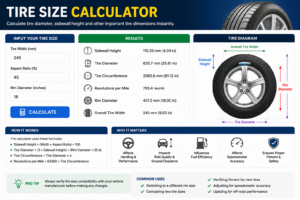
A Tire Size Calculator is a digital tool that uses your tire’s width, aspect ratio, and rim diameter to calculate the tire’s total diameter, sidewall height, and other critical measurements. Instead of doing manual math, you simply enter three numbers and the tool does all the work for you instantly.
Here is why this matters: tire size directly affects your vehicle’s handling, ride quality, ground clearance, fuel efficiency, and even your speedometer reading. A small change in tire dimensions can have a surprisingly big impact on how your car performs on the road.
The tool is especially useful when:
- You are switching to a different rim size
- You want to compare two tire sizes side by side
- You need to verify if a new tire will physically fit your vehicle
- You are calculating the effect on speedometer accuracy after an upgrade
- You are upsizing to larger, more aggressive tires for off-road use
The tool works by applying a simple but important formula: it converts the aspect ratio and width into a sidewall height, then adds the rim diameter (converted to millimeters) to find the total tire diameter. A reliable Tire Size Calculator gives you all of these measurements in one single click.
Understanding Tire Size Numbers
Before you can use this tool effectively, you need to understand what each number on your tire sidewall actually represents.
Take the common example: 205/55R16
- 205 — This is the tire width in millimeters. It is the distance measured across the tread from one sidewall to the other at the widest point.
- 55 — This is the aspect ratio. It tells you the sidewall height as a percentage of the tire width. A 55 aspect ratio means the sidewall height is 55% of 205 mm, which equals exactly 112.75 mm.
- R — This stands for Radial construction, which is by far the most common type of tire manufactured and sold today.
- 16 — This is the rim diameter in inches. It tells you the size of the wheel the tire is designed to mount on.
Understanding these three numbers is the complete foundation of everything a Tire Size Calculator does. Once you input them correctly, you can instantly calculate:
- Sidewall height in millimeters
- Total tire diameter in both millimeters and inches
- Tire circumference for speedometer calculations
- Revolutions per mile or kilometer
How to Use a Tire Size Calculator
Using a Tire Size Calculator is straightforward, even if you have no mechanical background at all. Here is a clear, step-by-step guide you can follow right now:
Step One — Find Your Current Tire Size Look at the sidewall of your existing tire. You will see a code printed on the rubber, such as 205/55R16. Write down the three key numbers: width (205), aspect ratio (55), and rim diameter (16).
Step Two — Enter the Values Open the tool and enter:
- Tire Width (mm): Enter 205
- Aspect Ratio: Enter 55
- Rim Diameter (inches): Enter 16
Step Three — Click Calculate The tool instantly delivers your results, including:
- Sidewall height in millimeters
- Rim diameter converted to millimeters
- Total tire diameter
Step Four — Interpret the Results A total diameter of around 631.9 mm for a 205/55R16 tire means the tire spans roughly 63 centimeters from the ground to the very top when properly inflated. This number is absolutely critical when comparing tires to ensure correct fitment and vehicle clearance.
Step Five — Compare Multiple Sizes You can run the calculation multiple times in a row to compare different tire sizes and quickly determine which one gives the closest total diameter to your original tire specification.
Why Tire Size Matters for Your Vehicle
Tire size is not just a number — it is an engineering specification that was carefully chosen by your vehicle’s manufacturer for very specific reasons. The original tire size on your car is designed to balance safety, performance, ride comfort, and fuel efficiency simultaneously.
Here is a detailed breakdown of exactly why getting the right size matters:
Handling and Stability A tire that is too wide can cause understeer and handling issues, especially in wet or slippery conditions. A tire with too low an aspect ratio might feel harsh and punishing on rough or uneven roads. Before making any change, always run the numbers through a sizing tool to find the right balance.
Ground Clearance If you increase the tire diameter, your vehicle’s ground clearance increases as well. This is particularly useful for off-road vehicles and lifted trucks. If you decrease the diameter, the car sits lower to the ground. Either change must be carefully verified to avoid the tire rubbing against the wheel arch or suspension components.
Load Capacity Larger tires with higher load ratings can generally handle more vehicle weight safely. Always verify the load rating when switching to a different size.
Braking Distance Incorrect tire sizing can negatively affect braking performance in real-world conditions. A tire that is significantly different in diameter from the original factory specification may noticeably increase stopping distances, which is a serious safety concern on public roads.
Tire Size Calculator Formulas Explained
Understanding the math behind a Tire Size Calculator makes you a far more informed and confident tire buyer. Here are the exact core formulas used in the calculation process:
Sidewall Height (mm)
Sidewall Height = (Tire Width × Aspect Ratio) ÷ 100
For a 205/55R16 tire: Sidewall Height = (205 × 55) ÷ 100 = 112.75 mm
Rim Diameter in Millimeters
Rim Diameter (mm) = Rim Diameter (inches) × 25.4
For a 16-inch rim: Rim Diameter = 16 × 25.4 = 406.4 mm
Total Tire Diameter (mm)
Total Diameter = (2 × Sidewall Height) + Rim Diameter (mm)
Total Diameter = (2 × 112.75) + 406.4 = 631.9 mm
Tire Circumference (mm)
Circumference = Total Diameter × π (3.14159)
Circumference = 631.9 × 3.14159 = 1,985.1 mm
These formulas are exactly what this tool uses under the hood. Knowing them helps you verify results independently, understand why even a small change in width or ratio has a significant effect on the total diameter, and make smarter purchasing decisions.
Common Tire Size Conversions
One of the most practical everyday uses of this tool is converting between metric and imperial measurements and comparing popular tire sizes side by side.
| Metric Tire Size | Total Diameter (mm) | Total Diameter (inches) |
|---|---|---|
| 195/65R15 | 634.8 mm | 24.99 inches |
| 205/55R16 | 631.9 mm | 24.88 inches |
| 215/60R16 | 652.4 mm | 25.68 inches |
| 225/45R17 | 632.3 mm | 24.90 inches |
| 235/65R17 | 736.6 mm | 29.0 inches |
| 265/70R17 | 800.1 mm | 31.5 inches |
A Tire Size Calculator makes these conversions completely effortless, allowing you to instantly see whether a replacement tire will closely match your original dimensions and keep all your vehicle systems calibrated correctly.
Choosing the Right Tire Size for Your Car
Selecting the correct tire size involves more than simply matching numbers. Here are the key factors every driver should carefully consider:
Match the Original Specification The easiest and safest approach is always to match the tire size printed in your vehicle’s owner manual or on the door jamb sticker. The manufacturer extensively tested the car with that specific tire size and engineered all vehicle systems around it.
Consider Your Driving Conditions
- City driving: Narrower tires with higher aspect ratios offer better fuel economy and a smoother, more comfortable daily ride.
- Highway driving: Mid-width tires with moderate aspect ratios balance cornering grip and long-distance fuel efficiency perfectly.
- Off-road driving: Wider tires with taller sidewalls provide superior traction and puncture resistance on rough and uneven terrain.
Check for Fitment Before Buying Always use a Tire Size Calculator before purchasing any new tire size to confirm the total diameter stays within 3% of your original factory size. A larger variance than this can negatively affect speedometer calibration, ABS braking systems, and automatic transmission shift points.
Consult Your Mechanic When in doubt, always consult a certified professional. This tool gives you the exact numbers, but an experienced mechanic can tell you whether those numbers will physically fit inside your specific vehicle’s wheel arch and suspension setup without any rubbing or clearance problems.
Tire Size and Fuel Efficiency
Tire size has a direct and measurable impact on your vehicle’s fuel consumption, and many drivers underestimate this connection.
Rolling Resistance Wider tires have more rubber in contact with the road surface at any given moment, which directly increases rolling resistance. More resistance means the engine must work harder to maintain speed, which ultimately burns more fuel and increases your running costs.
Tire Weight Larger tires are significantly heavier than smaller ones. Heavier rotating mass means the engine must expend more energy to accelerate and decelerate the vehicle, which reduces overall efficiency especially in stop-and-go city traffic.
Aerodynamics Tires that protrude beyond the wheel arch or that are excessively wide create additional aerodynamic drag. Verify your tire dimensions carefully to ensure your tires do not unnecessarily widen your vehicle’s frontal profile.
The Efficiency Sweet Spot For most passenger cars, the manufacturer’s recommended tire size strikes the optimal balance between grip and fuel efficiency. Deviating significantly from this recommended size, in either direction, typically hurts your real-world fuel economy noticeably — sometimes by as much as 5 to 8 percent over time.
Tire Size and Speedometer Accuracy
This is one of the most frequently overlooked consequences of changing tire size — your speedometer may no longer read accurately after the swap.
Why Does This Happen? Your speedometer measures vehicle speed by counting how many times the wheels complete a full rotation per unit of time. It is precisely calibrated based on the total circumference of your original factory tires. If you install a tire with a larger or smaller overall diameter, the circumference changes, and your speedometer will display an incorrect reading.
How Much Error Is Acceptable? Most traffic authorities and vehicle standards allow a maximum speedometer error of ±2–3%. A Tire Size Calculator can calculate the circumference difference between your original and new tire sizes, allowing you to accurately estimate the speedometer error before you install the new tires and commit to the purchase.
Practical Example:
- Original tire circumference: 1,985 mm
- New tire circumference: 2,050 mm
- Difference: 65 mm = +3.27% speedometer error (reads lower than actual speed)
Always verify the speedometer impact using the tool when changing tire sizes. If the calculated error exceeds 3%, you may need professional electronic speedometer recalibration to stay legally compliant and drive safely.
Upsizing and Downsizing Tires – What You Need to Know
Upsizing (going to a larger rim with a shorter sidewall tire) and downsizing (going to a smaller rim with a taller sidewall tire) are both popular and common modifications, but each comes with real trade-offs that you need to understand.
Upsizing Pros:
- Improved cornering and handling response due to a wider contact patch
- More aggressive and sporty aesthetic appearance — larger rims look distinctly better on most cars
- Shorter braking distances in dry, clean pavement conditions
Upsizing Cons:
- Noticeably harsher ride quality due to shorter sidewall absorbing less impact
- Significantly higher cost — larger rims and low-profile tires are more expensive to purchase and replace
- Much more susceptible to pothole and kerb damage due to reduced sidewall flex
Downsizing Pros:
- More comfortable and cushioned ride due to taller sidewall absorbing road imperfections
- Lower overall cost — smaller rims and standard-profile tires are considerably cheaper
- Better off-road and gravel capability due to more sidewall flex
Downsizing Cons:
- Reduced handling precision and steering response
- Less visually impressive appearance for most modern vehicle styles
In all cases, use a Tire Size Calculator to verify that the total diameter of the new tire stays close to your original factory specification. This single step protects your speedometer accuracy, transmission shift calibration, and ABS braking function simultaneously.
Metric vs. Imperial Tire Sizes
Most modern tires use the metric sizing system, but older vehicles and many trucks and off-road vehicles still use imperial sizing. Here is a clear comparison of both systems:
Metric (Standard) Format: 205/55R16
- Width expressed in millimeters
- Aspect ratio expressed as a percentage of width
- Rim diameter expressed in inches
Imperial (Flotation) Format: 31×10.50R15
- Total tire diameter expressed in inches
- Tread width expressed in inches
- Rim diameter expressed in inches
A Tire Size Calculator can often handle both sizing formats, allowing you to convert between them and compare different tire specifications on an equal basis when shopping across different tire categories.
The metric system completely dominates the passenger car and SUV market worldwide today. However, if you drive a classic car, a commercial light truck, or a dedicated off-road vehicle, you will regularly encounter imperial sizing specifications. Knowing how to convert between the two systems — and using the right tool to do it — ensures you always select the correct tire and avoid costly fitment mistakes.
FAQs
What does a Tire Size Calculator do? A Tire Size Calculator computes the sidewall height, total tire diameter, rim diameter in millimeters, and tire circumference based on your three inputs: tire width, aspect ratio, and rim diameter. It eliminates all manual calculation errors and delivers accurate, instant results every time.
Can I use this tool to compare two different tire sizes? Absolutely. Simply run the calculation twice — once for each tire size — and compare the total diameters. If the difference between the two results is within 3% of each other, the new tire is generally a safe and compatible substitute for the original factory specification.
How accurate is the calculation? The calculations are mathematically precise based on standardized industry formulas. However, real-world tire dimensions can vary slightly due to inflation pressure, vehicle load, and manufacturing tolerances. Always treat the calculated results as highly reliable reference values rather than absolute guarantees.
Does changing tire size affect my speedometer reading? Yes, it does. A larger total tire diameter means more ground is covered per wheel revolution, so your speedometer will display a lower speed than you are actually traveling. Always check the circumference difference when changing tire sizes to understand the potential speedometer error before finalizing your purchase.
What is the aspect ratio in tire sizing? The aspect ratio is the height of the tire’s sidewall expressed as a percentage of the tire’s total width. A 55 aspect ratio means the sidewall height is exactly 55% of the tire width in millimeters. Lower aspect ratios produce sportier, sharper handling; higher aspect ratios produce a softer, more comfortable ride.
Is a wider tire always better for performance? Not necessarily. While wider tires offer superior grip in dry conditions, they can actually perform worse in snow, ice, or standing water, and they reduce fuel efficiency noticeably. Always verify dimensions carefully and consult your vehicle manual before upsizing to a significantly wider tire.
Can I use this for trucks and SUVs? Yes, absolutely. This tool works accurately for any vehicle type — passenger cars, SUVs, pickup trucks, commercial vans, or even motorcycles. Simply enter the correct width, aspect ratio, and rim diameter from the sidewall of your specific tire and the calculation is equally accurate.
What is the minimum safe aspect ratio for daily driving? Most professional tire experts and manufacturers recommend staying above a 35 aspect ratio for everyday road driving. Very low-profile tires in the 25–30 aspect ratio range are significantly more susceptible to serious damage from potholes, kerbs, and uneven surfaces, and they require very smooth road conditions to perform reliably over time.
How do I find my tire size? Your current tire size is printed clearly on the outer sidewall of every tire on your vehicle. It will appear as a sequence of numbers and letters such as 205/55R16. You can also find the recommended tire size on the sticker inside your driver’s door jamb or in your vehicle owner’s manual.
Why do two tires with different aspect ratios sometimes have the same total diameter? This happens because a wider tire with a lower aspect ratio can produce the same sidewall height as a narrower tire with a higher aspect ratio. For example, 225/45R17 and 205/55R16 have nearly identical total diameters despite looking very different. The tool shows you exactly why this happens by breaking down every measurement individually Tire Size Calculator
Conclusion
Tires are the only part of your vehicle that physically touches the road surface — which makes getting the size exactly right absolutely critical for safety, performance, and economy. From ride quality and cornering response to fuel efficiency and speedometer accuracy, tire dimensions affect virtually every aspect of your daily driving experience.
A Tire Size Calculator is not just a convenience tool — it is an essential resource for any driver who wants to make properly informed, confident decisions about their tires. Whether you are replacing a flat tire in an emergency, upgrading your wheels for a better appearance, or simply curious about what those sidewall numbers mean, this tool gives you accurate, reliable answers in seconds.
Throughout this complete guide, we have covered everything from the fundamental formulas and common size conversions to the trade-offs of upsizing and the critical impact on speedometer calibration. The most important takeaway is straightforward and universal: always calculate before you buy.
Use a Tire Size Calculator every single time you consider any tire change, no matter how small. Check the total diameter of the new tire, compare it directly to your original factory size, and always verify that the difference stays comfortably within 3%. This one simple habit can save you from costly mistakes, unexpected handling problems, and potential legal issues related to speedometer inaccuracy on public roads.
Never underestimate the importance of running these calculations before making tire decisions. Professional tire dealers and automotive engineers use these exact same formulas every day. By checking your numbers yourself before you walk into any tire shop, you arrive informed, prepared, and impossible to mislead. You know exactly what you need and exactly why you need it.
Consider this your complete reference guide for all things related to tire sizing. Bookmark it, share it with fellow drivers, and return to it whenever you face a tire decision. The best vehicle modifications always start with accurate data — and the right calculation tool is where that data begins.
Tires carry you, your passengers, and everything that matters most to you on every journey. Treat them with the respect and attention they deserve. Start every tire decision with the right size, confirmed by a reliable Tire Size Calculator, backed by the knowledge in this complete guide, and validated by a trusted professional when needed.
Drive informed. Drive prepared. Drive safe. Your tires are your vehicle’s only connection to the road — make sure that connection is measured correctly with a Tire Size Calculator every single time.