Pension Calculator
Quickly calculate sales tax and find the total price instantly with our easy Sales Tax Calculator
Table of Contents
- Introduction
- What Is a Pension Calculator?
- Why Every Worker Needs a Pension Calculator
- The Three Core Pension Strategies Explained
- Key Inputs in a Pension Calculator and How to Use Them
- Work Longer Strategy: Building Maximum Pension Wealth
- Payout Strategy: Turning Your Pension into Reliable Retirement Income
- Lump Sum Strategy: Managing a One-Time Pension Payout
- How Inflation Erodes Pension Value Over Time
- The Role of Tax Rate in Pension Planning
- Real-Life Scenarios Using the Pension Calculator
- How to Set a Realistic Pension Goal
- Common Mistakes in Pension Planning
- Strategies to Strengthen Your Pension Outlook
- Frequently Asked Questions (FAQs)
- Conclusion
Introduction
Retirement is not a destination you stumble into — it is a financial destination you plan your way toward, one decision at a time. And for the millions of workers who depend on pension income to fund their post-work years, the quality of that planning determines everything: when you can retire, how comfortably you will live, and whether your money outlasts you or runs out before you do.
A Pension Calculator is the most important planning tool available to anyone building toward a pension-funded retirement. It takes the complex mathematics of long-term savings growth, withdrawal sustainability, and lump sum investment — and converts them into clear, personalized projections that tell you exactly where you stand and what you need to do.
Whether you are in the early stages of your career and wondering how much to contribute, approaching retirement and weighing your payout options, or managing a lump sum distribution and trying to make it last, a Pension Calculator gives you the numbers you need to make confident, informed decisions.
In this comprehensive guide, we will walk through every aspect of pension planning — the three core strategies, the key inputs that drive your projections, the impact of inflation and taxes, real-world scenarios, and the most effective steps you can take today to secure the retirement you deserve.
What Is a Pension Calculator?
A Pension Calculator is a digital financial planning tool that projects your retirement savings balance, monthly income sustainability, or lump sum performance based on your personal financial inputs — including age, salary, contribution rate, expected investment return, inflation, taxes, and target amounts.
Unlike a simple savings calculator, a Pension Calculator is specifically designed around the unique structure of retirement income planning. It models three distinct and commonly encountered pension scenarios:
Work Longer Strategy — For workers still in the accumulation phase, this model projects how your current pension savings will grow based on your contribution rate, expected return, and years until retirement. It also tells you whether you are on track to hit your target retirement balance.
Payout Strategy — For retirees or near-retirees planning how to draw from their pension, this model calculates how long your pension fund will last based on your withdrawal rate, investment return in retirement, inflation adjustments, and tax obligations. It compares your projected monthly income to your target monthly need.
Lump Sum Strategy — For individuals who receive a one-time pension payout and must invest and manage it independently, this model shows how a lump sum grows over time given a return rate, monthly income draw, inflation, management fees, and tax rate.
Together, these three modes make the Pension Calculator an end-to-end retirement planning tool — covering the full journey from first contribution to final withdrawal.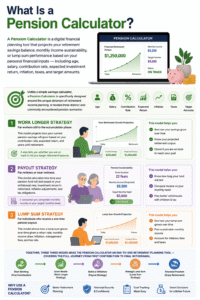
Why Every Worker Needs a Pension Calculator
The retirement savings crisis is real. A significant portion of workers reach retirement age with inadequate savings, not because they lacked the means to save, but because they lacked the visibility to understand what was required. A Pension Calculator solves this fundamental problem.
Here is why using a Pension Calculator regularly is essential:
It reveals your true retirement readiness. Instead of vague assumptions like “I think I’m saving enough,” the Pension Calculator gives you a precise projected balance at retirement — and tells you whether it will meet your goals.
It quantifies the cost of waiting. Every year you delay increasing contributions is a year of compound growth lost. The Pension Calculator shows you exactly what that delay costs in final balance terms — often a compelling enough number to prompt immediate action.
It models all three pension decisions at once. Whether you are accumulating, drawing down, or managing a lump sum, the Pension Calculator gives you relevant projections for each phase of your retirement journey.
It accounts for real-world factors. Inflation, taxes, management fees, and withdrawal rates all erode pension value in ways that simple mental math cannot capture. The Pension Calculator incorporates all of these factors for genuinely realistic projections.
It empowers you to act, not just hope. Knowing your numbers gives you agency. The Pension Calculator transforms retirement planning from an anxiety-inducing unknown into a manageable, trackable financial process.
The Three Core Pension Strategies Explained
A complete Pension Calculator covers three distinct stages of pension planning, each requiring a different mathematical approach and set of inputs.
Strategy 1 — Work Longer: This is the accumulation phase. You are still working, still contributing, and still growing your pension fund. The core question is: given your current balance, contribution rate, and expected return, what will your pension be worth when you retire — and will it hit your target?
Strategy 2 — Payout: This is the distribution phase. You have retired and are drawing income from your pension. The core questions are: how long will your money last at your planned withdrawal rate, and will the monthly income cover your living expenses after inflation and taxes?
Strategy 3 — Lump Sum: Some workers receive a single large pension payment rather than ongoing monthly contributions. This strategy models how to invest and draw from a lump sum to maximize longevity and ensure it lasts through retirement.
Understanding which strategy applies to your current situation determines which section of the Pension Calculator to focus on — and what decisions you need to make next.
Key Inputs in a Pension Calculator and How to Use Them
The accuracy of your Pension Calculator results depends entirely on the quality of your inputs. Here is a guide to each key field:
Current Age: Your age today. Together with your retirement age, this defines how many years of compound growth your pension has ahead of it.
Retirement Age: The age at which you plan to stop working. Every additional year of work adds both more contributions and more growth time — the Pension Calculator makes this impact immediately visible.
Current Salary: Your gross annual income. This is used to calculate your contribution amount based on your contribution percentage.
Current Savings: Your existing pension balance. This is the foundation of your projection — the amount that will compound for the entire duration of your remaining working years.
Contribution Percentage: The portion of your salary you contribute to your pension each period. Even small increases in this percentage can produce dramatically different outcomes. The Pension Calculator lets you test different contribution rates to find the optimal balance between current income and future security.
Expected Return Rate: The annual percentage return you expect from your pension investments. For long-term diversified portfolios, 6-8% is a commonly used historical average, though actual returns vary. Use conservative estimates for planning purposes.
Tax Rate: The percentage of your pension income or growth subject to tax. This reduces your effective take-home pension income and is a critical factor in realistic projections.
Target Amount / Goal: The pension balance you are aiming for at retirement. The Pension Calculator compares your projected outcome to this target and tells you whether your current strategy will achieve it.
Work Longer Strategy: Building Maximum Pension Wealth
The Work Longer Strategy is the foundation of pension planning for anyone who is still employed and contributing. The name reflects its core principle: more working years means more contributions, more compound growth, and a substantially larger final pension balance.
The Pension Calculator’s Work Longer module takes your current age, retirement age, existing balance, salary, contribution rate, and expected return — and projects your balance year by year until retirement.
Why compound growth makes the Work Longer strategy so powerful:
Consider someone aged 30 with a $20,000 existing balance, earning $50,000 per year and contributing 10% ($5,000/year) at a 7% return, targeting retirement at 65:
- 35 years of contributions: $175,000 in total employee contributions
- Compound investment growth on both existing balance and contributions: over $800,000
- Projected total balance: approximately $990,000+
The majority of the final balance comes from investment returns, not contributions — which is precisely why starting early and maintaining consistent contributions is so critical. The Pension Calculator makes this arithmetic visible and personal.
What to do if the Work Longer Strategy shows you are below target:
- Increase your contribution rate even by 1-2% — the Pension Calculator will show the significant impact
- Consider delaying retirement by a few years — each additional year adds both contributions and growth
- Explore higher-return investment options within your pension plan
- Reduce unnecessary fees that erode your balance
Payout Strategy: Turning Your Pension into Reliable Retirement Income
Once you retire, the financial challenge shifts from accumulation to preservation and distribution. The Payout Strategy module of the Pension Calculator is designed specifically for this phase — modeling how your pension fund performs when you begin withdrawing from it.
Key inputs for the Payout Strategy include your initial pension balance, spouse’s age (relevant for survivor benefit planning), life expectancy, withdrawal rate, investment return in retirement, inflation rate, and tax rate.
The central challenge of the payout phase is balancing three competing forces:
Longevity risk — Your money must last as long as you live. With life expectancies extending into the 80s and beyond, a 20 to 30-year retirement is increasingly common. The Pension Calculator models this by projecting your balance against your life expectancy.
Inflation risk — The purchasing power of a fixed pension payment erodes over time. At 3% annual inflation, a monthly pension of $3,000 today will have the purchasing power of just $1,813 in 20 years. The Pension Calculator factors inflation into your monthly income projections for a realistic assessment.
Sequence of returns risk — Poor investment performance early in retirement can permanently damage a pension fund’s ability to recover. Using conservative return assumptions in the payout phase — typically 4-6% — is recommended.
The 4% rule is a widely referenced guideline suggesting that withdrawing no more than 4% of your pension balance in the first year of retirement (adjusted for inflation annually) creates a sustainable income for 30+ years in most market conditions. Use the Pension Calculator to model this withdrawal rate against your specific balance and see how long it lasts.
Lump Sum Strategy: Managing a One-Time Pension Payout
Not all pension plans pay out as monthly income. Many workers receive a single lump sum payout — either as a defined benefit plan buyout, a pension transfer value, or a plan termination settlement. Managing this lump sum wisely is one of the most consequential financial decisions of your life.
The Lump Sum Strategy module in the Pension Calculator helps you answer the critical question: given this amount of money, how should I invest it and draw from it to generate reliable retirement income for 20+ years?
Key inputs include the lump sum amount, planned monthly income draw, expected return rate, investment duration, inflation rate, tax rate, and management fee.
Critical considerations for lump sum management:
Management fees matter enormously. A 1% annual management fee on a $250,000 lump sum grows to over $50,000 in lost value over 20 years through compounding. The Pension Calculator includes a management fee field to make this cost visible.
Inflation adjusts your real monthly income. If you draw $1,000 per month without inflation adjustments, your real purchasing power declines each year. The Pension Calculator accounts for this erosion so you can plan an inflation-adjusted withdrawal schedule.
Return assumptions must be conservative. A lump sum that must last 20+ years should be invested in a balanced, relatively conservative portfolio. Using 5-6% as a return assumption is more appropriate than the higher rates used in the accumulation phase.
Tax on distributions. Depending on your jurisdiction and plan type, lump sum distributions may be subject to income tax or special tax treatment. The Pension Calculator incorporates your tax rate to give you a net-income projection rather than a misleading pre-tax figure.
How Inflation Erodes Pension Value Over Time
Inflation is the silent threat to every pension plan — and it is one of the most frequently underestimated factors in retirement planning. Understanding how inflation erodes pension value is essential for using the Pension Calculator to build a genuinely secure retirement plan.
At an average inflation rate of 3% per year:
- After 10 years: your pension dollar buys 26% less
- After 20 years: your pension dollar buys 46% less
- After 30 years: your pension dollar buys 59% less
This means a pension of $3,000 per month today needs to grow to approximately $7,300 per month in 30 years just to maintain the same purchasing power. If your pension income is fixed and not indexed to inflation, you will progressively lose financial ground every year throughout retirement.
The Pension Calculator incorporates inflation into all three strategy modules:
In the Work Longer Strategy, inflation affects the real value of your target amount — you may need a larger nominal balance than you initially think.
In the Payout Strategy, inflation reduces the real monthly income over time — the Pension Calculator models this so you can see whether your income will still meet your needs in year 20 of retirement.
In the Lump Sum Strategy, inflation erodes both your investment returns and your withdrawal value over time — another reason to use conservative assumptions and plan for longevity.
The Role of Tax Rate in Pension Planning
Taxes are one of the largest single drains on pension income, and yet they are routinely underestimated in retirement planning. A realistic Pension Calculator must incorporate your expected tax rate to produce projections that reflect actual take-home income rather than misleading pre-tax figures.
Why pension income is taxable:
In most countries, including the United States, pension income from traditional defined benefit plans and 401(k) or similar defined contribution plans is taxable as ordinary income in the year it is received. This means your effective retirement income is your gross pension minus taxes — a distinction that matters enormously for monthly budget planning.
Tax-rate considerations for different pension phases:
During the accumulation phase, contributions to traditional pension plans are typically made pre-tax, reducing your current tax bill. However, this defers — not eliminates — the tax obligation to withdrawal.
During the payout phase, withdrawals from traditional pension accounts are taxed as ordinary income. Your effective tax rate in retirement may be lower than during your working years (due to lower total income), but it is rarely zero. Enter a realistic effective tax rate into the Pension Calculator — typically 10-22% for most retirees — for accurate projections.
For Roth-style accounts (contributions made after tax), withdrawals in retirement are tax-free. If your pension plan includes Roth elements, you can model these with a 0% tax rate in the relevant calculation.
Real-Life Scenarios Using the Pension Calculator
Scenario 1 — The Early Career Planner: James, age 30, has $20,000 saved, earns $50,000, and contributes 10% per year with a 7% expected return, aiming to retire at 65. His Pension Calculator Work Longer projection shows a balance of approximately $990,000 — just below his $1 million target. By increasing his contribution rate to 11%, he closes the gap and meets his goal comfortably.
Scenario 2 — The Retiree Managing Monthly Income: Margaret, age 65, retires with an $800,000 pension balance. She models the Payout Strategy: 4% withdrawal rate, 5% investment return, 3% inflation, 10% tax rate, targeting $3,000 per month in real income. Her Pension Calculator shows her balance lasting 28 years — to age 93 — well beyond her life expectancy of 85. She has a comfortable margin.
Scenario 3 — The Lump Sum Recipient: Robert, age 60, receives a $250,000 lump sum pension payout. He plans to draw $1,000 per month, expects a 6% return, has a 1% management fee, and faces a 10% tax rate over 20 years. His Pension Calculator projects his balance reaching approximately $480,000 — well above his $500,000 goal — demonstrating that disciplined lump sum management can generate substantial long-term value.
How to Set a Realistic Pension Goal
One of the most important — and most frequently neglected — steps in pension planning is setting a specific, achievable target. Without a clear goal, the Pension Calculator cannot tell you whether you are on track. With one, it becomes an extremely precise navigation tool.
Method 1 — The Multiplier Approach: A widely used rule of thumb is to target a retirement nest egg of 25 times your expected annual retirement expenses. If you need $40,000 per year in retirement, your target pension balance is $1,000,000. Enter this into the Pension Calculator as your target amount to see whether your current strategy will achieve it.
Method 2 — The Income Replacement Approach: Most financial planners recommend replacing 70-80% of your pre-retirement income in retirement. If you earn $60,000, target $42,000-$48,000 per year in pension income. Divide by your planned withdrawal rate (e.g., 4%) to calculate the required balance: $42,000 ÷ 0.04 = $1,050,000.
Method 3 — The Lifestyle Budget Approach: Build a detailed monthly retirement budget covering housing, food, healthcare, travel, and leisure. Multiply by 12 for annual needs. Account for inflation and expected healthcare cost growth. This bottom-up approach produces the most personalized and accurate target — which you then use as the input goal in your Pension Calculator.
Common Mistakes in Pension Planning
Even with the right tool, these planning errors can derail your retirement security:
Setting an unrealistically high expected return. Projecting 10-12% annual returns may produce exciting numbers but leads to dangerous overconfidence. Use 7-8% for the accumulation phase and 4-6% for the payout phase in your Pension Calculator for realistic results.
Ignoring inflation entirely. Many people calculate retirement needs in today’s dollars without accounting for what those dollars will be worth in 20-30 years. Always use a realistic inflation rate — 2-3% — in your Pension Calculator inputs.
Underestimating life expectancy. Planning to age 80 when you might live to 95 creates a serious shortfall risk. Use life expectancy of 90-95 as a planning assumption, especially if you are in good health and have family longevity history.
Not increasing contributions after pay rises. Most pension plans allow contribution rate increases, but many workers never update them. Every salary increase is an opportunity to improve your pension trajectory without reducing your standard of living.
Forgetting about management fees. Even 1% per year in fees compounds into enormous losses over a 30-year period. Use the Pension Calculator’s management fee input to see exactly what fees are costing you — and consider switching to lower-fee options if the impact is significant.
Withdrawing too early or at too high a rate. Drawing more than 4-5% annually in early retirement puts unsustainable pressure on a portfolio. Model your withdrawal strategy carefully in the Pension Calculator before committing to a monthly income figure.
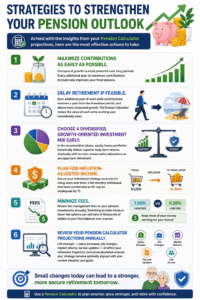
Strategies to Strengthen Your Pension Outlook
Armed with the insights from your Pension Calculator projections, here are the most effective actions to take:
Maximize contributions as early as possible. Compound growth is most powerful over long periods. Every additional year of maximum contributions dramatically improves your final balance.
Delay retirement if feasible. Each additional year of work adds contributions, removes a year from the drawdown period, and allows more compound growth. The Pension Calculator makes the value of each extra working year immediately clear.
Choose a diversified, growth-oriented investment mix early. In the accumulation phase, equity-heavy portfolios historically deliver superior long-term returns. Gradually shift to more conservative allocations as you approach retirement.
Plan for inflation-adjusted income. Ensure your withdrawal strategy accounts for rising costs over time. A flat monthly withdrawal that feels comfortable at 65 may be inadequate by 75.
Minimize fees. Review the management fees on your pension investments annually. Switching to index funds or lower-fee options can add tens of thousands of dollars to your final balance over a career.
Review your Pension Calculator projections annually. Life changes — salary increases, job changes, market returns, tax law updates — all affect your retirement trajectory. Annual recalculation ensures your strategy remains optimally aligned with your current situation and goals.
Frequently Asked Questions (FAQs)
What is the difference between a defined benefit pension and a defined contribution pension?
A defined benefit (DB) pension promises a specific monthly income in retirement, usually calculated as a percentage of your final salary multiplied by years of service. A defined contribution (DC) pension (like a 401k or personal pension) accumulates a pot of money based on contributions and investment returns — the final income depends on how much is in the pot when you retire. The Pension Calculator is most directly applicable to defined contribution plans, where the final balance depends on variables like contribution rate, return, and time.
How do I know if I am saving enough for retirement?
Use the Pension Calculator’s Work Longer Strategy to project your balance at retirement and compare it to your target. A common benchmark is 25 times your expected annual retirement expenditure. If your projected balance falls short, you can immediately model the impact of increasing your contribution rate or extending your working years.
What is a safe withdrawal rate for pension income?
The 4% rule is a widely respected guideline: withdrawing 4% of your pension balance in year one of retirement, then adjusting annually for inflation, historically sustains a portfolio for 30+ years in most market conditions. Use the Pension Calculator’s Payout Strategy module to test this against your specific balance and life expectancy.
How does inflation affect my pension plan?
Inflation reduces the purchasing power of your pension income each year. At 3% annual inflation, money loses half its purchasing power over 24 years. The Pension Calculator incorporates an inflation rate input so your projections reflect real income value rather than nominal figures that overstate your actual retirement security.
Should I take a lump sum or monthly pension payout?
This depends on your health, life expectancy, investment confidence, other income sources, and the terms offered. A monthly pension provides certainty and longevity protection; a lump sum offers flexibility and potential for higher returns if well-managed. Use the Pension Calculator to model both scenarios with realistic assumptions and compare the projected total income over your retirement period before making this irreversible decision.
What return rate should I use in the Pension Calculator?
For the accumulation phase (Work Longer Strategy), a rate of 7-8% is a reasonable long-term average for a diversified equity-weighted portfolio. For the distribution phase (Payout and Lump Sum strategies), use a more conservative 4-6% to reflect a lower-risk post-retirement portfolio. Always run a downside scenario at 2-3% lower than your base assumption to stress-test your plan.
How often should I use the Pension Calculator?
At a minimum, review your pension projections annually — and also after any major life change: salary increase, job change, marriage, divorce, or a significant market movement that affects your balance. Regular recalculation with the Pension Calculator ensures your contribution strategy and retirement timeline remain aligned with your actual financial situation and goals.
Conclusion
Retirement security is not guaranteed by simply having a pension — it is built through deliberate, informed planning that starts as early as possible and continues throughout your working life. A Pension Calculator is the most powerful instrument available for this planning, transforming complex financial mathematics into clear, personalized, actionable projections.
The three strategies covered in this guide — Work Longer, Payout, and Lump Sum — address every phase of the pension journey. Each one requires specific inputs, produces different insights, and points toward specific actions that can improve your outcome. Whether you are 30 and just getting started, 55 and recalibrating, or 65 and ready to draw, the Pension Calculator gives you the numbers to navigate each transition with confidence.
The most important step is always the same: run your numbers honestly, set a realistic target, and act on what you find. If the Pension Calculator shows you are on track — great, maintain the discipline. If it shows a gap — you now know exactly how large it is, what is driving it, and which levers to pull to close it.
Your retirement will last 20, 25, perhaps 30 years or more. It deserves the same level of attention and precision that you bring to any major financial commitment. Use the Pension Calculator regularly, update it as your life evolves, and build the retirement security that reflects a lifetime of hard work and smart planning.