Pregnancy Conception Calculator
Discover Your Ideal Daily Macros with the Macro Calculator
Table of Contents
- Introduction
- What Is an Ovulation Date Calculator?
- What Is a Pregnancy Conception Calculator?
- The Science of Ovulation – What Happens and When
- How the Ovulation Date Calculator Works
- The Three Calculation Methods Explained
- Understanding Your Conception Date Window
- Most Probable vs. Possible Conception Dates
- The Role of Sexual Intercourse Timing in Conception
- Ovulation Date Calculator for Irregular Cycles
- Factors That Affect Ovulation Timing
- How Age Affects Your Ovulation Date Calculator Results
- Using an Ovulation Date Calculator After Coming Off Contraception
- Combining Ovulation Date Calculator with Physical Fertility Signs
- What Happens After Conception – Early Pregnancy Signs
- How to Use Our Ovulation Date Calculator Step-by-Step
- Frequently Asked Questions (FAQs)
- Conclusion
Introduction
Of all the variables that determine whether conception happens in any given month, timing is the most critical and the most controllable. The human egg survives for only 12 to 24 hours after ovulation — a window so narrow that missing it by even a day means waiting another full cycle. For couples trying to conceive, that represents a month of lost opportunity, and for those facing age-related fertility pressures or medical timelines, every cycle counts.
An Ovulation Date Calculator eliminates the uncertainty. By processing your last menstrual period date, due date, or ultrasound data, it calculates the most probable dates of ovulation, the optimal window for conception, and the range of possible conception dates — giving you the precise, actionable information needed to time intercourse or insemination for the highest possible probability of success.
In this comprehensive guide, you will learn exactly how an Ovulation Date Calculator works, the science behind ovulation timing, how to interpret the conception date results, how the three input methods differ, and how to combine calculator data with physical fertility signs for maximum accuracy. We will also explore how the Ovulation Date Calculator connects to our free Pregnancy Conception Calculator — so that once conception is confirmed, you have the tools to track every stage of the pregnancy that follows.
Whether you are beginning your conception journey or have been trying for several months, the Ovulation Date Calculator is the most important planning tool available to you.
What Is an Ovulation Date Calculator?
An Ovulation Date Calculator is a fertility planning tool that uses your menstrual cycle data — specifically your last menstrual period, due date, or ultrasound findings — to estimate the dates on which ovulation is most likely to occur, and by extension, the window during which conception is possible.
The Ovulation Date Calculator is built on the well-established relationship between menstruation and ovulation. In a standard 28-day menstrual cycle, ovulation typically occurs approximately 14 days before the next expected period — meaning around day 14 of the cycle. The days immediately preceding and following ovulation constitute the fertile window, during which intercourse has the potential to result in pregnancy.
By entering a known date into the Ovulation Date Calculator — your last period date, your estimated due date, or your ultrasound gestational data — the tool calculates forward or backward to identify:
- The most probable conception dates
- The most probable dates of sexual intercourse that could result in conception
- The full range of possible conception dates accounting for natural cycle variation
Who benefits from using an Ovulation Date Calculator?
- Women trying to conceive who want to identify their optimal fertile window
- Women who have recently confirmed pregnancy and want to estimate when conception occurred
- Healthcare providers and midwives calculating gestational age and due dates from conception timing
- Women with irregular cycles seeking a structured framework for fertile window estimation
- Couples navigating assisted reproduction who need precise timing coordination
What Is a Pregnancy Conception Calculator?
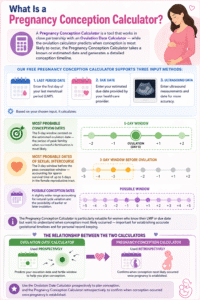
A Pregnancy Conception Calculator is a tool that works in close partnership with an Ovulation Date Calculator — while the ovulation calculator predicts when conception is most likely to occur, the Pregnancy Conception Calculator takes a known or estimated date and generates a detailed conception timeline.
Our free Pregnancy Conception Calculator supports three input methods: Last Period date, Due Date, and Ultrasound data. Based on your chosen input, it calculates:
- Most probable conception dates: The 5-day window centred on the estimated ovulation date — the period of peak fertility when successful fertilisation is most likely
- Most probable dates of sexual intercourse: The 3-day window before the peak conception window — accounting for sperm survival time of up to 5 days in the female reproductive tract
- Possible conception dates: A slightly wider range accounting for natural cycle variation and the possibility of earlier or later ovulation
The Pregnancy Conception Calculator is particularly valuable for women who know their LMP or due date but want to understand when conception most likely occurred — important for establishing accurate gestational timelines and for personal record keeping.
The relationship between the Ovulation Date Calculator and the Pregnancy Conception Calculator is sequential and complementary: use the Ovulation Date Calculator prospectively to plan conception, and the Pregnancy Conception Calculator retrospectively to confirm when conception occurred once pregnancy is established.
The Science of Ovulation – What Happens and When
Understanding the biological process that the Ovulation Date Calculator tracks is essential for using its results intelligently. Ovulation is not a random event — it is the precisely timed culmination of a complex hormonal cascade that repeats every cycle.
The Follicular Phase (Days 1 to 14 in a 28-day cycle): The menstrual cycle begins on the first day of menstruation. During the follicular phase, Follicle-Stimulating Hormone (FSH) from the pituitary gland stimulates several follicles in the ovaries to develop. One dominant follicle emerges and grows, producing increasing amounts of oestrogen that prepare the uterine lining for potential implantation.
The LH Surge: Rising oestrogen triggers the pituitary gland to release a sharp surge of Luteinising Hormone (LH). This LH surge is the direct hormonal trigger for ovulation — and occurs approximately 24 to 48 hours before the egg is released. Ovulation predictor tests detect this surge; the Ovulation Date Calculator estimates its timing from cycle length data.
Ovulation: The dominant follicle ruptures, releasing a mature egg into the fallopian tube. The egg remains viable for 12 to 24 hours. If fertilisation does not occur within this window, the egg disintegrates. This is the moment the Ovulation Date Calculator is designed to predict.
The Luteal Phase (Days 15 to 28): After ovulation, the ruptured follicle transforms into the corpus luteum, which produces progesterone to maintain the uterine lining. If fertilisation occurs, the embryo implants and produces hCG, which sustains the corpus luteum. If fertilisation does not occur, the corpus luteum degenerates and progesterone falls — triggering menstruation and starting the next cycle.
How the Ovulation Date Calculator Works
The Ovulation Date Calculator uses one of three input methods to calculate your ovulation and conception dates:
Method 1 – Last Period Date: The most commonly used input. The Ovulation Date Calculator adds 14 days to your LMP date to estimate ovulation, then identifies the surrounding fertile window. For example, if your last period started on January 1st, the calculator estimates ovulation around January 15th and identifies conception most likely occurring between January 14th and 18th.
Method 2 – Due Date: Working backward from a known estimated delivery date (EDD). Since standard gestational age is calculated as 40 weeks from LMP, the Ovulation Date Calculator subtracts 40 weeks from the EDD to estimate LMP, then adds 14 days to estimate ovulation. This method is particularly useful for women who have received an EDD from their healthcare provider and want to understand when conception most likely occurred.
Method 3 – Ultrasound Date: The most clinically accurate approach. The ultrasound provides a gestational age in weeks and days at a specific scan date. The Ovulation Date Calculator works backward from the gestational age to estimate the conception date range. First-trimester ultrasound (using Crown-Rump Length measurement) provides the most accurate gestational dating — typically accurate to within ±5 days.
All three methods produce the same output format: most probable conception dates, most probable intercourse dates, and the full range of possible conception dates — giving you a complete picture of the fertile window regardless of which input method best fits your situation.
The Three Calculation Methods Explained
Choosing the right input method for the Ovulation Date Calculator depends on what information you have available and what question you are trying to answer:
Last Period (LMP) Method – For Prospective Planning: This is the Ovulation Date Calculator’s ideal input when you are planning ahead — trying to identify your next fertile window before it occurs. Enter your most recent period start date and the calculator projects forward to your next ovulation window. This prospective use of the Ovulation Date Calculator is the most common and most practically valuable for couples actively trying to conceive.
The LMP method assumes a standard 28-day cycle with ovulation at day 14. Women with longer or shorter cycles should adjust their expectations accordingly — a woman with a 35-day cycle typically ovulates around day 21, while a woman with a 21-day cycle typically ovulates around day 7.
Due Date Method – For Retrospective Conception Dating: This method is used after pregnancy is established to determine when conception most likely occurred. It is particularly useful for women who are uncertain of their LMP or whose LMP does not align with their scan-confirmed gestational age. Enter your confirmed due date into the Ovulation Date Calculator and receive an estimated conception window that can be compared against your recollections of timing.
Ultrasound Method – For Clinical Accuracy: The ultrasound method incorporates scan-date gestational age data to produce the most accurate conception date estimates available short of a confirmed ovulation event. This method is especially valuable when LMP is uncertain, cycles are irregular, or there is a discrepancy between LMP-estimated and scan-confirmed gestational age.
Understanding Your Conception Date Window
The Ovulation Date Calculator produces a range of conception dates rather than a single date because conception is a biological probability — not a single-point event. Several factors contribute to this range:
Sperm Survival: Sperm can survive in the female reproductive tract for up to 5 days. Intercourse on any of the 5 days before ovulation can result in conception if the sperm survive until the egg is released.
Egg Viability: The egg remains viable for 12 to 24 hours after ovulation. Intercourse on the day of ovulation or the day before carries the highest individual probability of conception.
Cycle Variation: Even in women with regular cycles, ovulation can occur 1 to 3 days earlier or later than the calendar prediction. The Ovulation Date Calculator accounts for this biological variability by providing a range rather than a fixed date.
The “most probable conception dates” in the calculator output represent the 5-day core fertile window centred on the estimated ovulation date — typically days 12 to 18 of a 28-day cycle. This is the window during which the vast majority of successful conceptions occur.
The “possible conception dates” represent a slightly wider range — accounting for sperm survival, egg viability, and natural ovulation variability — that captures nearly all biologically plausible conception scenarios.
Most Probable vs. Possible Conception Dates
The Ovulation Date Calculator differentiates between two levels of probability in its results — a distinction that has both practical and clinical significance:
Most Probable Conception Dates: This is the core fertile window — the 4 to 5 days during which the probability of conception from unprotected intercourse is highest. This window brackets the estimated ovulation date and represents the period when the egg and surviving sperm are most likely to be simultaneously present in the fallopian tube.
Conception probability peaks on the day before and the day of ovulation. Studies show that intercourse on these two days carries a combined pregnancy probability of approximately 30% per cycle for healthy couples — far higher than intercourse on other days in the cycle.
Most Probable Dates of Sexual Intercourse: This output from the Ovulation Date Calculator accounts for sperm survival time — identifying the window during which intercourse is most strategically timed to ensure sperm are present and viable when the egg is released. The recommended intercourse window begins 3 days before the estimated ovulation date and extends to the ovulation date itself — a 4-day window that maximises the probability of sperm-egg encounter.
Possible Conception Dates: The wider range — accounting for all biologically plausible scenarios including early or late ovulation and extended sperm survival. This range is most useful for retrospective conception dating, when comparing the calculator output against known dates of intercourse to assess which encounter most likely resulted in pregnancy.
The Role of Sexual Intercourse Timing in Conception
The Ovulation Date Calculator’s intercourse timing output is one of its most practically actionable features. Understanding optimal intercourse timing — and why it differs from simply targeting the ovulation day itself — significantly improves conception probability:
The “Every Other Day” Approach: Research consistently shows that intercourse every other day throughout the fertile window produces conception rates equivalent to daily intercourse, with the advantage of maintaining sperm count at optimal levels. Use the Ovulation Date Calculator’s fertile window to determine the days for this every-other-day schedule.
Why to Start Before the Calculated Ovulation Date: Waiting until the estimated ovulation day to have intercourse risks missing the window — the egg survives only 12 to 24 hours and ovulation cannot be confirmed until after it has occurred. Starting intercourse 3 days before the Ovulation Date Calculator’s estimated ovulation date ensures sperm are already present when the egg arrives.
The Morning Advantage: Sperm motility and quality are typically highest in morning samples. For couples using timed intercourse based on Ovulation Date Calculator data, morning intercourse during the fertile window captures the day’s best sperm quality.
Post-Intercourse Best Practices: Avoid lubricants not specifically designed for fertility (many commercial lubricants are spermicidal). Lying still for 10 to 15 minutes after intercourse can support sperm transport, though the clinical evidence for this is modest.
Ovulation Date Calculator for Irregular Cycles
Women with irregular cycles face a significant challenge: the standard 14-day post-menstruation ovulation assumption used by most Ovulation Date Calculator tools does not apply reliably to their cycles. Understanding this limitation and working around it is essential for conception success.
What constitutes an irregular cycle? A cycle is considered irregular if its length varies by more than 7 to 9 days from cycle to cycle — for example, cycling between 24 and 35 days. Irregular cycles are common in women with PCOS, thyroid conditions, high stress levels, significant weight changes, or those who have recently stopped hormonal contraception.
How to use the Ovulation Date Calculator with irregular cycles:
- Track cycle lengths for 3 to 6 months before using the LMP-based Ovulation Date Calculator, to establish your typical range and average
- Use the shortest cycle length minus 18 to determine the first fertile day, and the longest cycle length minus 11 to determine the last fertile day — creating a wider but more realistic fertile window
- Combine the Ovulation Date Calculator with physical fertility signs (cervical mucus changes, basal body temperature shifts, LH test strips) for greatest accuracy
- Consider the ultrasound method if you have current scan-confirmed gestational age data — this removes cycle variability from the equation entirely
The Ovulation Date Calculator’s due date method is particularly valuable for irregular-cycle women who are already pregnant and need to retrospectively establish conception timing without relying on their variable LMP data.
Factors That Affect Ovulation Timing
Several physical, hormonal, and lifestyle factors can shift ovulation earlier or later than the Ovulation Date Calculator predicts, and understanding them improves how you apply the calculator’s results:
Stress: High psychological or physical stress can delay or suppress ovulation through its effect on the hypothalamic-pituitary-ovarian axis. A particularly stressful month can push ovulation back by several days — meaning the Ovulation Date Calculator’s standard prediction may underestimate the fertile window’s timing.
Illness: Fever and acute illness during the follicular phase can delay ovulation. If you experience significant illness early in your cycle, use the Ovulation Date Calculator as a starting point but be prepared to test with LH strips to confirm actual timing.
Travel and Time Zone Changes: Disruption to circadian rhythm from significant time zone changes has been associated with cycle disruption and delayed ovulation in some women.
Body Weight: Both significantly low and significantly high body fat percentages affect oestrogen metabolism and can disrupt the hormonal cascade that the Ovulation Date Calculator is designed to predict.
Thyroid Function: Thyroid hormones directly influence reproductive hormone regulation. Both hypothyroidism and hyperthyroidism can shift ovulation timing and reduce cycle predictability — making Ovulation Date Calculator results less reliable without LH strip confirmation.
Recent Hormonal Contraception: Ovulation may take 1 to 3 cycles to return to its natural pattern after stopping combined hormonal contraception — with some women experiencing longer readjustment periods. Use the Ovulation Date Calculator alongside physical fertility monitoring during this readjustment phase.
How Age Affects Your Ovulation Date Calculator Results
While the Ovulation Date Calculator’s mathematical formula remains the same regardless of age, the biological context it operates within changes significantly as women age — particularly after 35:
Ovarian Reserve Decline: The number and quality of eggs available for ovulation decreases with age. By 35, ovarian reserve is measurably reduced; by 40, the decline is substantial. This does not change when ovulation occurs, but it affects the probability that each ovulation produces a viable egg.
Luteal Phase Shortening: Some women over 35 experience a shortened luteal phase — the period after ovulation before menstruation. A shorter luteal phase reduces the window for implantation, and may shift the cycle pattern in ways that affect the Ovulation Date Calculator’s LMP-based predictions.
Cycle Irregularity: Cycles become less regular as perimenopause approaches (typically the mid-to-late 40s). For women in their 40s, combine the Ovulation Date Calculator with LH testing to confirm that the calculated fertile window matches actual hormonal activity.
Practical implications for women over 35: Use the Ovulation Date Calculator consistently, combine it with LH strip testing, and consult a fertility specialist if conception has not occurred within 6 months of timed intercourse — half the typical 12-month threshold recommended for younger women.
Using an Ovulation Date Calculator After Coming Off Contraception
One of the most common contexts for first using an Ovulation Date Calculator is the period immediately following the cessation of hormonal contraception. Understanding what to expect helps set realistic timelines and appropriate Ovulation Date Calculator starting points:
Combined Oral Contraceptive Pill: Ovulation typically returns within 1 to 3 months of stopping the pill, though 1 to 2 cycles of irregularity are common. Begin using the Ovulation Date Calculator from your first natural period after stopping, using your LMP date as the starting point.
Hormonal IUD (Mirena/Kyleena): Ovulation often returns within the first month of removal. The Ovulation Date Calculator can be used from the first natural period following IUD removal.
Depot Injection (Depo-Provera): The most significant delay — ovulation may not return for 6 to 12 months after the last injection, and in some cases longer. Use the Ovulation Date Calculator cautiously during this period and be prepared for highly irregular cycles as ovulation readjusts.
Implant (Nexplanon): Ovulation returns rapidly after implant removal — often within weeks. The Ovulation Date Calculator can be used reliably from the first natural period after removal.
Combining Ovulation Date Calculator with Physical Fertility Signs
The Ovulation Date Calculator provides an evidence-based estimate — but combining it with physical fertility signs transforms an estimate into a high-confidence window:
Cervical Mucus Changes: In the days approaching ovulation, cervical mucus transitions from dry or creamy to clear, stretchy, and slippery — often described as similar to raw egg white. This “egg white cervical mucus” is the most visible physical sign of peak fertility, and its appearance should closely correspond with the Ovulation Date Calculator’s fertile window. If it appears earlier or later, trust the physical sign over the calculated date.
Basal Body Temperature (BBT): BBT rises by 0.2 to 0.5°C after ovulation due to the thermogenic effect of progesterone from the corpus luteum. BBT charting confirms that ovulation has occurred — but because the temperature rise follows ovulation rather than preceding it, BBT data is confirmatory rather than predictive. Use the Ovulation Date Calculator and cervical mucus signs to predict the window, and BBT to confirm ovulation occurred within it.
LH Surge Testing: LH test strips detect the pre-ovulatory LH surge — providing 12 to 36 hours’ advance notice of ovulation. The LH surge should align closely with the peak fertile window identified by the Ovulation Date Calculator. If the surge occurs significantly earlier or later than predicted, adjust your next cycle’s starting point accordingly.
Mittelschmerz (Ovulation Pain): Some women experience a one-sided pelvic ache or twinge at ovulation — the result of the follicle rupturing. When present, this sensation closely correlates with the Ovulation Date Calculator’s estimated ovulation date and provides additional real-time confirmation of timing.
What Happens After Conception – Early Pregnancy Signs
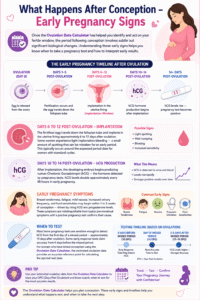
Once the Ovulation Date Calculator has helped you identify and act on your fertile window, the period following conception involves subtle but significant biological changes. Understanding these early signs helps you know when to take a pregnancy test and how to interpret early results:
Days 6 to 12 Post-Ovulation – Implantation: The fertilised egg travels down the fallopian tube and implants in the uterine lining approximately 6 to 12 days after ovulation. Some women experience light implantation bleeding — a small amount of spotting that can be mistaken for an early period. This typically occurs around the expected period date for women with standard cycles.
Days 10 to 14 Post-Ovulation – hCG Production: After implantation, the developing embryo begins producing human Chorionic Gonadotropin (hCG) — the hormone detected by pregnancy tests. hCG levels double approximately every 48 hours in early pregnancy.
Early Pregnancy Symptoms: Breast tenderness, fatigue, mild nausea, increased urinary frequency, and food sensitivities may begin within 1 to 2 weeks of conception — driven by rising hCG and progesterone levels. These symptoms are indistinguishable from typical pre-menstrual symptoms until a positive pregnancy test confirms their cause.
When to Test: Most home pregnancy tests are sensitive enough to detect hCG from the first day of a missed period — approximately 14 days after ovulation. Some early-response tests claim accuracy from 4 days before the missed period. For women who have timed conception using the Ovulation Date Calculator, the estimated ovulation date provides an accurate reference point for calculating the optimal test date.
How to Use Our Ovulation Date Calculator Step-by-Step
Our free Ovulation Date Calculator is simple to use and produces instant, comprehensive results. Here is the complete guide:
Step One – Select Your Calculation Method: Choose from Last Period, Due Date, or Ultrasound — depending on which data you have available and whether you are planning conception prospectively or dating conception retrospectively.
Step Two – Enter Your Date:
- Last Period method: Enter the start date of your most recent menstrual period
- Due Date method: Enter your estimated delivery date
- Ultrasound method: Enter the scan date, weeks confirmed at scan, and days
Step Three – Click Calculate: Instantly view your three result outputs: most probable conception dates, most probable intercourse dates, and possible conception dates.
Step Four – Plan Intercourse Timing: Use the most probable intercourse dates output as your primary action window. Begin intercourse on the first day of this window and continue every other day through the end of the most probable conception dates range.
Step Five – Confirm with Physical Signs: Check for cervical mucus changes and consider using LH test strips during the identified fertile window to confirm the Ovulation Date Calculator’s timing with real-time hormonal data.
Step Six – Track and Adjust: After each cycle, note whether physical signs aligned with the Ovulation Date Calculator predictions. If they consistently differ, adjust the LMP date forward or backward to refine future estimates.
Frequently Asked Questions (FAQs)
What is an Ovulation Date Calculator? An Ovulation Date Calculator is a fertility tool that estimates your ovulation date and conception window based on your last period date, due date, or ultrasound data — helping you identify the optimal timing for conception.
How accurate is the Ovulation Date Calculator? For women with regular 28-day cycles, the Ovulation Date Calculator is highly accurate — typically estimating ovulation within 1 to 2 days. For women with irregular cycles, it provides a starting estimate that should be confirmed with LH testing.
What is the difference between Ovulation Date Calculator and a pregnancy test? The Ovulation Date Calculator predicts ovulation before it occurs; a pregnancy test detects hCG after conception and implantation. They serve sequential purposes in the conception-to-confirmation journey.
Can I use the Ovulation Date Calculator if my periods are irregular? Yes, but with adjusted expectations. Use it as an estimate and combine with LH strip testing and cervical mucus monitoring. The ultrasound method may provide more reliable results for women with highly irregular cycles.
How many days before ovulation should I start intercourse? The Ovulation Date Calculator identifies the most probable intercourse window beginning approximately 3 days before estimated ovulation. Starting intercourse on this date and continuing every other day through the estimated ovulation date maximises conception probability.
Why does the Ovulation Date Calculator show a range of dates rather than one date? Because ovulation can vary by 1 to 3 days even in regular cycles, and sperm survival of up to 5 days means conception can occur from intercourse across several days. The Ovulation Date Calculator reflects this biological reality with a range rather than an artificially precise single date.
What should I do if the Ovulation Date Calculator results do not match my physical signs? Trust your physical signs — particularly cervical mucus and LH surge — over the calculated estimate. Adjust your next cycle’s input by shifting the LMP date to reflect when physical signs confirmed ovulation actually occurred.
Can the Ovulation Date Calculator help if I have been trying to conceive for several months? Yes. The Ovulation Date Calculator helps ensure intercourse timing is genuinely optimal — many couples who have been trying unsuccessfully for months discover their timing was off by 1 to 3 days. Correcting this alone can be the difference that achieves conception.
Is the Ovulation Date Calculator free? Yes. Our Ovulation Date Calculator and Pregnancy Conception Calculator are completely free, requiring no account or registration. Enter your data and receive instant results.
When should I see a fertility specialist if the Ovulation Date Calculator has not helped me conceive? After 12 months of timed intercourse for women under 35, or 6 months for women over 35. If you have irregular cycles, a history of pelvic inflammatory disease, or known reproductive health conditions, consult a specialist earlier regardless of how long you have been trying.
Conclusion
Conception is a biological event with a narrow window, a precise hormonal trigger, and a clear optimal timing strategy — and the Ovulation Date Calculator is the tool that puts all of that information at your fingertips. By transforming your menstrual data into a concrete, actionable fertile window, the Ovulation Date Calculator removes guesswork from the most important timing decision in your conception journey.
Whether you are planning ahead from your last period date, working backward from a confirmed due date, or using scan-confirmed gestational age for maximum accuracy, the Ovulation Date Calculator delivers three clear, evidence-based outputs: your most probable conception dates, your optimal intercourse timing window, and the full range of biologically possible conception dates.
Combined with physical fertility signs — cervical mucus, LH strips, and basal body temperature — the Ovulation Date Calculator forms the analytical core of a complete, confident fertility planning strategy. And once conception is confirmed, our free Pregnancy Conception Calculator stands ready to map your entire 40-week journey with the same precision and clarity.
Use the Ovulation Date Calculator today. Know your window. Act with confidence. Give conception every possible advantage.