Calculate tile quantity instantly with our Tile Calculator and make every renovation project easier.
Table of Contents
- Introduction
- What Is a Heat Index Calculator?
- The Formula Behind a Heat Index Calculator
- How to Use a Heat Index Calculator Step by Step
- Understanding Temperature, Humidity, and Apparent Heat
- Heat Index Calculator: Danger Levels Explained
- Heat Index vs. Actual Temperature – Why They Differ
- Real-World Examples Using a Heat Index Calculator
- Why Heat Index Matters for Health and Safety
- Applications of a Heat Index Calculator Across Industries
- Tips for Staying Safe in High Heat Index Conditions
- Common Mistakes When Using a Heat Index Calculator
- FAQs
- Conclusion
Introduction
On a hot, humid day, the temperature shown on a weather app rarely tells the whole story. Anyone who has stepped outside on a sweltering summer afternoon knows that high humidity makes the air feel significantly hotter than the thermometer reading suggests. This “feels like” temperature — the one your body actually experiences — is known as the heat index, and understanding it can be genuinely important for health and safety. That is exactly why a reliable Heat Index Calculator has become an essential tool for meteorologists, outdoor workers, athletes, and anyone spending time outdoors in warm weather.
The heat index combines air temperature and relative humidity into a single value that represents how hot the air actually feels to the human body. This is not a simple approximation — it is based on a well-established scientific formula developed from human physiology research on how the body regulates temperature through sweat evaporation. When humidity is high, sweat evaporates more slowly, reducing the body’s ability to cool itself, which makes the air feel hotter than the actual air temperature. A Heat Index Calculator applies this exact relationship automatically, converting temperature and humidity readings into an accurate apparent temperature value in seconds.
This comprehensive guide explains everything you need to know about the heat index and how a Heat Index Calculator works. We will cover the formula, walk through step-by-step usage, explain the official danger level categories used by meteorological agencies, and explore why heat index awareness matters for outdoor workers, athletes, event organizers, and anyone who spends time outside during warm and humid weather. By the end of this guide, you will understand exactly how apparent temperature is calculated and how to use that information to stay safe.
What Is a Heat Index Calculator?
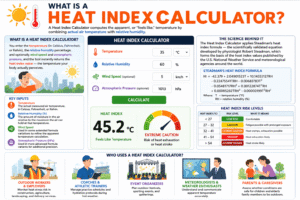
A Heat Index Calculator is a digital tool that computes the apparent, or “feels like,” temperature by combining actual air temperature with relative humidity. You enter the temperature (in Celsius, Fahrenheit, or Kelvin), the relative humidity percentage, and optionally wind speed and atmospheric pressure, and the tool instantly returns the heat index value — the temperature your body actually perceives.
The key inputs for a Heat Index Calculator are:
- Temperature — the actual measured air temperature, in Celsius, Fahrenheit, or Kelvin
- Relative Humidity (%) — the amount of moisture in the air relative to the maximum the air can hold at that temperature
- Wind Speed — used in some extended formula variations to refine the apparent temperature calculation
- Atmospheric Pressure (hPa) — used in more advanced formula variants for additional precision
From these inputs, the Heat Index Calculator applies Steadman’s heat index formula — the scientifically validated equation developed by physiologist Robert Steadman, which forms the basis of the heat index values published by the U.S. National Weather Service and meteorological agencies around the world.
This tool is used by:
- Outdoor workers and employers in construction, agriculture, landscaping, and delivery services who need to monitor heat stress risk
- Coaches and athletic trainers managing practice schedules and hydration protocols during hot weather
- Event organizers planning outdoor festivals, sporting events, and gatherings
- Meteorologists and weather enthusiasts who want to understand and communicate apparent temperature accurately
- Parents and caregivers assessing whether conditions are safe for children and elderly family members to be outdoors

The Formula Behind a Heat Index Calculator
Every Heat Index Calculator is built around Steadman’s heat index formula, a regression equation derived from detailed human thermoregulation research.
Steadman’s Heat Index Formula:
HI = -8.784 + 1.611T + 2.338H + (-0.146TH) + (-0.012T²) + (-0.016H²)
Where:
- HI = Heat Index (in Celsius)
- T = Air temperature (in Celsius)
- H = Relative humidity (as a percentage)
Step 1 — Normalize the Temperature Since the formula requires temperature in Celsius, a Heat Index Calculator first converts any input temperature to Celsius:
- From Fahrenheit: °C = (°F − 32) × 5/9
- From Kelvin: °C = K − 273.15
Step 2 — Apply the Regression Equation Once temperature is in Celsius, the formula combines the temperature term, the humidity term, and three interaction and squared terms that account for the nonlinear way temperature and humidity interact to affect perceived heat.
Step 3 — Return the Result The final value represents the apparent temperature — how hot the air actually feels — expressed in the same Celsius scale used throughout the calculation.
Why the Formula Is Nonlinear The relationship between temperature, humidity, and perceived heat is not a simple addition — it is a complex interaction captured by the squared and cross-multiplication terms in the equation. This is why a Heat Index Calculator is essential rather than a rough mental estimate: manually working through this six-term equation accurately is impractical without a computational tool.
How to Use a Heat Index Calculator Step by Step
Using a Heat Index Calculator takes only a few seconds. Here is the complete process:
Step One — Enter the Temperature Type the current air temperature into the Temperature field. This can be sourced from a local weather station, a weather app, or a thermometer reading.
Step Two — Select the Temperature Unit Choose Celsius, Fahrenheit, or Kelvin from the Temp Unit dropdown, matching whichever unit your temperature reading is in. The Heat Index Calculator automatically converts your input to Celsius internally before applying the formula, so you can use whichever unit is most convenient for your region.
Step Three — Enter the Relative Humidity Type the current relative humidity percentage into the Humidity field. This value is available from local weather reports, weather stations, or humidity sensors, and typically ranges from 0% (completely dry air) to 100% (fully saturated air).
Step Four — Enter Wind Speed and Pressure (Optional) For more advanced heat index calculations, enter the current wind speed and atmospheric pressure in hPa. These additional inputs allow the this tool to apply refinements used in extended heat index models for greater precision in specific conditions.
Step Five — Click Calculate Press the Calculate button. The this tool normalizes your temperature to Celsius, applies Steadman’s formula, and displays the calculated apparent temperature along with the normalized input values used in the calculation.
Step Six — Interpret the Result The result shows the heat index in Celsius. Compare this value against the official danger level categories to understand the health risk associated with current conditions and decide whether to adjust outdoor activity plans.
Understanding Temperature, Humidity, and Apparent Heat
To use a this tool meaningfully, it helps to understand why humidity has such a dramatic effect on perceived temperature.
How the Body Cools Itself The human body regulates temperature primarily through sweating. As sweat evaporates from the skin, it absorbs heat energy from the body, producing a cooling effect. This evaporative cooling process is remarkably effective — it is the body’s primary defense against overheating in warm conditions.
Why Humidity Interferes With Cooling When relative humidity is high, the air is already close to saturated with moisture, which slows the rate at which sweat can evaporate from the skin. With reduced evaporation, the body’s cooling mechanism becomes far less effective, and the air feels significantly hotter than the actual air temperature would suggest. This is precisely the physical phenomenon that a this tool quantifies.
Why Dry Heat Feels Different From Humid Heat This explains why 35°C (95°F) in a desert climate with 10% humidity feels far more tolerable than the same 35°C in a tropical climate with 80% humidity. In the desert scenario, sweat evaporates rapidly and cools the body effectively. In the humid scenario, sweat barely evaporates, leaving the body unable to shed heat efficiently — a difference a this tool captures precisely.
Heat Index Calculator: Danger Levels Explained
Meteorological agencies classify heat index values into danger categories that help the public understand health risks at a glance. Here are the standard classifications used by the U.S. National Weather Service, expressed in Fahrenheit with Celsius equivalents:
Caution (27–32°C / 80–90°F) Fatigue is possible with prolonged exposure and physical activity. Continuing activity could result in heat cramps.
Extreme Caution (32–39°C / 90–103°F) Heat cramps and heat exhaustion are possible with prolonged exposure and physical activity. Anyone using a this tool and finding results in this range should take regular breaks and increase fluid intake.
Danger (39–51°C / 103–124°F) Heat cramps and heat exhaustion are likely; heat stroke is possible with prolonged exposure and physical activity. A this tool result in this category signals that strenuous outdoor activity should be limited or rescheduled.
Extreme Danger (51°C / 124°F and above) Heat stroke is highly likely with continued exposure. When a this tool returns a value in this range, outdoor activity should be avoided entirely except when absolutely necessary, and only with extreme precautions.
These classifications make a this tool result immediately actionable — rather than just a number, it becomes a clear signal for the level of caution required.
Heat Index vs. Actual Temperature – Why They Differ
One of the most valuable functions of a this tool is showing exactly how much hotter conditions feel compared to the thermometer reading.
A Concrete Comparison At 32°C (90°F) with 40% relative humidity, the heat index is approximately 34°C (93°F) — a modest 2°C increase. But at the same 32°C (90°F) with 80% relative humidity, the heat index jumps to approximately 41°C (106°F) — a dramatic 9°C increase. This is the exact calculation a this tool performs, revealing how significantly humidity amplifies perceived heat.
Why This Gap Matters People often underestimate heat risk because they focus on the thermometer reading rather than the heat index. A “manageable” 32°C day can actually pose serious heat stress risk when humidity is high — information that is invisible without running the numbers through a this tool.
Wind Speed’s Limited Effect on Heat Index Unlike wind chill (which factors heavily into cold-weather apparent temperature), wind has a comparatively smaller effect on the standard heat index formula, though some extended models incorporate it for additional precision. The dominant factors remain temperature and humidity.
Real-World Examples Using a Heat Index Calculator
Working through concrete examples shows exactly how a this tool translates raw weather data into actionable safety information.
Example 1: Moderate Summer Day
- Temperature: 30°C, Humidity: 50%
- Heat Index ≈ 31.5°C — within the Caution range, generally manageable with normal precautions.
Example 2: Hot and Humid Afternoon
- Temperature: 33°C, Humidity: 70%
- Heat Index ≈ 40°C — entering the Danger range, requiring limited strenuous activity and frequent hydration breaks.
Example 3: Tropical Heat Wave
- Temperature: 35°C, Humidity: 85%
- Heat Index ≈ 50°C — approaching Extreme Danger, where outdoor exertion should be avoided during peak hours.
Example 4: Dry Desert Heat
- Temperature: 38°C, Humidity: 15%
- Heat Index ≈ 36°C — actually slightly lower than the raw temperature, illustrating how low humidity can make dry heat feel more tolerable than the thermometer suggests.
In every case, running the numbers through a this tool provides an immediate, actionable understanding of the real conditions, rather than relying on temperature alone.
Why Heat Index Matters for Health and Safety
Heat-related illness is one of the most preventable weather-related health risks, and heat index awareness is central to prevention.
Heat Exhaustion and Heat Stroke Heat exhaustion occurs when the body loses excessive water and salt through sweating, causing symptoms like heavy sweating, weakness, dizziness, and nausea. If untreated, it can progress to heat stroke — a life-threatening condition where the body’s temperature regulation fails entirely. Monitoring heat index values with a this tool allows people to recognize dangerous conditions before symptoms develop.
Vulnerable Populations Children, elderly individuals, people with chronic illnesses, and outdoor workers face elevated risk from high heat index conditions. Caregivers and employers who regularly check a this tool can make informed decisions about outdoor activity schedules, rest breaks, and hydration protocols to protect these vulnerable groups.
Workplace Safety Compliance Many occupational safety guidelines and regulations tie required rest breaks and hydration protocols directly to heat index thresholds. Employers in construction, agriculture, and outdoor industries use a this tool to determine when mandatory precautions apply, helping ensure regulatory compliance and worker safety simultaneously.
Applications of a Heat Index Calculator Across Industries
The heat index has practical applications far beyond daily weather forecasts.
Sports and Athletics Coaches and athletic trainers use heat index data to adjust practice schedules, mandate additional water breaks, and in extreme cases cancel outdoor training sessions. School athletic programs increasingly rely on a this tool as part of formal heat safety protocols required by sports governing bodies.
Construction and Outdoor Labor Construction site managers monitor heat index conditions throughout the workday to schedule the most physically demanding tasks during cooler morning hours. Regular use of a this tool supports compliance with occupational heat safety standards and reduces the risk of heat-related workplace incidents.
Event Planning Organizers of outdoor festivals, marathons, and public gatherings use heat index forecasts to plan medical support staffing, water station placement, and shade infrastructure. A this tool applied to forecast data helps event planners prepare appropriate safety measures well in advance.
Agriculture Farm managers use heat index information to schedule labor-intensive fieldwork and protect both workers and livestock during periods of dangerous heat and humidity combinations.
Tips for Staying Safe in High Heat Index Conditions
Whenever a this tool returns a result in the Extreme Caution range or higher, these practical steps help reduce health risk.
Stay Hydrated Drink water regularly, even before feeling thirsty. Thirst is a delayed signal of dehydration, and by the time you feel thirsty, mild dehydration may already be affecting your body’s cooling capacity.
Take Frequent Breaks Schedule rest periods in shaded or air-conditioned areas during high heat index conditions, especially during physically demanding activities. Short, frequent breaks are more effective than occasional long ones.
Wear Appropriate Clothing Light-colored, loose-fitting, breathable clothing helps sweat evaporate more effectively and reflects rather than absorbs solar radiation, keeping the body cooler in high heat index conditions.
Avoid Peak Heat Hours Schedule strenuous outdoor activity for early morning or evening when temperatures and heat index values are typically lower, avoiding the midday and early afternoon peak.
Know the Warning Signs Recognize the early symptoms of heat exhaustion — heavy sweating, weakness, dizziness, headache, and nausea — and stop activity immediately if they appear, moving to a cool area and rehydrating.
Common Mistakes When Using a Heat Index Calculator
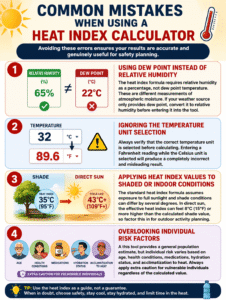
Avoiding these errors ensures your results are accurate and genuinely useful for safety planning.
Using Dew Point Instead of Relative Humidity The heat index formula requires relative humidity as a percentage, not dew point temperature. These are different measurements of atmospheric moisture. If your weather source only provides dew point, convert it to relative humidity before entering it into the tool.
Ignoring the Temperature Unit Selection Always verify that the correct temperature unit is selected before calculating. Entering a Fahrenheit reading while the Celsius unit is selected will produce a completely incorrect and misleading result.
Applying Heat Index Values to Shaded or Indoor Conditions The standard heat index formula assumes exposure to full sunlight and shade conditions can differ by several degrees. In direct sun, the effective heat index can feel 8°C (15°F) or more higher than the calculated shade value, so factor this in for outdoor activity planning.
Overlooking Individual Risk Factors A this tool provides a general population estimate, but individual risk varies based on age, health conditions, medications, hydration status, and acclimatization to heat. Always apply extra caution for vulnerable individuals regardless of the calculated value.
FAQs
What does a Heat Index Calculator do? A Heat Index Calculator computes the apparent “feels like” temperature by combining actual air temperature with relative humidity, using Steadman’s scientifically validated heat index formula. Enter your temperature and humidity values, and the tool instantly returns how hot the air actually feels to the human body.
How accurate is a this tool? A Heat Index Calculator using Steadman’s formula is highly accurate for standard outdoor conditions, matching the values published by national meteorological agencies. Accuracy can be affected by direct sunlight exposure, wind conditions, and individual physiological differences, which is why the result should be treated as a general guide rather than an exact personal measurement.
What is the difference between heat index and humidex? Heat index and humidex are similar concepts used in different countries — heat index is standard in the United States, while humidex is used in Canada. Both combine temperature and humidity into an apparent temperature value, but they use slightly different formulas and are typically expressed differently (humidex has no fixed unit, while heat index is expressed in temperature degrees).
Can a this tool be used for indoor conditions? The standard heat index formula was developed primarily for outdoor, shaded conditions, and its accuracy decreases for indoor environments without direct sun or wind exposure. It can still provide a useful general estimate indoors, but industrial and occupational heat stress assessments often use more specialized formulas like the Wet Bulb Globe Temperature (WBGT) for indoor and direct-sun environments.
Why does humidity matter so much in a Heat Index Calculator? Humidity determines how effectively sweat can evaporate from your skin, which is your body’s primary cooling mechanism. High humidity slows evaporation, reducing cooling efficiency and making the air feel hotter than the actual temperature. This is why the heat index formula weighs humidity so heavily alongside temperature.
What heat index level is considered dangerous? A heat index of 39°C (103°F) or higher falls into the Danger category, where heat cramps and heat exhaustion become likely and heat stroke becomes possible with continued exposure. Values of 51°C (124°F) and above are classified as Extreme Danger, where heat stroke becomes highly likely with continued exposure.
Can I use a Heat Index Calculator for planning outdoor events? Yes — event organizers regularly use heat index forecasts to plan medical support, hydration stations, and shade infrastructure for outdoor gatherings. Checking heat index values in the days leading up to an event allows organizers to adjust schedules and safety measures proactively based on expected conditions.
Conclusion
The heat index is one of the most important yet frequently overlooked pieces of weather information — the difference between a “manageable” temperature reading and dangerously hot conditions often comes down entirely to humidity. A reliable Heat Index Calculator turns raw temperature and humidity data into an immediately actionable understanding of how conditions actually feel and what precautions are appropriate.
Understanding and applying Steadman’s heat index formula through a Heat Index Calculator is not just an academic exercise — it has real, practical consequences for health and safety. From outdoor workers scheduling their most demanding tasks around the safest hours, to coaches adjusting practice intensity, to families deciding whether it is safe to spend an afternoon outdoors, the heat index provides the information needed to make genuinely informed decisions.
Throughout this guide, we have covered every dimension of heat index calculation — from the formula and its physiological basis, through the official danger level classifications, real-world examples across different climates, and practical safety guidance for high heat index conditions. The knowledge in this guide, combined with regular use of a this tool, equips you to recognize and respond to heat risk before it becomes a health emergency.
Use a Heat Index Calculator whenever temperature and humidity combine to create potentially dangerous conditions. Check the result against the official danger categories, adjust outdoor activity accordingly, and stay alert to the early warning signs of heat-related illness. That simple habit — checking a reliable Heat Index Calculator before heading outdoors in warm weather — is one of the most effective and accessible ways to stay safe during hot and humid conditions.