Roll Fair and Random Virtual Dice in Seconds with Our Free Dice Roller
Table of Contents
- Introduction
- What Is a Fuel Cost Calculator?
- How a Fuel Cost Calculator Works
- Key Inputs Required for Accurate Results
- Fuel Cost Calculator for Road Trips
- How to Reduce the Fuel Cost Your Calculator Reveals
- Fuel Cost Calculator for Fleet and Business Use
- Understanding Fuel Efficiency and MPG
- Fuel Cost Calculator vs. Manual Estimation
- Factors That Affect Your Fuel Cost
- Common Mistakes When Using a Fuel Cost Calculator
- FAQs
- Conclusion
Introduction
Every driver, traveler, and fleet manager needs a reliable way to estimate what a journey will cost before it begins. Fuel is one of the largest ongoing expenses for any vehicle owner, and without a clear calculation, it is easy to underestimate how much a trip will actually take from your budget. A Fuel Cost Calculator gives you that clarity in seconds.
A Fuel Cost Calculator takes the guesswork out of trip planning. By entering a few key details — your vehicle’s fuel efficiency, the distance of your trip, and the current price of fuel — you get an instant, accurate estimate of what you will spend at the pump. Whether you are planning a weekend road trip, managing a delivery fleet, or simply trying to compare the running costs of two different vehicles, this tool delivers the answer you need.
This guide covers everything you need to know — how a Fuel Cost Calculator works, what inputs it requires, how to get the most accurate results, and how to use the information it provides to reduce your fuel spending and plan smarter journeys.
What Is a Fuel Cost Calculator?
A Fuel Cost Calculator is a digital tool that estimates the total fuel expense for a given journey or time period based on distance, fuel efficiency, and fuel price. It transforms three simple inputs into a clear cost figure, helping drivers make informed decisions about travel, vehicle choice, and budgeting.
At its simplest, the formula a Fuel Cost Calculator uses is:
Fuel Cost = (Distance ÷ Fuel Efficiency) × Fuel Price
For example, if your trip is 300 miles, your vehicle gets 30 miles per gallon, and fuel costs $4.00 per gallon:
Fuel Cost = (300 ÷ 30) × $4.00 = $40.00
A Fuel Cost Calculator automates this calculation entirely, eliminating arithmetic errors and saving you time. More advanced versions allow you to factor in multiple legs of a journey, compare different vehicles, or calculate costs in different fuel units (liters vs. gallons, kilometers vs. miles).
A Fuel Cost Calculator is used by:
- Individual drivers planning road trips or daily commutes
- Fleet managers tracking fuel budgets across multiple vehicles
- Travelers comparing the cost of driving vs. flying or taking the train
- Businesses calculating delivery or logistics expenses
- Car buyers estimating the long-term running cost of different vehicles
How a Fuel Cost Calculator Works
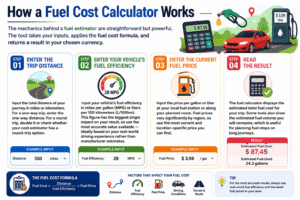
The mechanics behind a fuel estimator are straightforward but powerful. The tool takes your inputs, applies the fuel cost formula, and returns a result in your chosen currency.
Step 1 – Enter the trip distance Input the total distance of your journey in miles or kilometers. For a one-way trip, enter the one-way distance. For a round trip, double it or check whether your cost estimator has a round-trip option.
Step 2 – Enter your vehicle’s fuel efficiency Input your vehicle’s fuel efficiency in miles per gallon (MPG) or liters per 100 kilometers (L/100km). This figure has the biggest single impact on your result, so use the most accurate value available — ideally based on your real-world driving experience rather than manufacturer estimates.
Step 3 – Enter the current fuel price Input the price per gallon or liter at your local fuel station or along your planned route. Fuel prices vary significantly by region, so use the most current and location-specific price you can find.
Step 4 – Read the result The fuel calculator displays the estimated total fuel cost for your trip. Some tools also show the estimated fuel volume you will consume, which is useful for planning fuel stops on long journeys.
Key Inputs Required for Accurate Results
The accuracy of any trip cost tool depends entirely on the quality of the inputs you provide. Garbage in, garbage out — use precise values and your estimates will be reliably close to your actual spending.
Distance Use a mapping tool to measure the actual route distance, not a straight-line estimate. Road distance is always longer than the straight-line distance between two points, sometimes significantly so in mountainous or urban areas.
Fuel Efficiency (MPG or L/100km) Manufacturer-quoted MPG figures are typically tested under ideal conditions. Real-world fuel efficiency is usually 10–20% lower than the official figure. Use your vehicle’s trip computer reading or track your own fill-up data for the most accurate input.
Fuel Price Fuel prices can vary by $0.30–$0.50 per gallon within a single metropolitan area, and by far more across different states or countries. For long trips, research fuel prices along your route and use an average to get a realistic estimate from your fuel cost tool.
Number of Passengers or Load Weight Some advanced fuel cost estimators factor in vehicle load, since heavier loads reduce fuel efficiency. If you are traveling with a full car or carrying heavy cargo, expect real costs to run slightly higher than the base calculation.
Fuel Cost Calculator for Road Trips
Road trip planning is one of the most popular uses for a Fuel Cost Calculator. Before you set off on a long drive, knowing your estimated fuel cost helps you set a realistic travel budget, plan fuel stops, and decide whether driving or flying makes more financial sense.
To use a fuel estimator for a road trip:
- Measure the total route distance using a navigation app.
- Enter your vehicle’s real-world MPG based on highway driving (highway MPG is typically higher than city MPG).
- Find fuel prices at your origin, destination, and key stops along the route.
- Run the calculation and build the result into your overall trip budget.
A cost estimator is especially useful for multi-day or multi-stop road trips. Break the journey into legs, calculate the cost of each leg separately, and sum the totals for a full picture of your fuel budget.
For families planning a vacation, a fuel calculator can help decide between driving and flying. When four people travel together, the per-person cost of a road trip is often dramatically lower than four individual plane tickets — but only if you calculate it properly.
How to Reduce the Fuel Cost Your Calculator Reveals
Once your trip cost tool shows you what a journey will cost, you have the opportunity to reduce that figure through smart driving and vehicle management decisions.
Improve Your Vehicle’s Fuel Efficiency The single most effective way to reduce fuel cost is to improve MPG. Regular maintenance — fresh oil, clean air filters, properly inflated tires, and a healthy engine — can improve real-world efficiency by 5–15%. All of that improvement shows up directly in a lower result when you rerun your calculation.
Choose a More Fuel-Efficient Route Shorter is not always cheaper. A route that avoids heavy city traffic and stop-start driving may use significantly less fuel than a shorter route through congested areas. Run different routes through your fuel cost tool to compare costs before you leave.
Reduce Highway Speed Aerodynamic drag increases dramatically above 60 mph. Driving at 70 mph instead of 60 mph can reduce fuel efficiency by 15% or more. Slower, steadier highway driving produces noticeably lower results on any fuel estimator.
Reduce Vehicle Load Remove unnecessary weight from your vehicle. Every extra 100 pounds reduces fuel efficiency by approximately 1–2%. For long trips, this adds up to a measurable difference in your fuel cost.
Combine Trips If you are making multiple short trips, combining them into one efficient loop reduces total distance and cold-start fuel consumption. A cost estimator helps you see exactly how much combining trips saves.
Fuel Cost Calculator for Fleet and Business Use
For businesses that operate vehicles, a Fuel Cost Calculator is not just a convenience — it is a financial management tool. Fleet managers, logistics coordinators, and small business owners use fuel cost estimates to build accurate budgets, track expenses, and identify inefficiencies.
Key business applications include:
- Delivery cost estimation: Calculate the fuel cost of each delivery route to price services accurately.
- Driver reimbursement: Use a fuel cost calculation as the basis for mileage reimbursement rates.
- Vehicle replacement decisions: Compare the fuel cost of aging, less efficient vehicles against newer, more efficient replacements.
- Budget forecasting: Project monthly and annual fuel expenses based on planned mileage and current fuel prices.
A fuel calculator used consistently across a fleet can reveal significant savings opportunities. If one vehicle consistently shows higher fuel costs than others on the same routes, it may indicate a maintenance issue, driver behavior problem, or a case for vehicle replacement.
Understanding Fuel Efficiency and MPG
Fuel efficiency is the single most important variable in any trip cost tool. Understanding what affects it and how to measure it accurately makes your estimates far more reliable.
What Is MPG? Miles per gallon (MPG) measures how far your vehicle travels on one gallon of fuel. A higher MPG means lower fuel cost for any given distance. A vehicle that gets 40 MPG costs half as much to fuel per mile as one that gets 20 MPG.
City vs. Highway MPG Vehicles have different efficiency ratings for city and highway driving. City driving involves frequent acceleration and braking, which consumes more fuel. Highway driving at a steady speed is more efficient. Use city MPG for urban trips and highway MPG for freeway journeys in your fuel cost estimates.
Factors That Reduce Fuel Efficiency:
- Air conditioning use (can reduce efficiency by 5–25%)
- Cold weather (thicker engine oil and longer warm-up periods)
- Roof racks and external cargo carriers (increased aerodynamic drag)
- Aggressive acceleration and hard braking
- Under-inflated tires (each 1 PSI below optimal reduces efficiency by approximately 0.2%)
Knowing your real MPG is the foundation of a trustworthy fuel cost tool result. Track your fuel consumption over several fill-ups to establish your personal baseline before entering figures into any calculation.
Fuel Cost Calculator vs. Manual Estimation
Before digital tools, drivers estimated fuel costs using rough rules of thumb — and frequently got it wrong. A proper Fuel Cost Calculator eliminates the guesswork and produces results that are accurate to within a few percent of actual spending.
| Method | Accuracy | Speed | Effort |
|---|---|---|---|
| Manual rule of thumb | Low | Fast | Low |
| Spreadsheet calculation | Medium | Slow | High |
| fuel estimator | High | Instant | Very low |
The advantages of using a dedicated cost estimator are clear. It applies the correct formula every time, accepts precise inputs, and returns an accurate result in seconds. There is no arithmetic to perform, no unit conversions to manage, and no room for human calculation error.
For drivers who want to compare different vehicles, a fuel calculator makes it trivial to see the cost difference between a vehicle that gets 25 MPG and one that gets 35 MPG over a fixed annual mileage. The long-term difference is often thousands of dollars per year — a figure that is immediately obvious when you run both scenarios through the tool.
Factors That Affect Your Fuel Cost
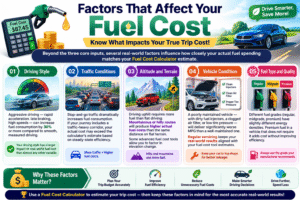
Beyond the three core inputs, several real-world factors influence how closely your actual fuel spending matches your trip cost tool estimate.
Driving Style Aggressive driving — rapid acceleration, late braking, high speeds — can increase fuel consumption by 30% or more compared to smooth, measured driving. Your driving style has a larger impact on real-world fuel cost than almost any other variable.
Traffic Conditions Stop-and-go traffic dramatically increases fuel consumption. If your journey includes a traffic-heavy corridor, your actual cost may exceed the calculator’s estimate based on steady-state efficiency.
Altitude and Terrain Driving uphill requires more fuel than flat driving. Mountainous or hilly routes will produce higher actual fuel costs than the same distance on flat terrain. Some advanced fuel cost tools allow you to factor in elevation change.
Vehicle Condition A poorly maintained vehicle — with dirty fuel injectors, a clogged air filter, or low tire pressure — will deliver significantly worse MPG than a well-maintained one. Regular servicing keeps your real-world results aligned with your fuel cost tool estimates.
Fuel Type and Quality Different fuel grades (regular, midgrade, premium) have slightly different energy densities. Premium fuel in a vehicle that does not require it adds cost without improving efficiency. Always use the grade your manufacturer recommends.
Common Mistakes When Using a Fuel Cost Calculator
Even a precise tool produces unreliable results if used incorrectly. These are the most common errors people make when using a Fuel Cost Calculator.
Using Manufacturer MPG Instead of Real-World MPG Official EPA fuel economy figures are measured under controlled laboratory conditions. Real-world driving typically produces 10–20% lower efficiency. Always use your actual observed MPG rather than the sticker figure for accurate estimates.
Forgetting Round-Trip Distance Many users enter one-way distance and forget to double it for a return journey. Check whether your fuel estimator has a round-trip option, or manually double the distance before entering it.
Using an Outdated Fuel Price Fuel prices change daily. An estimate based on fuel prices from two weeks ago may be significantly off if prices have shifted. Always use the most current price available when running your calculation.
Ignoring Highway vs. City MPG Differences Using a single average MPG figure for a trip that is mostly urban driving will underestimate your actual fuel cost. Use the most appropriate efficiency figure for the type of driving your trip involves.
Not Accounting for Detours or Stops Real road trips often involve unplanned detours, scenic routes, or additional stops. Build a small buffer — 5–10% — into your cost estimator estimate to account for route variations.
FAQs
What is a Fuel Cost Calculator used for? A Fuel Cost Calculator estimates the total fuel expense for a journey or time period based on distance, vehicle fuel efficiency, and the current price of fuel. It is used by individual drivers, fleet managers, and businesses to plan budgets and compare vehicle costs.
How accurate is a Fuel Cost Calculator? A Fuel Cost Calculator is highly accurate when given precise inputs. The main sources of error are inaccurate MPG figures and outdated fuel prices. Using your real-world MPG and the current fuel price in your area will produce results within a few percent of your actual fuel spending.
Can I use a fuel calculator for electric vehicles? Standard fuel cost tools are designed for petrol and diesel vehicles. For electric vehicles, the equivalent tool uses energy consumption (kWh per mile or kilometer) and electricity price per kWh instead of MPG and fuel price. Some advanced trip cost tool platforms support both fuel types and allow direct comparison.
How do I find my vehicle’s real-world MPG? Fill your tank completely, reset your trip odometer, drive until the tank is low, fill up again, and divide the miles driven by the gallons added. This gives you your actual real-world MPG, which is the most accurate figure to use in any fuel cost estimate.
Does a fuel cost tool account for fuel price changes along a route? Basic tools use a single fuel price for the entire journey. For long interstate or cross-country trips, fuel prices can vary significantly by state or region. Use a weighted average of prices along your route for a more realistic estimate.
Can I compare two vehicles with a Fuel Cost Calculator? Yes. Run the same distance through a Fuel Cost Calculator with each vehicle’s MPG and the same fuel price. The difference in results shows you exactly how much more — or less — each vehicle costs to run over that distance. This is one of the most useful applications of the tool.
Is a Fuel Cost Calculator useful for budgeting? Absolutely. A Fuel Cost Calculator is an excellent budgeting tool for anyone who drives regularly. Enter your typical monthly mileage and current fuel price to get a reliable monthly fuel cost estimate, which you can build directly into your household or business budget.
What units does a fuel estimator use? Most tools support both imperial (miles per gallon, gallons, dollars) and metric (liters per 100 km, liters, local currency). Choose the unit system that matches your vehicle’s data and your local fuel pricing for accurate results.
Conclusion
A Fuel Cost Calculator is one of the most practical financial tools available to any driver, traveler, or fleet manager. It transforms three simple inputs — distance, fuel efficiency, and fuel price — into a clear, actionable cost estimate that helps you plan smarter, spend less, and make better decisions about how and when to drive.
Whether you are budgeting for a cross-country road trip, comparing the running costs of two vehicles, managing fuel expenses across a delivery fleet, or simply checking whether your daily commute cost has changed with the latest fuel price increase, a cost estimator gives you the answer instantly and accurately.
The insights a fuel calculator delivers go beyond just the number. They help you identify where fuel savings are possible, reveal the true cost of driving vs. other transport options, and provide the data you need to negotiate reimbursements or set delivery pricing with confidence.
Use a Fuel Cost Calculator before every significant journey, and revisit it whenever fuel prices shift or you change vehicles. The combination of accurate inputs, a reliable calculation, and consistent use — powered by a trustworthy Fuel Cost Calculator — is the foundation of smart, cost-conscious driving for individuals and businesses alike.