Discover Your Ideal Pregnancy Weight Range with the Pregnancy Weight Calculator
Table of Contents
- Introduction
- What Is a Due Date Calculator?
- How Does a Due Date Calculator Work?
- The Four Calculation Methods Explained
- What Is Naegele’s Rule?
- How Cycle Length Affects Your Due Date
- Understanding Your Pregnancy Trimesters
- What the Results of a Due Date Calculator Mean
- How Accurate Is a Due Date Calculator?
- Factors That Can Shift Your Due Date
- Planning Your Pregnancy With a Due Date Calculator
- Frequently Asked Questions (FAQs)
- Conclusion
Introduction
Discovering you are pregnant is a life-changing moment — and within seconds, the question that dominates every new parent’s mind is the same: “When will my baby arrive?” Your estimated due date is not simply a date on a calendar. It is the central anchor around which your entire prenatal care journey is organized — from your first ultrasound appointment to your hospital birth plan, from nursery preparation timelines to parental leave scheduling.
A Due Date Calculator is the fastest, most accessible, and most accurate tool available for answering that foundational question. Rather than waiting for your first obstetrician appointment or relying on vague estimates from week-counting charts, a Due Date Calculator gives you an instant, personalized result based on the specific data you provide — including your calculation method, the relevant date, and your average menstrual cycle length.
In this comprehensive guide, we will walk you through everything you need to know about how a Due Date Calculator works, which calculation method is right for your situation, how your cycle length adjusts the result, what each output value means for your pregnancy journey, and how to use your estimated due date as a practical planning tool from conception to birth.
Your due date is more than a prediction — it is a roadmap. And the Due Date Calculator is the tool that draws it for you.
What Is a Due Date Calculator?
A Due Date Calculator is a digital pregnancy tool that estimates your expected delivery date based on one of several clinically validated calculation methods. It takes a specific reference date you provide — such as the first day of your last menstrual period, your conception date, an ultrasound measurement date, or your IVF embryo transfer date — applies the appropriate gestational formula, and adjusts the result based on your unique menstrual cycle length to produce a personalized estimated due date.
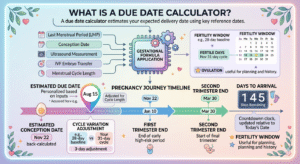
Our Due Date Calculator goes far beyond simply telling you a single date. It produces a complete set of pregnancy milestones in one calculation, including:
- Estimated Due Date — Your personalized expected delivery date, adjusted for your cycle length and chosen calculation method.
- Cycle Variation Adjustment — The number of days your due date is shifted from the standard 28-day cycle baseline, based on your actual average cycle length.
- Estimated Conception Date — The approximate date on which fertilization most likely occurred, back-calculated from your estimated due date.
- First Trimester End Date — The date on which your first trimester concludes — a critical milestone that marks the end of the highest-risk period of early pregnancy.
- Second Trimester End Date — The date on which your second trimester ends and your third and final trimester of pregnancy begins.
- Days to Arrival — A real-time countdown of the number of days remaining until your estimated due date, updated automatically based on today’s date.
- Fertility Window — An estimate of the most fertile days in your cycle based on your average cycle length — useful both for planning and for understanding when conception likely occurred.
Together, these outputs transform the Due Date Calculator from a simple date-prediction tool into a complete early pregnancy planning companion.
How Does a Due Date Calculator Work?
The Due Date Calculator uses a combination of well-established obstetric formulas and cycle-length adjustments to produce its results. Here is a detailed breakdown of the calculation logic that powers each result you receive:
The Standard Gestational Baseline
Human pregnancy is clinically defined as lasting approximately 280 days (40 weeks) from the first day of the last menstrual period (LMP) — or approximately 266 days from the actual date of conception. This 280-day standard is the foundation of the Naegele’s Rule formula and virtually all modern obstetric due date calculations. The Due Date Calculator applies this baseline to the reference date you provide, then adjusts it based on your individual cycle length.
Cycle Length Adjustment
The standard 280-day pregnancy assumption is based on a 28-day menstrual cycle. However, most women do not have a perfectly regular 28-day cycle. Cycles can range anywhere from 22 to 44 days, and every day’s deviation from the 28-day standard shifts your actual ovulation day — and therefore your conception date and due date — by the same amount. The Due Date Calculator automatically calculates this adjustment by subtracting 28 from your actual average cycle length and applying the resulting positive or negative correction to your due date.
IVF Transfer Special Case
For IVF pregnancies using a known embryo transfer date, the Due Date Calculator uses a fixed 263-day calculation from the transfer date, regardless of cycle length. This is because embryo age at transfer is precisely known in IVF cycles, making cycle-length adjustments unnecessary and irrelevant for this specific calculation method.
The Four Calculation Methods Explained
One of the most important features of the Due Date Calculator is its support for four distinct and clinically recognized calculation methods. Each method is appropriate for a different situation, and choosing the correct one for your specific circumstances directly determines the accuracy of your estimated due date.
| Method | Best Used When | Days Added | Cycle Adjusted? |
|---|---|---|---|
| First Day of Last Period (LMP) | You have regular cycles and know your last period start date | 280 + cycle adjustment | ✅ Yes |
| Ultrasound Date | You have had an early pregnancy ultrasound with a dated measurement | 280 − cycle adjustment | ✅ Yes |
| Conception Date | You tracked ovulation and know your approximate conception date | 266 − cycle adjustment | ✅ Yes |
| IVF Transfer Date | You conceived through in vitro fertilization with a known transfer date | 263 (fixed) | ❌ No |
If you are unsure which method to use, the First Day of Last Period method is the most widely used and clinically accepted approach for women with regular menstrual cycles. For the most precise possible result, your healthcare provider will typically combine the LMP-based estimate from the Due Date Calculator with a first-trimester ultrasound measurement to confirm or adjust the estimate.
What Is Naegele’s Rule?
Naegele’s Rule is the oldest and most widely used formula for estimating a pregnancy due date. First described by German obstetrician Franz Karl Naegele in 1812, this formula has remained the foundational standard of due date calculation in obstetrics for over two centuries — and it remains the basis of every modern Due Date Calculator used in clinical settings today.
The original Naegele’s Rule formula works as follows:
Example: Last period started January 1 → Add 1 year = January 1 next year → Subtract 3 months = October 1 → Add 7 days = October 8
While this original formula is mathematically equivalent to adding 280 days to your LMP date, it assumes a standard 28-day cycle with ovulation on day 14. Our Due Date Calculator improves on the basic Naegele’s Rule formula by incorporating your actual cycle length into the calculation — making the result significantly more personalized and more accurate than the original one-size-fits-all formula.
This cycle-adjusted approach is sometimes called the Mittendorf-Williams Rule, which research has shown to be more accurate than the original Naegele’s formula, particularly for women with cycles that deviate significantly from the 28-day standard.
How Cycle Length Affects Your Due Date
Understanding how your personal menstrual cycle length interacts with the Due Date Calculator is one of the most important pieces of knowledge you can have as an expectant parent. The 280-day standard pregnancy duration is built around the assumption that ovulation occurs on Day 14 of a 28-day cycle. But ovulation timing shifts directly with cycle length — and that shift cascades directly into your due date.
Here is a clear reference table showing how cycle length adjusts your estimated due date relative to the standard 28-day baseline:
| Cycle Length (days) | Adjustment from 28-day baseline | Effect on Due Date |
|---|---|---|
| 22 days | −6 days | Due date moves 6 days earlier |
| 25 days | −3 days | Due date moves 3 days earlier |
| 28 days | 0 (standard) | No adjustment needed |
| 30 days | +2 days | Due date moves 2 days later |
| 33 days | +5 days | Due date moves 5 days later |
| 35 days | +7 days | Due date moves 7 days later |
| 40 days | +12 days | Due date moves 12 days later |
| 44 days | +16 days | Due date moves 16 days later |
This is why using a cycle-adjusted Due Date Calculator is substantially more accurate than using a standard 280-day pregnancy wheel or a basic online date calculator that ignores cycle length entirely. A 16-day difference in your due date estimate is the difference between being told you are full term and being told you still have over two weeks to go.
Understanding Your Pregnancy Trimesters
One of the most valuable outputs of the Due Date Calculator is the automatic calculation of your trimester end dates. Your pregnancy is divided into three distinct trimesters, each representing a critical phase of fetal development, maternal health monitoring, and prenatal care priorities.
First Trimester (Weeks 1–12)
The first trimester covers the first 12 weeks of pregnancy — from your LMP date through the end of the 12th gestational week. This is the most critical and highest-risk phase of pregnancy, during which all of your baby’s major organ systems form. The risk of miscarriage is highest during the first trimester, which is why most couples choose to wait until after Week 12 to announce their pregnancy publicly. The Due Date Calculator shows your first trimester end date so you can plan your prenatal care schedule, genetic testing timelines, and announcement timing accordingly.
Second Trimester (Weeks 13–27)
The second trimester is often called the “honeymoon trimester” — the phase when morning sickness typically subsides, energy returns, and the pregnancy becomes much more visibly apparent. During these weeks, your baby grows from roughly the size of a lemon to the size of a head of lettuce, and the risk of miscarriage drops dramatically. Key milestones during the second trimester include the anatomy scan ultrasound (typically between Weeks 18–20) and the first time you feel your baby move — a sensation known as quickening. The Due Date Calculator gives you your second trimester end date so you can anticipate when your third and final trimester will begin.
Third Trimester (Weeks 28–40+)
The third trimester begins at Week 28 and concludes with your baby’s birth — ideally at or near your estimated due date from the Due Date Calculator. During these final weeks, your baby gains the majority of their birth weight, their lungs mature in preparation for independent breathing, and they descend into the birth position. This trimester involves the most frequent prenatal appointments, typically every two weeks from Week 28 to Week 36, and then every week from Week 36 until birth.
What the Results of a Due Date Calculator Mean
The Due Date Calculator produces a set of clearly labelled results, each serving a distinct practical purpose in your pregnancy planning. Here is exactly what each output value means and how to use it:
- Due Date: Your estimated delivery date — the most important output. Mark this on your calendar as the central reference point for all pregnancy planning, birth preparation, and parental leave scheduling.
- Method: Confirms which calculation method was used to generate your due date — LMP, Ultrasound, Conception, or IVF — so you can verify the result matches your intended input.
- Cycle Variation: Shows exactly how many days your due date has been adjusted relative to the standard 28-day cycle baseline. A positive number means your due date is later than the standard estimate; a negative number means it is earlier.
- Estimated Conception Date: The approximate date on which fertilization most likely occurred. This date is back-calculated from your due date and can help you identify the likely timing of conception.
- First Trimester Ends: The date on which your first trimester concludes. After this date, the risk of miscarriage drops substantially and most routine first-trimester prenatal screenings should be complete.
- Second Trimester Ends: The date on which your second trimester concludes and your third trimester begins. Your prenatal appointment frequency typically increases at this point.
- Days to Arrival: A real-time countdown of how many days remain between today and your estimated due date. This number updates automatically based on the current date and serves as a practical progress tracker.
- Fertility Window: An estimate of the most fertile days in your menstrual cycle based on your cycle length. Calculated as cycle length minus 14 days post-period start — the estimated ovulation window.
How Accurate Is a Due Date Calculator?
A well-designed Due Date Calculator that incorporates cycle-length adjustment — like the one above — is significantly more accurate than a basic 280-day formula. However, it is important to understand what “accuracy” means in the context of due date prediction, because no calculator — and indeed no clinical method — can predict the exact date of delivery with certainty.
Studies consistently show that only about 4–5% of babies are actually born on their estimated due date. The vast majority of full-term births occur within a two-week window spanning from two weeks before to two weeks after the estimated due date. This means that the due date produced by a Due Date Calculator is best understood as the center of a delivery window, not a precise appointment with destiny.
Here is how the accuracy of different due date estimation methods compares:
| Method | Typical Accuracy Range | Best Use Case |
|---|---|---|
| LMP-based Due Date Calculator (cycle-adjusted) | ±7–10 days | Regular cycles with known LMP date |
| First-trimester ultrasound (6–10 weeks) | ±5–7 days | Most clinically accurate single method |
| Second-trimester ultrasound (11–14 weeks) | ±7–10 days | Good if no first-trimester scan available |
| Late ultrasound (after 20 weeks) | ±14–21 days | Less accurate; used for growth monitoring only |
| IVF transfer date calculation | ±2–3 days | Most accurate for IVF pregnancies |
For the most accurate due date determination, most obstetricians recommend combining the estimate from a Due Date Calculator with a first-trimester ultrasound measurement taken between Weeks 6 and 10. These two methods together provide the highest level of due date confidence available in routine prenatal care.
Factors That Can Shift Your Due Date
Even after using a cycle-adjusted Due Date Calculator and confirming with an early ultrasound, several factors can lead your healthcare provider to revise your estimated due date during the course of your pregnancy. Understanding these factors helps you navigate any adjustments with confidence rather than confusion.
- Irregular Menstrual Cycles: If your cycles vary significantly in length from month to month, the cycle length you enter into the Due Date Calculator may not accurately reflect the specific cycle in which conception occurred. This is the most common reason for due date revisions in the first trimester.
- Uncertain Last Menstrual Period Date: Some women cannot remember the exact first day of their last menstrual period — particularly if cycles are irregular or if the pregnancy was unplanned. In these cases, a first-trimester ultrasound becomes the primary dating method and supersedes the Due Date Calculator estimate.
- Ultrasound Size Discrepancy: If the fetal measurements obtained at your first-trimester ultrasound differ from the size expected based on the Due Date Calculator estimate by more than one week, your provider may revise your due date to align with the ultrasound measurement. First-trimester ultrasound is considered the gold standard for due date revision.
- Multiple Pregnancy (Twins/Triplets): Multiple pregnancies are managed on different gestational timelines than singleton pregnancies. Your provider will use the Due Date Calculator result as a starting point but will typically plan for earlier delivery in multiple gestation cases.
- PCOS or Hormonal Irregularity: Conditions that affect ovulation timing — such as polycystic ovary syndrome (PCOS), thyroid disorders, or hyperprolactinemia — can make cycle-length-based due date calculations less reliable. Ultrasound dating is strongly preferred in these cases.
Planning Your Pregnancy With a Due Date Calculator
Once you have your estimated due date from the Due Date Calculator, you have the single most important anchor point for organizing your entire pregnancy. Here is a practical planning framework for using your due date results effectively from the moment you see that positive pregnancy test:
Book Your First Prenatal Appointment Immediately
Your estimated due date tells your healthcare provider exactly how many weeks pregnant you currently are and when your first-trimester screening tests need to be scheduled. Most providers recommend booking your first prenatal appointment between Weeks 8 and 10 — as soon as possible after using the Due Date Calculator to confirm your approximate gestational age.
Plan Your Parental Leave Around the Due Date Window
Since only 4–5% of babies arrive on their exact due date, it is wise to plan parental leave to begin one to two weeks before your calculated due date rather than on the date itself. The days-to-arrival countdown from the Due Date Calculator helps you track exactly how much time you have to make these arrangements.
Schedule Your Prenatal Tests by Trimester Dates
Your first and second trimester end dates from the Due Date Calculator tell you the exact deadlines for time-sensitive prenatal screening tests:
- First trimester screening (nuchal translucency ultrasound + blood tests): Must be completed between Weeks 11–13. Your first trimester end date is the deadline.
- Non-invasive prenatal testing (NIPT): Typically offered from Week 10 onward. Schedule as early as possible after your first prenatal appointment.
- Anatomy scan ultrasound: Typically scheduled between Weeks 18–20 — shortly after your second trimester begins.
- Glucose tolerance test (gestational diabetes screening): Typically performed between Weeks 24–28 — in the final weeks of your second trimester.
- Group B Streptococcus (GBS) swab: Performed between Weeks 35–37 in your third trimester.
Prepare Your Hospital Bag and Birth Plan
Most birth experts recommend having your hospital bag packed and your birth plan written and shared with your care team by Week 36 — four weeks before your calculated due date. The days-to-arrival counter in the Due Date Calculator makes it easy to count backward from your due date and identify exactly when Week 36 begins.
Re-run the Calculator as Your Pregnancy Progresses
If your healthcare provider revises your due date based on an ultrasound measurement, simply re-enter the updated date into the Due Date Calculator using the Ultrasound method to get an updated full set of pregnancy milestones reflecting your revised timeline. The calculator updates all trimester dates and the days-to-arrival countdown automatically.
Frequently Asked Questions (FAQs)
What is a Due Date Calculator and how does it work?
A Due Date Calculator is a digital tool that estimates your expected delivery date based on a reference date you provide — such as your last menstrual period, an ultrasound date, your conception date, or your IVF transfer date. It applies the clinically standard 280-day (or 266-day for conception-based) gestational formula and adjusts the result for your specific menstrual cycle length.
Which calculation method should I use in the Due Date Calculator?
If you have regular cycles and know when your last period started, use the First Day of Last Period (LMP) method — it is the most commonly used and widely accepted approach. Use the Ultrasound method if you have had a dating scan. Use the Conception method if you tracked ovulation. Use the IVF method if you conceived through in vitro fertilization.
How accurate is a Due Date Calculator?
A cycle-adjusted Due Date Calculator is accurate to within approximately ±7–10 days for women with regular cycles. However, only about 4–5% of babies are born on their exact due date. The most accurate due date determination combines the Due Date Calculator estimate with a first-trimester ultrasound performed between Weeks 6 and 10.
What if my cycle is not 28 days?
The Due Date Calculator automatically adjusts your estimated due date based on your actual average cycle length. If your cycle is longer than 28 days, your due date shifts later; if it is shorter, your due date shifts earlier. Simply enter your actual average cycle length (22–44 days) and the calculator handles the adjustment automatically.
When does each trimester start and end?
The first trimester covers Weeks 1–12, the second trimester covers Weeks 13–27, and the third trimester covers Weeks 28–40+. Your Due Date Calculator automatically calculates and displays the exact calendar dates on which your first and second trimesters end, based on your personalized estimated due date.
Can I use the Due Date Calculator for an IVF pregnancy?
Yes. Select the IVF Transfer Date method and enter the date of your embryo transfer. The Due Date Calculator uses a fixed 263-day calculation from the transfer date for IVF pregnancies, without cycle-length adjustment, because the embryo age at transfer is precisely known in IVF cycles.
What is the fertility window shown in the Due Date Calculator?
The fertility window shows the estimated most fertile days in your menstrual cycle, calculated as your cycle length minus 14 days after the start of your period. This represents the approximate ovulation window and indicates when conception is most likely to occur during a natural cycle.
My doctor gave me a different due date — which one is correct?
If your doctor revised your due date based on an ultrasound measurement, the ultrasound-based date is generally considered more accurate than the LMP-based estimate from the Due Date Calculator — especially if the scan was performed in the first trimester. Use the Ultrasound method in the Due Date Calculator with your scan date to update your full milestone timeline accordingly.
Can I use the Due Date Calculator if I don’t know my exact last period date?
If you are unsure of your last period date, the Due Date Calculator’s Ultrasound or Conception methods are better alternatives. An early ultrasound measurement is actually the most accurate single dating method available, particularly when LMP is uncertain.
What does ‘Days to Arrival’ mean in the Due Date Calculator?
The ‘Days to Arrival’ figure is a real-time countdown of how many days remain between today’s date and your estimated due date. It updates automatically every time you run the Due Date Calculator and serves as a practical pregnancy progress tracker that many expectant parents find highly motivating.
Conclusion
Your estimated due date is the single most important number in your pregnancy — and the Due Date Calculator is the fastest, most accurate, and most comprehensive tool available for determining it. From the moment you see a positive pregnancy test, knowing your due date unlocks an entire cascade of critical planning decisions: when to book your first prenatal appointment, when your trimesters begin and end, when to schedule key screening tests, when to finalize your birth plan, and when to have everything ready for your baby’s arrival.
What makes our Due Date Calculator unique is its support for all four clinically recognized calculation methods — LMP, Ultrasound, Conception, and IVF — combined with automatic cycle-length adjustment that makes the result significantly more personalized and more accurate than any basic 280-day formula. Whether your cycle is 22 days or 44 days, the Due Date Calculator adjusts your estimate to reflect your biology, not a statistical average.
Remember that your estimated due date represents the center of a two-to-four-week delivery window — most babies arrive within two weeks before or after their calculated due date. Use the result as a planning anchor, not a fixed appointment. Stay flexible, stay informed, and trust the process.
Use the Due Date Calculator today, share your results with your healthcare provider, and begin your pregnancy journey with the clarity, confidence, and excitement that every expectant parent deserves. Your baby’s arrival day will be here before you know it.