Credit Card Calculator
Plan smarter retirement income with our easy-to-use Annuity Calculator
Table of Content
- Introduction
- What Is a Credit Card Interest Calculator?
- How Does Credit Card Interest Work?
- Why You Need a Credit Card Interest Calculator
- How to Use a Credit Card Interest Calculator
- Key Terms You Must Know Before Using a Credit Card Interest Calculator
- How Interest Rate Affects Your Total Debt
- The Role of Monthly Payments in a Credit Card Interest Calculator
- Extra Payments: A Powerful Strategy to Save Money
- Annual Fees, Late Fees, and Their Impact on Your Balance
- Credit Utilization Ratio and Why It Matters
- Common Mistakes People Make With Credit Card Debt
- Strategies to Pay Off Credit Card Debt Faster
- How a Credit Card Interest Calculator Helps With Financial Planning
- Frequently Asked Questions (FAQs)
- Conclusion
Introduction
Credit card debt is one of the most expensive forms of debt in the modern financial world. With interest rates often exceeding 15% to 25% annually, even a modest balance can grow into a significant financial burden if left unmanaged. Understanding exactly how much interest you are paying — and how long it will take to clear your balance — is the first step toward financial freedom.
This is where a credit card interest calculator becomes an essential tool. Whether you are trying to figure out your total repayment cost, planning extra payments, or comparing different payment strategies, a credit card interest calculator gives you the numbers you need to make smart financial decisions.
In this comprehensive guide, we will walk you through everything you need to know — from how credit card interest works, to how to use a credit card interest calculator effectively, to proven strategies for eliminating debt faster. By the end of this article, you will have a clear, actionable understanding of your credit card situation and the tools to change it.
What Is a Credit Card Interest Calculator?
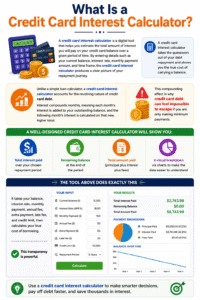
A credit card interest calculator is a digital tool that helps you estimate the total amount of interest you will pay on your credit card balance over a given period of time. By entering details such as your current balance, interest rate, monthly payment amount, and time frame, the credit card interest calculator produces a clear picture of your repayment journey.
Unlike a simple loan calculator, a credit card interest calculator accounts for the revolving nature of credit card debt. Interest compounds monthly, meaning each month’s interest is added to your outstanding balance, and the following month’s interest is calculated on that new, higher total. This compounding effect is why credit card debt can feel impossible to escape if you are only making minimum payments.
A well-designed credit card interest calculator will show you:
- Total interest paid over your chosen repayment period
- Remaining balance at the end of the period
- Total amount paid (principal plus interest plus fees)
- A visual breakdown via charts to make the data easier to understand
The tool above does exactly this — it takes your balance, interest rate, monthly payment, annual fee, extra payment, late fee, and credit limit, then calculates your true cost of borrowing. This transparency is powerful.
How Does Credit Card Interest Work?
Before you can fully benefit from a credit card interest calculator, you need to understand how interest is calculated on credit cards.
Credit card companies charge interest using the Annual Percentage Rate (APR), which is your yearly interest rate. However, interest is applied monthly. To find your Monthly Periodic Rate (MPR), the credit card company divides your APR by 12.
For example:
- APR = 18%
- Monthly rate = 18% ÷ 12 = 1.5% per month
Each month, your outstanding balance is multiplied by this monthly rate to calculate the interest charge. If your balance is $5,000 and your monthly rate is 1.5%, you will owe $75 in interest for that month alone.
If your minimum payment only covers the interest, your principal balance barely decreases. This is the debt trap millions of people fall into. A credit card interest calculator helps you see this trap clearly — and plan your way out of it.
Why You Need a Credit Card Interest Calculator
Most people underestimate how much their credit card debt actually costs them. They see a $5,000 balance and think they just need to pay back $5,000. But the real cost, after years of interest, can be dramatically higher.
A credit card interest calculator gives you:
- Clarity — You see the exact numbers, not vague estimates
- Motivation — Seeing how much extra you pay in interest motivates action
- Control — You can model different scenarios (higher payments, extra payments) instantly
- Planning ability — You can set a realistic debt-free date
- Comparison power — Compare paying $200/month vs. $300/month and see the difference
Financial advisors consistently recommend that anyone carrying a credit card balance use a credit card interest calculator to understand the true cost of their debt before making any financial decisions.
How to Use a Credit Card Interest Calculator
Using the credit card interest calculator on this page is simple. Here is a step-by-step walkthrough:
Step One — Enter Your Current Balance
This is the amount you currently owe on your credit card. For example, $5,000.
Step Two — Enter Your Interest Rate
Enter the APR shown on your credit card statement. For example, 18%.
Step Three — Enter Your Monthly Payment
This is the fixed amount you plan to pay each month. Paying more than the minimum dramatically reduces your total interest.
Step Four — Set Your Time Frame in Years
How many years do you want to model? Enter 5 for a five-year repayment plan.
Step Five — Enter Your Annual Fee (if any)
Some credit cards charge an annual fee. Enter it here.
Step Six — Enter Extra Monthly Payments
If you plan to make additional payments beyond your regular monthly amount, enter that here. This is a powerful variable — even $50 extra per month makes a significant difference over time.
Step Seven — Enter Any Late Fees
If you have been charged late fees, include them to get an accurate picture of your total debt.
Step Eight — Enter Your Credit Limit
Your credit limit helps calculate your credit utilization ratio.
Once you click CALCULATE, the credit card interest calculator will instantly display your total debt including interest, total interest paid, and remaining balance — along with a visual bar chart for easy understanding.
Key Terms You Must Know Before Using a Credit Card Interest Calculator
Understanding these terms will help you use a credit card interest calculator more effectively:
- APR (Annual Percentage Rate): The yearly interest rate charged on your balance. The higher the APR, the more you pay.
- Minimum Payment: The smallest amount you are required to pay each month. Paying only the minimum is the most expensive way to pay off your card.
- Principal: The original amount you borrowed or charged to the card.
- Compounding Interest: Interest charged on both your principal and previously accumulated interest.
- Credit Utilization Ratio: The percentage of your credit limit you are currently using. Keeping this below 30% is recommended for a healthy credit score.
- Grace Period: The window after your billing cycle ends during which you can pay your balance without being charged interest.
How Interest Rate Affects Your Total Debt
The interest rate is the most powerful variable in any credit card interest calculator. A difference of just a few percentage points can mean thousands of dollars in extra interest over the life of your debt.
Consider this example with a $5,000 balance and $200 monthly payment:
| Interest Rate | Total Interest Paid (5 years) | Remaining Balance |
|---|---|---|
| 12% | ~$1,500 | $0 |
| 18% | ~$2,200 | $500+ |
| 24% | ~$3,000+ | $2,000+ |
As you can see, a higher interest rate can mean your balance barely decreases — even with consistent monthly payments. This is why negotiating a lower APR or transferring your balance to a lower-rate card are strategies worth exploring.
A credit card interest calculator makes these comparisons instant and visible, removing all guesswork.
The Role of Monthly Payments in a Credit Card Interest Calculator
How much you pay each month is one of the most controllable variables in your debt repayment plan. Increasing your monthly payment — even slightly — has a compounding positive effect.
Using a credit card interest calculator, you can model scenarios like:
- What happens if I pay $200/month vs. $300/month?
- How many months sooner will I be debt-free if I increase my payment by $100?
- How much total interest do I save by paying $50 more per month?
The results are often surprising and motivating. A small increase in monthly payment can shave years off your repayment timeline and save thousands in interest.
Extra Payments: A Powerful Strategy to Save Money
One of the most underused features in a credit card interest calculator is the “Extra Payment” field. Extra payments — even small ones — directly reduce your principal balance, which means less interest accumulates the following month.
Strategies for making extra payments include:
- Applying tax refunds directly to your credit card balance
- Using work bonuses to make lump-sum payments
- Allocating monthly savings of small amounts (e.g., cutting one subscription) toward extra payments
- The Debt Avalanche Method: Paying extra on the highest-interest card first
- The Debt Snowball Method: Paying extra on the smallest balance first for psychological momentum
Enter different extra payment amounts into the credit card interest calculator to see exactly how much each strategy saves you in interest and time.
Annual Fees, Late Fees, and Their Impact on Your Balance
Fees are often overlooked when calculating credit card costs, but they add up significantly over time.
- Annual fees can range from $0 to $500+ depending on the card
- Late payment fees are typically $25 to $40 per occurrence
- Foreign transaction fees, balance transfer fees, and cash advance fees add further costs
The credit card interest calculator on this page includes fields for annual fees and late fees, giving you a more accurate and complete picture of your true cost of borrowing.
If your card charges a high annual fee, use the calculator to determine whether the card’s benefits justify the cost versus switching to a no-fee alternative.
Credit Utilization Ratio and Why It Matters
Your credit utilization ratio is the percentage of your total available credit that you are currently using. For example, if your credit limit is $10,000 and your balance is $5,000, your utilization ratio is 50%.
Why does this matter?
- Credit bureaus recommend keeping utilization below 30% for a healthy credit score
- High utilization signals financial stress to lenders and can lower your score significantly
- A lower score means higher interest rates on future loans — creating a cycle that is difficult to break
By entering your credit limit into the credit card interest calculator, you can track your utilization ratio and understand its impact on your overall financial health.
Common Mistakes People Make With Credit Card Debt
Avoiding these mistakes can save you thousands of dollars:
Paying Only the Minimum Payment
This is the single most costly mistake. Minimum payments are designed to keep you in debt longer, maximizing the interest you pay. Always pay more than the minimum when possible.
Ignoring the Interest Rate
Many people focus only on their monthly payment amount without considering the interest rate. A high APR means a large portion of your payment is going to interest, not reducing your balance.
Not Tracking Fees
Annual fees, late fees, and other charges increase your effective cost of borrowing significantly.
Missing Payments
A single missed payment can trigger a penalty APR (often 29.99% or higher) and add a late fee. Set up automatic payments to avoid this.
Making Large Purchases on High-Interest Cards
If you are already carrying a balance, adding new charges at high interest rates compounds your problem quickly.
Strategies to Pay Off Credit Card Debt Faster
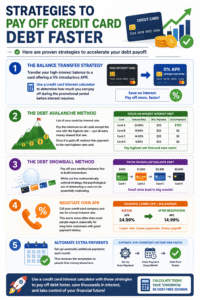
Here are proven strategies to accelerate your debt payoff:
The Balance Transfer Strategy
Transfer your high-interest balance to a card offering a 0% introductory APR. Use a credit card interest calculator to determine how much you can pay off during the promotional period before interest resumes.
The Debt Avalanche Method
List all your cards by interest rate. Pay the minimum on all cards except the one with the highest rate — put all extra money toward that one. Once it is paid off, redirect that payment to the next highest-rate card.
The Debt Snowball Method
Pay off your smallest balance first to build momentum. While not the mathematically optimal strategy, the psychological win of eliminating a card can be powerfully motivating.
Negotiate Your APR
Call your credit card company and ask for a lower interest rate. This works more often than most people expect, especially for long-time customers with good payment history.
Automate Extra Payments
Set up automatic additional payments each month. This removes the temptation to spend that money elsewhere.
How a Credit Card Interest Calculator Helps With Financial Planning
A credit card interest calculator is not just a debt management tool — it is a financial planning tool. Here is how you can use it beyond simple debt calculations:
Scenario Planning: Model multiple repayment strategies side by side. Compare aggressive payoff (high monthly payment) versus conservative payoff (lower monthly payment plus investing the difference).
Goal Setting: Use the calculator to set a specific debt-free date and work backward to determine the monthly payment required.
Budget Alignment: By knowing your exact monthly interest cost, you can build a more accurate household budget.
Loan Comparison: Considering a personal loan to consolidate your credit card debt? Use the credit card interest calculator to compare the total cost of keeping your current card versus taking the personal loan.
Emergency Planning: If your income changes, use the calculator to understand how reducing your monthly payment will affect your total interest and repayment timeline.
Frequently Asked Questions (FAQs)
What is the best way to use a credit card interest calculator?
Enter your exact current balance, interest rate from your statement, and the monthly payment you can realistically afford. Then experiment with higher payment amounts and extra payments to see how quickly they reduce your total interest.
How accurate is a credit card interest calculator?
A credit card interest calculator provides a strong estimate based on the figures you enter. Real-world results may vary slightly due to billing cycle timing, compounding methods, and payment posting dates. However, for planning purposes, the estimates are highly reliable.
How many times should I use a credit card interest calculator?
Use it every time your balance, interest rate, or payment plan changes. Regular use keeps you informed and accountable.
Can a credit card interest calculator help me decide between two cards?
Yes. Enter the details of each card separately and compare total interest paid over the same time period. The card with the lower total interest cost is the better financial choice.
What is a good monthly payment to enter?
Always enter an amount higher than the minimum payment. Financial experts recommend paying at least 3% to 5% of your balance per month to make meaningful progress against your debt.
Does making extra payments really make a big difference?
Absolutely. Even $25 to $50 in extra monthly payments can save hundreds or thousands of dollars in interest over the life of your debt. Use the extra payment field in the calculator to see the exact impact.
What is a dangerous credit utilization ratio?
Using more than 30% of your credit limit is considered high. Above 50% is considered dangerous. Above 70% can significantly damage your credit score.
Should I pay off my credit card or invest my money?
If your credit card interest rate is higher than your expected investment return (typically 7% to 10% for stock market investments), paying off your credit card first is the mathematically superior choice. Use the credit card interest calculator to quantify what your debt is costing you annually, then compare it to your expected investment returns.
Conclusion
Credit card debt does not have to be a permanent part of your financial life. With the right tools and a clear understanding of how interest works, you can take control, make a plan, and become debt-free.
A credit card interest calculator is one of the most powerful financial tools available to you — and it is completely free to use. It removes the mystery from your debt, replaces anxiety with clarity, and gives you a roadmap to financial freedom.
The key takeaways from this guide are:
- Understand your APR and how it compounds monthly
- Always pay more than the minimum payment
- Use extra payments whenever possible — even small amounts matter
- Account for all fees when calculating your true cost of borrowing
- Use a credit card interest calculator regularly to track your progress and stay motivated
Start today. Enter your numbers into the credit card interest calculator at the top of this page. See exactly what your debt is costing you. Then take the first step toward changing it.
Financial freedom is not a distant dream — it is a calculation, a plan, and a decision away.