Body Surface Area Calculator
Check Your Kidney Health Instantly with the GFR Calculator
Table of Contents
- Introduction
- What Is a Body Surface Area Calculator?
- Why Body Surface Area Is Critical in Clinical Medicine
- The Two Formulas Behind the Body Surface Area Calculator
- How Our Body Surface Area Calculator Works Step by Step
- Understanding Every Clinical Result from the Calculator
- BSA Adjusted – The Primary Output Explained
- Cardiac Index and Its Relationship to Body Surface Area
- Metabolic Rate Estimation from BSA
- Renal Status and Dosage Scale in the Body Surface Area Calculator
- The Reference Table – Six BSA Metrics at a Glance
- Mosteller vs. DuBois – Comparing Both Formulas
- Gender Factor in the Body Surface Area Calculator
- Unit Flexibility – Kilograms, Pounds, Grams, Feet, and Inches
- BSA in Chemotherapy and Drug Dosing
- BSA in Paediatric Medicine
- Common Conditions Where BSA Matters
- Frequently Asked Questions (FAQs)
- Conclusion
Introduction
When clinicians prescribe chemotherapy agents, calculate cardiac output, estimate metabolic needs, or dose critical medications for patients of vastly different body sizes, they cannot rely on weight or height alone. A tall, lean athlete and a short, heavily built patient of the same body weight have dramatically different physiological profiles — different skin surface areas, different organ proportions, different fluid distribution volumes, and different metabolic rates. The measurement that normalises all of these differences is Body Surface Area (BSA) — and the tool that calculates it instantly, accurately, and without a laboratory is the Body Surface Area Calculator.
Body Surface Area is the total measured or calculated surface area of the human body, expressed in square metres (m²). It is one of the most widely used clinical normalisation metrics in medicine — used to calibrate drug doses, assess cardiac function, estimate glomerular filtration rate, guide burn injury treatment, and determine metabolic energy requirements. Despite its profound clinical importance, BSA cannot be directly measured in routine practice — it must be estimated from validated mathematical formulas based on height and weight. The Body Surface Area Calculator automates this estimation, producing instant, formula-based BSA values alongside six additional clinical reference metrics.
Our free Body Surface Area Calculator applies two internationally recognised BSA formulas — the Mosteller formula and the DuBois formula — alongside a gender adjustment factor, and delivers six clinical results plus a six-row reference table in a single calculation. Whether you are a clinician verifying a dosing calculation, a medical student learning physiological normalisation, a nurse checking a chemotherapy protocol, or a health-conscious individual exploring their metabolic baseline, our Body Surface Area Calculator provides the comprehensive, formula-driven BSA assessment you need.
In this complete guide, you will learn what BSA is, why it matters clinically, how both calculation formulas work, what every result from our tool means, and where BSA is most critically applied across medicine, pharmacology, and physiology.
What Is a Body Surface Area Calculator?
A Body Surface Area Calculator is a clinical mathematics tool that estimates the total external surface area of a human body — expressed in square metres (m²) — using height and weight as inputs. Rather than attempting to physically measure every curve and contour of the body’s surface (a practical impossibility in routine medicine), a Body Surface Area Calculator applies validated mathematical formulas that produce highly accurate BSA estimates from two readily available measurements.
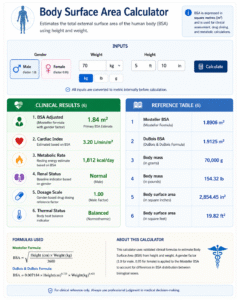
Our Body Surface Area Calculator produces twelve results in total:
Clinical Results Panel (six metrics):
- BSA Adjusted (Mosteller formula with gender factor) — the primary BSA estimate
- Cardiac Index — estimated based on BSA
- Metabolic Rate — resting energy estimate based on BSA
- Renal Status — baseline indicator based on gender
- Dosage Scale — gender-based drug dosing reference factor
- Thermal Status — body heat balance indicator
Reference Table (six metrics):
- Mosteller BSA (four decimal places)
- DuBois BSA (four decimal places)
- Body mass in grams
- Body mass in pounds
- Body surface area in square inches
- Body surface area in square feet
The Body Surface Area Calculator accepts weight in kilograms, pounds, or grams and height in feet and inches — converting all inputs to metric internally before applying both formulas. A gender factor (1.0 for male, 0.95 for female) is applied to reflect documented differences in BSA distribution between biological sexes.
Why Body Surface Area Is Critical in Clinical Medicine
Of all the physiological normalisation metrics used in medicine, BSA is the most universally applicable — used in pharmacology, cardiology, nephrology, oncology, paediatrics, burns medicine, and nutritional science. Here is why:
It Captures Size More Completely Than Weight Alone: Body weight reflects total mass — but two patients of the same weight may have very different body compositions, heights, and surface areas. BSA incorporates both height and weight, capturing the three-dimensional scale of the body more completely than either metric alone. This makes BSA-normalised values genuinely comparable across patients of different body types.
It Correlates with Organ Function: Many physiological functions — cardiac output, glomerular filtration, hepatic metabolism, lung capacity — scale proportionally with BSA. Normalising these measurements to BSA (rather than to raw body weight) allows clinicians to identify true organ dysfunction rather than apparent dysfunction caused purely by body size differences.
It Is the Standard for Chemotherapy Dosing: Most cytotoxic chemotherapy drugs are dosed in milligrams per square metre of BSA (mg/m²) — the most widely used drug dosing convention in oncology. An accurate Body Surface Area Calculator result is therefore a direct patient safety tool in cancer treatment: an underestimated BSA leads to underdosing (reducing treatment efficacy) while an overestimated BSA leads to overdosing (increasing toxicity risk).
It Guides Paediatric Drug Dosing: Children cannot be dosed using adult weight-based calculations because their organ maturity, metabolic rates, and body composition differ fundamentally from adults of equivalent weight. BSA-based dosing from a Body Surface Area Calculator provides the most reliable cross-age drug dosing framework, particularly for medications with narrow therapeutic indices.
It Normalises Cardiac Output: Cardiac output (the volume of blood pumped by the heart per minute) must be interpreted relative to body size. Cardiac Index — cardiac output ÷ BSA — is the standardised metric used to assess ventricular function, diagnose heart failure severity, and guide haemodynamic management. Our Body Surface Area Calculator computes this directly.
The Two Formulas Behind the Body Surface Area Calculator
Our Body Surface Area Calculator applies two validated formulas, each representing a different approach to BSA estimation:
Formula 1 – Mosteller (1987):
BSA (m²) = √ [(Height cm × Weight kg) ÷ 3600]
The Mosteller formula is the most widely used BSA equation in contemporary clinical practice — preferred for its mathematical simplicity, computational ease, and validated accuracy across diverse adult and paediatric populations. Published in the New England Journal of Medicine in 1987, the Mosteller formula produces results within 2% to 3% of directly measured BSA for most patients and is the default formula in most modern clinical BSA calculators.
Key characteristics of the Mosteller formula in our Body Surface Area Calculator:
- Easy to compute mentally (square root of height × weight ÷ 3600)
- Slightly overestimates BSA in very obese patients
- Excellent accuracy across children and adults of average build
- Preferred by most oncology protocols and pharmacy BSA references
Formula 2 – DuBois and DuBois (1916):
BSA (m²) = 0.007184 × Height (cm)^0.725 × Weight (kg)^0.425
The DuBois formula — developed by Delafield DuBois and Eugene DuBois and published in 1916 — is the oldest and historically most influential BSA estimation equation. Despite being over a century old, it remains widely referenced in pharmacological literature and is the formula originally used to establish BSA as a dosing standard in oncology. Many drug dosing references and clinical tables were originally calibrated to DuBois BSA values, making it important to retain alongside the Mosteller formula for reference and comparison.
Key characteristics of the DuBois formula in our Body Surface Area Calculator:
- Derived from direct measurements in only nine subjects — a significant limitation
- Tends to underestimate BSA in obese patients
- Historically significant; many older drug protocols reference DuBois BSA
- Useful as a secondary reference and cross-check alongside Mosteller
Our Body Surface Area Calculator displays both Mosteller and DuBois results — with the Mosteller value (gender-adjusted) used as the primary clinical output and the DuBois value provided in the reference table for comparison and legacy protocol verification.
How Our Body Surface Area Calculator Works Step by Step
Using our Body Surface Area Calculator takes under one minute and requires four inputs:
Step One – Select Gender: Choose Male (factor: 1.0) or Female (factor: 0.95). The gender factor in the Body Surface Area Calculator applies a 5% downward adjustment to the calculated BSA for female patients — reflecting research indicating that women typically have a slightly lower BSA per unit of body weight than men of equivalent size, due to differences in body composition and fat distribution.
Step Two – Enter Weight and Select Weight Unit: Enter your body weight and select kilograms (kg), pounds (lbs), or grams (g) from the unit dropdown. The Body Surface Area Calculator converts pounds using the factor 0.453592 and grams using the factor 0.001 to produce the kilogram value used in the Mosteller and DuBois formulas.
Step Three – Enter Height in Feet and Inches: Enter height as feet and inches. The Body Surface Area Calculator converts height to centimetres using the formula: [(feet × 12) + inches] × 2.54. Enter height as accurately as possible — height is raised to the power of 0.725 in the DuBois formula, meaning small height errors have a proportionally amplified effect on that result.
Step Four – Click Calculate: Instantly receive six clinical results in the Clinical Results panel and six reference metrics in the table — your complete BSA clinical profile from a single calculation.
Understanding Every Clinical Result from the Calculator
Our Body Surface Area Calculator produces six clinical results, each with specific physiological or pharmacological significance:
BSA Adjusted: The Mosteller formula result multiplied by the gender factor — the primary BSA value of the Body Surface Area Calculator. Expressed in m² to three decimal places. This is the value used for chemotherapy dosing calculations, cardiac index computation, and all clinical BSA-dependent applications.
Cardiac Index: BSA Adjusted × 2.5 L/min/m². Cardiac Index (CI) is the standard haemodynamic measure of cardiac pump efficiency relative to body size. A normal Cardiac Index ranges from 2.5 to 4.0 L/min/m² — values below 2.5 indicate reduced cardiac output relative to body size (cardiogenic shock territory), while values above 4.0 may suggest high-output states (fever, sepsis, anaemia). The Body Surface Area Calculator’s CI estimate provides a resting reference baseline.
Metabolic Rate: BSA Adjusted × 1,200 kcal/m². An approximate resting metabolic rate estimate derived from BSA — reflecting the established relationship between body surface area and basal energy expenditure. This estimate aligns with the observation that resting heat production per unit of BSA is approximately 1,000 to 1,300 kcal/m²/day in healthy adults. The Body Surface Area Calculator’s metabolic rate result provides a BSA-anchored energy baseline for comparison with other metabolic calculations.
Renal Status: Displayed as Male Baseline or Female Baseline. This indicator contextualises the renal filtration reference point associated with the selected gender’s BSA calculation — acknowledging that renal function assessment (particularly eGFR normalised to 1.73m² BSA) is gender-sensitive.
Dosage Scale: Displayed as 1.0× (Male) or 0.95× (Female). The dosage scale confirms the gender adjustment factor applied in the Body Surface Area Calculator’s BSA computation — providing explicit transparency about which scaling factor was used. This is clinically relevant when verifying BSA-based drug dose calculations.
Thermal Status: Displayed as Balanced — confirming the tool’s thermal equilibrium baseline assumption. Body heat regulation is closely linked to BSA (as heat dissipates from the skin surface), and this indicator contextualises that the calculation assumes a resting, thermoneutral state.
BSA Adjusted – The Primary Output Explained
The BSA Adjusted result is the centrepiece of the Body Surface Area Calculator — the number that all clinical applications of BSA depend upon. Here is what it means and how it is used:
Interpretation by BSA value:
- BSA below 1.5 m²: Below average — typical of shorter or lighter individuals, many women, and children over 10 years. Chemotherapy doses calculated on this BSA will be correspondingly lower than average adult doses.
- BSA 1.6 to 1.9 m²: Average range — encompassing most adult women (approximately 1.6 to 1.7 m²) and adult men (approximately 1.7 to 1.9 m²). The reference BSA of 1.73 m² used in GFR normalisation falls in the centre of this range.
- BSA above 2.0 m²: Above average — typical of tall or heavier individuals. Oncology protocols often cap BSA at 2.0 m² for dosing calculations to limit toxicity risk in obese patients whose actual drug clearance may not scale linearly with BSA.
The 1.73 m² reference standard: The value 1.73 m² is internationally used as the standard reference BSA — the “average” adult surface area derived from DuBois’s original measurements. When GFR is reported as ml/min/1.73 m², it is being normalised to this reference BSA to produce values comparable across patients of different body sizes. Your Body Surface Area Calculator result relative to 1.73 m² tells you whether standard normalised reference values overestimate or underestimate your individual physiology.
Cardiac Index and Its Relationship to Body Surface Area
Cardiac Index (CI) is one of the most important haemodynamic parameters in critical care medicine — and it cannot be assessed without BSA. Our Body Surface Area Calculator estimates CI by multiplying adjusted BSA by a reference cardiac output factor of 2.5 L/min/m²:
Normal Cardiac Index: 2.5 to 4.0 L/min/m²
Clinical interpretation of Cardiac Index values:
- CI below 1.8 L/min/m²: Severe cardiogenic shock — insufficient cardiac output for tissue perfusion
- CI 1.8 to 2.2 L/min/m²: Moderate cardiac failure — haemodynamically significant reduction
- CI 2.2 to 2.5 L/min/m²: Mild cardiac failure — compensated but below normal
- CI 2.5 to 4.0 L/min/m²: Normal range — adequate cardiac output relative to body size
- CI above 4.0 L/min/m²: High-output state — fever, sepsis, anaemia, thyrotoxicosis, or pregnancy
The CI displayed in our Body Surface Area Calculator is an estimate based on BSA alone — actual cardiac index measurement requires echocardiography or invasive haemodynamic monitoring (Swan-Ganz catheter). The calculated CI provides a physiological reference point for health-conscious users and educational context for clinical students — not a diagnostic cardiac output measurement.
Metabolic Rate Estimation from BSA
The Metabolic Rate result from the Body Surface Area Calculator — BSA Adjusted × 1,200 kcal/m² — provides a body surface area-based estimate of resting energy expenditure:
The BSA-metabolic rate relationship: The relationship between BSA and metabolic rate was established by early physiologists who observed that basal heat production per unit of body surface area was remarkably constant across mammalian species — approximately 1,000 kcal/m²/day in resting humans. Modern values range from 900 to 1,300 kcal/m²/day depending on age, sex, and metabolic health.
How the Body Surface Area Calculator’s metabolic estimate compares to BMR formulas: For an average adult male with BSA of 1.85 m², the Body Surface Area Calculator produces a metabolic rate estimate of approximately 2,220 kcal/day — comparable to BMR estimates from the Mifflin-St Jeor or Harris-Benedict formulas for adults of equivalent body size. This alignment validates the BSA-metabolic scaling approach as a clinically reasonable energy expenditure reference.
Clinical application: In hospital settings, the BSA-metabolic rate relationship is used to estimate caloric requirements for critically ill patients who cannot be assessed with conventional BMR formulas due to immobility, sedation, or altered physiology. The Body Surface Area Calculator’s metabolic rate output provides this baseline reference for nutritional planning contexts.
Renal Status and Dosage Scale in the Body Surface Area Calculator
Two contextual indicators in the Body Surface Area Calculator — Renal Status and Dosage Scale — provide gender-specific clinical reference information:
Renal Status (Male Baseline / Female Baseline): Kidney function — particularly GFR — is routinely normalised to a BSA of 1.73 m² to produce values comparable across body sizes. Women typically have a lower BSA than men, meaning their raw GFR may appear lower even when their kidney function per unit of BSA is equivalent. The Renal Status indicator flags which gender-specific baseline applies to your BSA calculation — relevant for interpreting eGFR values relative to the 1.73 m² standard.
Dosage Scale (1.0× / 0.95×): The dosage scale confirms the gender adjustment factor applied to your BSA in the Body Surface Area Calculator. When a female patient’s BSA is calculated at 0.95× the Mosteller result, any mg/m² drug dose calculated from that BSA is automatically 5% lower than the same mg/m² dose for a male patient of identical weight and height. This built-in gender adjustment ensures that BSA-based drug dosing is appropriately calibrated for both sexes.
The Reference Table – Six BSA Metrics at a Glance
The reference table in our Body Surface Area Calculator provides six additional metrics derived from your inputs:
Mosteller BSA (four decimal places): The gender-adjusted Mosteller formula result to maximum precision — the primary clinical reference value for drug dosing and physiological normalisation.
DuBois BSA (four decimal places): The DuBois formula result — provided as a secondary reference for protocols and literature that use DuBois-calibrated values. Comparing Mosteller and DuBois results from the Body Surface Area Calculator confirms formula agreement (typically within 2% to 5% for patients of average build) and flags potential discrepancy for very obese or very lean patients.
Mass in Grams: Body weight converted to grams — a unit used in some pharmacokinetic calculations, paediatric dosing protocols, and laboratory settings. The Body Surface Area Calculator automatically provides this conversion alongside BSA to consolidate all clinically relevant weight expressions in one place.
Mass in Pounds: Body weight in pounds — useful for US-based clinical settings and for patients who think in imperial units. The Body Surface Area Calculator’s pound conversion ensures instant reference regardless of the unit system used for input.
Area in Square Inches (in²): BSA converted from m² to square inches (× 1,550). This conversion is practically useful in burns medicine — where burn surface area is sometimes estimated in square inches — and for educational comparison with everyday objects to develop intuitive BSA scale.
Area in Square Feet (ft²): BSA converted to square feet (× 10.764). For context: an average adult BSA of approximately 1.73 m² equates to approximately 18.6 ft² — roughly the area of a standard interior door. This conversion from the Body Surface Area Calculator makes the abstract concept of body surface area viscerally comprehensible.
Mosteller vs. DuBois – Comparing Both Formulas
Understanding when each formula from the Body Surface Area Calculator is most appropriate:
When Mosteller is preferred:
- Modern oncology dosing protocols (most current chemotherapy guidelines specify Mosteller)
- Paediatric BSA calculations
- Routine clinical use where simplicity and modern validation are priorities
- Patients of average or below-average build
- Most contemporary Body Surface Area Calculator applications default to Mosteller for these reasons
When DuBois is referenced:
- Verifying BSA against older drug package inserts or clinical studies that used DuBois
- Historical research comparison
- Institutions or protocols that have not updated to Mosteller-based calculations
- Cross-referencing with GFR normalisation values originally calibrated to DuBois estimates
For most users of our Body Surface Area Calculator, the Mosteller BSA Adjusted result is the clinically appropriate primary value — with DuBois provided as a transparency measure and legacy reference.
Gender Factor in the Body Surface Area Calculator
The gender factor in our Body Surface Area Calculator — 1.0 for males and 0.95 for females — reflects documented, clinically meaningful differences in body surface area distribution:
Why BSA differs between genders at equivalent weight and height: Women typically have a higher body fat percentage than men at equivalent body weight — and adipose tissue is metabolically less active and distributed differently across the body surface than lean mass. Additionally, women’s body shape (narrower shoulders, wider hips relative to waist) produces a different surface area geometry than men’s body shape at equivalent BMI. These differences are captured in the 0.95 female gender factor, which adjusts the Mosteller result downward by 5% for female patients.
Clinical significance of the gender factor: In chemotherapy dosing — where BSA-calculated doses directly determine drug quantity — a 5% difference in BSA translates directly to a 5% difference in drug dose. For a high-dose chemotherapy agent with a narrow therapeutic window, this 5% distinction is clinically meaningful — potentially the difference between therapeutic efficacy and dose-limiting toxicity. The Body Surface Area Calculator’s gender factor ensures this distinction is captured and applied consistently.
Unit Flexibility – Kilograms, Pounds, Grams, Feet, and Inches
Our Body Surface Area Calculator supports three weight units and two height conventions:
Weight Units:
- Kilograms (kg): Conversion factor 1.0 — native metric unit, used directly in both BSA formulas
- Pounds (lbs): Conversion factor 0.453592 — the standard lb-to-kg conversion. Common in US clinical settings where patient weights are typically recorded in pounds
- Grams (g): Conversion factor 0.001 — rarely used for adult body weight but included for paediatric contexts where neonatal and infant weights may be recorded in grams
Height Input: Height is entered as feet and inches — the default convention in our Body Surface Area Calculator for US-based users. The tool converts this to centimetres internally: [(feet × 12) + inches] × 2.54. Users in metric countries should convert their height to feet and inches before entry using the standard conversion (1 cm = 0.0328 feet; or simply divide total height in cm by 2.54 to get inches, then divide by 12 for feet).
BSA in Chemotherapy and Drug Dosing
The most critical clinical application of the Body Surface Area Calculator is chemotherapy drug dosing — where BSA is the universally accepted dosing denominator for cytotoxic agents:
Why BSA-based dosing evolved in oncology: In the 1950s and 1960s, researchers discovered that animal toxicity data for cytotoxic drugs correlated better with body surface area than body weight across different species. BSA was subsequently adopted as the human chemotherapy dosing standard — producing the mg/m² dosing convention that remains universal in oncology today.
How the Body Surface Area Calculator is used in chemotherapy dosing: Dose (mg) = Prescribed dose (mg/m²) × Patient’s BSA (m²) from the Body Surface Area Calculator
For example: A patient prescribed carboplatin at 400 mg/m² with a BSA of 1.72 m² receives a calculated dose of 400 × 1.72 = 688 mg.
BSA capping in obese patients: Many oncology institutions cap BSA at 2.0 m² for dosing calculations when actual BSA exceeds this threshold — based on evidence that drug clearance in obese patients does not increase proportionally with BSA beyond this point. When using the Body Surface Area Calculator for obese patients, discuss institutional capping policy with the prescribing oncologist before applying the calculated result to dosing.
Other BSA-dosed drugs beyond chemotherapy:
- Some immunosuppressants (e.g. cyclosporin adjustment reference)
- Certain antifungal agents in critical care
- Some haematological agents
- Paediatric anticoagulation protocols
BSA in Paediatric Medicine
The Body Surface Area Calculator is particularly important in paediatric clinical practice — where weight-based adult dosing conventions are inadequate:
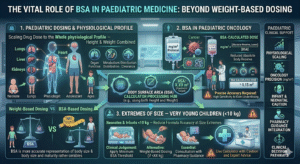
Why paediatric dosing requires BSA: Children’s organ development, metabolic capacity, drug distribution volumes, and clearance rates change dramatically across the developmental spectrum from neonate to adolescent. BSA-based dosing from the Body Surface Area Calculator scales drug dose to the child’s full physiological profile — height and weight combined — rather than weight alone, which can be misleading in children with abnormal growth patterns.
BSA in paediatric oncology: Chemotherapy protocols for childhood cancers are almost universally dosed in mg/m² using BSA from a Body Surface Area Calculator — with particularly careful attention to BSA accuracy because children have lower absolute body reserve and are more sensitive to both under- and overdosing than adults.
Very young children — additional considerations: In neonates and infants below 10 kg, some clinicians apply a minimum BSA threshold or use weight-based dosing for very small patients because BSA formula accuracy is reduced at extremes of body size. The Body Surface Area Calculator should be used in conjunction with paediatric pharmacy guidance for patients in this range.
Common Conditions Where BSA Matters
Beyond drug dosing, the Body Surface Area Calculator plays an important role across multiple clinical conditions:
Burn Injuries: The Rule of Nines — used to estimate the percentage of total body surface area affected by burns — is one of the most important applications of BSA in emergency medicine. The total BSA from the Body Surface Area Calculator is the denominator from which burn surface area percentage is calculated, guiding fluid resuscitation volumes (Parkland formula: 4 ml × kg × % BSA burned in first 24 hours).
Heart Failure Assessment: Cardiac output, stroke volume, and pulmonary artery pressures are all normalised to BSA to produce indexed values (Cardiac Index, Stroke Volume Index, etc.) that allow standardised comparison across patients of different sizes. BSA from the Body Surface Area Calculator is essential for correct interpretation of echocardiographic and invasive haemodynamic data.
Kidney Disease and eGFR: The internationally standardised GFR is reported as ml/min normalised to 1.73 m² BSA. Patients with BSA significantly different from 1.73 m² — particularly very small or very large patients — may have their eGFR systematically over- or underestimated by standard reporting. The Body Surface Area Calculator result allows correction of normalised GFR back to absolute GFR when needed for precise clinical decision-making.
Nutrition and Intensive Care: In ICU settings, energy requirements are often estimated using BSA-based formulas — particularly for patients on mechanical ventilation or with altered consciousness where conventional self-reported intake data is unavailable. The metabolic rate estimate from the Body Surface Area Calculator provides a BSA-anchored starting point for nutritional support planning.
Skin Conditions: Dermatology uses BSA to quantify disease extent — psoriasis, eczema, and other dermatological conditions are often staged by percentage of body surface area affected. The total BSA from the Body Surface Area Calculator is the reference from which these percentages are calculated and against which treatment response is measured.
Frequently Asked Questions (FAQs)
What is a Body Surface Area Calculator? A Body Surface Area Calculator is a clinical tool that estimates the total external surface area of a human body in square metres (m²) using height and weight, via validated mathematical formulas such as Mosteller and DuBois.
What is a normal BSA for adults? Average BSA values are approximately 1.6 to 1.7 m² for adult women and 1.7 to 1.9 m² for adult men. The internationally used reference BSA is 1.73 m² — the value to which GFR and many other physiological measurements are normalised. Our Body Surface Area Calculator displays your individual BSA relative to these reference ranges.
Which formula is more accurate — Mosteller or DuBois? Both formulas are clinically validated and produce results within 2% to 5% of each other for most patients of average build. Mosteller is generally preferred in contemporary practice for its simplicity and broader validation across diverse populations. DuBois is historically significant and retained for legacy protocol reference in our Body Surface Area Calculator.
Why is BSA used for chemotherapy dosing instead of body weight? BSA correlates better with drug clearance than body weight for most cytotoxic agents — because it reflects the combined influence of height and weight, captures body size more completely, and correlates more strongly with hepatic and renal drug clearance capacity. Our Body Surface Area Calculator’s BSA result is therefore the appropriate dosing denominator for oncology calculations.
What does the gender factor do in the Body Surface Area Calculator? The gender factor (1.0 for males, 0.95 for females) adjusts the calculated BSA for the documented difference in body surface area distribution between biological sexes — ensuring that drug doses, cardiac index estimates, and metabolic rate calculations are appropriately calibrated for each gender.
Can children use the Body Surface Area Calculator? Yes — the Mosteller formula used in our Body Surface Area Calculator is validated for paediatric populations. For very young children (below 2 years) or neonates, BSA calculation accuracy is reduced and paediatric pharmacy guidance should supplement any calculator result.
How does BSA differ from BMI? BMI (Body Mass Index) is weight ÷ height² and assesses weight status relative to height. BSA is √(height × weight ÷ 3600) and estimates the actual physical surface area of the body. The Body Surface Area Calculator produces a metric used for clinical dosing and physiological normalisation; BMI is used for weight status classification. They measure different things and serve different purposes.
Is the Body Surface Area Calculator accurate for obese patients? Both Mosteller and DuBois formulas tend to overestimate BSA in severely obese patients because drug clearance does not increase proportionally with adipose tissue mass. Many oncology institutions cap BSA at 2.0 m² for chemotherapy dosing in obese patients — check with your prescribing physician or clinical pharmacist when applying Body Surface Area Calculator results in this context.
What units does the Body Surface Area Calculator use? Our Body Surface Area Calculator accepts weight in kilograms, pounds, or grams and height in feet and inches. All inputs are converted to metric internally before formula application. Results are displayed in m², g, lbs, in², and ft² — covering the full range of clinically and practically useful unit expressions.
Conclusion
Body Surface Area is one of medicine’s most powerful normalisation tools — the mathematical bridge between a patient’s physical size and the physiological, pharmacological, and clinical measurements that depend on body scale to be meaningfully interpreted. From the precise oncology dose that must be calculated for a chemotherapy-naïve patient to the cardiac index that guides haemodynamic management in an ICU, from the burn surface area percentage that determines fluid resuscitation volume to the eGFR normalisation that defines kidney disease staging — BSA from a Body Surface Area Calculator sits at the foundation of all of it.
Our free Body Surface Area Calculator delivers twelve comprehensive results from four simple inputs — applying both the Mosteller and DuBois formulas with a gender adjustment factor to produce your adjusted BSA, cardiac index, metabolic rate, dosage scale, and a complete six-metric reference table across every relevant unit system. It is the most accessible, comprehensive, and clinically transparent free Body Surface Area Calculator available, combining dual-formula output, gender correction, and multi-unit reference in a single instant calculation.
Whether you are verifying a chemotherapy dose, assessing a cardiac index, exploring your metabolic baseline, or simply understanding the physiology of your own body — our Body Surface Area Calculator gives you the precise, formula-validated, clinically grounded body surface area data you need.
Use our Body Surface Area Calculator today — and let the science of your body’s geometry inform the decisions that depend on it.