BMI table for adults
| Classification | BMI range - kg/m² |
|---|---|
| Severe Thinness | < 16 |
| Moderate Thinness | 16 - 17 |
| Mild Thinness | 17 - 18.5 |
| Normal | 18.5 - 25 |
| Overweight | 25 - 30 |
| Obese Class I | 30 - 35 |
| Obese Class II | 35 - 40 |
| Obese Class III | > 40 |
BMI chart for adults
BMI table for children and teens, age 2-20
| Category | Percentile Range |
|---|---|
| Underweight | < 5% |
| Healthy weight | 5% - 85% |
| At risk of overweight | 85% - 95% |
| Overweight | > 95% |
Check your VAT amount instantly using the VAT Calculator
Table of Contents
-
Introduction to BMI Calculator Online
-
What is Body Mass Index (BMI)?
-
How to Use Our BMI Calculator Online
-
Importance of Calculating BMI
-
BMI Table for Adults
-
BMI Chart for Adults
-
BMI Table for Children and Teenagers (Age 2 to 20)
-
Limitations of BMI
-
Frequently Asked Questions (FAQs)
- Conclusion
Introduction to BMI Calculator Online
Welcome to our BMI Calculator Online, the easiest and most accurate way to calculate your Body Mass Index (BMI) in just a few seconds. Maintaining a healthy body weight is essential for overall health, and knowing your BMI is one of the simplest ways to assess whether your weight falls within a healthy range. Our BMI Calculator Online is designed for adults, teenagers, and children, providing instant results that help you understand your current health status and guide you toward better lifestyle choices.
Body Mass Index is a widely used measure by health professionals to categorize weight levels, including underweight, normal weight, overweight, and obesity. With increasing awareness about health and wellness, many individuals are turning to online tools like our BMI Calculator Online for quick and reliable calculations. Unlike generic BMI charts, our online calculator provides personalized results based on the data you enter, making it easier for you to track your health over time.
Using the BMI Calculator Online is simple and intuitive. All you need to do is input your weight and height, select the appropriate units (kilograms/meters or pounds/inches), and click the calculate button. Within moments, you will see your BMI value along with the corresponding category. This enables you to instantly understand whether your current weight is within the healthy range and take proactive steps if adjustments are needed.
One of the advantages of using a BMI Calculator Online over manual calculations or generic charts is its accuracy and speed. Manual calculations can be confusing, especially when converting units or using formulas, whereas our online tool does everything for you automatically. Moreover, it’s accessible anywhere, anytime—whether on your smartphone, tablet, or desktop—allowing you to monitor your health conveniently.
Additionally, our BMI Calculator Online is more than just a number generator. Along with the BMI value, it provides helpful insights and guides you to explore BMI tables for adults, children, and teenagers. These references allow you to see how your BMI compares to healthy standards for your age group, helping you make informed health decisions.
Start using our BMI Calculator Online today to take the first step toward a healthier lifestyle. Whether your goal is to maintain your current weight, lose weight, or gain muscle, knowing your BMI is an essential metric to help you achieve your fitness and wellness goals.


What is Body Mass Index (BMI)?
Body Mass Index (BMI) is a widely used health measurement that helps determine whether a person’s body weight is appropriate for their height. It is a simple numerical value calculated using a standard formula that compares weight and height to categorize individuals into different weight groups. BMI Calculator Online is commonly used by healthcare professionals, fitness trainers, and health organizations to assess potential health risks related to body weight.
The formula for BMI is straightforward:
BMI = Weight (kg) ÷ Height (m²)
This means a person’s weight in kilograms is divided by the square of their height in meters. For example, if someone weighs 65 kg and has a height of 1.70 meters, their BMI would be 65 ÷ (1.70 × 1.70), which equals approximately 22.5. This falls within the “normal weight” range.
BMI values are generally classified into four main categories:
-
Underweight: Below 18.5
-
Normal weight: 18.5 to 24.9
-
Overweight: 25 to 29.9
-
Obesity: 30 and above
These categories help identify whether a person may be at risk of health conditions such as heart disease, type 2 diabetes, high blood pressure, and other weight-related issues. Because BMI Calculator Online is quick and easy to calculate, it is often used as a screening tool in medical settings.
However, it is important to understand that BMI does not directly measure body fat percentage. It does not differentiate between muscle mass and fat, meaning athletes or muscular individuals may have a higher BMI Calculator Online without having excess body fat. Therefore, while BMI is a useful starting point, it should be considered alongside other health assessments.
In conclusion, Body Mass Index (BMI) is a practical and effective method for evaluating weight status and understanding potential health risks.
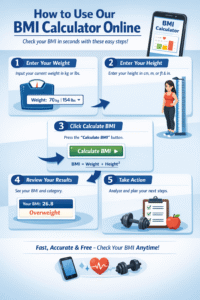
How to Use Our BMI Calculator Online
Using our BMI Calculator Online is simple, fast, and designed to give you accurate results within seconds. Whether you want to check your fitness progress or understand your current weight status, our tool makes the process smooth and user-friendly. You don’t need any technical knowledge—just your height and weight details.
Step 1: Enter Your Weight
Start by entering your current weight in the provided field. Make sure you select the correct unit (kilograms or pounds, depending on the option available). For the most accurate BMI result, use your latest measured weight rather than an estimated value.
Step 2: Enter Your Height
Next, input your height. You can usually enter it in centimeters, meters, or feet and inches. Double-check your height measurement to avoid incorrect results, as BMI calculations are highly dependent on accurate height values.
Step 3: Click the Calculate Button
After entering your details, simply click on the “Calculate BMI” button. The calculator instantly applies the standard BMI formula:
BMI = Weight (kg) ÷ Height (m²)
Within seconds, your BMI score will appear on the screen.
Step 4: Review Your BMI Category
Once calculated, the tool will display your BMI value along with your weight category—Underweight, Normal weight, Overweight, or Obese. This classification helps you understand where you stand in terms of healthy body weight.
Step 5: Analyze and Take Action
The result gives you a quick overview of your health status. If your BMI Calculator Online falls outside the normal range, you may consider improving your diet, increasing physical activity, or consulting a healthcare professional for personalized advice.
Our BMI Calculator Online is mobile-friendly, easy to use, and completely free. It provides instant, reliable results to help you monitor your health anytime, anywhere. Regularly checking your BMI can support better fitness planning and smarter lifestyle decisions.
Importance of Calculating BMI
Calculating Body Mass Index (BMI) is an important step in understanding your overall health and fitness level. BMI is a simple yet effective measurement that compares your weight to your height to determine whether you fall into a healthy weight category. While it may seem like just a number, your BMI can provide valuable insight into potential health risks and help guide better lifestyle decisions.
One of the main reasons BMI Calculator Online is important is that it helps identify weight-related health risks at an early stage. Individuals with a high BMI may have a greater risk of developing conditions such as heart disease, type 2 diabetes, high blood pressure, and certain types of cancer. On the other hand, a very low BMI may indicate undernutrition, weakened immunity, or other underlying health concerns. By calculating your BMI regularly, you can detect possible problems before they become serious.
Another key benefit of calculating BMI is that it supports effective fitness and diet planning. Whether your goal is weight loss, muscle gain, or maintaining a healthy body weight, knowing your BMI gives you a starting point. It allows you to set realistic health goals and track your progress over time. Many healthcare professionals use BMI as an initial screening tool to assess patients and recommend appropriate lifestyle changes.
BMI is also important because it is quick, affordable, and easy to calculate. Unlike complex medical tests, it does not require special equipment—just your height and weight measurements. Although BMI does not directly measure body fat percentage, it remains one of the most widely accepted methods for evaluating weight status worldwide.
In conclusion, calculating BMI is essential for monitoring health, preventing disease, and maintaining a balanced lifestyle.
BMI Table for Adults
A BMI Table for Adults is a simple reference chart that helps individuals understand their weight category based on their Body Mass Index value. It is widely used by healthcare professionals and fitness experts to quickly assess whether a person falls within a healthy weight range. The BMI Calculator Online table is based on a standard formula that compares weight to height, but instead of calculating each time, the table provides clear ranges that make interpretation easy.
For adults aged 20 years and older, BMI Calculator Online categories are generally divided into four main groups. A BMI below 18.5 is classified as underweight. This may indicate insufficient body fat or possible nutritional deficiencies. A BMI between 18.5 and 24.9 is considered normal or healthy weight. Individuals in this range are typically at lower risk for weight-related health problems. A BMI between 25 and 29.9 falls into the overweight category, which may increase the risk of conditions such as heart disease, high blood pressure, and type 2 diabetes. A BMI of 30 or above is classified as obese, a category associated with higher health risks and potential complications.
The BMI table is important because it provides a quick screening tool for identifying potential health concerns. It helps individuals recognize whether they need to maintain, gain, or lose weight to improve their overall health. However, it is important to understand that the BMI table does not measure body fat directly. Factors such as muscle mass, age, gender, and body composition are not considered in BMI calculations.
In summary, the BMI Table for Adults serves as a practical guideline for evaluating weight status. It offers a clear and standardized way to interpret BMI values and supports better health awareness and lifestyle planning.
BMI Chart for Adults
A BMI Chart for Adults is a visual guide that helps individuals understand their weight status based on their Body Mass Index value. It is designed to provide a clear overview of different BMI ranges and the corresponding weight categories. Healthcare professionals, fitness trainers, and nutrition experts commonly use the BMI chart as a quick screening tool to evaluate whether a person’s weight is appropriate for their height.
The BMI chart for adults applies to individuals aged 20 years and above. It organizes BMI values into standard categories that indicate potential health risks. A BMI below 18.5 is classified as underweight, which may suggest insufficient body fat or possible nutritional concerns. A BMI between 18.5 and 24.9 falls within the normal or healthy weight range. Individuals in this category are generally considered to have a balanced weight in relation to their height and may face lower risks of weight-related diseases.
A BMI between 25 and 29.9 is categorized as overweight. People in this range may have an increased risk of developing health conditions such as high blood pressure, heart disease, and type 2 diabetes. A BMI of 30 or higher is classified as obese, a category linked to more serious health complications and long-term medical concerns.
The BMI chart is popular because it is simple, easy to understand, and requires only height and weight measurements. However, it is important to remember that BMI does not directly measure body fat percentage. Factors like muscle mass, age, gender, and body composition are not considered in the calculation.
In summary, the BMI Chart for Adults provides a clear and standardized way to assess weight status and support informed health decisions.
BMI Table for Children and Teenagers (Age 2 to 20)
Limitations of BMI
While BMI is useful, it has limitations:
-
Does not differentiate between muscle and fat
-
Not suitable for pregnant women
-
Does not account for bone density
-
Use along with other health indicators like waist circumference

Frequently Asked Questions (FAQs)
1. What is BMI?
BMI (Body Mass Index) is a numerical value calculated using your height and weight to determine whether you are underweight, normal weight, overweight, or obese.
2. How is BMI calculated?
BMI is calculated using the formula: Weight (kg) ÷ Height (m²). It compares your body weight to your height.
3. Is BMI accurate for everyone?
BMI is a useful screening tool, but it does not measure body fat directly. Athletes or muscular individuals may have a higher BMI Calculator Online without excess body fat.
4. What is a healthy BMI range?
For adults, a BMI between 18.5 and 24.9 is considered a healthy or normal weight range.
5. What does a high BMI indicate?
A high BMI may indicate overweight or obesity, which can increase the risk of heart disease, diabetes, and high blood pressure.
6. What does a low BMI mean?
A low BMI (below 18.5) may suggest underweight status, possible malnutrition, or other health concerns.
7. How often should I check my BMI?
You can check your BMI every few months, especially if you are monitoring weight loss, weight gain, or fitness progress.
8. Is BMI different for children and adults?
Yes, children and teenagers use BMI percentiles based on age and gender, while adults use fixed BMI ranges.
9. Can BMI measure body fat percentage?
No, BMI does not directly measure body fat. It only estimates weight status based on height and weight.
10. Why is BMI important?
BMI helps identify potential health risks early and supports better lifestyle, diet, and fitness planning decisions.
Conclusion