Savings Calculator
See how inflation impacts your money over time with our free Inflation Calculator.
Table of Contents
- Introduction
- What Is Savings Calculator
- What Is an Accumulated Interest Calculator?
- Why You Need an Accumulated Interest Calculator
- How Compound Interest Works
- Key Terms You Must Know Before Using an Accumulated Interest Calculator
- How to Use the Accumulated Interest Calculator Step by Step
- Understanding Your Results: Breaking Down the Numbers
- The Role of Compounding Frequency in Interest Accumulation
- How Inflation and Tax Rates Affect Your Savings
- Management Fees and Their Hidden Impact on Growth
- Setting a Realistic Savings Target
- Real-Life Examples Using the Accumulated Interest Calculator
- Common Mistakes People Make When Calculating Accumulated Interest
- Tips to Maximize Your Savings Growth
- Conclusion
Introduction
Money sitting idle in your pocket never grows — but money put to work with the right strategy can multiply beyond your imagination. Whether you are saving for retirement, your child’s education, a dream home, or simply building an emergency fund, understanding how interest accumulates over time is one of the most powerful financial skills you can develop. That is exactly where an Accumulated Interest Calculator becomes your best financial companion.
An Accumulated Interest Calculator is a smart digital tool that shows you exactly how your money will grow when interest compounds over weeks, months, or years. Instead of guessing or relying on rough estimates, you get precise, data-driven projections that help you plan your financial future with confidence.
In this comprehensive guide, we will walk you through everything you need to know — from the basic concept of compound interest to advanced factors like inflation, tax rates, management fees, and compounding frequency. By the end, you will not only understand how the Accumulated Interest Calculator works, but you will also know how to use it strategically to make smarter savings decisions.
What Is a Savings Calculator?
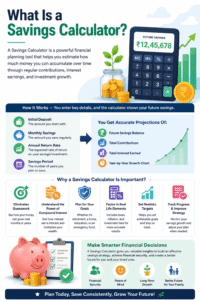
A Savings Calculator is a powerful financial planning tool that helps you estimate how much money you can accumulate over time through regular contributions, interest earnings, and investment growth. By entering details such as your initial deposit, monthly savings amount, annual return rate, and savings period, the calculator provides an accurate projection of your future savings balance.
A Savings Calculator eliminates guesswork by showing how your money can grow over months or years. It also helps you understand the effects of compound interest, taxes, inflation, and investment fees on your overall savings performance.
Whether you’re saving for retirement, a new home, education, an emergency fund, or long-term financial goals, a Savings Calculator gives you valuable insights to make smarter financial decisions. It allows you to set realistic targets, track progress, and create a more effective savings strategy for the future.
What Is an Accumulated Interest Calculator?
An Accumulated Interest Calculator is an online financial tool designed to calculate how much interest you earn on your savings over a specified period, factoring in compounding, additional contributions, and real-world deductions like taxes and fees.
Unlike a simple interest calculator that only applies a flat rate to your original principal, an Accumulated Interest Calculator accounts for the snowball effect of compounding — meaning the interest you earn also starts earning interest. Over time, this creates exponential growth that can dramatically increase your final balance.
The key inputs typically required by an Accumulated Interest Calculator include:
- Initial deposit — the amount you start with
- Monthly addition — regular contributions you make over time
- Annual return rate — the expected percentage your savings will grow each year
- Compounding frequency — how often interest is applied (daily, weekly, monthly, annually, etc.)
- Inflation rate — to calculate the real value of your future savings
- Tax rate — to account for taxes on interest earned
- Management fee — any annual fee charged by a financial institution
- Years to save — the duration of your savings plan
- Target amount — your savings goal
When all these factors are combined, the Accumulated Interest Calculator delivers a realistic and honest picture of what your savings journey will actually look like.
Why You Need an Accumulated Interest Calculator
Most people underestimate the power of compound interest simply because it is invisible until you actually calculate it. Without an Accumulated Interest Calculator, you are essentially navigating your financial future without a map.
Here is why this tool is absolutely essential:
Clarity over guesswork. When you use an Accumulated Interest Calculator, you replace vague hopes with concrete numbers. You know exactly what to expect at each milestone.
Goal setting becomes realistic. Many people set savings targets without knowing whether they are achievable given their current contributions and interest rates. The Accumulated Interest Calculator tells you if your target is on track or if you need to adjust.
Motivation through visualization. Seeing your balance grow year by year on a chart or in a table is incredibly motivating. It reinforces the habit of saving consistently.
Smarter financial decisions. When you compare scenarios — for example, saving $100 more per month, or starting five years earlier — the Accumulated Interest Calculator shows you the exact financial impact, empowering you to make better choices.
Awareness of hidden costs. Taxes, inflation, and management fees can quietly erode your savings. A good Accumulated Interest Calculator includes these factors so you are never caught off guard.
How Compound Interest Works
Compound interest is often called the eighth wonder of the world — and for good reason. It is the process by which your interest earns more interest, creating a self-reinforcing cycle of growth.
Here is a simple way to understand it:
Imagine you deposit $1,000 at a 5% annual interest rate.
- After Year 1: You earn $50 in interest. Your balance is $1,050.
- After Year 2: You earn 5% on $1,050, which is $52.50. Your balance is $1,102.50.
- After Year 3: You earn 5% on $1,102.50, which is $55.13. Your balance is $1,157.63.
Notice how your annual interest payment grows each year even though the rate stays the same. This is the magic of compounding, and it is precisely what the Accumulated Interest Calculator is built to harness.
The longer your money compounds, the more dramatic the effect. Time is the most powerful variable in the compounding equation — which is why starting to save early, even with small amounts, produces far better results than starting late with larger contributions.
Key Terms You Must Know Before Using an Accumulated Interest Calculator
Before diving into the calculator, let us clarify some important financial terms that will help you get the most accurate results.
Principal: This is your starting balance — the initial deposit you put into your savings account or investment.
Annual Return Rate: This is the percentage your savings grow each year. For a savings account, this is typically the APY (Annual Percentage Yield). For investments, it may be an estimated average return based on historical data.
Compounding Frequency: This refers to how often interest is calculated and added to your balance. The more frequently interest compounds, the faster your savings grow. Options typically include annually, semiannually, quarterly, monthly, biweekly, weekly, daily, or continuously.
Inflation Rate: Over time, the purchasing power of money decreases due to inflation. An Accumulated Interest Calculator that includes an inflation rate helps you calculate the real value of your future savings in today’s dollars.
Tax Rate: Interest earned is often taxable income. Including the tax rate in your calculation gives you a net-after-tax projection, which is far more realistic.
Management Fee: If your money is held in a managed fund or investment account, an annual management fee (often expressed as a percentage) is deducted from your balance. Even a small fee can have a significant impact over many years.
Target Amount: Your financial goal — the specific amount you want to accumulate by a certain age or date.
How to Use the Accumulated Interest Calculator Step by Step
Using the Accumulated Interest Calculator is straightforward, but entering accurate data is critical for meaningful results. Here is a simple step-by-step process:
Step 1 — Enter your initial deposit. Input how much money you are starting with today. This could be your current savings balance or a lump sum you plan to invest.
Step 2 — Add your monthly contribution. Enter how much you plan to add to your savings each month. Even small consistent contributions make a significant difference thanks to compounding.
Step 3 — Choose your compounding frequency. Select how often interest is applied to your account. For most savings accounts, this is monthly. For investments, it may vary.
Step 4 — Enter the annual return rate. This is your expected annual interest rate or investment return. Be realistic — conservative estimates are usually better for long-term planning.
Step 5 — Fill in the inflation, tax, and management fee fields. These fields make the Accumulated Interest Calculator much more accurate by accounting for real-world reductions to your growth.
Step 6 — Set your timeframe and target. Enter how many years you plan to save and what your target amount is. The calculator will tell you if you are on track to meet your goal.
Step 7 — Click Calculate. The Accumulated Interest Calculator will instantly generate your projected final balance, total contributions, total net interest earned, and a year-by-year breakdown table and chart.
Understanding Your Results: Breaking Down the Numbers
Once you run the Accumulated Interest Calculator, you will see several key figures. Here is how to interpret them:
Estimated Final Balance: This is the total projected value of your savings at the end of your chosen timeframe. It includes your principal, all contributions, and all accumulated interest (after tax deductions).
Initial Investment: Your starting deposit. This is the foundation upon which all growth is built.
Total Contributions: The sum of all monthly deposits made over the years. This shows you how much you personally put in versus how much came from interest.
Total Interest Earned (Net): This is the real power of the Accumulated Interest Calculator — it reveals exactly how much your money worked for you, after taxes are deducted from gross interest.
Target vs. Reality: The calculator compares your final balance to your target amount and shows you whether you are ahead, behind, or right on track.
Year-by-Year Table: A detailed breakdown showing deposits, interest earned, and ending balance for each year. This is invaluable for tracking progress and adjusting your plan over time.
The Role of Compounding Frequency in Interest Accumulation
One of the most underappreciated features of an Accumulated Interest Calculator is its ability to show the impact of different compounding frequencies.
To illustrate, consider a $10,000 investment at a 6% annual return over 20 years with no additional contributions:
- Annually: Final balance ≈ $32,071
- Monthly: Final balance ≈ $33,102
- Daily: Final balance ≈ $33,198
The difference between annual and daily compounding may seem modest in percentage terms, but it represents hundreds of additional dollars simply by choosing a more frequent compounding schedule.
For long-term savings like retirement funds, choosing an account or investment that compounds more frequently can add thousands of dollars to your final balance without any additional effort from you.
How Inflation and Tax Rates Affect Your Savings
A nominal balance of $50,000 in ten years may not be worth $50,000 in today’s purchasing power. This is why accounting for inflation in your Accumulated Interest Calculator results is so important.
If inflation averages 2% per year, the real value of your future savings is measurably lower than the nominal figure. The Accumulated Interest Calculator helps you understand the inflation-adjusted value of your goal so you can save enough to truly meet your needs.
Taxes work similarly. If you earn $5,000 in interest but face a 25% tax rate, you only keep $3,750. Without factoring in taxes, your savings projection would be significantly overestimated. A reliable Accumulated Interest Calculator subtracts applicable taxes from interest earned each year, giving you a far more accurate and honest projection.
Always factor in both inflation and taxes when using an Accumulated Interest Calculator for long-term planning — these are the two biggest silent threats to your savings growth.
Management Fees and Their Hidden Impact on Growth
Management fees are one of the most overlooked factors in savings and investment planning. Even a seemingly small annual fee of 0.5% or 1% can reduce your final balance by thousands — or even tens of thousands — of dollars over a 20 to 30-year savings period.
Here is a striking example: On a $100,000 portfolio growing at 7% annually over 30 years:
- With no management fee: Final balance ≈ $761,226
- With 1% annual management fee: Final balance ≈ $574,349
- Difference: over $186,000 lost to fees
This is why the Accumulated Interest Calculator includes a management fee field — so you can see the true cost of fee-heavy products and make more informed choices between low-cost index funds, high-fee managed funds, and traditional savings accounts.
Setting a Realistic Savings Target
Every savings journey needs a destination. The target amount field in the Accumulated Interest Calculator is where you define yours. But how do you set a realistic target?
For retirement savings: A common rule of thumb is to save 25 times your expected annual expenses. If you need $40,000 per year in retirement, your target is $1,000,000.
For a home down payment: Calculate 20% of the expected property value in your desired area, plus closing costs and a buffer.
For education funding: Research current tuition costs and project them forward using an inflation rate.
For emergency funds: Aim for 3 to 6 months of living expenses.
Once you have a target, enter it into the Accumulated Interest Calculator to see exactly how your current contributions and interest rate will perform against that goal. If the projected final balance falls short, you can immediately adjust — increase monthly contributions, extend your timeframe, or find a higher-yield account.
Real-Life Examples Using the Accumulated Interest Calculator
Example 1 — The Early Starter: Sarah, age 25, deposits $1,000 and adds $200 per month at a 5% annual return for 35 years (until age 60). With taxes at 5% and inflation at 2%, her Accumulated Interest Calculator projects a final balance significantly higher than her total contributions, demonstrating the enormous value of starting early.
Example 2 — The Late Starter: John, age 40, begins with $5,000 and adds $500 per month at the same 5% return for 20 years. Despite contributing more per month, John ends up with a considerably smaller balance than Sarah. This example powerfully illustrates why time in the market matters more than the size of contributions.
Example 3 — The Fee-Aware Investor: Maria chooses a managed fund with a 1.5% annual management fee. When she enters this into the Accumulated Interest Calculator, she sees the long-term cost clearly and decides to switch to an index fund with a 0.1% fee — saving herself potentially hundreds of thousands of dollars over her savings lifetime.
Common Mistakes People Make When Calculating Accumulated Interest
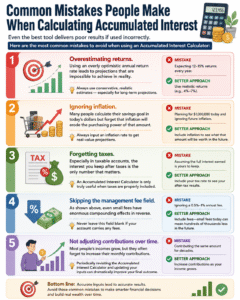
Even the best tool delivers poor results if used incorrectly. Here are the most common mistakes to avoid when using an Accumulated Interest Calculator:
Overestimating returns. Using an overly optimistic annual return rate leads to projections that are impossible to achieve in reality. Always use conservative, realistic estimates — especially for long-term projections.
Ignoring inflation. Many people calculate their savings goal in today’s dollars but forget that inflation will erode the purchasing power of that amount. Always input an inflation rate to get real-value projections.
Forgetting taxes. Especially in taxable accounts, the interest you keep after taxes is the only number that matters. An Accumulated Interest Calculator is only truly useful when taxes are properly included.
Skipping the management fee field. As shown above, even small fees have enormous compounding effects in reverse. Never leave this field blank if your account carries any fees.
Not adjusting contributions over time. Most people’s incomes grow, but they often forget to increase their monthly contributions. Periodically revisiting the Accumulated Interest Calculator and updating your inputs can dramatically improve your final outcome.
Tips to Maximize Your Savings Growth
Getting the most out of your money is not just about using the right calculator — it is about making smart, consistent financial decisions over time. Here are proven strategies to boost your accumulated interest:
Start as early as possible. The most impactful variable in any Accumulated Interest Calculator is time. Starting just five years earlier can double your final balance in many scenarios.
Increase contributions with every raise. Whenever your income grows, direct a portion of the increase directly into savings before lifestyle inflation absorbs it.
Choose accounts with higher compounding frequency. When comparing financial products, prefer accounts that compound monthly or daily over those that compound annually.
Minimize fees ruthlessly. Use the Accumulated Interest Calculator to compare fee structures side by side. Over 20 to 30 years, low-fee options almost always win.
Reinvest all interest and dividends. Never withdraw interest earned. Keeping it in the account allows it to compound and grow exponentially.
Set and regularly review your target. Your financial goals will evolve over time. Return to the Accumulated Interest Calculator at least once a year to update your inputs and ensure you are still on track.
Automate your contributions. Manual saving is inconsistent. Automating monthly deposits removes temptation and ensures your compounding timeline is never interrupted.
Conclusion
Saving money is not just about discipline — it is about strategy. The Accumulated Interest Calculator is one of the most powerful tools available to anyone who wants to take control of their financial future. By entering a few key numbers, you gain a crystal-clear picture of where your money is headed, whether your current plan will meet your goals, and what adjustments could make a significant difference.
The key takeaways from this guide are simple but profound: Start saving as early as possible. Contribute consistently, even modest amounts. Choose accounts with favorable compounding frequency. Account for inflation and taxes honestly. Minimize management fees wherever possible.
Every time you use the Accumulated Interest Calculator, you are not just crunching numbers — you are making a commitment to your future self. The projections you see on the screen are not merely hypothetical figures; they are the real, tangible outcome of choices you make today.
Whether you are just beginning your savings journey or reassessing a long-standing financial plan, the Accumulated Interest Calculator gives you the clarity, confidence, and motivation to stay the course. Take the time to enter your real numbers, explore different scenarios, and discover the powerful role that consistent saving and compounding interest can play in building the life you want.
Your financial freedom does not begin when the numbers get big — it begins the moment you start using the right tools to understand exactly where you stand and precisely where you are headed.