Prorated Rent Calculator
Calculate partial-month rent for move-in, move-out, or custom dates using actual days, a 30-day method, or annualized rent.
Calculate Partial Rent
Enter your monthly rent and rental dates below.
Plan smarter, calculate faster, and take control of your finances with our easy-to-use Finance Calculator.
Table of Contents
- Introduction
- The Ultimate Free Prorated Rent Calculator & Guide
- What Is a Prorated Rent Calculator?
- What Is Prorated Rent?
- How to Use This Calculator
- How to Calculate Prorated Rent
- The Prorated Rent Formula
- Calculation Methods Compared
- Prorated Rent for Move-In
- Prorated Rent for Move-Out
- Worked Examples
- Daily Rent and Partial-Month Calculations
- Security Deposits and Additional Fees
- Common Mistakes to Avoid
- Tips for Tenants and Landlords
- Frequently Asked Questions
- Conclusion
Introduction
Moving into a new apartment in the middle of the month or leaving before the month ends? You may not need to pay the full monthly rent.
In many rental situations, tenants are charged only for the days they occupy or are responsible for the property. This amount is commonly known as prorated rent.
Our prorated rent calculator helps you estimate the amount of rent due for a partial rental period. You can use it for a mid-month move-in, early move-out, temporary rental period, or custom date range.
Simply enter your monthly rent, select your dates, choose a calculation method, and review the detailed result. The calculator can show your:
- Monthly rent
- Occupied days
- Daily rental rate
- Prorated rent
- Calculation method
- Security deposit
- Additional fees
- Estimated total amount due
This tool is useful for tenants who want to plan a moving budget, landlords preparing an itemized rent statement, and property managers checking a partial-month charge.
A clear calculation helps you understand exactly how the amount was created. Instead of seeing one unexplained total, you can review the dates, daily rate, occupied days, and additional charges separately.
Important: This calculator provides a mathematical estimate. Your lease agreement, local rental laws, and written instructions from your landlord or property manager determine the final amount you may owe.
The Ultimate Free Prorated Rent Calculator & Guide
Looking for a reliable free prorated rent calculator? Whether you need a move in prorated rent calculator, a move out prorated rent calculator, or a combined move in move out prorated rent calculator, understanding how to prorate rent is essential. Tenants and landlords often search for a prorated rent calculator excel sheet, a downloadable prorated rent calculator template, or specialized tools for california, texas, nyc, new york, nj, ontario, uk, south africa, singapore, japan, and quebec. By applying the correct prorated rent calculation formula based on 30 days, actual monthly days, yearly/annualized splits, or specific lease terms—including special offers like 2 months free or 6 weeks free rent—you can easily figure out how much is my prorated rent. From platform-specific tools like zillow, turbotenant, quickbooks, rentvine, and yardi, to figuring out how does prorated rent work for mid-month transitions, salary/income-based setups, or zip code rates, this guide covers every aspect of partial-month rent management.
What Is a Prorated Rent Calculator?
A prorated rent calculator is an online tool that estimates rent for part of a month or for a custom rental period.
A standard monthly rent payment usually covers an entire month. However, tenants do not always move in on the first day or move out on the last day. When the rental period covers only some days of the billing cycle, the monthly rent may be divided according to the number of billable days.
A typical calculator uses the following information:
- Monthly rent
- Start date
- End date
- Move-in date
- Move-out date
- Number of days in the billing period
- Selected calculation method
- Date inclusion rules
- Security deposit
- Other rental fees
The calculator then estimates the amount due for that specific period.
A free prorated rent calculator can be useful before you sign a lease, move into a property, leave a rental, or question a final rent statement. It allows you to check the calculation without manually counting calendar days or performing multiple mathematical steps.
Different calculators may show different results because they may use different formulas. One tool may use the actual number of days in the month, while another may divide rent by 30 days every time.
That is why a good calculator should show the formula and method used, not only the final amount.
The most accurate estimate is based on the calculation method written in your lease agreement.
What Is Prorated Rent?
Prorated rent is the portion of monthly rent charged for the days a tenant occupies or is responsible for a rental property during a partial billing period.
For example, imagine that:
- Monthly rent is $1,800
- The tenant moves in on August 20
- The rental period ends on August 31
- Both dates are included
August has 31 days, and August 20 through August 31 contains 12 days.
Using the actual-days method:
$1,800 ÷ 31 × 12 = $696.77
The estimated prorated rent is $696.77.
Proration may apply when:
- A tenant moves in during the month
- A tenant moves out before the last day
- A lease begins on an unusual date
- A lease ends on an unusual date
- A tenant occupies a property temporarily
- Monthly rent changes during a billing period
- A property changes ownership during the month
- A custom rental period needs to be calculated
A partial month rent calculator makes the process easier by calculating the daily rate and applying it to the correct number of days.
However, not every lease uses the same proration rule. Some agreements use actual calendar days. Others use a fixed 30-day period or an annualized calculation.
Always check your lease before choosing a calculation method.
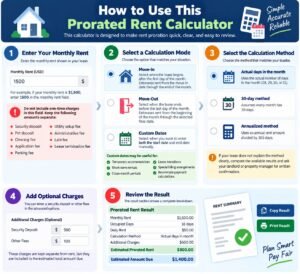
How to Use This Calculator
This calculator is designed to make rent proration quick, clear, and easy to review.
Step 1: Enter Your Monthly Rent
Enter the monthly rent shown in your lease.
For example, if your monthly rent is $1,500, enter 1500 in the monthly rent field.
Do not include one-time charges in this field. Keep the following amounts separate:
- Security deposit
- Pet deposit
- Cleaning fee
- Application fee
- Parking fee
- Utility setup fee
- Administrative fee
- Late fee
- Lease termination fee
Keeping these charges separate gives you a more accurate rent calculation.
Step 2: Select a Calculation Mode
The calculator includes three options.
Move-In
Select Move-In when the lease begins after the first day of the month. The calculator estimates rent from the move-in date through the end of that billing month.
Move-Out
Select Move-Out when the lease ends before the last day of the month. The calculator estimates rent from the beginning of the month through the selected final date.
Custom Dates
Select Custom Dates when you want to enter both the start date and end date manually.
Custom dates may be useful for:
- Temporary accommodation
- Short-term rentals
- Cross-month periods
- Lease transitions
- Special billing arrangements
- Roommate payment calculations
Step 3: Select the Calculation Method
Choose the method that matches your lease:
- Actual days in the month
- 30-day method
- Annualized method
If your lease does not explain the method clearly, compare the available results and ask your landlord or property manager for written confirmation.
Step 4: Add Optional Charges
You can enter a security deposit or other fees in the advanced options.
These charges are kept separate from rent, but they are included in the estimated total amount due.
Step 5: Review the Result
The result section shows:
- Monthly rent
- Occupied days
- Daily rent
- Calculation method
- Additional charges
- Estimated prorated rent
- Estimated amount due
You can copy or print the result for your personal records.
How to Calculate Prorated Rent
The basic answer to how to calculate prorated rent is simple:
- Determine the daily rent.
- Count the billable days.
- Multiply the daily rent by the billable days.
For example, assume:
- Monthly rent: $1,800
- Move-in date: August 20
- End date: August 31
- Occupied days: 12
- Method: Actual days in the month
August has 31 days.
First, find the daily rent:
$1,800 ÷ 31 = $58.0645 per day
Then multiply the daily rent by the occupied days:
$58.0645 × 12 = $696.77
The estimated prorated rent is $696.77.
Why Can the Result Be Different?
Two rent calculators may show different results because of:
- Different calculation methods
- Different month lengths
- Inclusive or exclusive dates
- Different rounding rules
- Different treatment of move-in dates
- Different treatment of move-out dates
- Additional fees being included or excluded
- Notice-period charges
Before comparing two results, compare their formulas and settings.
The final amount alone does not tell you whether a calculation is correct.
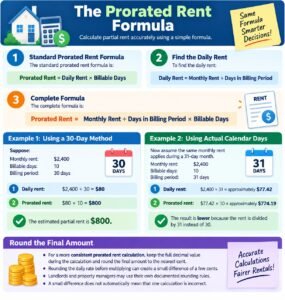
The Prorated Rent Formula
The standard prorated rent formula is:
Prorated Rent = Daily Rent × Billable Days
To find the daily rent:
Daily Rent = Monthly Rent ÷ Days in Billing Period
The complete formula is:
Prorated Rent = Monthly Rent ÷ Days in Billing Period × Billable Days
Example Using a 30-Day Method
Suppose:
- Monthly rent: $2,400
- Billable days: 10
- Billing period: 30 days
Daily rent:
$2,400 ÷ 30 = $80
Prorated rent:
$80 × 10 = $800
The estimated partial rent is $800.
Example Using Actual Calendar Days
Now assume the same monthly rent applies during a 31-day month.
Daily rent:
$2,400 ÷ 31 = approximately $77.42
Prorated rent:
$77.42 × 10 = approximately $774.19
The result is lower because the rent is divided by 31 instead of 30.
Round the Final Amount
For a more consistent prorated rent calculation, keep the full decimal value during the calculation and round the final amount to the nearest cent.
Rounding the daily rate before multiplying can create a small difference of a few cents.
Landlords and property managers may use their own documented rounding rules. A small difference does not automatically mean that one calculation is incorrect.
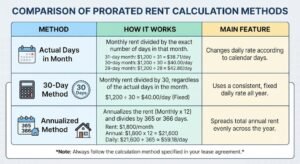
Calculation Methods Compared
The calculator includes three commonly used calculation methods.
| Method | How It Works | Main Feature |
|---|---|---|
| Actual Days in Month | Monthly rent is divided by the exact number of days in that month. | Changes according to the calendar |
| 30-Day Method | Monthly rent is always divided by 30. | Uses a fixed daily rate |
| Annualized Method | Annual rent is divided by 365 or 366 days. | Spreads rent across the year |
Actual Days in the Month
This method uses the exact number of calendar days in the relevant month.
- January has 31 days.
- April has 30 days.
- February usually has 28 days.
- February has 29 days in a leap year.
If the monthly rent is $1,200:
- 31-day month: $1,200 ÷ 31 = approximately $38.71
- 30-day month: $1,200 ÷ 30 = $40
- 28-day month: $1,200 ÷ 28 = approximately $42.86
This method is often used when the lease refers to actual calendar days.
30-Day Method
The 30-day method always divides monthly rent by 30.
If monthly rent is $1,200:
$1,200 ÷ 30 = $40 per day
The daily rate remains the same regardless of whether the month has 28, 30, or 31 days.
This method is easy to understand and provides a consistent daily rate.
Annualized Method
The annualized method converts monthly rent into annual rent before calculating the daily rate.
For example:
- Monthly rent: $1,800
- Annual rent: $1,800 × 12 = $21,600
- Annualized daily rate: $21,600 ÷ 365
During a leap year, the calculation may use 366 days.
The method stated in your lease should take priority over the method that produces the lowest amount.
Prorated Rent for Move-In
A mid-month move-in often results in a partial first-month payment.
A prorated rent calculator move in calculation usually starts on the date the tenant becomes responsible for the property and ends on the final day of the billing month.
For example:
- Monthly rent: $1,500
- Move-in date: June 20
- End date: June 30
- Days in June: 30
- Billable days: 11
Daily rent:
$1,500 ÷ 30 = $50
Prorated first-month rent:
$50 × 11 = $550
The estimated first-month rent is $550.
Which Move-In Date Should You Use?
The correct start date may be:
- Lease start date
- Key handover date
- Possession date
- Date listed in the move-in agreement
- Date approved by the landlord
The date you physically move your belongings may not always be the official date used for rent.
What May Be Included in the First Payment?
Your first payment may include:
- Prorated rent
- Full rent for the next month
- Security deposit
- Pet deposit
- Parking charges
- Administrative fees
- Utility setup charges
A first month rent calculator generally calculates only the rental portion. Review your full move-in statement separately.
Prorated Rent for Move-Out
A tenant who leaves before the end of the month may owe rent only through the approved final date.
A prorated rent calculator move out calculation generally begins on the first day of the billing month and ends on the final date for which rent is owed.
For example:
- Monthly rent: $2,100
- Move-out date: September 12
- Method: 30-day method
- Billable days: 12
Daily rent:
$2,100 ÷ 30 = $70
Final prorated rent:
$70 × 12 = $840
The estimated rent amount is $840.
Leaving Early May Not End Rent Responsibility
Physically leaving the property does not always end your rental obligation.
Your lease may require:
- 30-day notice
- 60-day notice
- Rent through a specific date
- Early termination fee
- Lease-break charge
- Payment until a replacement tenant moves in
- Cleaning or repair charges
A last month rent calculator can estimate the mathematical rent for a date range, but it cannot determine your legal responsibility.
Always obtain written confirmation of the approved move-out date and final payment amount.
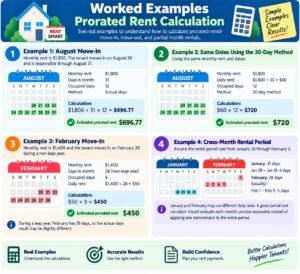
Worked Examples
Example 1: August Move-In
Monthly rent is $1,800. The tenant moves in on August 20 and is responsible through August 31.
- August has 31 days.
- Occupied days: 12.
- Method: Actual days.
Calculation:
$1,800 ÷ 31 × 12 = $696.77
Estimated prorated rent:
$696.77
Example 2: Same Dates Using the 30-Day Method
Using the same monthly rent and dates:
- Monthly rent: $1,800
- Daily rent: $1,800 ÷ 30 = $60
- Occupied days: 12
Calculation:
$60 × 12 = $720
Estimated prorated rent:
$720
Example 3: February Move-In
Monthly rent is $1,400 and the tenant moves in on February 20 during a non-leap year.
- February has 28 days.
- Occupied days: 9.
- Daily rent: $1,400 ÷ 28 = $50.
Calculation:
$50 × 9 = $450
Estimated prorated rent:
$450
During a leap year, February has 29 days, so the actual-days result may be slightly different.
Example 4: Cross-Month Rental Period
Assume the rental period runs from January 28 through February 5.
Under the actual-days method:
- January 28 through January 31 contributes 4 days.
- February 1 through February 5 contributes 5 days.
- January and February may use different daily rates.
January has 31 days, while February usually has 28 days. A good partial rent calculator should evaluate each month’s portion separately instead of applying one denominator to the entire period.
Daily Rent and Partial-Month Calculations
A daily rent calculator helps determine how much rent is associated with one day.
However, the daily rate depends on the chosen method.
Assume that monthly rent is $1,200.
Actual-Days Method
- 31-day month: approximately $38.71 per day
- 30-day month: $40 per day
- 28-day month: approximately $42.86 per day
30-Day Method
- Every month: $40 per day
Annualized Method
- Annual rent: $1,200 × 12 = $14,400
- Daily rate: approximately $39.45 per day
A daily rate should be viewed as part of the complete rent calculation. It does not necessarily mean that the property has a separate daily lease.
The correct result also depends on whether the first and last dates are included.
Security Deposits and Additional Fees
Prorated rent is usually only one part of a move-in or move-out payment.
Other possible charges include:
- Security deposit
- Pet deposit
- Cleaning fee
- Parking charge
- Utility setup fee
- Application fee
- Administrative fee
- Late fee
- Key replacement fee
- Lease termination fee
- Repair charge
These amounts should be listed separately from rent.
A security deposit is not automatically the same as prorated rent.
In many rental arrangements, the security deposit is held by the landlord and may be refundable if the tenant follows the lease terms and returns the property properly.
You can enter the deposit and other charges into the calculator for budgeting purposes. They will appear separately from the rent amount but may be included in the estimated total due.
When reviewing a rental statement, check for:
- Monthly rent
- Number of billable days
- Daily rate
- Prorated rent
- Security deposit
- Other fees
- Credits
- Previous balance
- Final amount due
An itemized statement makes it easier to identify errors or unexpected charges.
How Date Counting Changes the Result
Date counting is one of the most common reasons for differences in prorated rent.
Suppose the rental period is August 20 through August 31.
If both dates are included, the period contains 12 days.
If the start date is excluded, the period contains 11 days.
If the end date is excluded, it also contains 11 days.
If both dates are excluded, the period contains 10 days.
The correct setting depends on the lease or written rental policy.
Relevant dates may include:
- Lease start date
- Key handover date
- Date of possession
- Notice date
- Final inspection date
- Key-return date
- Approved move-out date
The date you physically leave may not always be the date used for rent purposes.
Best practice: Keep copies of your lease, move-in checklist, notice letter, inspection report, key-return confirmation, and final rent statement.
Common Mistakes to Avoid
Using the Wrong Denominator
Do not automatically divide rent by 30. Your lease may require actual calendar days or an annualized calculation.
Counting One Extra Day
People often subtract the dates and forget that an inclusive period contains one additional day.
Forgetting the Final Date
Some tenants calculate rent through the day before the official move-out date. Confirm whether the final date is billable.
Adding the Deposit to Monthly Rent
Do not add the security deposit to monthly rent before calculating the daily rate. Enter it separately.
Rounding Too Early
Rounding the daily rate before multiplying can create a small difference. Round the final amount whenever possible.
Ignoring Cross-Month Periods
A rental period that crosses two months may require different daily rates under the actual-days method.
Assuming Physical Departure Ends Rent
Moving your belongings out does not automatically end notice-period or lease obligations.
Comparing Only the Final Number
Two different results may both be mathematically correct if they use different formulas or settings.
Treating the Estimate as Legal Advice
A calculator can perform the mathematics, but it cannot interpret local rental laws or lease-break provisions.
Tips for Tenants and Landlords
Tips for Tenants
Before paying prorated rent, compare the amount with:
- Your lease start or end date
- The written rental policy
- The calculation method
- The number of billable days
- The daily rate
- Additional charges
- Credits or previous payments
Save a copy of your calculation for your records. A printed or copied breakdown can be useful if you later need to discuss the amount with your landlord.
When planning your move-in budget, remember that the initial payment may include both partial rent and a full upcoming month. You may also need to budget for:
- Security deposit
- Utilities
- Moving costs
- Parking
- Pet charges
- Application fees
- Insurance
Tips for Landlords and Property Managers
Landlords should clearly explain:
- Which proration method is used
- Whether the start date is included
- Whether the final date is included
- How the amount is rounded
- When the next full rent payment is due
- Which fees are refundable
- Whether the deposit is separate from rent
An itemized statement should show the monthly rent, daily rate, occupied days, prorated amount, and additional charges.
Clear written policies reduce confusion and help prevent payment disputes.
Frequently Asked Questions
What Is Prorated Rent?
Prorated rent is the portion of rent charged for the days a tenant occupies or is responsible for a property during a partial billing period.
What Is a Prorated Rent Calculator?
A prorated rent calculator estimates rent for a partial month or custom rental period. It uses the monthly rent, dates, billable days, and selected method to calculate an estimated amount.
Is Prorated Rent Always Calculated by Dividing Rent by 30?
No. Some leases use actual calendar days, while others use a fixed 30-day method or an annualized formula.
The method in your lease should be used whenever possible.
How Do I Calculate Prorated Rent for a Move-In?
Enter your monthly rent and move-in date. Count the billable days from the move-in date through the end of the billing period. Multiply the daily rate by the number of billable days.
How Do I Calculate Prorated Rent for a Move-Out?
Use the first day of the billing period and the approved final move-out date. Confirm whether the final date is included and whether additional notice-period rent applies.
What Is the Difference Between a Partial Month Rent Calculator and a Daily Rent Calculator?
A daily rent calculator usually calculates the amount associated with one day. A partial month rent calculator applies that daily rate to a specific date range and calculates the total partial rent.
Why Do Two Rent Proration Calculators Show Different Results?
The calculators may use different methods, month lengths, date-counting rules, or rounding policies.
Always compare the formulas and settings, not only the final number.
Can I Calculate Rent for Dates That Cross Two Months?
Yes. Select the custom-date option and enter both dates. Under the actual-days method, each month’s portion may be calculated separately.
Does a Security Deposit Count as Prorated Rent?
Usually, no. A security deposit is generally a separate charge and should be shown separately from rent.
What Is the Best Rent Proration Method?
There is no universal method that applies to every lease. The best method is the one stated in your rental agreement or confirmed by your landlord.
Can This Tool Calculate Commercial Rent?
The basic formula may be useful for commercial rent, but commercial leases often include taxes, maintenance costs, operating expenses, and other charges. Review the commercial lease carefully.
Does February Change the Calculation?
Yes. February usually contains 28 days and contains 29 days during a leap year. Under the actual-days method, this changes the daily rate.
Should I Include the Move-In Date?
That depends on your lease. Some agreements include the possession date, while others begin billing on the next day.
Should I Include the Move-Out Date?
Some rental agreements charge rent through the final possession date, while others use a different rule. Confirm the policy in writing.
Is This a Free Prorated Rent Calculator?
Yes. This free prorated rent calculator can estimate move-in rent, move-out rent, and custom partial-period rent without requiring an account.
What Is a Rent Proration Calculator Used For?
A rent proration calculator is used to estimate the portion of rent owed for less than a complete rental month.
It can be used for:
- Move-in payments
- Move-out payments
- Temporary stays
- Custom rental periods
- Lease transitions
- Rent statement checks
Why Is My Landlord’s Amount Different?
The difference may be caused by:
- A different calculation method
- Different date-counting rules
- A notice period
- Early termination charges
- Different rounding
- Additional fees
- Credits or previous payments
Ask for an itemized statement and compare each part of the calculation.
Should I Round the Daily Rate?
For a consistent result, keep the full decimal value during the calculation and round only the final amount.
Can I Use This Tool for a Short-Term Rental?
Yes. The custom dates option can estimate rent for a short-term period. Short-term rentals may also include taxes, cleaning charges, and booking fees.
Does Moving Out Early Always Reduce My Rent?
Not necessarily. A lease may require advance notice, continued rent, or an early termination fee.
Can I Use This Calculator for a Roommate Split?
Yes. You can use the result to estimate the total rent for a period and then divide the amount according to the roommate agreement.
How Accurate Is the Calculator?
The result is mathematically accurate based on the dates, rent, method, and settings entered. However, the final amount may differ if your lease uses another method or includes additional contractual charges.
Conclusion
Prorated rent becomes easier to understand when you separate the calculation into four basic parts:
- Monthly rent
- Billing period
- Billable days
- Calculation method
Use this prorated rent calculator to estimate rent for a move-in, move-out, or custom rental period. Review the daily rate, occupied days, formula, additional charges, and estimated final amount before making a payment.
The most important step is to compare the result with your lease agreement. Different leases may use actual calendar days, a fixed 30-day method, or an annualized formula. They may also use different rules for including the move-in or move-out date.
Whether you are preparing your first rental payment, checking a final rent statement, creating a landlord invoice, or planning a temporary stay, a clear calculation can help prevent confusion.
Use the calculator above to calculate your partial rent, compare methods, and understand exactly how your estimated amount was calculated.
Reminder: This guide and calculator provide general information and mathematical estimates. They do not replace your lease agreement, professional accounting advice, or legal advice.