Property Transfer Tax Calculator
Calculate the Perfect Canvas Dimensions for Printing and Digital Design Using Our Free Canvas Size Calculator
Table of Contents
- Introduction
- What Is a Property Transfer Tax Calculator?
- What Is Property Transfer Tax and Why Does It Exist?
- How the Property Transfer Tax Calculator Works
- Property Value — The Foundation of Every Tax Calculation
- Buyer Category — Standard, First-Time, and Corporate Buyers
- Property Usage — Residential, Commercial, and Vacant Land
- Tax Rate and How the Effective Rate Is Determined
- Registration Fee — The Hidden Cost of Property Ownership
- Tax Calculation Profile — Standard Duty vs. Progressive Tier
- Understanding Total Acquisition Cost
- Property Transfer Tax Calculator for First-Time Home Buyers
- Property Transfer Tax Calculator for Real Estate Investors
- Property Transfer Tax for Corporate and LLC Purchases
- FAQs About Property Transfer Tax Calculator
- Conclusion
Introduction
Buying or selling property is one of the most significant financial transactions most people will ever make — and one of the most tax-laden. Beyond the purchase price itself, every real estate transaction triggers a range of government-imposed charges, the most substantial of which is the property transfer tax. For many buyers, this tax comes as a surprise — an unexpected five-figure expense that appears at closing and can derail carefully planned budgets if not anticipated in advance.
The Property Transfer Tax Calculator exists to eliminate that surprise entirely. By entering a few key details — your property value, buyer category, property usage, tax rate, and registration fee — you receive an instant, accurate picture of your full tax liability and total acquisition cost before you ever sign a purchase agreement.
Whether you are a first-time home buyer, a seasoned real estate investor, or a corporate entity acquiring commercial real estate, understanding your property transfer tax obligation is not optional — it is essential. An underestimated closing cost can force you to scramble for additional funds at the last moment, potentially jeopardizing the transaction entirely.
This comprehensive guide explains everything you need to know about the Property Transfer Tax Calculator — from how it computes the effective tax rate across different buyer categories and property usage types to how progressive tier calculations affect high-value transactions. Read this guide before your next real estate transaction and walk into closing fully informed.
What Is a Property Transfer Tax Calculator?
A Property Transfer Tax Calculator is an online financial tool that estimates the transfer tax due, registration fee, and total acquisition cost associated with a real estate transaction. It takes into account multiple variables — including property value, buyer type, property usage, tax rate, and tax calculation profile — and applies them through a calculation engine to produce an accurate tax estimate in seconds.
The Property Transfer Tax Calculator is not a single-rate tool. Unlike a basic percentage calculator, it accounts for the real-world complexity of property tax systems, where different buyer categories and property uses attract different rates, and where high-value properties may be subject to progressive tier surcharges.
Key outputs of the Property Transfer Tax Calculator:
- Property Value — The entered purchase price of the property
- Effective Rate (%) — The actual tax rate after all category, usage, and profile adjustments
- Transfer Tax Due ($) — The total property transfer tax payable based on the effective rate
- Registration Fee ($) — The flat government fee for recording the property deed
- Total Acquisition Cost ($) — The full cost of purchasing the property including property value, transfer tax, and registration fee
- Usage / Profile — Confirmation of the property usage type and tax calculation method applied
This complete output makes the Property Transfer Tax Calculator an indispensable planning tool for buyers, sellers, real estate agents, mortgage brokers, and property lawyers.
What Is Property Transfer Tax and Why Does It Exist?
Property transfer tax — also known as real estate transfer tax, stamp duty, deed transfer tax, or land transfer tax depending on the jurisdiction — is a government-imposed charge levied whenever the ownership of a property is transferred from one party to another. It is one of the oldest and most universal forms of taxation in the world, with roots in European stamp duty systems dating back centuries.
The primary purpose of property transfer tax is to generate revenue for state, provincial, or local governments. These funds are typically used to finance public services — schools, roads, emergency services, and community infrastructure — in the areas where the properties are located.
Secondary purposes of property transfer tax include:
Market Regulation — Governments use transfer tax rates to influence property market behavior. Higher rates on foreign buyers, corporate purchasers, or luxury properties can cool overheated markets. Lower rates or exemptions for first-time buyers encourage homeownership and social stability.
Revenue Stability — Unlike income taxes that fluctuate with economic cycles, real estate transaction volumes tend to generate steady government revenue even during downturns, because property sales always occur regardless of broader economic conditions.
Record Keeping and Legal Certainty — The registration fee component of property transfer tax finances the official recording of deed transfers in government land registries, creating a legally recognized chain of title that protects both buyers and sellers.
Understanding why property transfer tax exists helps buyers see it not just as a cost but as a contribution to the infrastructure and legal system that makes property ownership safe and valuable. The Property Transfer Tax Calculator helps you understand exactly what that contribution amounts to in your specific situation.
How the Property Transfer Tax Calculator Works
The Property Transfer Tax Calculator applies a multi-layered calculation process that reflects the real-world complexity of property transfer tax systems. Here is the step-by-step breakdown of the calculation logic:
Step 1 — Enter the Base Tax Rate You enter your jurisdiction’s base tax rate (%) — the starting percentage applied to the property value. This base rate is then modified by subsequent factors.
Step 2 — Apply Buyer Category Adjustments
- First-Time Buyer: The effective rate is reduced by 0.5% — reflecting the common policy of encouraging new homeownership through tax relief
- Corporate / LLC Buyer: The effective rate is increased by 1.0% — reflecting the common surcharge applied to non-individual purchasers in many jurisdictions
- Standard Buyer: No adjustment — the base rate applies as entered
Step 3 — Apply Property Usage Adjustments
- Commercial Property: The effective rate increases by 0.5% — reflecting higher government charges on income-generating properties
- Vacant Land: The effective rate decreases by 0.25% — reflecting the absence of existing structure and lower assessed value complexity
- Residential Property: No adjustment — the base rate (after buyer adjustment) applies as is
Step 4 — Apply Progressive Tier Surcharge (if selected) If the Progressive Tier Calculation profile is selected AND the property value exceeds $500,000, the effective rate increases by an additional 0.75% — reflecting real-world progressive stamp duty systems used in many countries and states.
Step 5 — Calculate Transfer Tax Transfer Tax = Property Value × Effective Rate ÷ 100
Step 6 — Calculate Total Acquisition Cost Total Acquisition Cost = Property Value + Transfer Tax + Registration Fee
The Property Transfer Tax Calculator completes all six steps instantly and displays a clear, itemized result — giving you everything you need to plan your budget and prepare for closing.
Property Value — The Foundation of Every Tax Calculation
The property value is the single most important input in the Property Transfer Tax Calculator — because every other figure in the calculation flows directly from it. The property value is the agreed purchase price of the property as stated in the sale agreement, expressed in dollars.
Why Accurate Property Value Entry Matters Even a small percentage error in the entered property value can produce a significant error in the calculated transfer tax. At a 2.5% effective rate, the difference between entering $245,000 and $250,000 results in a $125 difference in transfer tax due. At higher values, the discrepancy grows proportionally.
Always use the contracted purchase price — not the assessed value, appraised value, or market estimate — when using the Property Transfer Tax Calculator. In most jurisdictions, property transfer tax is calculated on the higher of the contracted price or the government-assessed fair market value.
How Property Value Interacts with Progressive Tier Calculation In the Property Transfer Tax Calculator, the $500,000 threshold is the trigger for the progressive tier surcharge. This means:
- Properties valued at or below $500,000 are not subject to the additional 0.75% surcharge even when Progressive Tier Calculation is selected
- Properties valued above $500,000 attract the full 0.75% surcharge on the entire transaction value when the progressive profile is active
This threshold reflects real-world progressive property tax systems used in jurisdictions like the United Kingdom (Stamp Duty Land Tax), Canada (Land Transfer Tax), Australia (Stamp Duty), and several US states, where the effective tax rate increases with the transaction value.
Buyer Category — Standard, First-Time, and Corporate Buyers
One of the most impactful variables in the Property Transfer Tax Calculator is the buyer category. Different types of buyers attract different effective tax rates because governments deliberately use the property transfer tax system to incentivize certain behaviors and discourage others.
Standard Buyer A standard buyer is any individual or couple purchasing a property who does not qualify for first-time buyer relief and is not purchasing through a corporate entity. The base tax rate applies without adjustment. Most residential property purchases fall into this category.
First-Time Buyer A first-time buyer is an individual who has never previously owned a residential property. The Property Transfer Tax Calculator applies a 0.5% reduction to the effective rate for first-time buyers, reflecting the widespread government policy of reducing the financial barrier to first-time homeownership.
Real-world first-time buyer relief programs include:
- UK Stamp Duty Land Tax Relief — No stamp duty on properties up to £425,000 for first-time buyers
- Canada First-Time Home Buyer Incentive — Reduced land transfer tax rates in provinces like Ontario and British Columbia
- Various US State Programs — Multiple states offer reduced transfer tax rates or exemptions for qualifying first-time buyers
If you qualify as a first-time buyer, always select this category in the Property Transfer Tax Calculator — the savings can be substantial on even moderately priced properties.
Corporate / LLC Buyer When a property is purchased by a company, Limited Liability Company (LLC), trust, or other corporate entity, most jurisdictions apply a surcharge above the standard real estate transfer tax rate. The Property Transfer Tax Calculator adds 1.0% to the effective rate for corporate buyers, reflecting the additional taxes and regulatory requirements imposed on LLC property purchases and corporate acquisitions.
This surcharge exists because:
- Corporate entities can hold property indefinitely without triggering transfer tax through share transfers rather than deed transfers
- Governments use surcharges to prevent tax avoidance through corporate structures
- Non-individual buyers are assumed to be making investment decisions rather than establishing a primary residence, reducing the social policy case for relief
Understanding how your buyer category affects the effective rate is one of the most valuable insights the Property Transfer Tax Calculator provides.
Property Usage — Residential, Commercial, and Vacant Land
The type of property being purchased is the second major variable affecting your effective tax rate in the Property Transfer Tax Calculator.
Residential Property Residential property — houses, apartments, condominiums, townhouses, and other dwellings intended for personal habitation — is the baseline property usage type in the Property Transfer Tax Calculator, attracting no additional rate adjustment. Most home buyers, both owner-occupiers and buy-to-let investors, fall into this category.
Residential property attracts the most favorable property transfer tax treatment in most jurisdictions because governments prioritize housing accessibility and homeownership as social goods.
Commercial Property Commercial property — retail premises, office buildings, industrial units, warehouses, hotels, and any property used for business purposes — attracts a 0.5% surcharge in the Property Transfer Tax Calculator. This reflects the standard practice in many jurisdictions of applying higher real estate transfer tax rates to income-generating properties.
Commercial buyers are generally sophisticated investors who can absorb higher transaction costs, and governments recognize that commercial property generates ongoing business income, making higher upfront taxation justifiable. The total acquisition cost for commercial property will therefore always be higher than for an equivalent residential property purchase when calculated through the Property Transfer Tax Calculator.
Vacant Land Vacant land — undeveloped lots, agricultural parcels, and plots purchased for future construction — attracts a 0.25% reduction in the Property Transfer Tax Calculator. This relief reflects the fact that vacant land generates no immediate residential use, is typically lower in value per square area than developed property, and often requires significant additional investment before productive use.
Selecting the correct property usage type in the Property Transfer Tax Calculator ensures your effective rate accurately reflects your transaction type — a critical detail that affects how much cash you need to bring to closing.
Tax Rate and How the Effective Rate Is Determined
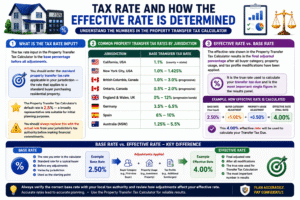
The tax rate input in the Property Transfer Tax Calculator is the base percentage before all adjustments. You should enter the standard property transfer tax rate applicable in your jurisdiction — the rate that applies to a standard buyer purchasing residential property.
Common Property Transfer Tax Rates by Jurisdiction:
| Jurisdiction | Base Transfer Tax Rate |
|---|---|
| California, USA | 1.1% (county + state) |
| New York City, USA | 1.0% – 1.425% |
| British Columbia, Canada | 1.0% – 3.0% (progressive) |
| Ontario, Canada | 0.5% – 2.0% (progressive) |
| England & Wales, UK | 0% – 12% (progressive bands) |
| Germany | 3.5% – 6.5% |
| Spain | 6% – 10% |
| Australia (NSW) | 1.25% – 5.5% |
The Property Transfer Tax Calculator’s default rate is 2.5% — a broadly representative rate suitable for initial planning purposes. You should always replace this with the actual rate from your jurisdiction’s tax authority before making financial commitments.
Effective Rate vs. Base Rate The effective rate shown in the Property Transfer Tax Calculator results is the final adjusted percentage after all buyer category, property usage, and tax profile modifications have been applied. It is the true rate used to calculate your transfer tax due and is the most important single figure in the results panel.
Registration Fee — The Hidden Cost of Property Ownership
The registration fee is one of the most consistently overlooked closing costs in real estate transactions — and the Property Transfer Tax Calculator makes it visible.
A registration fee is the flat government charge for officially recording the transfer of property ownership in the public land registry. Unlike transfer tax, which is percentage-based and scales with property value, the registration fee is typically a fixed amount — though in some jurisdictions it is calculated on a sliding scale.
The Property Transfer Tax Calculator includes a default registration fee of $1,200 — a figure representative of mid-range jurisdictions. You should replace this with the exact registration fee quoted by your local land registry or conveyancing lawyer.
What the Registration Fee Covers:
- Title search and verification — Confirming the seller has clear, unencumbered title to convey
- Deed recording — Officially entering the new ownership details in the government land registry
- Mortgage registration — If applicable, registering the lender’s security interest in the property
- Discharge of existing encumbrances — Clearing any previous mortgages, liens, or claims from the title record
Why the Registration Fee Must Be Included in Your Budget Even though the registration fee may seem small relative to the transfer tax due on a high-value property, it is a mandatory, non-negotiable closing cost. The Property Transfer Tax Calculator adds the registration fee to the transfer tax and property value to calculate the true total acquisition cost — ensuring you never underestimate the cash required to complete your property purchase.
Tax Calculation Profile — Standard Duty vs. Progressive Tier
The Tax Calculation Profile is one of the most sophisticated features of the Property Transfer Tax Calculator — it allows you to model either a flat-rate or a progressive-rate tax scenario, reflecting the two main types of property transfer tax systems used around the world.
Standard State / Local Duty Under this profile, the effective tax rate is applied uniformly to the entire property value — this is the simpler, flat-rate approach used by many US counties and states. For example, if your effective rate is 2.5% and your property is worth $300,000, the transfer tax due is $7,500, regardless of which portion of the value falls in which price band.
This is the default profile in the Property Transfer Tax Calculator and is appropriate for most straightforward real estate transactions in flat-rate jurisdictions.
Progressive Tier Calculation Under this profile, properties valued above $500,000 attract an additional 0.75% surcharge on the entire transaction value. This reflects the real-world progressive tier systems used in jurisdictions like:
- British Columbia, Canada — Where land transfer tax rates increase from 1% to 3% on property values above $2 million
- England and Wales, UK — Where stamp duty land tax applies at rising percentage bands
- New South Wales, Australia — Where stamp duty scales progressively with property value
- New York City, USA — Where the mansion tax applies an additional surcharge on properties over $1 million
If you are purchasing a high-value property ($500,000+) in a progressive-rate jurisdiction, always select the Progressive Tier Calculation profile in the Property Transfer Tax Calculator to avoid underestimating your tax liability.
Understanding Total Acquisition Cost
The Total Acquisition Cost is the single most important figure the Property Transfer Tax Calculator produces — because it tells you exactly how much cash you need to complete the property purchase, not just how much the property costs.
Total Acquisition Cost = Property Value + Transfer Tax Due + Registration Fee
Why This Matters Many first-time and even experienced buyers budget only for the down payment and mortgage — overlooking closing costs that can add 2%–5% to the total cash requirement. On a $500,000 property at a 2.5% standard rate with a $1,200 registration fee, the total acquisition cost would be:
- Property Value: $500,000
- Transfer Tax Due (2.5%): $12,500
- Registration Fee: $1,200
- Total Acquisition Cost: $513,700
That is $13,700 in cash — above and beyond the purchase price — that must be available at closing. The Property Transfer Tax Calculator makes this figure clear and immediate, ensuring no buyer is caught off guard.
For corporate buyers on commercial property — where the effective rate may be 1.0% (corporate surcharge) + 0.5% (commercial surcharge) above the base rate — the total acquisition cost can be significantly higher than the initial property value suggests. The Property Transfer Tax Calculator captures all of these layers in a single, comprehensive result.
Property Transfer Tax Calculator for First-Time Home Buyers
For first-time home buyers, the Property Transfer Tax Calculator is an essential tool for budget planning and mortgage qualification. Understanding the full cost of purchasing a property — including the transfer tax due and registration fee — is critical for determining how much deposit you need to save and how much you can realistically borrow.
First-Time Buyer Relief When you select First-Time Buyer in the buyer category field, the Property Transfer Tax Calculator automatically applies a 0.5% reduction to your effective rate. While this may seem modest, the savings are meaningful:
- On a $250,000 first home, 0.5% = $1,250 saved
- On a $400,000 first home, 0.5% = $2,000 saved
- On a $600,000 first home, 0.5% = $3,000 saved
These savings directly reduce the cash you need at closing, making homeownership more accessible and reducing the time needed to save a sufficient deposit.
Planning Your First Property Purchase Use the Property Transfer Tax Calculator as part of your financial planning before you begin house hunting. Enter your target property value, select First-Time Buyer, choose Residential property usage, enter your local tax rate, and include the relevant registration fee. The resulting total acquisition cost tells you exactly how much cash you need beyond your down payment — a critical figure for mortgage pre-approval discussions with your lender.
Property Transfer Tax Calculator for Real Estate Investors
Real estate investors — whether individuals or corporate entities — face a more complex property transfer tax environment than standard residential buyers. The Property Transfer Tax Calculator is specifically designed to handle this complexity through its buyer category and property usage adjustments.
Modeling Investment Property Costs For a residential investment property (standard buyer, residential usage), the Property Transfer Tax Calculator applies the base rate without adjustment — identical to an owner-occupier purchase. However, when the investment is structured through a corporate entity, the 1.0% corporate surcharge significantly increases the effective rate and total acquisition cost.
The Case for Individual vs. Corporate Ownership Many real estate investors face the decision of whether to purchase property personally or through an LLC. The Property Transfer Tax Calculator allows you to model both scenarios side by side:
- Enter the same property value and tax rate
- Switch between Standard Buyer and Corporate / LLC in the buyer category
- Compare the resulting transfer tax due and total acquisition cost
This comparison provides a clear, quantified picture of the property transfer tax cost difference between personal and corporate ownership — one important factor in the broader investment structuring decision.
Commercial Property Investment For commercial real estate investors, the 0.5% commercial usage surcharge compounds with any corporate surcharge to produce a materially higher effective rate. At a 2.5% base rate, a corporate buyer purchasing commercial property faces an effective rate of 4.0% (2.5% + 1.0% corporate + 0.5% commercial) — meaning a $1,000,000 commercial acquisition would carry a transfer tax due of $40,000 plus registration fees.
The Property Transfer Tax Calculator makes this full cost immediately visible, enabling investors to accurately model returns and ensure the transaction remains profitable after all transaction costs are accounted for.
Property Transfer Tax for Corporate and LLC Purchases
Corporate and LLC property buyers face unique challenges in managing property transfer tax liability, and the Property Transfer Tax Calculator is built to reflect their specific rate environment.
Why Corporate Buyers Pay More As noted earlier, the 1.0% corporate surcharge in the Property Transfer Tax Calculator reflects real-world government policy in many jurisdictions. The rationale is straightforward: corporate entities — unlike individual homeowners — can transfer property ownership indirectly by selling shares or membership interests in the owning entity rather than transferring the deed. This share transfer does not trigger real estate transfer tax in most jurisdictions, creating a tax planning opportunity that governments counterbalance with higher upfront transfer taxes on corporate acquisitions.
Jurisdictions with Notable Corporate Surcharges:
- Singapore — Additional Buyer’s Stamp Duty of 35% for corporate residential buyers (as of 2023)
- Canada (British Columbia) — Additional 2% speculation tax on corporate-owned residential properties
- UK — 3% Stamp Duty Land Tax surcharge for companies buying residential property
- New South Wales, Australia — Corporate trustees subject to surcharge purchaser duty
Using the Property Transfer Tax Calculator for LLC Purchase Decisions Before forming an LLC to acquire investment property, use the Property Transfer Tax Calculator to quantify the additional transfer tax cost of corporate ownership. Compare this against the liability protection, tax efficiency, and estate planning benefits of LLC ownership. The Property Transfer Tax Calculator gives you the tax cost side of this equation in seconds.
FAQs About Property Transfer Tax Calculator
Q1. What is a Property Transfer Tax Calculator used for? A Property Transfer Tax Calculator is used to estimate the transfer tax due, registration fee, and total acquisition cost of a real estate transaction. It accounts for buyer category, property usage, tax rate, and tax calculation profile to give you an accurate cost picture before closing.
Q2. How does the Property Transfer Tax Calculator determine the effective rate? The Property Transfer Tax Calculator starts with your entered base tax rate and then applies adjustments: −0.5% for first-time buyers, +1.0% for corporate / LLC buyers, +0.5% for commercial property, −0.25% for vacant land, and +0.75% for properties over $500,000 when the progressive tier profile is selected.
Q3. What is the difference between Standard Duty and Progressive Tier Calculation? Standard State / Local Duty applies the effective rate uniformly across the entire property value. Progressive Tier Calculation adds an additional 0.75% surcharge when the property value exceeds $500,000, reflecting progressive tax structures used in many countries and states.
Q4. Does the Property Transfer Tax Calculator apply to all countries? The Property Transfer Tax Calculator is designed as a universal planning tool. While tax rates, exemptions, and surcharges vary significantly by country and jurisdiction, the underlying calculation logic — property value × effective rate + registration fee — applies universally. Always verify your specific jurisdiction’s rates before finalizing any financial plan.
Q5. How much can a first-time buyer save using the Property Transfer Tax Calculator? First-time buyers receive a 0.5% reduction in the effective rate. On a $300,000 property, this saves $1,500 in transfer tax due. On a $500,000 property, the saving is $2,500. The Property Transfer Tax Calculator makes this saving immediately visible when you switch the buyer category to First-Time Buyer.
Q6. What registration fee should I enter in the Property Transfer Tax Calculator? The registration fee varies by jurisdiction. The Property Transfer Tax Calculator defaults to $1,200 as a representative mid-range figure. For accurate results, contact your local land registry, conveyancing solicitor, or real estate attorney for the exact fee applicable in your jurisdiction and transaction.
Q7. Can I use the Property Transfer Tax Calculator for commercial real estate transactions? Yes. Select Commercial under Property Usage and the Property Transfer Tax Calculator automatically applies the standard 0.5% commercial surcharge to your effective rate. You can also combine this with the Corporate / LLC buyer category to model commercial corporate acquisitions accurately.
Q8. What does Total Acquisition Cost include in the Property Transfer Tax Calculator? Total Acquisition Cost = Property Value + Transfer Tax Due + Registration Fee. It represents the full cash outlay required to complete the property purchase — beyond any mortgage or financing arranged separately.
Q9. Is the Property Transfer Tax the same as property tax (annual)? No. Property transfer tax is a one-time charge paid at the time of purchase when ownership transfers from seller to buyer. Annual property tax (sometimes called rates or council tax) is an ongoing yearly obligation based on the assessed value of the property while you own it. The Property Transfer Tax Calculator calculates only the one-time transfer tax due.
Q10. What should I do after using the Property Transfer Tax Calculator? Use your Property Transfer Tax Calculator result as a starting point for financial planning. Share the total acquisition cost figure with your mortgage broker or financial advisor. Verify the exact tax rate and registration fee with a licensed real estate attorney or conveyancer in your jurisdiction. Adjust your savings target and mortgage amount accordingly before signing any purchase agreement.
Conclusion
A property purchase is rarely as simple as the agreed sale price — and the Property Transfer Tax Calculator ensures you always know the full picture. By accounting for buyer category, property usage, progressive tier thresholds, and registration fees, this powerful tool transforms a complex, multi-variable tax calculation into a clear, instant, and actionable result.
The financial consequences of underestimating property transfer tax are real and serious. Buyers who arrive at closing without sufficient funds for transfer tax due and registration fees can face delayed closings, breached contracts, and lost deposits. The Property Transfer Tax Calculator prevents every one of these scenarios by making your complete cost of acquisition known before you commit.
Here is what you should take away from this comprehensive guide:
- The Property Transfer Tax Calculator calculates effective rate, transfer tax due, registration fee, and total acquisition cost from six simple inputs
- First-time buyers receive a 0.5% rate reduction — always declare your buyer status to capture available relief
- Corporate / LLC buyers pay a 1.0% surcharge — model both personal and corporate ownership scenarios before structuring your purchase
- Commercial property carries a 0.5% surcharge above residential rates
- Vacant land attracts a 0.25% reduction reflecting its undeveloped status
- Properties above $500,000 are subject to a 0.75% progressive surcharge when the Progressive Tier Calculation profile is selected
- Total Acquisition Cost is always higher than the property price — always budget for it
- Always verify your local property transfer tax rate and registration fee with a licensed professional before making financial commitments
Use the Property Transfer Tax Calculator before every real estate transaction — whether you are buying your first home, expanding an investment portfolio, or acquiring commercial premises through a corporate structure. Knowledge is your most powerful financial tool, and this calculator delivers that knowledge in seconds.
Enter your numbers, know your costs, and walk into every closing with complete confidence.