Wind Chill Calculator
Estimate Mulch Volume and Coverage with Fast and Accurate Results Using Our Free Mulch Calculator
Table of Contents
- Introduction
- What Is a Wind Chill Calculator?
- Why Wind Chill Matters More Than Air Temperature
- The Science Behind the Wind Chill Calculator
- How to Use Our Wind Chill Calculator
- Wind Speed Units Explained – mph, km/h, m/s, and Knots
- Temperature Units in the Wind Chill Calculator – °F, °C, and Kelvin
- What Is Heat Loss and Why Does the Wind Chill Calculator Show It?
- Wind Chill Chart – Quick Reference Guide
- Real-Life Dangers of Wind Chill – Frostbite and Hypothermia
- Benefits of Using an Online Wind Chill Calculator
- Who Should Use a Wind Chill Calculator?
- Frequently Asked Questions (FAQs)
- Conclusion
Introduction
Have you ever stepped outside on a cold, windy day and felt far colder than the thermometer suggested? That experience is not in your head — it is a well-documented meteorological phenomenon called wind chill. The air temperature alone does not tell the full story of how cold your body will feel when wind is stripping away your body heat at high speed.
This is exactly where a wind chill calculator becomes essential. A wind chill calculator combines air temperature and wind speed using a scientifically validated formula to tell you the apparent temperature — the temperature your exposed skin actually experiences. The difference between the air temperature and the wind chill value can be dramatic. A 10°C day with 40 km/h winds can feel as cold as 1°C or below, posing real risks of frostbite and hypothermia if you are not dressed appropriately.
Our free online wind chill calculator uses the official NOAA/North American Wind Chill Index formula, supports multiple units for both wind speed and temperature, and even shows the equivalent heat loss from exposed skin in watts per square metre. In this complete guide, we will explain the science behind wind chill, walk you through how to use the wind chill calculator, discuss real-world safety implications, and answer the most common questions. By the end, you will understand wind chill deeply — and know exactly how to use the wind chill calculator to stay safe.
What Is a Wind Chill Calculator?
A wind chill calculator is a digital tool that computes the apparent temperature felt on exposed human skin as a result of wind and cold air combined. It takes two inputs — air temperature and wind speed — and applies a standardized formula to produce the wind chill temperature, which is always lower than or equal to the actual air temperature.
Our wind chill calculator is built on the official formula adopted jointly by NOAA (National Oceanic and Atmospheric Administration) and the Meteorological Service of Canada in 2001. This formula replaced older, less accurate models and is now the universal standard used in weather forecasts across North America and many parts of the world.
What our wind chill calculator calculates:
- Wind chill temperature in °C, °F, and Kelvin — so you see the result in whatever unit you prefer
- Equivalent heat loss in watts per square metre — the rate at which exposed skin loses heat to the environment
- Accurate apparent temperature — what your body actually feels, not just what the thermometer reads
The wind chill calculator is valid for air temperatures at or below 10°C (50°F) and wind speeds above 4.8 km/h (3 mph). Below these thresholds, wind chill is not officially defined — the apparent temperature equals the actual air temperature.
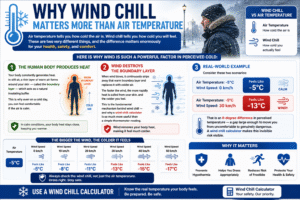
Why Wind Chill Matters More Than Air Temperature
Air temperature tells you how cold the air is. Wind chill tells you how cold you will feel. These are two very different things, and the difference matters enormously for your health, safety, and comfort.
Here is why wind is such a powerful factor in perceived cold:
The Human Body Produces Heat Your body constantly generates heat. In still air, a thin layer of warm air forms around your skin — called the boundary layer — which acts as a natural insulating buffer. This is why even on a cold day, you can feel comfortable if the air is calm.
Wind Destroys the Boundary Layer When wind blows, it continuously strips away that warm boundary layer and replaces it with colder air. The faster the wind, the more rapidly heat is pulled from your skin, and the colder you feel. This is the fundamental mechanism behind wind chill — and why a wind chill calculator is so much more useful than a simple thermometer reading.
Real-World Example Consider these two scenarios:
- Air temperature: -5°C, Wind speed: 0 km/h → Feels like -5°C
- Air temperature: -5°C, Wind speed: 30 km/h → Feels like -13°C
That is an 8-degree difference in perceived temperature — a gap large enough to move you from uncomfortable to genuinely dangerous. A wind chill calculator makes this invisible risk visible.
The Science Behind the Wind Chill Calculator
Our wind chill calculator uses the official NOAA Wind Chill Index formula, which was developed through extensive testing with human subjects and thermal manikins under controlled conditions.
The Formula: WC = 35.74 + (0.6215 × T) − (35.75 × V⁰·¹⁶) + (0.4275 × T × V⁰·¹⁶)
Where:
- WC = Wind Chill temperature in °F
- T = Air temperature in °F
- V = Wind speed in mph
The wind chill calculator converts your inputs automatically — whether you enter temperature in Celsius or Kelvin, or wind speed in km/h, m/s, or knots — into the required units for the formula, then converts the result back into your preferred display unit.
Heat Loss Calculation In addition to the apparent temperature, our wind chill calculator also computes the equivalent heat loss rate using an empirical approximation:
Heat Loss (W/m²) = (10.45 + 10√V − V) × (33 − WC_celsius)
This figure represents how many watts of heat per square metre of exposed skin are lost to the environment. Higher values mean faster heat loss and greater cold stress on the body.
Why is this formula so accurate? The NOAA formula was validated using real measurements from human subjects in wind tunnels and cold chambers. It accounts for the non-linear relationship between wind speed and heat loss — which is why doubling wind speed does not double the wind chill. Our wind chill calculator captures this complexity precisely.
How to Use Our Wind Chill Calculator
Using our wind chill calculator takes less than 30 seconds. Here is a step-by-step guide:
Step 1 – Enter Wind Speed Type the current wind speed in the Wind Speed field. You can enter any value in your preferred unit — mph, km/h, m/s, or knots — and select the unit from the dropdown menu next to the input field.
Step 2 – Enter Air Temperature Type the current air temperature in the Air Temperature field. Select your preferred unit — Fahrenheit (°F), Celsius (°C), or Kelvin — from the dropdown. The wind chill calculator accepts any of these.
Step 3 – Click “Calculate” Press the green Calculate button. The wind chill calculator instantly processes your inputs and displays the result.
Step 4 – Read Your Results The results panel shows:
- The apparent temperature in °C, °F, and Kelvin simultaneously
- The equivalent heat loss in watts per square metre
Step 5 – Clear and Try Again Click Clear to reset both fields and test a different combination of temperature and wind speed.
Pro Tip: Try running the wind chill calculator with the same temperature at different wind speeds to see how dramatically wind affects perceived cold. The results are often surprising — and sobering.
Wind Speed Units Explained – mph, km/h, m/s, and Knots
Our wind chill calculator supports four different wind speed units. Here is a quick reference to understand each one:
Miles per Hour (mph) The standard unit used in weather forecasts in the United States and United Kingdom. The NOAA wind chill formula is based on mph, so the wind chill calculator uses this as its internal calculation base.
Kilometres per Hour (km/h) The standard unit in Canada, Australia, and most of Europe. Our wind chill calculator automatically converts km/h to mph before applying the formula. 1 km/h = 0.621 mph.
Metres per Second (m/s) Used in scientific contexts and by many meteorological agencies globally. The wind chill calculator converts m/s to mph using the factor: 1 m/s = 2.237 mph.
Knots The standard unit for maritime and aviation weather. One knot = 1.151 mph. Enter knots into the wind chill calculator when working with marine weather forecasts or sailing conditions.
Which unit should you use? Use whatever unit your local weather forecast provides. Our wind chill calculator handles all four seamlessly — just select the right unit from the dropdown and the tool does the rest.
Temperature Units in the Wind Chill Calculator – °F, °C, and Kelvin
Our wind chill calculator accepts temperature in three units:
Fahrenheit (°F) The standard temperature scale used in the United States. The NOAA wind chill formula calculates in Fahrenheit. The wind chill calculator displays results in °F among its output values.
Celsius (°C) The standard scale used in most of the world, including Canada, the UK, Europe, and Australia. Enter your temperature in °C and the wind chill calculator automatically converts it to °F for the calculation, then converts the result back to °C for display.
Kelvin (K) Used in scientific and physics contexts. Absolute zero = 0 K, which equals -273.15°C. The wind chill calculator accepts Kelvin input and converts it correctly. At typical outdoor temperatures, Kelvin values will be around 260–280 K.
Conversion Reference:
- °C to °F: (°C × 9/5) + 32
- °F to °C: (°F − 32) × 5/9
- K to °C: K − 273.15
- °C to K: °C + 273.15
Our wind chill calculator applies all of these conversions automatically.
What Is Heat Loss and Why Does the Wind Chill Calculator Show It?
One of the most unique features of our wind chill calculator is the heat loss display — showing the rate of heat loss from exposed skin in watts per square metre (W/m²).
Why does this matter?
Wind chill temperature tells you how cold it feels. Heat loss tells you how fast your body is losing warmth. These are related but distinct pieces of information:
- A low heat loss value (under 600 W/m²) means comfortable conditions with no significant cold risk
- A moderate heat loss value (600–1200 W/m²) indicates uncomfortable conditions — exposed skin cools quickly
- A high heat loss value (1200–2400 W/m²) signals dangerous conditions — frostbite risk increases significantly
- An extreme heat loss value (above 2400 W/m²) represents life-threatening cold exposure on unprotected skin
The wind chill calculator provides this value so you can assess not just how cold it feels, but how quickly that cold is becoming physiologically dangerous. This is particularly important for outdoor workers, hikers, mountaineers, skiers, and anyone spending extended time in cold and windy conditions.
Wind Chill Chart – Quick Reference Guide
Use this chart alongside our wind chill calculator to quickly assess conditions without entering values each time.
| Air Temp (°C) | Wind 10 km/h | Wind 20 km/h | Wind 30 km/h | Wind 40 km/h |
|---|---|---|---|---|
| 0°C | -3°C | -5°C | -7°C | -8°C |
| -5°C | -9°C | -12°C | -14°C | -15°C |
| -10°C | -15°C | -18°C | -20°C | -22°C |
| -15°C | -21°C | -24°C | -27°C | -29°C |
| -20°C | -27°C | -31°C | -34°C | -36°C |
| -25°C | -33°C | -38°C | -41°C | -43°C |
As you can see, even moderate wind speeds cause dramatic drops in apparent temperature. For precise values at your exact conditions, use the wind chill calculator to get accurate results down to the degree.
Real-Life Dangers of Wind Chill – Frostbite and Hypothermia
Understanding wind chill is not just academic — it is a matter of personal safety. The wind chill calculator helps you identify when conditions cross into genuinely dangerous territory.
Frostbite Frostbite occurs when skin and underlying tissue freeze. At a wind chill of -27°C, exposed skin can develop frostbite in 30 minutes. At -40°C wind chill, frostbite can occur in 5 to 10 minutes. Use the wind chill calculator before venturing out to assess your frostbite risk.
Early signs of frostbite:
- Numbness or tingling in fingers, toes, nose, or ears
- Skin turning red, then white or grayish-yellow
- Waxy or hard skin texture
Hypothermia Hypothermia occurs when your core body temperature drops below 35°C (95°F). Wind chill dramatically accelerates heat loss from the entire body surface. The wind chill calculator heat loss figure helps you understand how quickly this process is occurring in current conditions.
Warning signs of hypothermia:
- Intense shivering — the first and most recognizable sign
- Confusion or slurred speech
- Slow, shallow breathing
- Weak pulse
Safety Guidelines Based on Wind Chill Calculator Results:
| Wind Chill | Risk Level | Recommended Action |
|---|---|---|
| 0°C to -9°C | Low | Dress warmly |
| -10°C to -27°C | Moderate | Cover exposed skin |
| -28°C to -39°C | High | Limit time outdoors |
| -40°C to -47°C | Very High | Frostbite in 10 minutes |
| Below -48°C | Extreme | Life-threatening exposure |
Always run the wind chill calculator before outdoor activities in cold, windy weather.
Benefits of Using an Online Wind Chill Calculator
There are clear, concrete benefits to using our wind chill calculator over guessing or relying on air temperature alone:
Instant Accuracy The wind chill calculator applies the NOAA formula precisely — no rounding errors, no manual arithmetic. Results appear in seconds.
Multi-Unit Support Whether you think in Fahrenheit or Celsius, mph or km/h, our wind chill calculator accepts your preferred units and delivers results in all units simultaneously.
Safety-Critical Information The wind chill calculator tells you not just how cold it feels, but how dangerous that cold is — through both the wind chill temperature and the heat loss in W/m².
Free and Always Available Our wind chill calculator requires no subscription, no login, and no download. It is available on any device, anytime.
Mobile Friendly Use the wind chill calculator on your phone at the trailhead, on the ski slope, or before leaving home — it works perfectly on all screen sizes.
Educationally Valuable Students, teachers, and meteorology enthusiasts can use the wind chill calculator to explore how different temperature and wind speed combinations affect apparent temperature and heat loss.

Who Should Use a Wind Chill Calculator?
Our wind chill calculator is designed for a wide range of users:
- Outdoor workers — construction crews, road workers, utility crews exposed to cold and wind
- Hikers and mountaineers — planning routes and assessing exposure risk in alpine conditions
- Skiers and snowboarders — assessing conditions on the mountain before heading out
- Parents — determining whether it is safe for children to play outside on cold, windy days
- Athletes — runners, cyclists, and cross-country skiers assessing cold weather training conditions
- Emergency responders — firefighters and rescue teams working in cold environments
- Meteorologists and students — studying cold weather phenomena and the NOAA formula
- Sailors and boaters — assessing wind chill at sea where wind speeds are often high
- Pilots and aviation professionals — evaluating ground crew cold exposure during winter operations
- Anyone who goes outside in winter — the wind chill calculator is useful for every person who experiences cold, windy weather
Frequently Asked Questions (FAQs)
Q1: What is the wind chill calculator formula based on? Our wind chill calculator uses the official NOAA/North American Wind Chill Index formula, adopted in 2001 after validation with human subjects in wind tunnel testing. It is the global standard for wind chill calculation and the same formula used in official weather forecasts across North America.
Q2: Is wind chill the actual temperature? No. Wind chill is the apparent temperature — how cold exposed human skin feels due to the combined effect of cold air and wind. The actual air temperature remains unchanged. Our wind chill calculator makes this distinction clear by showing both values.
Q3: At what wind speed does the wind chill calculator apply? The official NOAA formula is valid for wind speeds above 4.8 km/h (3 mph). Below this threshold, wind chill equals air temperature. Our wind chill calculator automatically returns the air temperature as the apparent temperature when wind speed is negligible.
Q4: At what temperature does the wind chill calculator apply? The formula is valid at air temperatures at or below 10°C (50°F). Above this temperature, wind chill is not officially defined. Our calculator returns the air temperature as the result when the input temperature exceeds 10°C.
Q5: What does the heat loss figure mean in the wind chill calculator? The heat loss figure (in W/m²) represents how many watts of heat are being lost from each square metre of exposed skin. A higher number means faster heat loss and greater cold danger. Values above 1200 W/m² represent significant frostbite risk, and values above 2400 W/m² are considered life-threatening without adequate protection.
Q6: Can I use the calculator in Fahrenheit? Yes. Our wind chill calculator fully supports Fahrenheit for temperature input and output. Select Fahrenheit °F from the temperature unit dropdown and the tool will display all results — including wind chill — in °F.
Q7: How accurate is the wind chill calculator? Our wind chill calculator is as accurate as the NOAA formula allows — within ±1°C or ±2°F under standard conditions. Accuracy depends on the quality of your inputs. Use accurate weather data for wind speed and temperature for the best results.
Q8: Does the calculator work for knots? Yes. Our wind chill calculator accepts wind speed in knots, which is the standard unit in maritime and aviation weather. Select “knots” from the wind speed unit dropdown and enter your value.
Q9: Can children get frostbite faster than adults? Yes. Children have a higher surface-area-to-body-mass ratio and less body fat than adults, meaning they lose heat faster. Use the wind chill calculator before sending children outdoors in cold, windy conditions and dress them for the wind chill temperature, not the air temperature.
Q10: Is the calculator free to use? Yes, our wind chill calculator is completely free with no registration or subscription required. Use it as many times as you need across any device — mobile, tablet, or desktop.
Conclusion
Wind chill is one of the most misunderstood and underestimated weather factors in everyday life. Millions of people dress for the air temperature and are caught off guard by how cold the wind makes them feel — sometimes with dangerous consequences. Frostbite, hypothermia, and cold-related illness are preventable — but only if you know the real apparent temperature before you step outside.
Our free calculator gives you that information instantly and accurately. Using the official NOAA Wind Chill Index formula, it converts your air temperature and wind speed into a precise apparent temperature across multiple units, and even tells you the rate of heat loss from exposed skin. Whether you are planning a winter hike, sending your kids out to play, heading to a ski slope, or working outdoors in cold conditions, the calculator is the most important weather tool you can use.
Key takeaways from this guide:
- A calculator calculates how cold exposed skin actually feels, combining air temperature and wind speed
- The NOAA formula used in our wind chill calculator is the global standard for apparent temperature calculation
- Wind chill can make a -5°C day feel like -13°C — a difference with serious safety implications
- Our wind chill calculator supports mph, km/h, m/s, and knots for wind speed and °C, °F, and Kelvin for temperature
- At wind chill values below -27°C, frostbite can develop on exposed skin in under 30 minutes
- The heat loss reading in our wind chill calculator tells you how rapidly your body is losing heat
- Our wind chill calculator is free, instant, and works on all devices
Do not let wind chill catch you unprepared. Use our wind chill calculator every time you check the weather in winter — and dress for the wind chill, not just the thermometer.