Electricity Calculator
Calculate Density, Mass, and Volume with Fast and Accurate Results Using Our Free Density Calculator
Table of Contents
- Introduction
- What Is an Electricity Calculator?
- How an Electricity Calculator Works
- Key Inputs Every Electricity Calculator Uses
- Understanding Your Monthly Electricity Bill
- Appliance-by-Appliance Energy Breakdown
- How to Reduce Your Electricity Bill Using an Electricity Calculator
- Electricity Calculator for Households vs. Businesses
- Billing Cycles – Monthly, Quarterly, and Yearly Estimates
- Efficiency Ratings and How They Change Your Calculation
- Common Mistakes When Estimating Electricity Costs
- FAQs
- Conclusion
Introduction
Electricity is one of the largest recurring expenses in any home or business, yet most people have no clear idea what is actually driving their monthly bill. They receive a statement, pay it, and repeat the cycle without ever understanding which appliances are consuming the most energy or where savings can be made. That cycle of financial guesswork ends the moment you start using an Electricity Calculator.
An Electricity Calculator is a practical, data-driven tool that transforms raw usage numbers — wattage, hours of use, local tariff rates — into accurate cost estimates. Whether you want to know what your air conditioner costs each month, how much a water heater adds to your annual bill, or how changing your usage habits by one hour per day could save you hundreds of dollars per year, the Electricity Calculator gives you a precise, itemized answer in seconds.
This guide covers everything you need to know: how an Electricity Calculator works, what every input means, how to interpret the results, how different appliances compare in energy consumption, and how to use the tool strategically to cut costs. Whether you are a homeowner trying to trim household expenses, a renter wanting to understand your share of utility costs, or a business owner managing operational overhead, mastering the Electricity Calculator is one of the highest-return habits you can build.
By the end of this guide, you will not just know how to run a calculation — you will understand why each number matters, what to do with the result, and how to use your Electricity Calculator on an ongoing basis to track, compare, and reduce your energy spending.
What Is an Electricity Calculator?
An Electricity Calculator is a digital tool that computes the cost of electrical energy consumed by one or more appliances over a defined time period. It uses a straightforward but powerful formula to translate physical energy consumption — measured in kilowatt-hours (kWh) — into monetary cost based on your local electricity tariff.
At its most basic level, an Electricity Calculator asks three questions:
- How much power does the appliance consume? (Watts)
- How long is it running? (Hours per day, days per month)
- How much does your electricity provider charge per kWh?
From those three values, the tool calculates daily energy consumption, monthly energy consumption, base cost, applicable taxes, fixed charges, and total bill — all within a single interface.
A well-designed Electricity Calculator goes several steps further by incorporating:
- Appliance presets — Air conditioners, refrigerators, water heaters, and other common appliances with pre-loaded wattage values
- Billing cycle selection — Monthly, quarterly, or yearly projections
- Multi-currency support — USD, EUR, GBP, INR/PKR, and other denominations
- Tax rate fields — Local electricity taxes applied as a percentage of the base cost
- Fixed charges — Standing charges, meter rental fees, and service charges that appear on every bill regardless of usage
- Efficiency ratings — Standard (100%), eco-friendly (90%), or high-load (110%) multipliers that reflect real-world appliance performance
The Electricity Calculator is used by:
- Homeowners comparing appliances before purchase
- Renters splitting utility bills fairly among housemates
- Small business owners budgeting operational electricity costs
- Students and engineers learning about energy consumption principles
- Property managers estimating utility costs for rental units
How an Electricity Calculator Works
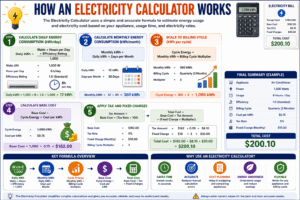
The core calculation of any Electricity Calculator follows a well-established energy cost formula. Understanding this formula helps you use the tool more intelligently and interpret results with confidence.
Step 1 — Calculate Daily Energy Consumption (kWh/day):
Daily kWh = (Watts × Hours per Day × Efficiency Rating) ÷ 1,000
For example, a 1,500-watt air conditioner running 8 hours per day at standard efficiency:
1,500 × 8 × 1.0 ÷ 1,000 = 12 kWh per day
Step 2 — Calculate Monthly Energy Consumption:
Monthly kWh = Daily kWh × Days per Month
12 × 30 = 360 kWh per month
Step 3 — Scale to Billing Cycle:
Cycle Energy = Monthly kWh × Billing Cycle Multiplier
For a quarterly bill: 360 × 3 = 1,080 kWh
Step 4 — Calculate Base Cost:
Base Cost = Cycle Energy × Cost per kWh
At $0.15/kWh: 1,080 × 0.15 = $162.00
Step 5 — Apply Tax and Fixed Charges:
Tax Amount = Base Cost × (Tax Rate ÷ 100) Total Cost = Base Cost + Tax Amount + (Fixed Charge × Billing Cycle Multiplier)
At 5% tax and $10 fixed monthly charge:
Tax = $162 × 0.05 = $8.10 Fixed = $10 × 3 = $30.00 Total = $162.00 + $8.10 + $30.00 = $200.10
This is exactly what the Electricity Calculator computes instantly — a result that would take several minutes of manual arithmetic and is prone to unit-conversion errors if done by hand.
Key Inputs Every Electricity Calculator Uses
Understanding each input field helps you enter accurate data and get reliable results. Here is a detailed explanation of every parameter your cost estimator tool uses.
Appliance Type Most calculators include a dropdown with common appliances. Selecting “Air Conditioner” automatically loads the default wattage for that appliance type. You can override the wattage manually if your specific model differs.
Power (Watts) This is the single most important input. It determines how much energy the appliance draws per hour. Find this value on the appliance label, in the user manual, or on the manufacturer’s website. For variable-load appliances like refrigerators, use the average running wattage, not the peak startup wattage.
Hours per Day How many hours the appliance runs on a typical day. Be honest with this estimate — overestimating gives inflated costs, underestimating hides real spending.
Days per Month Default is 30 days, but seasonal appliances may run fewer days. A pool heater used only in summer months, for example, should reflect actual days of operation.
Cost per kWh Your local electricity tariff rate, shown on your utility bill. This rate varies significantly by country, state, and even time of day. In the US, the national average is approximately $0.13–$0.16/kWh. In the UK it exceeds £0.30/kWh. In Pakistan and India, residential tariffs vary by slab.
Billing Cycle Choose monthly (×1), quarterly (×3), or yearly (×12) to project costs over different time horizons. Viewing yearly costs often creates the clearest motivation to change usage habits — what looks like a small daily cost becomes a striking annual figure.
Currency Select your currency symbol for correctly formatted output. The tool supports USD ($), EUR (€), GBP (£), and INR/PKR (₹).
Tax Rate (%) Many utility providers apply a percentage tax on the base cost of electricity. Enter your local tax rate to get a fully loaded cost estimate.
Fixed Charge A flat monthly fee that appears on every bill regardless of consumption. This covers meter rental, grid maintenance, and service fees. Do not omit this — it can represent $10–$30 or more per month and significantly affects total cost at low consumption levels.
Efficiency Rating
- Standard (100%) — Default for most appliances running at rated capacity
- Eco-Friendly (90%) — Applies when an appliance draws slightly less than rated wattage due to energy-saving modes
- High Load (110%) — Applies when an appliance runs above rated capacity, typical under heavy load or in hot climates
Understanding Your Monthly Electricity Bill
Your electricity bill is not just a single number. It is a combination of several charges, and failing to account for all of them leads to underestimated budgets. An energy cost estimator breaks the bill into its true components.
Energy Charge (Base Cost) The largest component. It is directly proportional to how many kWh you consumed during the billing period, multiplied by the per-unit tariff rate. This is the only part you can directly reduce by changing appliance usage habits.
Tax Amount A percentage applied to the base energy charge. Electricity taxes vary by jurisdiction and can range from 0% in some regions to over 20% in others.
Fixed/Standing Charges A flat fee that appears on every bill. Even if you consume zero electricity, this charge still applies. It covers the cost of maintaining your connection to the grid.
Fuel or Regulatory Surcharges Some utilities add pass-through charges for fuel costs, renewable energy programs, or regulatory compliance. These are often listed as separate line items. Add these to your fixed charge field for a more complete estimate.
Total Bill The sum of all the above. An Electricity Calculator that breaks down each component separately gives you far more actionable insight than one that just outputs a single total number.
Appliance-by-Appliance Energy Breakdown
One of the most powerful uses of a power cost estimator is comparing the consumption of different appliances side by side. Here is a reference breakdown based on typical wattage values and 5 hours of daily use at $0.15/kWh for 30 days.
| Appliance | Typical Wattage | Monthly kWh | Monthly Cost |
|---|---|---|---|
| Air Conditioner | 1,500 W | 225 kWh | $33.75 |
| Water Heater | 2,000 W | 300 kWh | $45.00 |
| Refrigerator | 100 W | 15 kWh | $2.25 |
| Washing Machine | 500 W | 75 kWh | $11.25 |
| Microwave | 1,000 W | 150 kWh | $22.50 |
| LED TV (55″) | 100 W | 15 kWh | $2.25 |
| Desktop Computer | 200 W | 30 kWh | $4.50 |
| Electric Oven | 2,400 W | 360 kWh | $54.00 |
| Ceiling Fan | 75 W | 11.25 kWh | $1.69 |
| LED Bulb (10W) | 10 W | 1.5 kWh | $0.23 |
Key insight from this table: The electric oven and water heater are the top two energy consumers in most homes. Reducing their daily use by even one hour creates significant monthly savings. Run each appliance through your energy cost tool individually to see exactly what each one costs your household.
How to Reduce Your Electricity Bill Using an Electricity Calculator
The Electricity Calculator is not just a reporting tool — it is a planning tool. By changing input values and observing the output, you can model savings before you commit to any behavioral or equipment change.
Strategy 1 — Reduce Daily Hours of Use Run the calculation with your current hours, then reduce by 1–2 hours and compare. For a 1,500W air conditioner at $0.15/kWh, cutting use from 10 hours to 7 hours per day saves approximately $20.25 per month — $243 per year.
Strategy 2 — Switch to Lower-Wattage Appliances Replace a 2,400W electric oven with a 1,000W microwave for certain cooking tasks. The energy cost tool will instantly show you the savings per month.
Strategy 3 — Select Eco-Friendly Efficiency Mode Some modern appliances consume 10–15% less power through energy-saving modes. Enter 90% efficiency and observe the cost reduction.
Strategy 4 — Adjust Billing Cycle View Switch the billing cycle from monthly to yearly. Seeing $243 in annual savings rather than $20 monthly savings creates a stronger psychological incentive to change habits.
Strategy 5 — Account for Tax and Fixed Charges Many people underestimate their bill because they forget taxes and standing charges. Running the full calculation — including these fields — gives you an accurate picture of your true cost per appliance.
Strategy 6 — Compare Appliance Presets Use the appliance type dropdown to load preset values for common devices. Compare a standard refrigerator (100W) to a second older unit (180W) and see exactly how much the older model costs annually — often the justification needed to replace it.
Electricity Calculator for Households vs. Businesses
The same core calculation applies to both domestic and commercial settings, but the scale, inputs, and interpretation differ meaningfully.
For Households:
- Focus on individual appliance costs
- Track seasonal variation (higher air conditioning costs in summer)
- Use monthly billing cycle to match your utility bill
- Compare usage before and after behavioral changes
For Businesses:
- Model energy costs for multiple appliances running simultaneously
- Use quarterly or yearly billing cycles to align with accounting periods
- Factor in higher commercial tariff rates if applicable
- Calculate energy cost as a percentage of operating overhead
A business operating ten computers (200W each), three air conditioning units (1,500W each), and general lighting (500W total) running 8 hours per day for 22 working days per month at $0.15/kWh would accumulate:
- Computers: 10 × 200 × 8 × 22 ÷ 1,000 = 352 kWh
- Air Conditioning: 3 × 1,500 × 8 × 22 ÷ 1,000 = 792 kWh
- Lighting: 500 × 8 × 22 ÷ 1,000 = 88 kWh
- Total: 1,232 kWh × $0.15 = $184.80/month before taxes and fixed charges
Running each of these separately through a bill estimator gives a detailed breakdown that helps a business owner identify which equipment represents the largest energy overhead and where investment in efficiency would deliver the best return.
Billing Cycles – Monthly, Quarterly, and Yearly Estimates
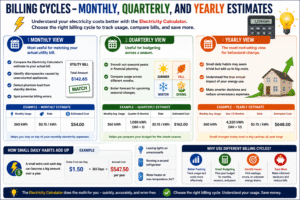
Choosing the right billing cycle changes how you see and act on your electricity costs. Each cycle view serves a different purpose.
Monthly View Most useful for matching your actual utility bill. When your bill arrives, you can compare the Electricity Calculator’s estimate to the billed amount and identify discrepancies caused by unaccounted appliances, phantom load from standby devices, or billing errors.
Quarterly View Useful for budgeting across a season. Summer months with heavy air conditioning use differ sharply from winter months. A quarterly view helps smooth out seasonal peaks in financial planning.
Yearly View The most motivating view for behavioral change. Small daily habits — leaving lights on, running a second refrigerator in the garage, keeping a water heater at maximum temperature 24/7 — that seem trivial on a daily basis accumulate into striking annual figures. A $1.50/day habit costs $547.50 per year.
Efficiency Ratings and How They Change Your Calculation
The efficiency rating multiplier in your energy usage calculator reflects real-world performance variation. No appliance operates at exactly its rated wattage under all conditions.
Standard (100% Efficiency) Applies to appliances operating at rated conditions in typical environments. Use this as the default for new appliances in temperate climates.
Eco-Friendly (90% Efficiency) Applies to appliances with energy-saving modes, inverter technology, or modern efficiency standards. A modern inverter air conditioner drawing 10% less than its rated wattage is modeled accurately with this setting.
High Load (110% Efficiency) Applies in conditions where an appliance works harder than rated — an air conditioner cooling a poorly insulated room in extreme heat, a water heater in a very cold climate, or an oversized refrigerator in a hot garage. Using 110% for these scenarios prevents underestimation of actual costs.
Efficiency rating is a multiplier applied to the wattage input before the kWh calculation. A 1,500W air conditioner at 110% efficiency is treated as a 1,650W unit in the formula, accurately reflecting its real-world consumption.
Common Mistakes When Estimating Electricity Costs
Even with a reliable bill estimator, certain common input errors lead to inaccurate results. Being aware of these pitfalls helps you get more reliable estimates.
Using Peak Wattage Instead of Running Wattage Many appliances — particularly motors and compressors — draw significantly more power at startup than during steady-state operation. A refrigerator may spike to 400W at startup but run at 100W during normal operation. Always use the average running wattage, not the startup peak.
Ignoring Standby Power Draw Televisions, gaming consoles, phone chargers, and smart devices draw power even when not actively in use. A device drawing just 5W in standby mode 24 hours a day consumes 3.6 kWh per month. Across 10 such devices, that is 36 kWh — an invisible cost that your energy usage calculator will not capture unless you add it explicitly.
Forgetting Fixed Charges Many users calculate only the energy cost and ignore fixed charges. On low-consumption months, fixed charges can represent 20–30% of the total bill — omitting them leads to significant underestimation.
Using the Wrong Tariff Rate Utility rates vary by time of day (time-of-use tariffs), consumption slab (tiered pricing), and customer type (residential vs. commercial). Always use the tariff rate that applies to your actual consumption level and usage pattern.
Underestimating Daily Hours It is easy to guess “4 hours” for an appliance that actually runs 6–7 hours. Track actual usage for a few days before entering the figure to get a realistic estimate.
Skipping the Efficiency Rating Using 100% efficiency for an old, inefficient appliance that actually consumes 15% more than its rated wattage means your estimate is systematically low. Apply 110% for aging or heavily loaded appliances.
FAQs
What is an Electricity Calculator used for? An Electricity Calculator is used to estimate the cost of running electrical appliances over a given time period. It uses wattage, daily usage hours, days of operation, and the local electricity tariff to compute daily, monthly, and yearly energy costs — including taxes and fixed charges.
How do I find the wattage of my appliance? Check the label on the back or bottom of the appliance. It will typically show a value like “1500W” or “1.5kW”. You can also find it in the product manual or on the manufacturer’s website. For variable-load devices, use the typical running wattage.
Why does my actual bill differ from the calculator estimate? Several factors can cause differences: standby power draw from other devices, time-of-use tariff variations, billing adjustments by your utility, and seasonal efficiency changes in appliances. Use the energy usage calculator as an approximation and compare it to your bill over several months to refine your inputs.
Can I use an Electricity Calculator for solar panel planning? Yes. By knowing your total monthly kWh consumption across all appliances, you can size a solar PV system to offset that consumption. Run every appliance through the calculation tool individually, sum the monthly kWh figures, and use that total to determine your solar panel capacity requirements.
What is a kWh and why does it matter? A kilowatt-hour (kWh) is the standard unit of electrical energy measurement. One kWh equals one kilowatt of power consumed continuously for one hour. It is the unit your electricity meter counts and the unit your provider charges you for. All energy cost calculations hinge on converting watt-hours to kWh.
How accurate is the Electricity Calculator? Accuracy depends entirely on the quality of your inputs. If your wattage, daily hours, and tariff rate are correct, the output will closely match your actual bill. The main source of inaccuracy is underestimating daily usage or using peak wattage instead of running wattage.
Does the calculator account for multiple appliances? The standard interface calculates one appliance at a time. To estimate whole-house consumption, run each appliance separately and sum the results. Some advanced versions of the bill estimator allow multi-appliance entry within a single session.
Can I calculate electricity costs in Pakistani Rupees or Indian Rupees? Yes. Select the ₹ (INR/PKR) currency option and enter your local tariff rate in rupees per kWh. The output will then display costs in your local currency denomination.
Conclusion
Electricity costs are controllable — but only if you understand them. The guesswork ends the moment you start using an Electricity Calculator as a regular part of your household or business financial routine.
The Electricity Calculator gives you instant visibility into what every appliance costs per day, per month, per billing cycle, and per year. It accounts for wattage, usage hours, local tariff rates, taxes, fixed charges, and efficiency ratings — delivering a complete, itemized cost breakdown that matches the structure of your actual utility bill.
The range of insights your energy cost tool provides covers every scenario: from comparing two appliances before purchase, to modeling the savings from reducing daily usage by one hour, to projecting the annual energy cost of running an entire office. Every decision made with the tool is grounded in accurate numbers rather than estimates.
Small changes, when calculated accurately, reveal large annual savings. Replacing one high-wattage appliance, adjusting usage habits for peak-tariff hours, or adding insulation to reduce the load on your air conditioner — all of these decisions become quantifiable through a reliable bill estimator.
Use an Electricity Calculator for every appliance in your home or business, enter honest usage figures, include your actual tariff rate with taxes and fixed charges, and review the results at monthly and yearly time horizons. The result is not just an accurate cost estimate — it is a financial strategy based on real data.
The foundation of every smart energy decision is accurate measurement — and that starts with your Electricity Calculator.