Find Your Perfect Bra Fit with Accurate Measurements Using Our Bra Size Calculator
Table of Contents
- Introduction
- What Is a Dice Roller?
- How a Dice Roller Works
- Types of Dice and Their Uses
- Virtual Dice Roller vs. Physical Dice
- How to Use a Dice Roller for Board Games
- Dice Roller for Tabletop RPGs and D&D
- Non-Conventional Dice Roller Explained
- Probability and Statistics Behind Dice Rolling
- Benefits of Using a Dice Roller Online
- Common Mistakes to Avoid When Rolling Dice
- FAQs
- Conclusion
Introduction
Whether you are playing a classic board game, running a Dungeons & Dragons campaign, or settling a friendly dispute, a dice roller is one of the most reliable and convenient tools you can use. Rolling dice is at the heart of countless games, simulations, and decision-making activities, and having a fast, accurate, and accessible way to roll them matters more than many people realize.
A dice roller removes the need for physical dice entirely. It generates random results instantly, works on any device, and supports a wide range of die types — from the standard six-sided die to custom dice with any number of sides. Whether you are at home, traveling, or in the middle of a tabletop session without your dice bag, a random roller has you covered.
This guide covers everything you need to know — how a online roller works, the different types of dice it supports, how probability applies to rolls, and why online rolling tools have become the go-to choice for millions of players and hobbyists worldwide.
What Is a Dice Roller?
A dice roller is a digital tool that simulates the random outcome of rolling one or more dice. It replicates the behavior of physical dice using a random number generator (RNG), producing results that are statistically equivalent to physical rolling — without the chance of a die landing off the table or an argument over a crooked roll.
The standard dice roller handles the most common die in gaming — the six-sided die (d6). However, modern rolling tools support a full range of polyhedral dice used in tabletop role-playing games, including four-sided (d4), eight-sided (d8), ten-sided (d10), twelve-sided (d12), and twenty-sided (d20) dice. Some tools go even further, allowing you to set any number of sides, making them a true non-conventional random roller.
A online roller is used by:
- Board game players who need quick, reliable random numbers
- Tabletop RPG players running complex multi-dice rolls
- Teachers and educators using dice for probability lessons
- Game developers testing dice mechanics
- Anyone making random decisions in everyday life
How a Dice Roller Works
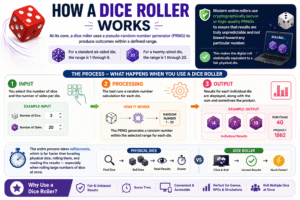
At its core, a dice roller uses a pseudo-random number generator (PRNG) to produce outcomes within a defined range. For a standard six-sided die, the range is 1 through 6. For a twenty-sided die, the range is 1 through 20. The generator picks a number at random within that range and displays the result.
Modern online rollers use cryptographically secure or high-quality PRNGs to ensure that results are truly unpredictable and not biased toward any particular number. This makes the digital roll statistically equivalent to a fair physical die.
Here is a simplified breakdown of what happens when you use a rolling tool:
- Input: You select the number of dice and the number of sides per die.
- Processing: The tool runs a random number calculation for each die.
- Output: Results for each individual die are displayed, along with the sum and sometimes the product.
The entire process takes milliseconds, which is far faster than locating physical dice, rolling them, and reading the results — especially when rolling large numbers of dice at once.
Types of Dice and Their Uses
A well-built dice roller supports every standard die type used in gaming and simulation. Understanding which die to use for which purpose helps you get the most out of any online roller.
d4 – Four-Sided Die The d4 is a pyramid-shaped die used in games like D&D for damage rolls with small weapons. It produces results of 1 through 4.
d6 – Six-Sided Die The most common die in existence. Used in board games like Monopoly, Yahtzee, Risk, and countless others. A standard rolling tool defaults to the d6.
d8 – Eight-Sided Die Used in tabletop RPGs for medium weapon damage rolls. Produces results of 1 through 8.
d10 – Ten-Sided Die Used in percentile systems and RPGs. Two d10s can combine for a 1–100 range.
d12 – Twelve-Sided Die Used for heavy weapon damage rolls in D&D and similar games.
d20 – Twenty-Sided Die The iconic die of Dungeons & Dragons. Used for attack rolls, saving throws, and skill checks. One of the most frequently used dice in any random roller for RPG play.
Custom / Non-Conventional Dice A non-conventional online roller allows you to set any number of sides — d3, d7, d13, d30, d100, or beyond. This is useful for custom game mechanics, probability experiments, and simulations.
Virtual Dice Roller vs. Physical Dice
Many players debate whether a virtual dice roller is equivalent to rolling real dice. Here is an honest comparison:
| Feature | Physical Dice | Virtual online roller |
|---|---|---|
| Portability | Requires carrying dice | Available on any device |
| Speed | Slower, manual | Instant results |
| Fairness | Can be biased by imbalance | Mathematically unbiased |
| Variety | Limited to dice you own | Any die type, any quantity |
| Accessibility | Can be lost or damaged | Always available online |
The virtual dice roller wins on convenience, consistency, and accessibility. Physical dice add a tactile and theatrical element that many players enjoy, but for pure randomness and reliability, a digital random roller delivers equally valid results.
For online play, remote tabletop sessions, or situations where physical dice are unavailable, a online roller is the clear practical choice.
How to Use a Dice Roller for Board Games
Board games have relied on dice for centuries. From ancient games to modern classics, dice rolling is the mechanism that introduces chance, suspense, and replayability. A random roller fits perfectly into any board game session.
To use a online roller for board games:
- Select the number of dice you need (most board games use 1 or 2 standard d6 dice).
- Click or tap the roll button.
- Read the result and apply it to your game.
Common board games that benefit from a rolling tool include:
- Monopoly (2 d6 dice)
- Risk (1–3 d6 dice per attack or defense)
- Yahtzee (5 d6 dice per turn)
- Settlers of Catan (2 d6 dice per turn)
- Backgammon (2 d6 dice)
When playing online or over video call, a shared random roller ensures that all players trust the results — no one can accuse another player of a biased roll or a hidden re-roll. The online roller acts as a neutral, automated referee.
Dice Roller for Tabletop RPGs and D&D
Tabletop role-playing games are the primary home of complex dice rolling. A Dungeons & Dragons session can require dozens of different rolls per session — attack rolls, damage rolls, saving throws, skill checks, initiative rolls, and more. A powerful random roller handles all of these with ease.
In D&D and similar systems, a online roller must support:
- Multiple dice types in a single roll (e.g., 2d6 + 1d8)
- Adding modifiers to roll results (e.g., roll d20 + 5)
- Rolling advantage or disadvantage (roll twice, take highest or lowest)
- Custom die sizes for homebrew mechanics
A dice roller for D&D is practically essential for online play, whether you are using a virtual tabletop platform or running a session over a video call. It keeps the game moving, eliminates disputes over results, and supports every mechanical need the game requires.
Dungeon Masters especially benefit from a random roller when running combat with multiple enemies, each requiring their own attack and damage rolls. What would take minutes with physical dice takes seconds with a good online roller.
Non-Conventional rolling tool Explained
Not all dice follow the standard polyhedral shapes. Many custom games, simulations, and experiments require dice with unusual numbers of sides. A non-conventional dice roller gives you the freedom to define any die you need.
How a non-conventional online roller works:
- You enter the number of sides (e.g., 7, 13, 30, 100).
- You enter the number of dice to roll.
- The tool generates random results within the range of 1 to your chosen number of sides.
- The sum and product of all rolls are displayed alongside individual results.
Use cases for a non-conventional rolling tool include:
- Custom board game mechanics with unique die types
- Classroom probability experiments using unusual distributions
- Wargames and simulations requiring non-standard randomness
- Decision-making tools where you assign options to numbers
The non-conventional random roller is especially valuable for game designers and educators who need precise control over the random range their tool produces.
Probability and Statistics Behind Dice Rolling
Understanding the mathematics behind a dice roller makes you a smarter player and a better game designer. Every die roll is a probability event with predictable long-term distributions.
For a fair six-sided die:
- Each face (1–6) has a 1 in 6 chance (approximately 16.7%) of appearing on any single roll.
- Over many rolls, the results tend toward an equal distribution across all faces.
For two six-sided dice rolled together (2d6):
- The possible sums range from 2 to 12.
- 7 is the most likely result, with six combinations producing it.
- 2 and 12 are the least likely, with only one combination each.
A rolling tool faithfully replicates this probability distribution because its RNG is designed to give each outcome an equal chance on every independent roll.
Key probability concepts relevant to dice rolling:
- Independent events: Each roll is independent of the last — a die has no memory.
- Expected value: The average result of many rolls. For a d6, the expected value is 3.5.
- Variance: How spread out results are. More dice = results cluster closer to the average.
For game designers, understanding these distributions helps balance mechanics. A random roller is a useful testing tool — run hundreds of simulated rolls to verify that your game’s mechanics behave as expected.
Benefits of Using a Dice Roller Online
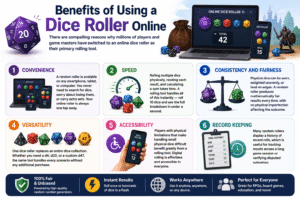
There are compelling reasons why millions of players and game masters have switched to an online dice roller as their primary rolling tool.
Convenience A random roller is available on any smartphone, tablet, or computer. You never need to search for dice, worry about losing them, or carry extra sets. Your online roller is always one tap away.
Speed Rolling multiple dice physically, reading each result, and calculating a sum takes time. A rolling tool handles all of this instantly — roll 10 dice and see the full breakdown in under a second.
Consistency and Fairness Physical dice can be worn, weighted unevenly, or land on edges. A random roller produces mathematically fair results every time, with no physical imperfection affecting the outcome.
Versatility One dice roller replaces an entire dice collection. Whether you need a d4, d20, or a custom d47, the same tool handles every scenario without any additional purchase.
Accessibility Players with physical limitations that make handling small physical dice difficult benefit greatly from a rolling tool. Digital rolling is effortless and accessible to everyone.
Record Keeping Many random rollers display a history of recent rolls, which is useful for tracking results across a long game session or verifying disputed outcomes.
Common Mistakes to Avoid When Rolling Dice
Even when using a online roller, certain mistakes can affect your gaming experience or produce incorrect results.
Using the wrong die type Always confirm which die the rules require before rolling. A rolling tool is only as useful as the inputs you give it — entering the wrong number of sides produces irrelevant results.
Ignoring modifiers Many game systems require you to add or subtract modifiers from your roll. A random roller gives you the raw number — remember to apply any relevant bonuses or penalties afterward.
Rolling the wrong number of dice Doublecheck that you have selected the correct quantity of dice. In D&D, damage rolls often involve multiple dice of the same type (e.g., 3d6), and entering the wrong count changes the result significantly.
Assuming a online roller is biased Some players distrust a rolling tool after a streak of low results. This is a normal feature of randomness — short streaks of good or bad results do not indicate a broken random roller. Over thousands of rolls, the distribution will even out.
Not using advantage/disadvantage correctly In D&D 5e, advantage means rolling 2d20 and taking the highest result. Disadvantage means taking the lowest. Many online online rollers support this mechanic directly — use it correctly to follow the rules.
FAQs
What is a dice roller used for? A dice roller simulates the random outcome of rolling one or more physical dice. It is used in board games, tabletop RPGs, educational settings, and anywhere a random number within a specific range is needed.
Is an online dice roller truly random? Yes. A quality dice roller uses a pseudo-random number generator that produces statistically unbiased results. The outcomes are as random as a fair physical die — and in many cases more consistent, since digital dice have no physical imperfections.
Can I roll multiple types of dice at once? Many random roller tools allow you to combine different die types in one roll — for example, rolling a d6 and a d20 simultaneously. This is especially useful in tabletop RPGs where different dice are used for different parts of a single action.
What is a non-conventional online roller? A non-conventional rolling tool lets you set a custom number of sides on your die. Instead of limiting you to standard polyhedral shapes, it generates random results for any range you define — a d7, d13, d30, or any other value.
Is a random roller allowed in official game tournaments? This depends entirely on the tournament rules. Many organized events require physical dice to maintain a standardized, verifiable process. Always check the specific rules of any tournament or organized event before substituting a online roller for physical dice.
How many dice can I roll at once? Most rolling tool tools allow you to roll any number of dice simultaneously — from a single die up to dozens. The tool displays each individual result and the total sum, making it easy to apply results to your game.
Can a random roller help me learn probability? Absolutely. A online roller is an excellent educational tool for exploring probability concepts. Roll a single die hundreds of times and observe the distribution, or experiment with multiple dice to see how sums cluster toward the middle of the range.
What is the difference between d6 and d20 in a rolling tool? A d6 in a random roller produces a result from 1 to 6, while a d20 produces a result from 1 to 20. The d6 is the standard die used in most board games; the d20 is the signature die of Dungeons & Dragons and other RPGs.
Conclusion
A dice roller is one of the most practical, versatile, and accessible tools available to anyone who plays games, runs simulations, or works with probability. It replaces an entire physical dice collection with a single digital tool, delivers mathematically fair results instantly, and supports every die type from the common d6 to fully custom non-conventional dice.
Whether you are a casual board game player, a dedicated D&D Dungeon Master, a teacher illustrating probability, or a game designer testing mechanics, a dice roller delivers exactly what you need — fast, fair, and reliable random results.
The ability to roll any die, in any quantity, at any time, without physical equipment, is a genuine advantage in the modern gaming world. A dice roller bridges the gap between traditional tabletop gaming and digital convenience, making it possible to enjoy the same randomness and excitement of physical dice regardless of where you are or what equipment you have available.
Use a dice roller for every game, every session, and every situation where a fair random number matters. The combination of speed, accuracy, versatility, and accessibility — delivered consistently by a trustworthy rolling tool — is the foundation of a smooth, enjoyable, and fair gaming experience.