Encode & Decode URLs Instantly – URL Encode & Decode
Table of Contents
- Introduction
- What Is a Day Counter?
- How a Day Counter Calculates Days
- How to Use a Day Counter Step by Step
- Day Counter: Understanding the Results
- Real-World Uses of a Day Counter in Everyday Life
- Day Counter for Project and Business Planning
- Day Counter for Health, Fitness, and Wellness Goals
- Day Counter for Special Events and Milestones
- Day Counter vs. Date Calculator – Key Differences
- Tips for Getting Accurate Results From a Day Counter
- Common Mistakes When Using a Day Counter
- FAQs
- Conclusion
Introduction
Time is the one resource that cannot be refunded, recovered, or borrowed — and keeping accurate track of it is essential for nearly every goal-oriented endeavor in life. Whether you are counting down to a wedding, tracking how long you have maintained a healthy habit, monitoring the duration of a business contract, managing a project deadline, or simply calculating how many days until your next vacation, you need one thing: an accurate, reliable day counter. A single miscalculation of days can mean missed deadlines, failed planning, and wasted time — all avoidable with the right tool.
A day counter is a simple but extraordinarily useful digital tool that calculates the exact number of days between any two dates you specify. You enter a start date and an end date, click Calculate, and the tool immediately returns the total number of days elapsed between those two dates — along with the equivalent in weeks for easy reference. No calendars to count through manually. No arithmetic to verify. No risk of miscounting across month boundaries, leap years, or the uneven lengths of different calendar months. A day counter does the work instantly and flawlessly every time.
This comprehensive guide explains everything you need to know about day counting — how a day counter works mathematically, who uses it and why, real-world examples across personal, professional, health, and event planning contexts, tips for accurate usage, and answers to the most frequently asked questions. Whether you are a complete beginner or someone who already uses date-based tracking regularly, this guide will show you how a day counter can make time-based planning more precise, more dependable, and significantly easier to manage.
What Is a Day Counter?
A this tool is a digital tool that computes the number of days between two calendar dates — a start date and an end date — and displays the result as a total day count and its equivalent in weeks. You select your two dates from a date picker, press Calculate, and the tool returns the duration instantly.
The key inputs for a this tool are:
- Start Date — the earlier date marking the beginning of the period you want to measure
- End Date — the later date marking the end of the period you want to measure
From these two inputs, a this tool returns:
- Total Days — the exact number of days between the two dates
- Total Weeks — the number of days expressed as weeks, rounded to one decimal place for easy context
A this tool is used by people in virtually every walk of life:
- Students and academics tracking assignment deadlines, exam dates, and semester lengths
- Project managers and business professionals monitoring contract durations, project timelines, and milestone intervals
- Health and fitness enthusiasts counting days of a diet, exercise streak, sobriety milestone, or wellness challenge
- Event planners and individuals counting down to weddings, anniversaries, vacations, and celebrations
- HR and legal professionals calculating notice periods, probationary durations, and contract terms
- Parents and families tracking pregnancy milestones, children’s ages, and school calendar events
How a Day Counter Calculates Days
Understanding how a this tool performs its calculation helps you use it with confidence and verify results when precision matters.
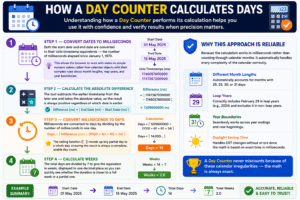
The Underlying Mathematics A this tool works by computing the absolute difference between two date values expressed in milliseconds — the standard way modern programming languages and web browsers represent dates internally.
Step 1 — Convert Dates to Milliseconds Both the start date and end date are converted to their Unix timestamp equivalents — the number of milliseconds elapsed since January 1, 1970. This allows the browser to work with dates as simple numeric values rather than calendar objects with their complex rules about month lengths, leap years, and year boundaries.
Step 2 — Calculate the Absolute Difference The tool subtracts the earlier timestamp from the later one and takes the absolute value, so the result is always positive regardless of which date is earlier:
Difference (ms) = |End Date (ms) − Start Date (ms)|
Step 3 — Convert Milliseconds to Days Milliseconds are converted to days by dividing by the number of milliseconds in one day:
Days = ⌈Difference (ms) ÷ (1000 × 60 × 60 × 24)⌉
The ceiling function (⌈ ⌉) rounds up any partial day to a whole day, ensuring the result is always a complete, usable day count.
Step 4 — Calculate Weeks The total days are divided by 7 to give the equivalent in weeks, displayed to one decimal place so you can quickly see whether the duration is closer to a full week or a partial one.
Why This Approach Is Reliable Because the calculation works in milliseconds rather than counting through calendar months, it automatically handles every complexity of the calendar correctly — different month lengths (28, 29, 30, or 31 days), leap years, year boundaries, and daylight saving time transitions. A this tool never miscounts because of these calendar irregularities — the math is always exact.
How to Use a Day Counter Step by Step
Using a this tool takes only seconds. Here is the complete step-by-step process.
Step One — Select the Start Date Click the Start Date field and choose your start date from the date picker. The start date is the first day of the period you want to measure — this might be today’s date, a past date, or a future date depending on what you are calculating.
Step Two — Select the End Date Click the End Date field and choose your end date. The this tool accepts any two dates, whether the end date is in the past, present, or future, and regardless of how far apart the two dates are.
Step Three — Click Calculate Press the Calculate button. The this tool instantly computes the difference between the two dates and displays the results in the panel on the right — showing the total days, total weeks, and the complete duration breakdown.
Step Four — Read Your Results The result panel shows:
- Total Weeks — the duration expressed in weeks (e.g., 14.3 weeks)
- Total Days — the precise day count (e.g., 100 days)
Step Five — Clear and Recalculate as Needed Press the Clear button to reset both date fields and start a new calculation. The this tool can be used as many times as needed — there is no limit on the number of calculations you can run.
Day Counter: Understanding the Results
The this tool returns two pieces of output — total days and total weeks — each serving a different practical purpose.
Total Days The total day count is the primary output of every this tool calculation. It tells you exactly how many days separate the two dates you selected. This figure is the one you use for precise planning, deadline tracking, and time-sensitive calculations — whenever the exact number of days matters.
Total Weeks The total weeks figure puts the day count in broader context. A count of 100 days is easier to intuitively grasp as “just over 14 weeks” than as an abstract number. For medium-to-long durations, the week count makes the time span more tangible — particularly useful in project planning, habit tracking, and milestone monitoring.
When the Two Dates Are the Same If you enter the same date for both start and end, a this tool returns a result of 0 days, indicating no time has elapsed. This can occur when checking whether a deadline has arrived or verifying the start of a countdown.
When the End Date Is Earlier Than the Start Date The this tool uses the absolute difference, so it returns the same positive number of days regardless of which date is earlier. This means you can enter dates in any order without affecting the accuracy of the result.
Real-World Uses of a Day Counter in Everyday Life
A this tool has practical applications in dozens of everyday personal and professional situations. Here are the most common and valuable uses.
Counting Down to a Vacation or Trip One of the most popular personal uses of a this tool is tracking the countdown to an upcoming trip. Enter today as the start date and your departure date as the end date, and you instantly know exactly how many days remain — a number that makes planning, packing, and preparation feel concrete and actionable rather than vague and distant.
Tracking Relationship Anniversaries Couples frequently use a this tool to calculate relationship milestones — how many days since their first date, how long until their anniversary, or how many days they have been married. These numbers carry personal significance, and a this tool provides them instantly and accurately without any mental arithmetic.
Monitoring Children’s Ages and Development Parents of newborns and young children often need to track age in days rather than months — particularly for medical purposes, developmental milestones, and feeding schedules during infancy. A this tool removes the tedium of counting through calendar pages to determine a child’s exact age in days.
Calculating Subscription and Renewal Periods A this tool helps you track when subscriptions, memberships, warranties, and service agreements expire. Enter the start date of the subscription and the renewal or expiration date, and you know exactly how many days remain — with enough notice to cancel, renew, or renegotiate before the deadline.
Day Counter for Project and Business Planning
In professional contexts, a this tool is an essential tool for timeline management, deadline tracking, and contract monitoring.
Project Timeline Management Every project has a start date and a delivery date, and the number of days between them defines the timeline within which all work must be completed. Project managers use a this tool to calculate the total project duration, break it into phases, set internal milestones, and verify that scheduled tasks fit within the available time. Knowing the exact day count prevents the optimistic scheduling mistakes that lead to missed deadlines.
Contract Duration Tracking Business contracts — service agreements, employment contracts, supplier agreements, and lease terms — all have defined durations. A this tool allows legal, HR, and procurement teams to instantly calculate how many days remain on any contract, how far past expiration a contract has run, or whether a notice period has been correctly observed.
Employee Probationary and Notice Periods HR professionals regularly use a this tool to verify probationary period durations and calculate statutory notice periods. Employment law in most countries specifies notice periods in days, and calculating these correctly is a legal requirement. A this tool eliminates the risk of miscounting across month boundaries and ensures compliance with contractual and statutory obligations.
Regulatory and Compliance Deadlines Many regulatory submissions, tax filings, and legal deadlines are expressed in days from a trigger event — for example, “30 days from the date of the invoice” or “90 days from the date of incorporation.” A this tool applied to these dates ensures that compliance actions are taken within the required window, avoiding penalties and enforcement actions.
Day Counter for Health, Fitness, and Wellness Goals
Time-based tracking is one of the most effective strategies for maintaining health and wellness habits, and a this tool makes it precise and motivating.
Sobriety and Addiction Recovery One of the most powerful and emotionally significant uses of a this tool is tracking sobriety milestones. Many recovery programs celebrate specific day counts — 30 days, 90 days, 180 days, one year — as markers of progress and commitment. A this tool provides the exact figure at any moment, reinforcing the real, tangible progress that can be hard to feel subjectively in the midst of a difficult journey.
Diet and Nutrition Challenges Many dietary programs run for a defined number of days — 21-day cleanses, 30-day challenges, 90-day transformation programs. A this tool helps participants track exactly how far into the challenge they are, how many days remain, and when key milestones are reached.
Exercise and Fitness Streaks Maintaining an exercise streak — running every day, practicing yoga daily, completing a daily workout for a defined period — is a common fitness motivation strategy. A this tool tracks the streak precisely, showing participants exactly how many consecutive days they have maintained the habit and providing concrete motivation to continue.
Medication and Treatment Courses Medical treatment courses — antibiotic regimens, post-operative recovery periods, physiotherapy programs — are often prescribed in days. A this tool helps patients and caregivers track exactly where they are in the treatment timeline, ensuring courses are completed correctly and check-in appointments are correctly scheduled.
Day Counter for Special Events and Milestones
A this tool adds precision and depth to the way people track, celebrate, and plan around life’s most meaningful moments.
Wedding Planning Wedding planning typically spans months to years, and a this tool transforms the abstract planning horizon into a concrete day count that helps couples and their planners stay on schedule. From “365 days to the wedding” through final countdown milestones, the day count creates urgency, clarity, and focus at every stage.
Pregnancy and Due Date Tracking Pregnancy is one of the most common and meaningful applications of a this tool. Calculated from the date of last menstrual period or conception, the gestational day count tracks progress through each trimester, identifies week milestones, and counts down to the estimated due date. A this tool provides the precision that marks progress at every stage of this journey.
Academic Milestones Students count days to exam periods, essay deadlines, graduation dates, and semester breaks. A this tool turns a looming academic deadline from a vague anxiety into a precise, manageable count of remaining days — making it far easier to allocate study time, plan revision schedules, and avoid last-minute panic.
Memorial and Remembrance Dates Many people use a this tool to track the number of days since the passing of a loved one, a historical event, or any significant personal milestone. These counts carry emotional weight, and the precision of an exact day count honors the significance of the moment being remembered.
Day Counter vs. Date Calculator – Key Differences
A this tool and a date calculator are related but distinct tools that serve different planning needs.
What a this tool Does A this tool takes two dates and returns the number of days between them. The inputs are both dates; the output is a day count. It answers the question: “How many days are there between Date A and Date B?”
What a Date Calculator Does A date calculator takes one date and a number of days and returns the resulting date after adding or subtracting that number. It answers the question: “What date is X days from Date A?” A date calculator works in the opposite direction — from a duration to a date, rather than from two dates to a duration.
When to Use Each
- Use a this tool when you know your two dates and want to know the duration in days between them
- Use a date calculator when you know one date and a duration and want to find the resulting date
- Both tools are complementary and together cover the complete set of date arithmetic tasks that arise in planning and scheduling
Tips for Getting Accurate Results From a Day Counter
Following these best practices ensures that your this tool results are correct and genuinely useful for planning purposes.
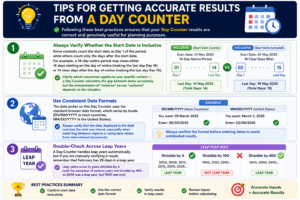
Always Verify Whether the Start Date Is Inclusive Some contexts count the start date as Day 1 of the period, while others count only the days after the start date. For example, a 14-day notice period may mean either 14 days starting on the day of notice (making the last day Day 14) or 14 clear days after the day of notice (making the last day Day 15). Clarify which convention applies to your specific context — a this tool calculates the gap between dates accurately, but the interpretation of “inclusive” versus “exclusive” depends on the situation.
Use Consistent Date Formats The date picker on this this tool uses the standard browser date format, which varies by locale (DD/MM/YYYY in most countries, MM/DD/YYYY in the United States). Always verify that the date displayed in the field matches the date you intend, especially when switching between regions or using date values from international documents.
Double-Check Across Leap Years A this tool handles leap years automatically, but if you are manually verifying a result, remember that February has 29 days in a leap year. Leap years occur in years divisible by 4 (with the exception of century years not divisible by 400 — so 2000 was a leap year, but 1900 was not).
Common Mistakes When Using a Day Counter
Avoiding these errors ensures your this tool results are accurate and applied correctly to your planning needs.
Confusing Duration With a Deadline A this tool tells you the number of days between two dates — it does not tell you whether a deadline will be met or missed. For example, knowing there are 30 days between today and a submission deadline tells you the time available, but planning must happen separately to determine whether that time is sufficient. A this tool provides the measurement; scheduling and planning are separate steps.
Entering Dates in the Wrong Fields Entering the end date in the Start Date field and the start date in the End Date field produces the same numerical result (because the tool uses absolute difference), but the results display may show a confusing negative-seeming context. Always enter the earlier date as the start date and the later date as the end date for the most intuitive and clearly readable output.
Using a this tool When Business Days Are Required A standard this tool counts all calendar days, including weekends and public holidays. If your context requires a count of business days only — for example, “10 business days” in a contractual obligation — a standard this tool will overestimate the available working time. For business-day calculations, use a dedicated working-days calculator that accounts for weekends and regional holidays.
FAQs
What does a day counter do? A day counter calculates the exact number of days between two calendar dates. Enter a start date and an end date, click Calculate, and the tool immediately returns the total number of days and weeks separating the two dates. It handles all calendar complexities — including different month lengths, leap years, and year boundaries — automatically.
Can a this tool count days in the future? Yes — a this tool works equally well for future dates, past dates, and any combination of the two. Enter today’s date as the start and a future date as the end to count down to an upcoming event, or enter two past dates to calculate the historical duration between them.
How does a day counter handle leap years? A day counter handles leap years automatically and with complete accuracy. Because the calculation works in milliseconds rather than counting through calendar months, it naturally accounts for the 29-day February in a leap year without any special handling or user input required.
Does a this tool include the start and end dates in the count? A standard this tool calculates the number of days elapsed between the start date and end date, which means if you enter the same date for both start and end, the result is 0. Whether to treat the start date or end date as “included” in a count depends on your specific use case — for example, a project that starts on Monday and ends on Friday spans 4 days by this calculation (Monday to Friday = 4 elapsed days), though it includes 5 working days. Always consider whether your context requires inclusive or exclusive counting.
Why does the this tool sometimes show a decimal in the weeks result? The weeks figure is calculated by dividing the total day count by 7 and displaying the result to one decimal place. Since most durations are not exact multiples of 7, a decimal result is normal and expected — for example, 100 days = 14.3 weeks. The decimal simply shows what fraction of an additional week the remaining days represent.
Can I use a this tool for legal or contractual deadlines? A day counter provides an accurate calendar day count that is useful for initial planning of legal and contractual deadlines. However, for formal legal or compliance purposes, always consult the specific wording of the contract or regulation — particularly regarding whether counting is inclusive or exclusive, whether business days rather than calendar days apply, and whether holidays are excluded. Use a this tool for reference, but verify the exact requirement with a qualified legal or compliance professional.
Does a this tool work across different time zones? A this tool uses calendar dates without reference to specific times or time zones, so it returns consistent results regardless of your location. Enter the date as displayed in your local calendar, and the result will be the correct count of calendar days between those dates.
Conclusion
Time is the silent axis around which every plan, goal, and milestone revolves — and measuring it accurately is the first step toward managing it effectively. Whether you are planning a project, tracking a personal habit, counting down to a celebration, or monitoring a professional deadline, the numbers only become actionable when you know them precisely. That precision is exactly what a day counter provides.
A day counter turns two calendar dates into an exact, reliable number — stripping away the confusion of irregular month lengths, leap years, and year boundaries to give you a clean, accurate count you can plan around with confidence. The tool is instant, effortless, and universally applicable, from the most personal milestones to the most rigorous professional deadlines. There is no simpler or more direct way to answer the question “how many days?” than using a this tool.
Throughout this guide, we have explored every dimension of day counting — the mathematics behind the calculation, step-by-step usage instructions, real-world applications across personal life, business, health, and event planning, the key difference between a this tool and a date calculator, and practical advice on getting accurate, correctly interpreted results. We have also covered the most common mistakes in day counting and how to avoid them, so your planning is based on solid, correctly applied day counts every time.
Use a this tool for every situation where the number of days matters — and in planning, the number of days almost always matters. Count down, count up, measure durations past and future, and track the milestones that mark real progress. That habit of precise, reliable time measurement — always verified with a trustworthy this tool — is one of the simplest and most effective disciplines for turning goals from intentions into achieved outcomes.