Calculate speed instantly with our fast and accurate Speed Calculator
Table of Contents
- Introduction
- What Is a Molecular Weight Calculator?
- Understanding Molecular Weight – Core Chemistry Concepts
- How to Use a Molecular Weight Calculator
- Molecular Weight Calculator: Supported Elements and Formulas
- Step-by-Step Examples Using the Molecular Weight Calculator
- Why Molecular Weight Matters in Chemistry
- Molecular Weight vs. Molar Mass – What Is the Difference?
- Applications of Molecular Weight in Science and Industry
- Molecular Weight Calculator in Pharmaceutical and Biochemistry Work
- Common Chemical Formulas and Their Molecular Weights
- Tips for Entering Formulas Correctly
- FAQs
- Conclusion
Introduction
Chemistry is built on numbers — and few numbers are more important than the molecular weight of a compound. Every reaction, every solution concentration, every drug formulation, and every industrial process depends on knowing the precise mass of the molecules involved. Yet for many students, researchers, and laboratory professionals, calculating molecular weight manually from a chemical formula can be a time-consuming and error-prone process. That is exactly where a Molecular Weight Calculator becomes an indispensable tool.
Molecular weight is the sum of the atomic weights of every atom in a chemical formula. It is expressed in grams per mole (g/mol) and forms the basis of stoichiometry — the quantitative branch of chemistry that describes the proportions in which chemical substances react. Whether you are preparing a buffer solution in a biochemistry lab, calculating drug dosages in a pharmaceutical setting, or simply working through a chemistry problem set, knowing the molecular weight of each compound you work with is absolutely fundamental.
This comprehensive guide explains everything you need to know about molecular weight and how a Molecular Weight Calculator makes working with it fast, accurate, and effortless. We will walk through what molecular weight is, how it is calculated, which elements and formulas this tool supports, and how it is applied across every major field of chemistry, biology, medicine, and industry. Whether you are a student encountering molar mass for the first time or a laboratory professional who works with chemical formulas every day, this guide and tool will serve as your complete reference.
What Is a Molecular Weight Calculator?
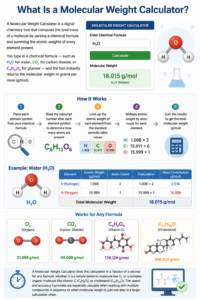
A Molecular Weight Calculator is a digital chemistry tool that computes the total mass of a molecule by parsing a chemical formula and summing the atomic weights of every element present. You type in a chemical formula — such as H2O for water, CO2 for carbon dioxide, or C6H12O6 for glucose — and the tool instantly returns the molecular weight in grams per mole (g/mol).
The tool works by:
- Parsing each element symbol from your chemical formula (H, C, N, O, S, P, and others)
- Reading the subscript number after each element symbol to determine how many atoms of that element are present
- Looking up the atomic weight of each element from the standard periodic table values
- Multiplying atomic weight by atom count for each element and summing the results
For example, for water (H2O):
- Hydrogen (H): atomic weight 1.008 × 2 atoms = 2.016
- Oxygen (O): atomic weight 15.999 × 1 atom = 15.999
- Total molecular weight = 18.015 g/mol
A Molecular Weight Calculator does this calculation in a fraction of a second for any formula, whether it is a simple diatomic molecule like O2 or a complex organic molecule like vitamin C (C6H8O6) or cholesterol (C27H46O). The speed and accuracy it provides are especially valuable when working with multiple compounds in sequence or when molecular weight is just one step in a larger calculation chain.
Understanding Molecular Weight – Core Chemistry Concepts
Before exploring how a Molecular Weight Calculator works in detail, it is helpful to understand the underlying chemistry concepts that make molecular weight so important.
Atoms and Atomic Weight Every chemical element is made up of atoms — the smallest units of matter that retain the chemical properties of that element. Each element has a characteristic atomic weight (also called atomic mass), expressed in atomic mass units (amu) or, equivalently, in grams per mole. These values are determined by the number of protons and neutrons in the nucleus and are listed on every periodic table:
- Hydrogen (H): 1.008 g/mol
- Carbon (C): 12.011 g/mol
- Nitrogen (N): 14.007 g/mol
- Oxygen (O): 15.999 g/mol
- Sulfur (S): 32.06 g/mol
- Phosphorus (P): 30.97 g/mol
Molecules and Chemical Formulas A molecule is two or more atoms bonded together. A chemical formula represents the composition of a molecule by listing each element present followed by the number of atoms of that element. The subscript numbers (like the “2” in H2O) tell you how many atoms of each element are in one molecule. When no subscript appears after an element, the count is 1.
The Mole Concept One mole of any substance contains exactly 6.022 × 10²³ entities (Avogadro’s Number). The molecular weight in g/mol tells you the mass of exactly one mole of molecules. So 18.015 grams of water contains exactly 6.022 × 10²³ water molecules. This is why the output of a Molecular Weight Calculator — a value in g/mol — is directly usable in stoichiometric calculations relating mass to moles to number of molecules.
How to Use a Molecular Weight Calculator
Using a Molecular Weight Calculator is straightforward, but a few key steps ensure you always get the right answer.
Step One — Enter the Chemical Formula Type the chemical formula of the compound you want to calculate in the input field. Use standard chemical notation:
- Capital letter for the first letter of each element symbol (H, C, O, N, etc.)
- Subscript numbers after each element to indicate atom count (H2, O6, C12)
- No spaces between elements or subscript numbers
Examples: H2O, CO2, NaCl, C6H12O6, H2SO4, CH3OH
Step Two — Click Calculate Press the Calculate button. The Molecular Weight Calculator instantly parses your formula, looks up atomic weights, performs the multiplication and summation, and displays the result in g/mol alongside a breakdown of the calculation.
Step Three — Read the Result The tool returns the total molecular weight of your compound in grams per mole. This value is ready to use directly in stoichiometric calculations, concentration formulas, and unit conversions.
Step Four — Clear and Recalculate Use the Clear button to reset the tool and enter a new formula. Running multiple calculations in sequence is a core use case — for example, calculating the molecular weights of all reagents and products in a balanced chemical equation.
Tips for Accurate Input:
- Always use correct capitalization. In chemical formulas, each element symbol begins with a capital letter. If a two-letter symbol has a lowercase second letter (like Cl for chlorine or Na for sodium), the distinction matters — the tool reads element boundaries from capitalization.
- Do not use brackets (parentheses) unless the tool explicitly supports them. The basic version handles linear formulas.
- Double-check your formula against a reliable reference before entering it, especially for complex organic molecules.
Molecular Weight Calculator: Supported Elements and Formulas
The core functionality of a Molecular Weight Calculator depends on its internal library of atomic weights. The version built around this tool supports the following key elements:
| Element | Symbol | Atomic Weight (g/mol) |
|---|---|---|
| Hydrogen | H | 1.008 |
| Carbon | C | 12.011 |
| Nitrogen | N | 14.007 |
| Oxygen | O | 15.999 |
| Sulfur | S | 32.06 |
| Phosphorus | P | 30.97 |
These six elements — H, C, N, O, S, and P — cover the vast majority of organic and biochemical compounds, including carbohydrates, proteins, lipids, nucleic acids, and most common pharmaceutical molecules. This makes the tool highly practical for the most frequent chemistry calculations encountered in academic and laboratory settings.
The atomic weight values used are based on the IUPAC (International Union of Pure and Applied Chemistry) standard atomic weights, which are the internationally recognized reference values used in all scientific and industrial chemistry. Using these precise values ensures that results from the tool match those from reference texts, chemical databases, and laboratory standards.
Step-by-Step Examples Using the Molecular Weight Calculator
Working through real examples is the best way to understand both the chemistry and the tool.
Example 1: Water (H2O)
- H: 1.008 × 2 = 2.016
- O: 15.999 × 1 = 15.999
- Molecular Weight = 18.015 g/mol
Water is the universal solvent and the most important compound in biology. Its molecular weight of approximately 18 g/mol is one of the most commonly used values in all of chemistry.
Example 2: Carbon Dioxide (CO2)
- C: 12.011 × 1 = 12.011
- O: 15.999 × 2 = 31.998
- Molecular Weight = 44.009 g/mol
Carbon dioxide is central to photosynthesis, respiration, and climate science. Its molecular weight appears in countless environmental and biochemical calculations.
Example 3: Glucose (C6H12O6)
- C: 12.011 × 6 = 72.066
- H: 1.008 × 12 = 12.096
- O: 15.999 × 6 = 95.994
- Molecular Weight = 180.156 g/mol
Glucose is the primary energy molecule in living cells. Its molecular weight is essential for calculating glucose concentrations in biological research, diabetes management, and food science.
Example 4: Sulfuric Acid (H2SO4)
- H: 1.008 × 2 = 2.016
- S: 32.06 × 1 = 32.06
- O: 15.999 × 4 = 63.996
- Molecular Weight = 98.072 g/mol
Sulfuric acid is one of the most widely produced industrial chemicals. Its molecular weight is used extensively in solution preparation, titration calculations, and industrial process chemistry.
These examples illustrate how a Molecular Weight Calculator turns what would be multi-step arithmetic into a single instant result, making it faster and less error-prone than manual calculation.
Why Molecular Weight Matters in Chemistry
Molecular weight is one of the most fundamentally important quantities in chemistry for a simple reason: it connects the microscopic world of atoms and molecules to the macroscopic world of grams and liters that chemists actually measure.
Stoichiometry and Reaction Calculations Every balanced chemical equation specifies the number of moles of each reactant and product involved in the reaction. To convert between moles and grams — which is necessary for every practical laboratory application — you need the molecular weight. Moles = Mass ÷ Molecular Weight. This single formula is used thousands of times every day in chemistry laboratories around the world.
Solution Concentration When preparing solutions for biological assays, chemical reactions, or industrial processes, the molecular weight is essential for calculating molarity (moles per liter) and mass concentration. If you want to prepare a 1 M solution of sodium chloride, you need to know its molecular weight (58.44 g/mol) to weigh out the correct mass for your target volume.
Identifying Unknown Compounds In analytical chemistry, mass spectrometry measures the mass-to-charge ratio of ionized molecules, producing a molecular weight measurement that can be matched against known compounds. Having reference molecular weights — quickly retrieved from a reliable tool — is essential for compound identification.
Pharmacology and Drug Design Every pharmaceutical compound has a molecular weight that influences how it behaves in the body — its absorption, distribution, metabolism, and excretion (ADME properties). Lipinski’s Rule of Five, used in early-stage drug design, includes a molecular weight limit of 500 g/mol as one criterion for good oral bioavailability.
Molecular Weight vs. Molar Mass – What Is the Difference?
This is one of the most common points of confusion in introductory chemistry, and clarifying it helps you use a Molecular Weight Calculator with complete confidence.
Molecular Weight technically refers to the weight of a single molecule measured in atomic mass units (amu or Da — Daltons). It is the sum of atomic masses of all atoms in the molecule.
Molar Mass refers to the mass of one mole of a substance, measured in grams per mole (g/mol).
Numerically, these values are identical. Water has a molecular weight of 18.015 amu per molecule and a molar mass of 18.015 g/mol. The difference is purely one of scale and unit convention. In everyday laboratory and educational contexts, “molecular weight” and “molar mass” are used interchangeably, and the output of a this tool in g/mol is equally valid for both interpretations.
The distinction becomes relevant in precise scientific writing and in mass spectrometry, where molecular weight is measured at the individual molecule level. For all stoichiometric calculations, concentration work, and formula problems, treat them as equivalent.
Applications of Molecular Weight in Science and Industry
The output of a Molecular Weight Calculator feeds directly into an enormous range of scientific and industrial applications.
Biochemistry and Molecular Biology Proteins, nucleic acids, carbohydrates, and lipids all have molecular weights that are central to their characterization. Gel electrophoresis — one of the most common techniques in molecular biology — separates molecules by size, which is directly related to molecular weight. Knowing the expected molecular weight of a protein allows scientists to confirm successful expression, purification, and identification.
Food Science and Nutrition Nutritional chemistry relies on molecular weights to calculate caloric values, nutrient concentrations, and ingredient ratios. The molecular weights of sugars, fats, amino acids, and vitamins are essential inputs for nutritional analysis and food product development.
Environmental Chemistry Tracking the fate of pollutants in the environment requires knowing their molecular weights for calculations of vapor pressure, solubility, and environmental persistence. Environmental chemists routinely use molecular weight data derived from tools like this to model the behavior of industrial chemicals in air, water, and soil.
Polymer Science Polymers are large molecules made of repeating monomer units. The molecular weight distribution of a polymer determines its mechanical properties, viscosity, melting point, and processability. Polymer scientists calculate molecular weights of repeat units and oligomers constantly throughout their design and analysis work.
Molecular Weight Calculator in Pharmaceutical and Biochemistry Work
Few fields depend more heavily on precise molecular weight data than pharmaceutical research and biochemistry.
Drug Formulation Every drug formulation begins with an active pharmaceutical ingredient (API) whose molecular weight determines how much mass corresponds to a given number of moles of the drug. Accurate molecular weight is essential for calculating the correct dose in milligrams, preparing stock solutions, and ensuring that tablet or capsule formulations contain the right amount of active ingredient.
Buffer Preparation Biochemistry laboratories routinely prepare precise buffer solutions — phosphate-buffered saline (PBS), Tris-HCl, HEPES, and others — that require calculating the exact mass of each salt or buffering agent to achieve the target molarity. Each preparation step requires the molecular weight of each component, making a Molecular Weight Calculator a daily-use tool in any biochemistry lab.
Protein and Nucleic Acid Work When expressing and purifying proteins, researchers need to confirm that their purified product has the correct molecular weight. Western blotting, mass spectrometry, and size-exclusion chromatography all produce molecular weight measurements that are validated against calculated values from the protein’s amino acid sequence. The same applies to RNA and DNA molecules in nucleic acid research.
Reagent Preparation When making standard solutions for titrations, enzyme assays, or spectroscopic measurements, every calculation begins with the molecular weight of the reagent being dissolved. An error in molecular weight at this stage propagates through every downstream calculation, making accuracy at this first step critical.
Common Chemical Formulas and Their Molecular Weights
Here is a quick reference table of commonly used compounds and their molecular weights, all of which can be verified with this tool.
| Compound | Formula | Molecular Weight (g/mol) |
|---|---|---|
| Water | H2O | 18.015 |
| Carbon Dioxide | CO2 | 44.009 |
| Glucose | C6H12O6 | 180.156 |
| Sulfuric Acid | H2SO4 | 98.072 |
| Ammonia | NH3 | 17.031 |
| Methane | CH4 | 16.043 |
| Ethanol | C2H6O | 46.068 |
| Urea | CH4N2O | 60.055 |
| Acetic Acid | C2H4O2 | 60.052 |
| Caffeine | C8H10N4O2 | 194.193 |
These values are calculated using the same atomic weight lookup that powers the tool, so you can use the table as both a reference and a way to verify that your formula inputs are producing the correct results.
Tips for Entering Formulas Correctly
Getting accurate results from a Molecular Weight Calculator depends on entering your chemical formula in the correct format.
Use Standard Chemical Notation Chemical formulas follow strict conventions developed by IUPAC. Each element symbol begins with a capital letter, and if the symbol has two letters, the second is lowercase. For example: H (hydrogen), C (carbon), N (nitrogen), O (oxygen), S (sulfur), P (phosphorus). The tool uses capitalization to identify where one element ends and the next begins.
Subscript Numbers Directly Follow the Element Write atom counts as numbers directly after the element symbol with no spaces. H2O not H 2 O. CO2 not C O 2. Even a single extra space can cause the parser to misread the formula.
Verify Your Source Formula If you are working from a textbook, database, or paper, double-check the formula before entering it. Common sources of error include misreading subscripts in printed formulas, confusing similar element symbols (N vs. Na, S vs. Si), and copying formulas with typos.
For Complex Molecules For molecules with parenthetical groups — like Ca(OH)2 or Fe2(SO4)3 — the basic version of the tool works best with the formula expanded. For Ca(OH)2, expand to CaO2H2 for correct parsing. More advanced tools support parenthetical notation directly.
FAQs
What does a Molecular Weight Calculator do? A Molecular Weight Calculator takes a chemical formula as input, identifies each element and its atom count, looks up the atomic weight for each element, and returns the total molecular weight in grams per mole (g/mol). It replaces manual periodic table lookups and arithmetic with an instant, accurate result.
What units does a Molecular Weight Calculator use? The standard output unit is grams per mole (g/mol), also written as g·mol⁻¹. This is the SI unit for molar mass and is the standard unit used in all laboratory, pharmaceutical, and research chemistry contexts. Individual molecule weight in atomic mass units (amu or Daltons) is numerically equal to the g/mol value.
Why is the result shown in g/mol? Grams per mole (g/mol) is the unit that directly connects molecular composition to laboratory-measurable masses. It tells you how many grams of a compound you need to weigh out to have exactly one mole of molecules — the fundamental unit of chemistry. This makes the output directly applicable to stoichiometric and concentration calculations.
Can this tool handle all chemical formulas? The current tool supports formulas composed of the six most common elements in organic and biochemical chemistry: H, C, N, O, S, and P. This covers the majority of molecules encountered in biology, biochemistry, organic chemistry, and pharmaceutical science. For formulas containing metals, halogens, or other elements, an expanded periodic table database would be needed.
How accurate is a Molecular Weight Calculator? The accuracy of a Molecular Weight Calculator depends on the precision of the atomic weights in its database and the correct parsing of your formula. Using IUPAC standard atomic weights ensures agreement with scientific reference sources. The main source of error is incorrect formula entry, so always verify your input formula before relying on the result.
Is molecular weight the same as molecular mass? Yes — molecular weight and molecular mass are used interchangeably in most scientific and educational contexts. Both refer to the sum of atomic masses of all atoms in a molecule, and both produce a value numerically equal to the molar mass in g/mol. The technical distinction (weight vs. mass as physical quantities) is rarely relevant in practice.
Can I use a Molecular Weight Calculator for polymers? You can use the tool to calculate the molecular weight of polymer repeat units or short oligomers by entering the formula for the repeating segment. However, high-molecular-weight polymers are described by average molecular weight distributions (Mn, Mw) rather than exact values, and those require specialized polymer characterization methods beyond formula-based calculation.
Conclusion
Molecular weight is one of the most frequently used and fundamentally important values in all of chemistry. Every stoichiometric calculation, every solution preparation, every pharmacological formulation, and every analytical identification step begins with knowing the molecular weight of the compounds involved. Having instant, accurate access to this value through a reliable Molecular Weight Calculator removes one of the most tedious and error-prone steps from chemical work of every kind.
A Molecular Weight Calculator turns what was once a multi-step, table-lookup process into a single instant result, freeing chemists, students, and researchers to focus on the higher-level science rather than the arithmetic. Whether you are preparing a 0.1 M buffer for a biochemistry experiment, checking whether a drug candidate meets Lipinski’s Rule of Five, or simply verifying a formula from a textbook, the tool delivers the answer you need in less than a second.
Throughout this guide, we have covered every dimension of molecular weight — from the atomic weight foundations and the mole concept, through step-by-step calculation examples and real-world applications in biochemistry, pharmaceuticals, food science, environmental chemistry, and polymer science. The knowledge in this guide equips you to use molecular weight calculations not just mechanically, but with genuine chemical understanding.
Make a Molecular Weight Calculator part of your standard chemistry workflow. Enter your formula, verify the result, and use the g/mol value with confidence in every downstream calculation. Accurate molecular weight data — delivered instantly by a reliable Molecular Weight Calculator — is the starting point for chemistry that is precise, reproducible, and scientifically rigorous in every setting, from the classroom to the research laboratory.