Permutation & Combination Calculator
Calculate sample size instantly with our fast and accurate Sample Size Calculator
Table of Contents
- Introduction
- What Is a Permutation and Combination Calculator?
- Understanding Permutation – Definition, Formula and Examples
- Understanding Combination – Definition, Formula and Examples
- Key Difference Between Permutation and Combination
- How to Use a Permutation and Combination Calculator
- Real-Life Applications of Permutation and Combination
- Tips for Getting the Best Results
- Common Mistakes Students Make
- Why You Should Always Use a Digital Calculator
- Frequently Asked Questions (FAQs)
- Conclusion
Introduction
Mathematics can sometimes feel overwhelming, especially when you are dealing with large numbers and complex counting problems. That is exactly where a Permutation and Combination Calculator steps in to make your life dramatically easier. Whether you are a student preparing for competitive exams, a teacher creating problem sets, or a professional working on probability-based projects, this tool is an absolute game-changer.
The Permutation and Combination Calculator is designed to handle all your counting and arrangement problems in seconds — with full accuracy and zero manual errors. Instead of spending precious time applying lengthy factorial formulas by hand, you simply enter two values and get a precise answer instantly. This tool eliminates guesswork, reduces the chance of human error, and speeds up your workflow significantly.
In this comprehensive guide, we will walk you through everything you need to know about permutations, combinations, their formulas, real-life uses, and how to maximize the efficiency of this powerful online tool. By the end of this article, you will not only understand the mathematical concepts behind permutation and combination but will also know exactly how to use a Permutation and Combination Calculator like a professional.
Let us start from the beginning and build your understanding step by step.
What Is a Permutation and Combination Calculator?
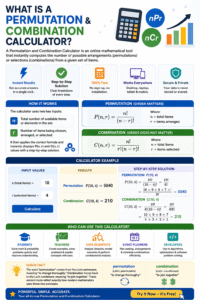
A Permutation and Combination Calculator is an online mathematical tool that instantly computes the number of possible arrangements (permutations) or selections (combinations) from a given set of items. Instead of manually applying complex factorial formulas that can take minutes or even hours, this calculator delivers accurate results in a single click.
At its core, the Permutation and Combination Calculator works with two key inputs:
- n — the total number of available items or elements in your dataset
- r — the number of items being chosen, arranged, or selected
Given these two values, the Permutation and Combination Calculator applies the correct mathematical formula and instantly displays both P(n, r) and C(n, r) values along with a clear step-by-step breakdown. This makes it an invaluable resource for students, educators, data scientists, event planners, software developers, and anyone who regularly works with probability and counting problems.
The tool is completely free, browser-based, and requires no installation or sign-up. It works on desktops, laptops, tablets, and mobile phones equally well, making it accessible to anyone, anywhere, at any time.
Quick Fact: The word “permutation” comes from the Latin permutare, meaning “to change thoroughly.” Combination traces back to the Latin combinare, meaning “to join together.” These ancient roots reflect exactly how modern mathematics uses these two concepts.
Understanding Permutation – Definition, Formula and Examples
A permutation is an arrangement of items where the order matters. When you are arranging objects in a sequence and the position of each object is significant, you are working with permutations. In other words, changing the order of items creates a completely different outcome.
The standard formula for calculating permutations is:
P(n, r) = n! / (n – r)!
Where n! (n factorial) = n × (n−1) × (n−2) × … × 1
For example, 5! = 5 × 4 × 3 × 2 × 1 = 120
Suppose you have 5 runners in a race and you want to find out how many ways the top 3 positions (Gold, Silver, Bronze) can be awarded. Here, order matters because finishing 1st, 2nd, and 3rd are completely different outcomes.
P(5, 3) = 5! / (5–3)! = 120 / 2 = 60
There are 60 different ways the medals can be awarded. Using a Permutation and Combination Calculator, you get this result instantly without any manual computation.
- Permutation without repetition – items cannot be reused (standard formula above)
- Permutation with repetition – items can be repeated; formula is n^r
- Circular permutation – arranging items in a circle; formula is (n–1)!
A good Permutation and Combination Calculator covers all of these scenarios to give you maximum flexibility across different types of problems.
Understanding Combination – Definition, Formula and Examples
A combination is a selection of items where the order does NOT matter. When you are simply choosing a group of items and the sequence in which they are selected is irrelevant, you are dealing with combinations. Unlike permutation, swapping the order of selected items does not create a new outcome in combination.
C(n, r) = n! / [r! × (n – r)!]
This is also written as ⁿCᵣ or “n choose r” in mathematical notation.
Suppose you need to form a team of 3 people from a group of 5. Since team membership does not depend on the order in which members are selected, this is a combination problem.
C(5, 3) = 5! / [3! × (5–3)!] = 120 / (6 × 2) = 10
There are 10 possible teams that can be formed. Again, the Permutation and Combination Calculator gives you this answer in milliseconds, saving you the effort of working through the factorial arithmetic manually.
- Combination without repetition – standard formula above (most common type)
- Combination with repetition – items can be reused; formula is C(n+r–1, r)
Key Difference Between Permutation and Combination
The most critical concept to grasp when using a Permutation and Combination Calculator is the fundamental difference between the two operations. Choosing the wrong one will give you a completely incorrect answer, so this distinction must be crystal clear before you begin.
| Feature | Permutation | Combination |
|---|---|---|
| Order | Order matters | Order does not matter |
| Formula | P(n,r) = n! / (n–r)! | C(n,r) = n! / [r!(n–r)!] |
| Result | Larger number of outcomes | Smaller number of outcomes |
| Example | Race podium positions | Selecting a committee |
| Keyword clues | “Arrange”, “order”, “rank”, “sequence” | “Choose”, “select”, “group”, “team” |
| Relationship | P(n,r) = C(n,r) × r! | C(n,r) = P(n,r) / r! |
Remember this simple rule: If changing the order creates a different outcome, use permutation. If changing the order gives the same outcome, use combination. This distinction is the most important thing to understand before using a Permutation and Combination Calculator.
Pro Tip: Look for trigger words in the problem. Words like arrange, order, rank, sequence, schedule, and position signal permutation. Words like choose, select, group, team, committee, and subset signal combination.
How to Use a Permutation and Combination Calculator
Using a Permutation and Combination Calculator is extremely straightforward. Here is a step-by-step guide to help you navigate it efficiently and get accurate results every time.
The first input field requires you to enter n, which represents the total number of items in your dataset. For example, if you have 8 flavors of ice cream to choose from, then n = 8.
The second input field asks for r, which is the number of items you want to select or arrange. If you are choosing 3 flavors from those 8, then r = 3.
Choose whether you want to calculate a Permutation (P) or a Combination (C). Some advanced versions of the Permutation and Combination Calculator compute both values simultaneously, which is very handy when you want to compare the two results side by side.
Press the “Calculate” button and the tool will instantly display the result, including a step-by-step breakdown of the formula applied. This step-by-step output is particularly useful for students who want to understand the process, not just the final answer.
Review the output carefully. The Permutation and Combination Calculator will show you P(n, r), C(n, r), and the factorial values used in the calculation so you can verify the logic and apply it to your problem with full confidence.
Important: Always double-check that you have entered n and r correctly before hitting calculate. Entering values in the wrong field is the most common user error.
Real-Life Applications of Permutation and Combination
The beauty of a Permutation and Combination Calculator is that its usefulness extends far beyond the classroom. Here are some powerful real-world domains where these calculations are applied every day.
Every time you set a password, you are creating a permutation. A 6-digit numeric PIN has P(10, 6) = 151,200 possible arrangements. Security engineers use the Permutation and Combination Calculator to determine how strong or vulnerable a password system is against brute-force attacks. The stronger the password rules, the higher the permutation value — and the harder it is to crack.
Lottery systems are pure combination problems. If a lottery requires you to pick 6 numbers from 1 to 49, the total number of possible ticket combinations is C(49, 6) = 13,983,816. That is why winning the jackpot is so rare. Using a Permutation and Combination Calculator helps you understand the true mathematical odds before you play.
A cricket coach selecting 11 players from a squad of 15 uses combinations: C(15, 11) = 1,365 possible team combinations. A Permutation and Combination Calculator helps coaches and sports analysts quickly evaluate squad selection options and understand how many different team formations are statistically possible.
Organizing a formal dinner where guests must be seated in a specific order is a permutation problem. Event planners regularly rely on the logic behind the Permutation and Combination Calculator to design optimal seating charts, stage arrangements, and scheduling sequences for large corporate events and weddings.
DNA sequencing and genetic research involve massive permutation and combination calculations. Scientists use digital calculators to determine the number of possible gene combinations in breeding research, mutation studies, and clinical trials where the number of variables can be astronomically large.
Algorithm designers use permutations to evaluate search paths and combinations to evaluate data subset problems. The Permutation and Combination Calculator is a go-to tool for developers working on optimization algorithms, machine learning feature selection, and combinatorial problem-solving in software engineering.
Tips for Getting the Best Results
To get the most accurate and useful results from a Permutation and Combination Calculator, keep the following tips in mind:
- Always identify whether order matters before selecting permutation or combination mode. This single decision determines everything else.
- Double-check your n and r values — entering them incorrectly is the most common user error and leads to completely wrong answers.
- Use the step-by-step breakdown provided by the calculator to understand the logic and verify your answer independently.
- For large numbers, rely entirely on the calculator — manual factorial calculations for numbers above 15 are highly error-prone and time-consuming.
- Bookmark a reliable Permutation and Combination Calculator for quick access during exams, assignments, or professional projects.
- Cross-check your answer using both the formula and the calculator output to build confidence and catch any input mistakes early.
- Re-read the question carefully if you are unsure whether the problem involves permutation or combination — the answer is almost always in the wording.
Common Mistakes Students Make
Even with a Permutation and Combination Calculator available, students often make conceptual errors that lead to wrong answers. Here are the most frequent mistakes and exactly how to avoid them.
This is the single biggest mistake made at every level of mathematics. Students often use the permutation formula when the problem requires a combination, or vice versa. Always ask yourself: does changing the order change the outcome? If yes, it is a permutation. If no, it is a combination.
Both permutation and combination are only valid when n ≥ r. You cannot select 7 items from a group of 4 — it is mathematically impossible. A reliable Permutation and Combination Calculator will flag this error instantly, but it is a good habit to verify this condition yourself before inputting values.
Some problems allow repetition (like a PIN code where you can repeat digits: 1122, 3311, etc.), while others do not (like selecting unique team members). Using the wrong formula completely changes the result. Make sure you read the problem carefully before entering your values into the calculator.
Words like “at least,” “at most,” “exactly,” and “none” completely change the problem structure. Always identify these keywords and break the problem into sub-cases before applying the Permutation and Combination Calculator to each case individually.
Some problems come with conditions — for example, “Person A and Person B must always be on the same team” or “the first position must always be filled by a specific person.” These restrictions require you to handle constrained cases separately before using the calculator for the remaining choices.
Why You Should Always Use a Digital Calculator
There are many compelling reasons to use a Permutation and Combination Calculator instead of working through every problem entirely by hand.
- Speed — Calculations that take minutes by hand are completed in milliseconds digitally. You save enormous amounts of time, especially during exams.
- Accuracy — The calculator eliminates human arithmetic errors, especially with large factorials where even a single multiplication mistake ruins the entire answer.
- Learning tool — The step-by-step breakdown helps students learn and verify the correct process, turning the calculator into an educational resource rather than just an answer machine.
- Accessibility — Available 24/7, completely free, and usable on any device with a browser — no downloads, no subscriptions, no complications.
- Handles extremely large values — A Permutation and Combination Calculator can easily handle values like P(100, 10) or C(52, 5) that would be completely impractical to compute manually.
- Builds confidence — When you verify your manual answer with the calculator and they match, it reinforces your understanding and gives you confidence in your problem-solving skills.
Whether you are a high school student revising for an exam, a university student tackling probability theory, or a professional statistician building predictive models, the Permutation and Combination Calculator saves you valuable time and delivers dependable results every single time.
Frequently Asked Questions (FAQs)
What is the main purpose of a Permutation and Combination Calculator?
A Permutation and Combination Calculator is used to quickly and accurately calculate the number of possible arrangements (permutations) or selections (combinations) from a given set of items. It eliminates the need for manual factorial calculations and dramatically reduces the risk of arithmetic errors.
When should I use permutation instead of combination?
Use permutation when the order of selection matters — such as ranking positions, creating sequences, scheduling events, or arranging objects in a line. Use combination when order does not matter — such as selecting a group, forming a team, or choosing items from a set. The Permutation and Combination Calculator supports both modes so you can choose the right one based on your specific problem.
Is the Permutation and Combination Calculator free to use?
Yes. Most online versions of the Permutation and Combination Calculator are completely free to use, require no sign-up or account creation, and work directly in your web browser on any device — including desktops, tablets, and smartphones.
Can the calculator handle very large values of n and r?
Absolutely. One of the biggest advantages of using a digital Permutation and Combination Calculator is its ability to handle extremely large values — such as C(100, 50) or P(200, 10) — that would be practically impossible to calculate manually without making errors.
What happens if I enter a value of r greater than n?
The Permutation and Combination Calculator will return an error or a value of zero, because it is mathematically impossible to arrange or select more items than the total number available. Always ensure that n ≥ r before entering your values into the tool.
Can I use the Permutation and Combination Calculator for exam preparation?
Yes, it is an excellent study and preparation tool. Students preparing for exams like SAT, GRE, GMAT, JEE, or university-level statistics and probability courses can use the Permutation and Combination Calculator to practice problems, verify their manual answers, and understand the step-by-step logic behind each calculation.
Does the calculator show step-by-step working?
Most modern versions of the Permutation and Combination Calculator provide a detailed breakdown showing exactly how the factorial values were applied and how the final answer was derived. This step-by-step output is extremely helpful for learning, teaching, and verifying solution processes.
What is the numerical difference between P(n,r) and C(n,r)?
P(n,r) is always greater than or equal to C(n,r) for any given n and r, because permutation counts the same groups multiple times in different orders, while combination treats them as a single entity. The precise relationship is: P(n,r) = C(n,r) × r! The Permutation and Combination Calculator clearly displays both values so you can compare them directly and understand the mathematical relationship between them.
Conclusion
In summary, a Permutation and Combination Calculator is one of the most versatile and useful mathematical tools available online today. It simplifies complex counting problems, supports both permutation and combination calculations, and provides step-by-step solutions that deepen your understanding of the underlying concepts.
Permutations help you count ordered arrangements where every position matters. Combinations help you count unordered selections where only group membership matters. Both are fundamental building blocks of probability, statistics, computer science, genetics, cryptography, and everyday decision-making. The Permutation and Combination Calculator bridges the gap between theoretical mathematical knowledge and practical real-world application.
Whether you need to compute how many ways a sports team can be selected, how many unique passwords are possible for a given character set, how many lottery combinations exist, or how many ways guests can be seated at a formal event — the Permutation and Combination Calculator is your most reliable and efficient companion.
Use it regularly, learn from its step-by-step breakdowns, and let it empower you to solve even the most complex counting problems with confidence, precision, and speed. Mathematics becomes far less intimidating when you have the right tools working in your corner — and the Permutation and Combination Calculator is exactly that.