Exponent Calculator
Calculate number sequences instantly with our fast and accurate Number Sequence Calculator
Table of Contents
- Introduction
- What Is an Exponent Calculator?
- Understanding Exponents – The Basic Concept
- Parts of an Exponent Expression – Base and Power
- Types of Exponents You Must Know
- The Exponent Formula Explained
- How to Use an Exponent Calculator Step by Step
- Positive, Negative, and Zero Exponents
- Fractional Exponents and Their Relationship to Roots
- Real-Life Applications of an Exponent Calculator
- Laws and Properties of Exponents
- Tips for Using an Exponent Calculator Effectively
- Common Mistakes Students and Professionals Make
- Frequently Asked Questions (FAQs)
- Conclusion
Introduction
Mathematics is full of operations that allow us to express enormous or extremely tiny quantities in a compact, manageable form. One of the most powerful of these operations is the exponent — a small number written above and to the right of a base that tells us how many times that base must be multiplied by itself. Whether the numbers involved are simple whole numbers or complex decimals and fractions, computing powers manually can quickly become time-consuming, tedious, and prone to error. That is exactly why an Exponent Calculator is such a transformative tool for students, educators, engineers, and scientists alike.
An Exponent Calculator takes the hard work out of raising numbers to a power. You simply enter the base and the exponent, press calculate, and receive an instant, accurate answer alongside a clear, step-by-step breakdown of the calculation. This makes the tool invaluable not just for getting answers quickly, but also for learning and understanding how exponent calculations actually work — from simple cases like 2³ = 8 all the way to complex cases involving negative exponents, decimal bases, and large power values.
In this complete guide, we will walk you through every important aspect of exponents and how to use an Exponent Calculator like a professional. We will cover the fundamental definition of exponents, all the major types including positive, negative, zero, and fractional exponents, the key laws and properties you need to know, real-world applications across multiple fields, common mistakes to avoid, and practical tips for getting the most from your calculations. By the time you finish reading this article, you will have a thorough, confident command of exponent arithmetic and a clear understanding of why this tool belongs in every mathematician’s and engineer’s toolkit. Let us begin.
What Is an Exponent Calculator?
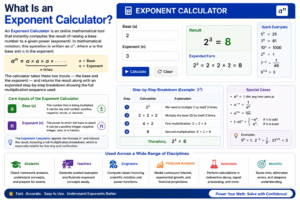
An Exponent Calculator is an online mathematical tool that instantly computes the result of raising a base number to a given power (exponent). In mathematical notation, this operation is written as aⁿ, where a is the base and n is the exponent. The calculator takes these two inputs — the base and the exponent — and returns the result along with an expanded step-by-step breakdown showing the full multiplication sequence used.
The two core inputs of an Exponent Calculator are:
- Base (a) — the number that is being multiplied. It can be any real number: positive, negative, whole, or decimal.
- Exponent (n) — the power to which the base is raised. It can be a positive integer, a negative integer, zero, or a fraction.
The Exponent Calculator then applies the formula aⁿ and returns the result, including the expanded form of the multiplication (e.g., 2 × 2 × 2 for 2³), which is particularly helpful for students who need to verify their work or understand the process step by step.
This tool is used across a wide range of disciplines. Students use it to check homework answers and prepare for exams. Teachers use it to generate worked examples. Engineers use it to compute values involving scientific notation and power functions. Financial analysts use it to model compound interest and exponential growth. Scientists use it for calculations involving radioactive decay, signal processing, and physical constants. In every one of these scenarios, the Exponent Calculator saves time, eliminates arithmetic errors, and deepens understanding of the underlying mathematics.
Understanding Exponents – The Basic Concept
Before getting the most out of an Exponent Calculator, it is essential to have a clear and solid understanding of what an exponent actually means. An exponent tells you how many times a number (the base) is multiplied by itself. It is a shorthand notation for repeated multiplication.
The general form is: aⁿ = a × a × a × … × a (n times)
For example:
- 2³ = 2 × 2 × 2 = 8
- 5² = 5 × 5 = 25
- 3⁴ = 3 × 3 × 3 × 3 = 81
- 10³ = 10 × 10 × 10 = 1,000
Exponents provide a powerful way to express very large and very small numbers compactly. Instead of writing 1,000,000,000, you can write 10⁹. Instead of writing 0.000001, you can write 10⁻⁶. This compact notation is used extensively in science, engineering, computing, and finance, and it is the foundation of scientific notation — one of the most important conventions in quantitative work.
The word “exponent” comes from the Latin exponere, meaning “to put out” or “to explain.” In mathematics, the exponent “explains” how many times the base appears as a factor in the multiplication. This concept, once fully understood, unlocks an enormous range of mathematical operations and formulas — and an Exponent Calculator is the fastest and most reliable way to compute them accurately.
Parts of an Exponent Expression – Base and Power
Every exponent expression consists of exactly two components, and understanding each one is fundamental to using mathematics correctly:
The Base
The base is the number that is being multiplied repeatedly. It forms the foundation of the entire expression. The base can be:
- A positive integer — such as 2, 5, or 10
- A negative integer — such as -3 or -7 (requires careful handling of sign)
- A decimal — such as 1.5 or 0.25
- A fraction — such as 1/2 or 3/4
- Zero — a special case where 0ⁿ = 0 for all positive n
The Exponent (Power)
The exponent is the small number written above and to the right of the base. It controls how many times the base is used as a factor. The exponent can be:
- A positive integer — standard repeated multiplication
- Zero — any nonzero base raised to the power of 0 equals 1
- A negative integer — produces a reciprocal result
- A fraction — produces roots (e.g., a^(1/2) = √a)
Understanding both components clearly is essential before you enter values into an Exponent Calculator, because entering the base and exponent in the wrong fields will produce a completely incorrect result.
Types of Exponents You Must Know
Exponents come in several different forms, each with its own behavior and rules. A thorough understanding of each type makes you a far more effective mathematician and a more informed user of any calculation tool.
Positive Integer Exponents
These are the most common type. When the exponent is a positive whole number, the base is simply multiplied by itself that many times:
- 4² = 4 × 4 = 16
- 2⁵ = 2 × 2 × 2 × 2 × 2 = 32
- 3³ = 3 × 3 × 3 = 27
Zero Exponent
Any nonzero number raised to the power of zero equals exactly 1. This is one of the most important and frequently tested rules in exponent arithmetic:
- 5⁰ = 1
- 100⁰ = 1
- (-7)⁰ = 1
- 0.5⁰ = 1
The only exception is 0⁰, which is mathematically indeterminate and undefined.
Negative Exponents
A negative exponent means the reciprocal of the base raised to the corresponding positive exponent:
- a⁻ⁿ = 1 / aⁿ
- 2⁻³ = 1 / 2³ = 1 / 8 = 0.125
- 5⁻² = 1 / 5² = 1 / 25 = 0.04
- 10⁻⁴ = 1 / 10,000 = 0.0001
Fractional Exponents
A fractional exponent represents a root operation:
- a^(1/2) = √a (square root)
- a^(1/3) = ∛a (cube root)
- a^(m/n) = the nth root of aᵐ
For example: 8^(1/3) = ∛8 = 2, and 16^(1/2) = √16 = 4
Large Exponents
When the exponent is a large number — such as 2¹⁰ = 1,024 or 2³² = 4,294,967,296 — manual calculation becomes completely impractical. This is where an Exponent Calculator delivers its greatest value, computing these enormous results instantly and with perfect accuracy.
The Exponent Formula Explained
The core formula used for all exponent calculations is simple and universal:
aⁿ = a × a × a × … × a (multiplied n times)
Where a is the base and n is the exponent.
For negative exponents, the formula becomes:
a⁻ⁿ = 1 / aⁿ
For fractional exponents, the formula becomes:
a^(m/n) = (ⁿ√a)ᵐ
The expanded form of the multiplication — for example, showing 2⁵ as 2 × 2 × 2 × 2 × 2 before displaying the result of 32 — is what the step-by-step output in a quality calculation tool shows you. Understanding this formula in all its forms is the key to working confidently with exponent arithmetic across every application, from basic school mathematics to advanced scientific computing.
How to Use an Exponent Calculator Step by Step
Using an Exponent Calculator is fast, intuitive, and requires no prior technical knowledge. Here is a detailed guide covering every step of the process:
Step One – Enter the Base Value
Click on the Base (a) input field and type the number you want to raise to a power. The base can be any real number — a positive integer like 5, a negative number like -3, a decimal like 2.5, or a fraction expressed as a decimal like 0.5. Make sure you are entering the base in the correct field, as confusing the base and exponent fields is the most common user error.
Step Two – Enter the Exponent Value
Click on the Exponent (n) input field and type the power to which you want to raise the base. The exponent can be a positive integer, a negative integer, or zero. Most standard versions of the calculator also accept fractional exponents entered as decimals (e.g., 0.5 for a square root).
Step Three – Click the Calculate Button
Press the “Calculate” button. The Exponent Calculator immediately applies the formula aⁿ, computes the result, and displays a four-part step-by-step breakdown: the formula, the expression with the actual values, the expanded multiplication, and the final result highlighted clearly.
Step Four – Read and Study the Step-by-Step Output
Do not just read the final answer — examine every step of the breakdown. The expanded multiplication (e.g., showing 3 × 3 × 3 × 3 for 3⁴) confirms that the formula was applied correctly and helps you understand exactly how the result was produced. This makes the tool genuinely educational rather than just a quick answer machine.
Step Five – Use the Result in Your Work
Apply the computed value to your problem — whether that is a homework question, a scientific formula, an engineering calculation, or a financial model. For large or complex calculations, the Exponent Calculator gives you the confidence of a machine-verified answer, eliminating the risk of compounding manual arithmetic errors across multiple steps.
Step Six – Clear and Recalculate
Press the “Clear” button to reset both input fields and the results panel to their default state. Always clear between separate calculations to ensure you are working with fresh inputs and there is no confusion from a previous result.
Positive, Negative, and Zero Exponents
Understanding how different types of exponent values change the behavior of the calculation is critical for using any calculation tool correctly and interpreting its results accurately.
Positive Exponents
Positive exponents produce results that grow rapidly as the exponent increases. This exponential growth is one of the most important concepts in mathematics, science, and finance. For example, doubling a value each step (2¹ = 2, 2² = 4, 2³ = 8, 2⁴ = 16, 2⁵ = 32) demonstrates how quickly exponentiation scales. By 2¹⁰, the result is already 1,024. By 2²⁰, it reaches 1,048,576. This explosive growth is precisely what makes exponents so powerful — and why an accurate calculation tool is so essential.
Zero Exponent — The Special Case
Any nonzero base raised to the power of zero always equals exactly 1. This rule holds true regardless of what the base is — whether it is 2, 100, -5, 0.01, or any other nonzero value. This result might seem counterintuitive at first, but it follows logically from the law of exponent division: aⁿ / aⁿ = a⁰ = 1. Understanding this rule prevents a very common error where students assume a⁰ = 0 and helps you interpret calculation results correctly.
Negative Exponents — Reciprocal Results
A negative exponent does not produce a negative result — it produces a reciprocal. The rule is a⁻ⁿ = 1 / aⁿ. So 2⁻³ = 1/8 = 0.125, not -8. This is a critically important distinction. Negative exponents are used extensively in scientific notation for very small numbers — for example, the mass of a proton is approximately 1.67 × 10⁻²⁷ kilograms. Understanding and correctly entering negative exponents ensures you get the right result from any calculation tool you use.
Fractional Exponents and Their Relationship to Roots
Fractional exponents bridge the gap between exponentiation and root-finding, and understanding this relationship unlocks a whole new level of mathematical capability.
The rule for fractional exponents is:
a^(1/n) = the nth root of a
And more generally:
a^(m/n) = (ⁿ√a)ᵐ = the nth root of a, raised to the power m
Practical examples:
- 9^(1/2) = √9 = 3 (square root of 9)
- 8^(1/3) = ∛8 = 2 (cube root of 8)
- 27^(2/3) = (∛27)² = 3² = 9
- 16^(3/4) = (⁴√16)³ = 2³ = 8
- 100^(1/2) = √100 = 10
This relationship means that root calculations are actually a special case of exponentiation. When you enter a fractional exponent (expressed as a decimal, such as 0.5 for 1/2 or 0.333 for 1/3) into a calculation tool, you are performing a root calculation using the exponent framework. This unified approach to powers and roots is one of the most elegant features of mathematical notation and one of the most practically useful aspects of exponent arithmetic.
Real-Life Applications of an Exponent Calculator
Exponent calculations appear in virtually every quantitative field, and an Exponent Calculator is a valuable tool in all of them. Here is a comprehensive look at where exponent arithmetic is applied in the real world:
Finance – Compound Interest and Investment Growth
The compound interest formula is one of the most important applications of exponents in everyday life:
A = P(1 + r/n)^(nt)
Where A is the final amount, P is the principal, r is the annual interest rate, n is the number of compounding periods per year, and t is the time in years. The exponent (nt) grows over time, causing the investment to grow exponentially. Financial analysts, investors, and individuals planning for retirement rely on exponent calculations constantly to model savings growth and loan repayments.
Science – Radioactive Decay
Radioactive decay follows an exponential decay model:
N(t) = N₀ × e^(-λt)
The exponent (-λt) in this formula decreases over time, causing the amount of radioactive material to reduce exponentially. Nuclear physicists, radiologists, and environmental scientists use exponent calculations daily to determine the remaining activity of radioactive substances at any given time.
Computer Science – Data Storage and Processing
Binary computing is entirely built on powers of 2. One kilobyte is 2¹⁰ = 1,024 bytes. One megabyte is 2²⁰ = 1,048,576 bytes. One gigabyte is 2³⁰ = 1,073,741,824 bytes. Every data storage capacity and memory addressing scheme in computing is based on powers of 2, making exponent calculations a fundamental daily requirement for developers, system architects, and IT engineers.
Physics – Energy, Distance, and Scale
Exponents appear throughout physics in formulas like Einstein’s mass-energy equivalence E = mc², the inverse square law for gravity and light intensity, and the exponential relationships in thermodynamics and quantum mechanics. Scientists at every level use exponent calculations to evaluate physical quantities and test theoretical predictions.
Biology – Population Growth and Epidemiology
Population growth, bacterial reproduction, and the spread of infectious diseases all follow exponential models. A single bacterium that divides every 20 minutes produces 2^(t/20) organisms after t minutes. Epidemiologists modelling the early spread of a virus use the same exponential framework. Biology students and public health researchers use exponent calculations to analyze and predict these growth patterns.
Engineering – Signal Processing and Amplification
Electrical engineers use exponents in the decibel scale for measuring signal strength, in filter design involving exponential decay functions, and in power calculations for electrical circuits. Telecommunications engineers, audio engineers, and RF specialists all use exponent-based calculations in their daily technical work.
Laws and Properties of Exponents
Mastering the laws of exponents is essential for simplifying expressions before entering them into any calculation tool, and for verifying that your results are mathematically reasonable.
Law 1 – Product of Powers Rule
When multiplying two powers with the same base, add the exponents:
aᵐ × aⁿ = a^(m+n)
Example: 2³ × 2⁴ = 2⁷ = 128
Law 2 – Quotient of Powers Rule
When dividing two powers with the same base, subtract the exponents:
aᵐ ÷ aⁿ = a^(m-n)
Example: 5⁶ ÷ 5² = 5⁴ = 625
Law 3 – Power of a Power Rule
When raising a power to another power, multiply the exponents:
(aᵐ)ⁿ = a^(m×n)
Example: (2³)⁴ = 2¹² = 4,096
Law 4 – Power of a Product Rule
When raising a product to a power, apply the exponent to each factor:
(ab)ⁿ = aⁿ × bⁿ
Example: (2 × 3)³ = 2³ × 3³ = 8 × 27 = 216
Law 5 – Power of a Quotient Rule
When raising a fraction to a power, apply the exponent to both numerator and denominator:
(a/b)ⁿ = aⁿ / bⁿ
Example: (2/3)² = 4/9 ≈ 0.444
Law 6 – Zero Exponent Rule
a⁰ = 1 for any nonzero value of a
Law 7 – Negative Exponent Rule
a⁻ⁿ = 1 / aⁿ for any nonzero value of a
Applying these seven laws confidently allows you to simplify complex expressions before calculating, check whether a result is in the right ballpark, and verify step-by-step outputs correctly.
Tips for Using an Exponent Calculator Effectively
To get the maximum accuracy and educational value from every calculation, keep these practical tips in mind:
- Always enter the base in the base field and the exponent in the exponent field. Swapping these two values produces a completely different and incorrect result — for example, entering 3 as the base and 8 as the exponent gives 6,561, while entering 8 as the base and 3 as the exponent gives 512. These are entirely different calculations.
- For negative bases, be careful with even and odd exponents. A negative base raised to an even exponent produces a positive result (e.g., (-2)⁴ = 16), while a negative base raised to an odd exponent produces a negative result (e.g., (-2)³ = -8).
- Express fractional exponents as decimals when the tool requires decimal input. For example, enter 0.5 for ½, 0.333 for ⅓, or 0.25 for ¼.
- Use the step-by-step output as a learning resource, not just a result display. Reading the expanded multiplication form helps you build mathematical intuition and verify the logic behind the answer.
- For very large exponents, trust the calculator entirely — manual multiplication becomes completely impractical and error-prone beyond about 10–12 factors.
- Bookmarking a reliable Exponent Calculator for instant access during study sessions, homework assignments, and professional calculations prevents workflow interruptions and keeps your work moving efficiently.
- Cross-check small results mentally — for simple cases like 2³ or 5², verify the calculator answer in your head to confirm you entered the values correctly before applying the result to a larger problem.
Common Mistakes Students and Professionals Make
Even with a digital tool available, errors in setup and interpretation are common. Here are the most important mistakes to recognize and avoid:
Confusing the Base and the Exponent
This is the single most frequent mistake. Users accidentally enter the exponent in the base field and the base in the exponent field, producing a completely wrong result. For example, if you mean to calculate 2⁸ = 256 but accidentally enter 8 as the base and 2 as the exponent, you get 8² = 64 — a very different number. Always read the field labels carefully.
Assuming a⁰ = 0
A surprisingly common error is assuming that any number raised to the power of zero equals zero. In reality, a⁰ = 1 for any nonzero base. Only the base itself being zero produces zero — and 0⁰ is undefined. This misconception leads to calculation errors in algebra, formula evaluation, and series expansions.
Confusing Negative Exponents with Negative Results
A negative exponent does not make the result negative. It makes the result a fraction (the reciprocal of the positive-exponent result). For example, 3⁻² = 1/9 = 0.111, not -9. Many students make this error and are surprised when their result is a small positive decimal instead of the expected negative number.
Applying the Product Rule to Different Bases
The product rule (aᵐ × aⁿ = a^(m+n)) only works when the bases are identical. Students sometimes incorrectly apply it to expressions like 2³ × 3³ and try to add the exponents, but since the bases are different (2 ≠ 3), this rule does not apply. In this case, the correct approach is to use the power of a product rule: (2×3)³ = 6³.
Not Simplifying Before Calculating
Many complex exponent expressions can be simplified using the laws of exponents before any calculation is needed. For example, instead of directly computing (2³)⁴, you can first apply the power of a power rule to get 2¹² and then compute that. Simplifying first reduces errors and makes the calculation faster and cleaner.
Entering Fractions Without Converting to Decimals
Some basic versions of an Exponent Calculator accept only decimal inputs, not fractions. Entering “1/2” as the exponent when the tool expects “0.5” will produce an error or an incorrect result. Always convert fractions to their decimal equivalents before entering them.
Frequently Asked Questions (FAQs)
What is an Exponent Calculator used for?
An Exponent Calculator is used to quickly and accurately compute the result of raising any base number to any given power. It is used by students solving math problems, teachers creating worked examples, engineers performing power-based calculations, scientists working with exponential models, and financial analysts computing compound growth values.
What inputs does the Exponent Calculator require?
The Exponent Calculator requires two inputs: the base (a) — the number being raised to a power — and the exponent (n) — the power to which the base is raised. Both values can be positive, negative, zero, or decimal numbers depending on the problem you are solving.
What does a negative exponent mean?
A negative exponent means the result is the reciprocal of the base raised to the equivalent positive exponent. The formula is a⁻ⁿ = 1 / aⁿ. For example, 2⁻⁴ = 1 / 2⁴ = 1/16 = 0.0625. The result is always a positive fraction (for positive bases), never a negative number. Negative exponents are commonly used in scientific notation to express very small quantities.
What does a zero exponent mean?
Any nonzero base raised to the power of zero equals exactly 1. This rule — a⁰ = 1 — holds true for every nonzero value of a, whether it is positive, negative, whole, or decimal. The only undefined case is 0⁰, which is considered indeterminate in mathematics. This rule follows logically from the quotient of powers law: aⁿ / aⁿ = a^(n-n) = a⁰ = 1.
Can the Exponent Calculator handle fractional exponents?
Yes. Most versions of the Exponent Calculator accept fractional exponents entered as decimals. For example, entering 0.5 as the exponent computes the square root of the base (a^0.5 = √a), entering 0.333 computes the cube root, and entering 0.25 computes the fourth root. This makes the tool useful for both standard exponent calculations and root-finding operations.
Is the Exponent Calculator free to use?
Yes. Most online versions of the Exponent Calculator are completely free, require no registration or subscription, and work directly in any modern web browser on desktops, tablets, and smartphones without needing any installation. The tool is available 24/7 for instant access whenever a calculation is needed.
Can the calculator handle very large exponents?
Absolutely. One of the greatest advantages of a digital calculation tool over manual computation is its ability to handle very large exponents — such as 2³² = 4,294,967,296 or 10¹⁵ = 1,000,000,000,000,000 — instantly and with complete accuracy. Manual computation of these values would require dozens or hundreds of individual multiplication steps, making errors virtually inevitable.
What is the difference between the base and the exponent?
The base is the number that is being multiplied by itself, and the exponent is the number that specifies how many times the base is used as a factor. In the expression 3⁴, the number 3 is the base and 4 is the exponent — meaning 3 is multiplied by itself 4 times: 3 × 3 × 3 × 3 = 81. Keeping this distinction clear is the most important prerequisite for using any exponent tool correctly.
Why do the laws of exponents matter when using a calculator?
Understanding the laws of exponents allows you to simplify complex expressions before entering them into a tool, verify that the result you receive is mathematically reasonable, and build the broader algebraic competency needed to apply exponent calculations correctly in multi-step problems. The laws also help you recognize when a shortcut exists, saving you time and reducing the risk of input errors.
Conclusion
The Exponent Calculator is one of the most versatile, widely applicable, and educationally valuable mathematical tools available online today. From the simplest case of squaring a whole number to the most complex applications involving negative exponents, fractional powers, and very large values, this tool handles every scenario instantly, accurately, and with a clear step-by-step explanation that supports genuine learning.
Exponents are everywhere in the modern world — in compound interest formulas, scientific notation, computer memory sizing, population growth models, radioactive decay equations, signal processing, and engineering design. Developing a strong command of exponent arithmetic — and having a reliable Exponent Calculator available at all times — is not just academically valuable, it is practically essential for anyone working in a quantitative field.
The step-by-step output provided by the Exponent Calculator transforms every calculation into a learning experience. By showing the formula, the expression with actual values, the expanded multiplication, and the final result in four clear stages, the tool teaches the process as it delivers the answer. This is what separates a truly useful educational tool from a simple number-cruncher.
Whether you are a student working through your first lesson on powers, a teacher building worked examples for a class, an engineer computing signal amplification factors, a financial analyst modeling investment growth, or a scientist calculating radioactive decay — the Exponent Calculator is your most accurate, efficient, and insightful companion for every power and exponent calculation you will ever need. Use it confidently, learn from every output it gives you, and let it elevate the quality and speed of your mathematical work at every level.