Greatest Common Factor (GCF) Calculator
Calculate square roots instantly with our fast and accurate Root Calculator
Table of Contents
- Introduction
- What Is the Greatest Common Factor (GCF)?
- What Is a GCF Calculator?
- Methods for Finding the GCF
- How the GCF Calculator Works — Factor Listing Method
- How to Use the GCF Calculator Step by Step
- Understanding the GCF Calculator’s Output
- GCF vs. LCM — Understanding the Difference
- GCF Calculator in Mathematics Education
- GCF Calculator for Fraction Simplification
- GCF Calculator in Algebra — Factoring Expressions
- GCF Calculator in Measurement and Ratio Problems
- GCF Calculator in Computer Science and Algorithms
- GCF of More Than Two Numbers
- Special Cases — GCF with 1, Primes, and Coprime Numbers
- Common Mistakes When Using a GCF Calculator
- Frequently Asked Questions (FAQs)
- Conclusion
Introduction
Every student who has simplified a fraction, every engineer who has reduced a measurement to its simplest ratio, and every programmer who has written a greatest common divisor routine has relied on the same fundamental mathematical concept — the Greatest Common Factor. Finding the largest number that divides two or more integers exactly is one of the most practically important operations in all of arithmetic, yet it is often one of the most tedious to compute manually for large numbers or multiple values. The GCF Calculator eliminates this difficulty entirely — accepting up to four numbers, computing all their individual factors, identifying every common factor, and presenting the Greatest Common Factor instantly alongside a complete, transparent breakdown of all factors involved.
In this comprehensive guide, we will explore everything about the GCF Calculator — the mathematical definition of the Greatest Common Factor, the methods used to find it, how the calculator works, and the remarkable breadth of real-world applications where GCF calculations arise. Whether you are a student learning number theory, a teacher preparing lessons, a professional working with ratios and measurements, or a programmer implementing arithmetic algorithms, this guide provides a thorough and practical mastery of the GCF Calculator and the mathematical concept it embodies.
What Is the Greatest Common Factor (GCF)?
The Greatest Common Factor (GCF) of two or more integers is the largest positive integer that divides each of the given numbers exactly, leaving no remainder. It is also known as the Greatest Common Divisor (GCD) or Highest Common Factor (HCF), depending on the country and educational tradition.
Understanding factors first: A factor of a number n is any positive integer that divides n evenly. For example:
- Factors of 12: 1, 2, 3, 4, 6, 12
- Factors of 18: 1, 2, 3, 6, 9, 18
The common factors of 12 and 18 are the numbers that appear in both lists: 1, 2, 3, 6
The GCF is the largest of these common factors: GCF(12, 18) = 6
Why does the GCF matter? The GCF tells you the largest uniform unit by which both (or all) numbers can be evenly divided. This makes it essential for:
- Simplifying fractions — divide numerator and denominator by their GCF
- Reducing ratios — express a ratio in its simplest form using the GCF
- Solving word problems — finding the largest equal groupings from multiple quantities
- Factoring polynomials — extracting the GCF from algebraic expressions
- Scheduling problems — finding when repeated events coincide
The GCF Calculator makes finding this critical value instant and transparent for any combination of up to four numbers.
What Is a GCF Calculator?
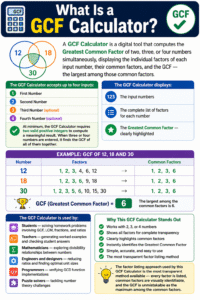
A GCF Calculator is a digital tool that computes the Greatest Common Factor of two, three, or four numbers simultaneously, displaying the individual factors of each input number, their common factors, and the GCF — the largest among those common factors.
The GCF Calculator accepts up to four inputs:
- First Number
- Second Number
- Third Number (optional)
- Fourth Number (optional)
At minimum, the GCF Calculator requires two valid positive integers to compute a meaningful result. When three or four numbers are entered, it finds the GCF of all of them together.
The GCF Calculator displays:
- The input numbers
- The complete list of factors for each number
- The Greatest Common Factor — clearly highlighted
The GCF Calculator is used by:
- Students — solving homework problems involving GCF, LCM, fractions, and ratios
- Teachers — generating worked examples and checking student answers
- Mathematicians — exploring divisibility relationships between numbers
- Engineers and designers — reducing ratios and finding optimal unit sizes
- Programmers — verifying GCD function implementations
- Puzzle solvers — tackling number theory challenges
The factor listing approach used by this GCF Calculator is the most transparent method available — every factor is listed, common factors are visually identifiable, and the GCF is unmistakable as the maximum among the common factors.
Methods for Finding the GCF
Several methods exist for computing the GCF, each with different advantages depending on the size of the numbers and the context.
Method 1 — Factor Listing (used by this GCF Calculator) List all factors of each number, identify the common factors, and select the largest.
- Best for: small to medium numbers, educational transparency
- Advantage: shows all factors explicitly, making the process fully visible
- Used by: the GCF Calculator — listing all factors for each input number
Method 2 — Prime Factorization Find the prime factorization of each number, then multiply together the prime factors common to all, using the minimum exponent for each shared prime.
- Example: GCF(180, 252) → 180 = 2² × 3² × 5, 252 = 2² × 3² × 7 → GCF = 2² × 3² = 36
- Best for: medium numbers, connecting to number theory
Method 3 — Euclidean Algorithm Repeatedly divide the larger number by the smaller and replace the larger with the remainder, until the remainder is 0. The last non-zero remainder is the GCF.
- Example: GCF(48, 36) → 48 = 1 × 36 + 12 → 36 = 3 × 12 + 0 → GCF = 12
- Best for: large numbers, computer implementations
- Most efficient algorithm for very large integers
Method 4 — Continuous Division Divide both numbers by a common factor (starting from the smallest prime) and continue until no common factor remains. Multiply all the divisors used.
- Best for: classroom demonstrations with small numbers
The GCF Calculator uses factor listing, which provides the greatest educational value by making every factor of every number visible to the user — transforming the calculator into a learning tool, not just an answer machine.
How the GCF Calculator Works — Factor Listing Method
The GCF Calculator implements the factor listing method through the following algorithm:
Step 1 — Collect Valid Inputs The calculator reads up to four input fields and filters out any blank or invalid entries, retaining only the valid positive integers provided.
Step 2 — Find All Factors of Each Number For each valid input n, the GCF Calculator iterates from 1 to n and collects every integer i for which n mod i = 0 (i.e., i divides n evenly). This produces the complete list of factors for each number.
Step 3 — Find Common Factors Starting with the factor list of the first number, the GCF Calculator filters it to retain only those factors that also appear in every other number’s factor list. This produces the list of common factors — numbers that divide all inputs evenly.
Step 4 — Identify the GCF The GCF is simply the maximum value in the list of common factors — the largest number that divides all inputs.
Example — GCF of 24, 36, 48, 60:
- Factors of 24: 1, 2, 3, 4, 6, 8, 12, 24
- Factors of 36: 1, 2, 3, 4, 6, 9, 12, 18, 36
- Factors of 48: 1, 2, 3, 4, 6, 8, 12, 16, 24, 48
- Factors of 60: 1, 2, 3, 4, 5, 6, 10, 12, 15, 20, 30, 60
- Common factors: 1, 2, 3, 4, 6, 12
- GCF = 12
The GCF Calculator presents all of this information directly — making the answer not just a number but a fully explained result that users can verify and learn from.
How to Use the GCF Calculator Step by Step
The GCF Calculator is designed for effortless use. Here is the complete guide:
Step 1 — Enter Your Numbers Type positive integers into the number fields. You must enter at least two numbers for the GCF Calculator to produce a valid result. The third and fourth fields are optional — use them when finding the GCF of three or four numbers simultaneously.
Step 2 — Click “Calculate GCF” Press the Calculate GCF button. The GCF Calculator immediately processes all valid inputs, lists every factor, identifies common factors, and determines the Greatest Common Factor.
Step 3 — Read the Input Confirmation The results panel first confirms which numbers were used in the calculation — useful for verifying that all intended values were entered correctly.
Step 4 — Review Each Number’s Factors The GCF Calculator displays the complete factor list for every input number. Scan across the lists to identify which numbers appear in all of them — these are the common factors.
Step 5 — Note the Greatest Common Factor The final line of the output displays the GCF in bold — the largest number that divides all of your inputs exactly.
Step 6 — Apply the Result Use the GCF for its intended purpose: simplify a fraction, reduce a ratio, factor an expression, or solve a grouping problem.
Step 7 — Clear and Repeat Use the Clear button to reset all fields and enter new numbers for the next calculation.
Understanding the GCF Calculator’s Output
The GCF Calculator’s output is structured to be both informative and educational. Here is how to read every part:
Input Numbers line: Confirms which values were accepted and processed. If a field was left blank or contained an invalid entry, that number is excluded from the calculation.
Factors of [n] lines: Each line lists all positive divisors of the corresponding input number in ascending order. For example, “Factors of 24: 1, 2, 3, 4, 6, 8, 12, 24” shows all eight divisors of 24.
Identifying common factors by inspection: Scan the factor lists — any number that appears in every list is a common factor. For 24, 36, 48, and 60, the numbers 1, 2, 3, 4, 6, and 12 all appear in every list.
Greatest Common Factor (GCF) line: The final boldface line states the GCF directly. For 24, 36, 48, 60, the GCF Calculator correctly returns GCF = 12.
The educational value of this format is that users do not simply receive an answer — they see the complete mathematical landscape of each number’s divisors, making the GCF result intuitive rather than mysterious.
GCF vs. LCM — Understanding the Difference
The GCF and the Least Common Multiple (LCM) are the two fundamental number-pair operations in arithmetic, and understanding the difference between them is essential for using the GCF Calculator appropriately.
GCF (Greatest Common Factor)
- The LARGEST number that divides ALL of the given numbers
- Found by taking the INTERSECTION of factor lists and selecting the MAXIMUM
- GCF ≤ the smallest of the given numbers
- Used for: simplifying fractions, reducing ratios, factoring
LCM (Least Common Multiple)
- The SMALLEST number that is divisible by ALL of the given numbers
- Found from the UNION of prime factors, using the MAXIMUM exponents
- LCM ≥ the largest of the given numbers
- Used for: adding fractions with different denominators, finding common schedules
The relationship between GCF and LCM: For any two numbers a and b:
GCF(a, b) × LCM(a, b) = a × b
Example: GCF(12, 18) = 6 and LCM(12, 18) = 36
6 × 36 = 216 = 12 × 18 ✓
When to use the GCF Calculator vs. an LCM Calculator:
- Simplifying 12/18 → use the GCF Calculator → GCF = 6 → 12/18 = 2/3
- Adding 1/12 + 1/18 → use an LCM Calculator → LCM = 36 → 3/36 + 2/36 = 5/36
GCF Calculator in Mathematics Education
GCF is one of the core topics in middle school mathematics, introduced alongside factors, multiples, and fraction operations. The GCF Calculator supports learning at every stage.
Elementary Introduction Young students first learn what factors are — numbers that divide a given number evenly. The GCF Calculator helps students visualize factor lists and understand what makes a factor “common” by showing all factors of multiple numbers side by side.
Middle School Applications At the middle school level, the GCF appears in:
- Fraction simplification — the GCF of numerator and denominator is the divisor that reduces a fraction to lowest terms
- Ratio reduction — GCF divides both parts of a ratio to give the simplest form
- Word problems — “What is the largest equal group size?” type problems
The GCF Calculator lets students check their manual work instantly, providing immediate feedback that builds confidence and clarifies errors.
High School and Beyond In algebra, the GCF appears in polynomial factoring — extracting the greatest common monomial factor from a polynomial expression. Understanding the numeric GCF is the foundation for algebraic GCF operations, making the GCF Calculator a useful conceptual bridge.
Standardized Tests GCF questions appear on the SAT, ACT, GCSE, and national mathematics assessments. Students who have practiced with the GCF Calculator and understand how factor lists work are better prepared for these questions under exam conditions.
GCF Calculator for Fraction Simplification
Simplifying fractions to their lowest terms is the most common everyday application of the GCF, and the GCF Calculator is the perfect tool for this purpose.
The rule: A fraction a/b is in lowest terms when GCF(a, b) = 1. To simplify any fraction, divide both numerator and denominator by their GCF.
Step-by-step fraction simplification using the GCF Calculator:
- Identify the numerator and denominator of your fraction
- Enter them as the first two numbers in the GCF Calculator
- Click Calculate GCF
- Divide both numerator and denominator by the GCF
- The result is the fraction in its simplest (lowest) terms
Example — Simplify 84/126:
- Use the GCF Calculator: GCF(84, 126) = 42
- 84 ÷ 42 = 2 (new numerator)
- 126 ÷ 42 = 3 (new denominator)
- Simplified fraction: 2/3
Example — Simplify 360/480:
- Use the GCF Calculator: GCF(360, 480) = 120
- 360 ÷ 120 = 3
- 480 ÷ 120 = 4
- Simplified fraction: 3/4
The GCF Calculator is the fastest and most reliable way to simplify fractions, especially when the numerator and denominator are large numbers where finding the GCF by inspection is difficult.
GCF Calculator in Algebra — Factoring Expressions
In algebra, the concept of GCF extends from numbers to polynomial expressions, and a solid understanding of numeric GCF (as provided by the GCF Calculator) is the essential foundation.
Greatest Common Monomial Factor To factor a polynomial, the first step is always to extract the GCF of all terms — the largest expression (combining numeric GCF and minimum variable powers) that divides every term of the polynomial.
Example — Factor 12x³ + 18x² + 24x:
- Numeric coefficients: 12, 18, 24 → use the GCF Calculator → GCF = 6
- Variable: x³, x², x → minimum power = x¹
- GCF of expression = 6x
- Factored form: 6x(2x² + 3x + 4)
The GCF Calculator handles the numeric part of this operation — computing GCF(12, 18, 24) = 6 — leaving the variable portion for manual analysis.
Factoring by Grouping More advanced factoring techniques (factoring by grouping, factoring trinomials) also rely on identifying the GCF of groups of terms. The GCF Calculator supports these operations by quickly finding the numeric GCF at each stage.
GCF Calculator in Measurement and Ratio Problems
The GCF Calculator is an essential tool for measurement and ratio problems — real-world situations where finding the largest common unit is the key to a practical solution.
Tile and Flooring Problems A classic application: “A room is 360 cm by 480 cm. What is the largest square tile that covers the floor with no cutting?”
- GCF(360, 480) = 120 cm → the largest square tile is 120 cm × 120 cm
- Use the GCF Calculator: GCF(360, 480) = 120 ✓
Rope and Cutting Problems “You have ropes of length 84 m and 126 m. What is the longest piece you can cut both ropes into, with no remainder?”
- GCF(84, 126) = 42 → longest cut: 42 m pieces
Packing and Grouping Problems “You have 24 apples, 36 oranges, and 48 bananas. What is the largest number of identical mixed fruit bags you can make?”
- GCF(24, 36, 48) = 12 → 12 identical bags, each containing 2 apples, 3 oranges, and 4 bananas
- Use the GCF Calculator with all three values for instant verification
Gear Ratios and Mechanical Engineering In mechanical design, gear ratios are always expressed in their simplest form. The GCF Calculator reduces any gear ratio to its lowest terms by dividing both values by their GCF — critical for minimizing gear sizes and avoiding unnecessary complexity.
Scale Drawings and Maps The scale of a map (e.g., 2500 : 1 reduced from 15000 : 6) is found by dividing both parts by their GCF. The GCF Calculator makes this reduction immediate and exact.
GCF Calculator in Computer Science and Algorithms
The GCF (equivalently, GCD) is one of the most important functions in computer science, appearing in algorithm design, cryptography, data structures, and numerical computing.
Euclidean Algorithm The Euclidean algorithm for computing GCD is one of the oldest algorithms in mathematics, dating to Euclid’s Elements (~300 BCE). It is still the standard implementation in nearly every programming language’s math library. Understanding the GCF Calculator — which computes GCF by explicit factor listing — illuminates the goal that the Euclidean algorithm achieves more efficiently for large numbers.
RSA Key Generation RSA encryption requires that the chosen public exponent e and the value φ(n) = (p−1)(q−1) be coprime — that is, their GCF must equal 1. This check is performed using a GCF computation every time an RSA key pair is generated.
Fraction Arithmetic in Computer Programs Programming languages that support rational arithmetic (exact fractions) use GCF computations after every addition, subtraction, multiplication, or division to keep fractions in lowest terms. The GCF Calculator demonstrates the operation that underlies these library functions.
Loop Optimization and Scheduling In computer architecture, instruction scheduling and loop optimization algorithms use GCF to determine instruction interleaving patterns and memory access strides. Understanding the GCF Calculator provides intuition for why these optimizations work.
GCF of More Than Two Numbers
One of the most powerful features of this GCF Calculator is its ability to handle up to four numbers simultaneously — a capability that extends beyond what many basic GCF tools offer.
How multi-number GCF works: The GCF of three or more numbers is found by taking the GCF of any two, then taking the GCF of that result with the next number, and so on. The GCF Calculator handles this automatically:
GCF(a, b, c, d) = GCF(GCF(GCF(a, b), c), d)
Equivalently, through the factor listing method: a factor is common to all four numbers if and only if it appears in every individual factor list.
Example — GCF(24, 36, 48, 60):
- Factors of 24: 1, 2, 3, 4, 6, 8, 12, 24
- Factors of 36: 1, 2, 3, 4, 6, 9, 12, 18, 36
- Factors of 48: 1, 2, 3, 4, 6, 8, 12, 16, 24, 48
- Factors of 60: 1, 2, 3, 4, 5, 6, 10, 12, 15, 20, 30, 60
- Common to all four: 1, 2, 3, 4, 6, 12
- GCF = 12
The GCF Calculator displays all four factor lists and identifies GCF = 12 in a single operation — a computation that would require multiple steps if done manually or with a two-number GCF tool.
Special Cases — GCF with 1, Primes, and Coprime Numbers
Understanding special cases helps you interpret the GCF Calculator’s results correctly.
GCF = 1 (Coprime Numbers) When the GCF Calculator returns 1, the input numbers are called coprime (or relatively prime) — they share no common factor other than 1. This does not mean the numbers are prime themselves; it means their factor lists share nothing beyond the universal factor 1.
- GCF(8, 15) = 1 → 8 and 15 are coprime
- GCF(14, 25) = 1 → 14 and 25 are coprime
Coprimeness is important in:
- RSA cryptography (e requirement)
- Fraction lowest-term verification (numerator and denominator must be coprime)
- Modular arithmetic (Bezout’s identity and the extended Euclidean algorithm)
GCF with a Prime Number If one of the inputs is a prime p, the GCF with any other number is either 1 (if the other number is not divisible by p) or p (if the other number is divisible by p). The GCF Calculator correctly identifies this by listing the minimal factor set of the prime.
GCF of a Number with Itself GCF(n, n) = n. When two identical numbers are entered, the GCF Calculator returns the number itself — because every factor of n is a common factor of n and n, and the largest is n.
GCF of a Number with Its Multiple GCF(n, kn) = n for any positive integer k. The smaller number always divides the larger evenly when the larger is a multiple of the smaller.
Common Mistakes When Using a GCF Calculator
The GCF Calculator is simple to use, but a few common errors can produce misleading results:
- Entering only one number — The GCF Calculator requires at least two valid positive integers. A single number has no “common” factor with anything — GCF is a relationship between numbers, not a property of one number alone
- Entering decimal or non-integer values — GCF is defined only for positive integers. Entering 3.5 or 7.2 produces undefined behavior. Always use whole numbers in the GCF Calculator
- Entering 0 — Zero is divisible by every positive integer, so GCF(0, n) = n by convention. However, most practical applications involve positive integers, and entering 0 may produce unexpected results depending on the implementation. Enter only positive integers greater than 0
- Confusing GCF with LCM — The GCF is the largest common factor (divides both); the LCM is the smallest common multiple (both divide it). When simplifying fractions, use the GCF Calculator; when finding common denominators, use an LCM tool
- Assuming the GCF of coprime numbers is 0 — The GCF of coprime numbers is 1, not 0. Every pair of integers shares 1 as a common factor. When the GCF Calculator returns 1, it correctly indicates that 1 is the only common factor
Frequently Asked Questions (FAQs)
What is a GCF Calculator? A GCF Calculator is a digital tool that finds the Greatest Common Factor of two or more numbers — the largest positive integer that divides all of the given numbers exactly — displaying all individual factors and common factors alongside the final GCF result.
What does GCF stand for? GCF stands for Greatest Common Factor. It is also known as the Greatest Common Divisor (GCD) and the Highest Common Factor (HCF).
What is the difference between GCF and GCD? GCF (Greatest Common Factor) and GCD (Greatest Common Divisor) are the same mathematical concept. GCF is more common in K-12 education in the United States; GCD is more common in higher mathematics and computer science contexts. The GCF Calculator computes both.
How many numbers can the GCF Calculator handle? This GCF Calculator accepts up to four numbers simultaneously. At least two must be provided for a valid GCF calculation.
What does it mean when the GCF Calculator returns 1? A GCF of 1 means the numbers are coprime — they share no common factor other than 1. This is a valid and important result, indicating that the numbers cannot be simultaneously reduced by any factor greater than 1.
How do I use the GCF Calculator to simplify a fraction? Enter the numerator and denominator as the two inputs in the GCF Calculator. The GCF it returns is the value by which you divide both the numerator and denominator to simplify the fraction to its lowest terms.
Can the GCF Calculator handle large numbers? Yes. The factor listing method works for any positive integer, though computation time increases for very large numbers (since all factors up to n must be checked). For practical educational and professional use, the GCF Calculator handles typical input sizes with ease.
What is the GCF of a prime number and any other number? If p is prime, GCF(p, n) is either p (if p divides n) or 1 (if p does not divide n). Because primes have only two factors (1 and themselves), the only possible common factors with any other number are 1 and p itself.
Is the GCF always smaller than or equal to the smallest input? Yes. Since the GCF divides every input number, it cannot be larger than the smallest of them. GCF ≤ min(inputs) always holds.
Why do programmers use GCF in their code? Programmers use GCF (often called GCD in code) for fraction reduction, RSA key validation, loop scheduling, hash table sizing, modular inverse computations, and many other algorithm design tasks. The Euclidean algorithm is the standard efficient implementation, and the GCF Calculator demonstrates the concept underlying it.
Conclusion
The Greatest Common Factor is one of the most fundamental and widely applicable concepts in arithmetic — a single number that encapsulates the shared divisibility structure of two or more integers and unlocks a range of practical mathematical operations. From simplifying a fraction before an exam, to reducing a gear ratio in a mechanical design, to validating a cryptographic key in a security protocol, the GCF is at the heart of countless calculations performed every day across education, engineering, and technology.
The GCF Calculator brings this essential operation within immediate reach of anyone who needs it. By listing all factors of every input number, identifying the complete set of common factors, and presenting the Greatest Common Factor clearly alongside the full supporting data, the GCF Calculator delivers not just an answer but a complete mathematical explanation — one that educates as it calculates.
Whether you are simplifying 360/480 into 3/4, finding that the largest tile for a 360 cm × 480 cm floor is 120 cm, discovering that 14 and 25 are coprime, or factoring out GCF(12, 18, 24) = 6 from an algebraic expression, the GCF Calculator handles every case instantly and transparently, with results you can trust and understand.
Bookmark this guide, use the GCF Calculator with numbers from your own work, and develop the fluency with common factors and divisibility that underlies so much of practical mathematics — one clear, step-by-step calculation at a time.