Pythagorean Theorem Calculator
Calculate area, radius, diameter, and circumference instantly with our fast and accurate Circle Calculator
Table of Contents
- Introduction
- What Is the Pythagorean Theorem?
- What Is a Pythagorean Theorem Calculator?
- The Pythagorean Theorem Formula — Explained
- Three Modes of the Pythagorean Theorem Calculator
- How to Use the Pythagorean Theorem Calculator Step by Step
- Understanding the Step-by-Step Solution
- Pythagorean Triples — Special Right Triangle Combinations
- Proofs of the Pythagorean Theorem
- Pythagorean Theorem Calculator in Education
- Pythagorean Theorem Calculator in Architecture and Construction
- Pythagorean Theorem Calculator in Navigation and Surveying
- Pythagorean Theorem Calculator in Physics and Engineering
- Pythagorean Theorem Calculator in Computer Graphics and Gaming
- Pythagorean Theorem in Three Dimensions
- Common Mistakes When Using the Pythagorean Theorem Calculator
- Frequently Asked Questions (FAQs)
- Conclusion
Introduction
Few theorems in the history of mathematics have proven as enduringly useful, as widely applicable, and as fundamentally important as the Pythagorean theorem. From the construction of ancient monuments to the design of modern skyscrapers, from navigation at sea to GPS satellite positioning, from computer graphics to structural engineering, the Pythagorean theorem forms the mathematical foundation for calculating distances and dimensions in right triangles. The Pythagorean Theorem Calculator brings this timeless mathematical principle into the digital age — allowing anyone to solve for any side of a right triangle in seconds, with a complete step-by-step solution that makes every calculation transparent and educational.
In this comprehensive guide, we will explore everything about the Pythagorean Theorem Calculator — the history and proof of the theorem, how the calculator works, all three modes of solving (finding the hypotenuse, finding a leg, and verifying right triangles), and the extraordinary range of real-world applications where this fundamental relationship between sides of a right triangle appears. Whether you are a student encountering the Pythagorean theorem for the first time, a professional applying it in engineering or architecture, or a curious learner who wants to understand why it works, this guide will give you a complete and practical mastery of the Pythagorean Theorem Calculator and the mathematical principle it embodies.
What Is the Pythagorean Theorem?
The Pythagorean theorem is a fundamental principle in Euclidean geometry that describes the relationship between the three sides of any right triangle. A right triangle is a triangle that contains one angle equal to exactly 90 degrees — called the right angle. The side opposite the right angle is the longest side, known as the hypotenuse, and the other two sides are called the legs.
The Pythagorean theorem states:
In any right triangle, the square of the length of the hypotenuse is equal to the sum of the squares of the lengths of the other two sides.
In formula form:
a² + b² = c²
Where a and b are the lengths of the two legs, and c is the length of the hypotenuse.
The theorem is named after the ancient Greek mathematician Pythagoras of Samos (c. 570–495 BCE), though evidence suggests the relationship was known to Babylonian and Indian mathematicians centuries earlier. The Babylonian clay tablet Plimpton 322 (dated to approximately 1800 BCE) contains Pythagorean triples, indicating practical knowledge of the theorem long before Pythagoras.
The Pythagorean theorem has over 370 known mathematical proofs — more than any other theorem in mathematics — attesting to its profound importance and the many different ways it can be understood. The Pythagorean Theorem Calculator applies this relationship computationally, giving you any missing side of a right triangle when two sides are known.
What Is a Pythagorean Theorem Calculator?
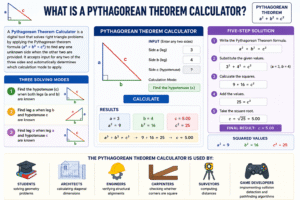
A Pythagorean Theorem Calculator is a digital tool that solves right triangle problems by applying the Pythagorean theorem formula (a² + b² = c²) to find any one unknown side when the other two are provided. It accepts input for any two of the three sides and automatically determines which calculation mode to apply.
The Pythagorean Theorem Calculator offers three solving modes:
- Find the hypotenuse (c) when both legs (a and b) are known
- Find leg a when leg b and hypotenuse c are known
- Find leg b when leg a and hypotenuse c are known
In addition to the missing side, the Pythagorean Theorem Calculator displays:
- The squared values of all three sides (a², b², c²)
- A complete five-step solution showing every stage of the calculation
- The substitution of actual values into the formula at each step
- The final result to two decimal places
The Pythagorean Theorem Calculator is used by: students solving geometry problems, architects calculating diagonal dimensions, engineers verifying structural alignments, carpenters checking whether corners are square, surveyors computing distances, and game developers implementing collision detection and pathfinding algorithms.
The Pythagorean Theorem Formula — Explained
The formula a² + b² = c² encodes a profound geometric truth that can be understood in multiple ways.
Geometric Interpretation Draw squares on each side of a right triangle. The area of the square on the hypotenuse (c²) exactly equals the combined area of the squares on the two legs (a² + b²). This is not just an algebraic formula — it is a statement about areas.
Algebraic Forms The standard formula a² + b² = c² can be rearranged into three equivalent forms, one for each unknown:
- Finding c (hypotenuse): c = √(a² + b²)
- Finding a (one leg): a = √(c² − b²)
- Finding b (other leg): b = √(c² − a²)
The Pythagorean Theorem Calculator applies whichever form is appropriate based on which two sides you provide as input.
Numerical Example — Classic 3-4-5 Triangle
a = 3, b = 4 a² = 9, b² = 16 a² + b² = 9 + 16 = 25 c = √25 = 5
Verify: 3² + 4² = 9 + 16 = 25 = 5² ✓
This is the most famous Pythagorean triple — a set of three positive integers that satisfy the theorem exactly — and the default example in many Pythagorean Theorem Calculator implementations.
Three Modes of the Pythagorean Theorem Calculator
The Pythagorean Theorem Calculator intelligently detects which two sides are provided and applies the correct formula automatically.
Mode 1 — Finding the Hypotenuse (Given a and b) When you enter both legs a and b and leave c blank:
c = √(a² + b²)
This is the most common use of the Pythagorean Theorem Calculator — computing the diagonal length when both perpendicular sides are known.
Example: a = 5, b = 12 → c = √(25 + 144) = √169 = 13
Mode 2 — Finding Leg b (Given a and c) When you enter leg a and hypotenuse c and leave b blank:
b = √(c² − a²)
This mode is used when the hypotenuse and one leg are known and the other leg must be found.
Example: a = 8, c = 17 → b = √(289 − 64) = √225 = 15
Mode 3 — Finding Leg a (Given b and c) When you enter leg b and hypotenuse c and leave a blank:
a = √(c² − b²)
This mode mirrors Mode 2 but solves for the other leg.
Example: b = 24, c = 25 → a = √(625 − 576) = √49 = 7
The Pythagorean Theorem Calculator handles all three modes from the same interface — simply enter any two values and leave the third blank, then click Calculate.
How to Use the Pythagorean Theorem Calculator Step by Step
The Pythagorean Theorem Calculator is designed to be intuitive and efficient. Here is the complete usage guide:
Step 1 — Identify Your Known Values Determine which two sides of your right triangle you know. You need exactly two sides — any two from {a, b, c} — to solve for the third.
Step 2 — Enter the Known Values Type the two known side lengths into their respective fields:
- Enter side a if you know leg a
- Enter side b if you know leg b
- Enter hypotenuse c if you know c
- Leave the unknown side’s field empty (or clear it)
Step 3 — Click “Calculate” The Pythagorean Theorem Calculator detects which two values are entered, selects the appropriate formula mode, and performs the calculation.
Step 4 — Review the Full Results The calculator populates all six result fields:
- The computed unknown side (a, b, or c)
- a² — the square of leg a
- b² — the square of leg b
- c² — the square of the hypotenuse
Step 5 — Read the Step-by-Step Solution The results panel displays a five-step solution showing the formula, value substitution, individual squares, their sum or difference, the square root step, and the final result.
Step 6 — Clear and Try a New Triangle Use the “Clear” button to reset all fields and enter a new right triangle.
Understanding the Step-by-Step Solution
One of the most valuable features of the Pythagorean Theorem Calculator is its transparent, step-by-step solution display. Here is what each step means using the classic 3-4-5 example:
Step 1: Formula a² + b² = c² States the Pythagorean theorem in its standard form.
Step 2: Substitute values: 3² + 4² = c² Replaces the variables with the actual numbers entered.
Step 3: Calculate squares: 9 + 16 = c² Shows the squared values of each leg explicitly.
Step 4: Add results: 25 = c² Performs the addition to find c².
Step 5: Take square root: c = √25 Applies the inverse operation to isolate c.
Final Result: c = 5.00 Displays the computed hypotenuse to two decimal places.
This step-by-step format transforms the Pythagorean Theorem Calculator from a simple answer machine into an educational tool, showing students exactly how the formula works at every stage and making the mathematics visible rather than hidden.
Pythagorean Triples — Special Right Triangle Combinations
Pythagorean triples are sets of three positive integers (a, b, c) that satisfy a² + b² = c² exactly, producing right triangles with whole-number side lengths. They are of great historical, mathematical, and practical interest.
Common Pythagorean triples:
| a | b | c | Verification |
|---|---|---|---|
| 3 | 4 | 5 | 9 + 16 = 25 ✓ |
| 5 | 12 | 13 | 25 + 144 = 169 ✓ |
| 8 | 15 | 17 | 64 + 225 = 289 ✓ |
| 7 | 24 | 25 | 49 + 576 = 625 ✓ |
| 20 | 21 | 29 | 400 + 441 = 841 ✓ |
| 9 | 40 | 41 | 81 + 1600 = 1681 ✓ |
| 6 | 8 | 10 | 36 + 64 = 100 ✓ (multiple of 3-4-5) |
Any multiple of a Pythagorean triple is also a Pythagorean triple — for example, multiplying 3-4-5 by any positive integer k gives a valid triple: 6-8-10, 9-12-15, 15-20-25, etc.
Pythagorean triples are practically important because they allow carpenters, builders, and engineers to construct perfect right angles using only a measuring tape — without needing a protractor or angle-measuring tool. The Pythagorean Theorem Calculator can verify any triple by checking that a² + b² = c².
Proofs of the Pythagorean Theorem
The Pythagorean theorem has more proven proofs than any other mathematical theorem — over 370 distinct proofs have been documented. Understanding a few of the key proofs deepens appreciation for why the theorem is true, not just that it is true.
Proof 1 — Algebraic (Rearrangement) Proof Draw a large square with side (a + b). Inside, place four identical right triangles with legs a and b, arranged so their hypotenuses form an inner square of side c. The area of the large square equals the area of the four triangles plus the inner square:
(a + b)² = 4 × (½ab) + c² a² + 2ab + b² = 2ab + c² a² + b² = c²
Proof 2 — Geometric (Euclid’s Proof) Euclid’s proof (Book I, Proposition 47 of the Elements) constructs squares on all three sides and proves through shear transformations and triangle congruence that the areas satisfy the theorem.
Proof 3 — Similar Triangle Proof Drop an altitude from the right angle to the hypotenuse. This creates two smaller triangles, each similar to the original. Using the proportionality of similar triangles:
a/c = (part of c corresponding to a)/a → a² = c × (that part) b/c = (other part)/b → b² = c × (the other part) Adding: a² + b² = c × (sum of both parts) = c × c = c²
These proofs confirm that the Pythagorean Theorem Calculator implements a theorem that is not merely empirically observed but rigorously proven from first principles of geometry.
Pythagorean Theorem Calculator in Education
The Pythagorean theorem is one of the most widely taught mathematical concepts in secondary school geometry, and the Pythagorean Theorem Calculator is an invaluable companion for learning and practice.
Classroom Applications Teachers use the Pythagorean Theorem Calculator to:
- Generate worked examples with step-by-step solutions for classroom demonstration
- Verify student answers instantly
- Explore irrational hypotenuses (e.g., what is the hypotenuse when a = 1, b = 1? → √2 ≈ 1.41)
- Show why the theorem applies only to right triangles
Student Practice Students use the Pythagorean Theorem Calculator to:
- Check manual homework calculations
- Understand where errors occurred in their step-by-step work
- Build confidence with the formula through immediate feedback
- Explore Pythagorean triples by trying different integer inputs
Standardized Testing Questions involving the Pythagorean theorem appear regularly on the SAT, ACT, GCSE, and national mathematics assessments. Students who are fluent with the theorem and have practiced with the Pythagorean Theorem Calculator develop strong intuition for which formula to apply and can solve these problems efficiently under exam conditions.
Pythagorean Theorem Calculator in Architecture and Construction
In architecture and construction, the Pythagorean theorem is applied daily — from laying foundations to framing roofs to installing diagonal bracing.
Squaring Foundations and Floors Before pouring a foundation or laying tiles, builders verify that corners are square (90°) using the 3-4-5 rule: if one leg is 3 units and the other is 4 units, the diagonal must measure exactly 5 units. The Pythagorean Theorem Calculator extends this check to any dimensions, verifying whether a corner is truly square.
Staircase Design A staircase rises vertically (rise) and extends horizontally (run). The hypotenuse of this right triangle is the actual stringer length — the diagonal board that the steps attach to. Architects use the Pythagorean Theorem Calculator to determine precise stringer lengths from rise and run dimensions.
Roof Pitch and Rafter Length A roof is defined by its rise (vertical height) and run (horizontal span). The rafter length — the actual sloped distance from ridge to wall plate — is the hypotenuse of this right triangle. Carpenters use the Pythagorean Theorem Calculator to compute rafter lengths for any roof pitch.
Diagonal Distances in Floor Plans When planning room layouts, architects frequently need to know the diagonal distance across a rectangular room — for cable runs, sight lines, or furniture placement. The Pythagorean Theorem Calculator gives this diagonal instantly from length and width.
Pythagorean Theorem Calculator in Navigation and Surveying
Navigation and surveying depend fundamentally on computing distances, and the Pythagorean theorem is one of the primary tools for doing so.
Dead Reckoning Navigation A ship or aircraft traveling in two perpendicular components (east-west and north-south) has a total displacement equal to the hypotenuse of the right triangle formed by those two components. The Pythagorean Theorem Calculator computes this resultant displacement instantly from the two perpendicular components.
Surveying and Land Measurement Surveyors establish baselines and perpendicular offsets to locate property boundaries and geographic features. The Pythagorean Theorem Calculator converts these perpendicular measurements into direct distances between points, which are essential for legal property descriptions.
GPS and Coordinate Distance In Cartesian coordinates, the distance between two points (x₁, y₁) and (x₂, y₂) is:
d = √((x₂−x₁)² + (y₂−y₁)²)
This is the Pythagorean theorem applied to coordinate differences — the legs are (x₂−x₁) and (y₂−y₁), and d is the hypotenuse. The Pythagorean Theorem Calculator computes this distance when you enter the coordinate differences as legs.
Pythagorean Theorem Calculator in Physics and Engineering
Physics and engineering are filled with applications of the Pythagorean theorem, appearing whenever two perpendicular quantities combine to produce a resultant.
Vector Addition When two forces, velocities, or other vector quantities act at right angles, their resultant magnitude is the hypotenuse of the right triangle formed by the two perpendicular components. The Pythagorean Theorem Calculator determines the resultant magnitude from any two perpendicular vector components.
Electrical Engineering — Impedance In AC circuits, resistance (R) and reactance (X) combine at right angles in the impedance triangle:
Z = √(R² + X²)
The Pythagorean Theorem Calculator computes impedance Z from R and X directly, making it a practical tool for circuit analysis.
Structural Engineering Diagonal braces, tension cables, and inclined members in trusses and bridges form right triangles with the horizontal and vertical structural elements. Engineers use the Pythagorean Theorem Calculator to determine the lengths of these diagonal members from the horizontal and vertical spans.
Optics — Path Length In geometric optics, the path length of a light ray traveling diagonally through a rectangular medium is the hypotenuse of a right triangle. The Pythagorean Theorem Calculator computes this path length for any rectangular cross-section.
Pythagorean Theorem Calculator in Computer Graphics and Gaming
The Pythagorean theorem is one of the most frequently used formulas in computer graphics and game development, where 2D and 3D distances must be computed thousands of times per second.
2D Distance Calculation Finding the distance between two pixels, game objects, or UI elements on a 2D screen requires:
distance = √((x₂−x₁)² + (y₂−y₁)²)
This is a direct application of the Pythagorean Theorem Calculator formula — the horizontal and vertical pixel differences are the legs, and the true distance is the hypotenuse.
Collision Detection Games determine whether two circular objects are colliding by comparing the distance between their centers to the sum of their radii. The distance calculation uses the Pythagorean theorem — if distance ≤ r₁ + r₂, collision is detected.
Camera and Line-of-Sight Game AI uses the Pythagorean theorem to determine whether an enemy is within a certain range of the player. The Pythagorean Theorem Calculator principle is implemented in virtually every game engine’s spatial query system.
Vector Normalization Normalizing a 2D vector (dividing by its magnitude) requires computing the vector’s magnitude — which is the hypotenuse of the triangle formed by its x and y components. This operation is performed millions of times per second in real-time 3D graphics.
Pythagorean Theorem in Three Dimensions
The Pythagorean theorem extends naturally into three dimensions, providing the formula for the space diagonal of a rectangular box and the distance between any two points in 3D space.
3D Distance Formula:
d = √(a² + b² + c²)
Where a, b, and c are the three perpendicular dimensions (length, width, height).
This is derived by applying the Pythagorean theorem twice:
- Find the face diagonal: f = √(a² + b²)
- Find the space diagonal: d = √(f² + c²) = √(a² + b² + c²)
The Pythagorean Theorem Calculator can be used for the first step (computing f), and the result entered as a leg for the second application — giving the full 3D diagonal.
Applications of 3D distance:
- Determining the longest object that fits in a shipping box
- Computing distances in 3D game worlds
- Calculating signal distances in 3D wireless networks
- Finding the body diagonal of a crystal unit cell in materials science
Common Mistakes When Using the Pythagorean Theorem Calculator
The Pythagorean Theorem Calculator is straightforward to use, but certain errors are common, especially among students new to the theorem.
- Applying the theorem to non-right triangles — The Pythagorean theorem applies only to right triangles. Using it on acute or obtuse triangles produces incorrect results. Always verify that your triangle has a 90° angle before using the Pythagorean Theorem Calculator
- Confusing legs and hypotenuse — The hypotenuse is always the longest side and always opposite the right angle. Entering the hypotenuse as a leg, or a leg as the hypotenuse, reverses the formula and gives a wrong result
- Entering only one side — The Pythagorean Theorem Calculator needs exactly two of the three sides. Entering only one side leaves the problem underdetermined and produces no valid result
- Forgetting to enter the correct fields — When finding the hypotenuse, enter a and b and leave c blank. Entering values in the wrong fields triggers the wrong calculation mode
- Assuming the result must be a whole number — Most right triangles do not have integer sides. The Pythagorean Theorem Calculator correctly returns irrational results like √2 ≈ 1.41 or √5 ≈ 2.24 — these are mathematically correct, not errors
- Squaring before subtracting — When finding a leg, the formula is √(c² − a²), not √(c − a)². Always square the individual sides first, then subtract
Frequently Asked Questions (FAQs)
What is the Pythagorean Theorem Calculator? A Pythagorean Theorem Calculator is a digital tool that solves right triangle side length problems using the formula a² + b² = c², finding any one unknown side when the other two are provided, with a complete step-by-step solution.
When can I use the Pythagorean Theorem Calculator? The Pythagorean Theorem Calculator can be used whenever you have a right triangle (a triangle with a 90° angle) and know exactly two of its three side lengths. It cannot be applied to non-right triangles.
What is the hypotenuse? The hypotenuse is the longest side of a right triangle — the side opposite the right angle. In the formula a² + b² = c², c is always the hypotenuse.
What is a Pythagorean triple? A Pythagorean triple is a set of three positive integers (a, b, c) that exactly satisfy a² + b² = c², producing a right triangle with whole-number sides. The most famous example is 3-4-5.
Does the Pythagorean theorem work for all triangles? No. The Pythagorean theorem applies only to right triangles. For acute or obtuse triangles, the Law of Cosines is the appropriate tool.
Why does the Pythagorean Theorem Calculator display a² and b² values? Displaying a², b², and c² separately makes the intermediate steps of the calculation visible, helping users understand the mathematics and verify each stage of the computation.
Can I find a leg instead of the hypotenuse with the Pythagorean Theorem Calculator? Yes. Enter the known leg and the hypotenuse, and leave the unknown leg blank. The Pythagorean Theorem Calculator automatically applies the formula b = √(c² − a²) or a = √(c² − b²) as appropriate.
What if my result is an irrational number? Many right triangles have irrational hypotenuses — for example, an isosceles right triangle with legs of 1 unit has a hypotenuse of √2 ≈ 1.414. The Pythagorean Theorem Calculator returns these as decimal approximations to two decimal places.
Can the Pythagorean theorem be used in three dimensions? Yes. The 3D distance formula d = √(a² + b² + c²) is a direct extension of the theorem, applied twice using two nested applications of the Pythagorean principle.
How accurate is the Pythagorean Theorem Calculator? The Pythagorean Theorem Calculator computes results to two decimal places of precision — sufficient for virtually all educational, construction, engineering, and professional applications.
Conclusion
The Pythagorean theorem — a² + b² = c² — is one of the most important, most proven, and most practically useful equations in all of mathematics. For over 2,500 years, it has empowered builders, navigators, scientists, and mathematicians to compute distances and dimensions with precision and certainty. Its elegance lies in its simplicity: just three numbers, one relationship, and an infinite range of applications.
The Pythagorean Theorem Calculator brings this ancient mathematical truth into an accessible, instant, and educational digital tool. By solving for any missing side of a right triangle from any two known sides, displaying all squared values, and providing a complete five-step solution, the Pythagorean Theorem Calculator serves every user — from the student encountering the theorem for the first time to the architect measuring a roof diagonal to the engineer computing a vector resultant.
Whether your right triangle lives on paper, on a construction site, in a computer simulation, in a physics equation, or on a navigation chart, the Pythagorean Theorem Calculator delivers the answer you need — instantly, accurately, and with full mathematical transparency that makes the solution as educational as it is useful.
Bookmark this guide, practice with the Pythagorean Theorem Calculator using triangles from your own work, and let one of history’s greatest mathematical theorems work for you — precisely, reliably, and completely.