Circle Calculator
Calculate ratios instantly with our fast and accurate Ratio Calculator
Table of Contents
- Introduction
- What Is a Circle?
- What Is a Circle Calculator?
- Circle Area Formula
- Step-by-Step Example: Area from Diameter
- The Area Circle Formula — Definition and Expression
- Deriving the Area Circle Formula
- Key Circle Measurements — Radius, Diameter, Circumference, and Area
- Relationships Between Circle Formulas
- How to Use the Circle Calculator Step by Step
- Understanding the Circle Calculator’s Output
- Area Circle Formula in Education and Mathematics
- Area Circle Formula in Engineering and Architecture
- Area Circle Formula in Science and Physics
- Area Circle Formula in Everyday Life
- Area of a Sector — Partial Circle Area
- Area Circle Formula vs. Circumference Formula
- Area Circle Formula in Coordinate Geometry
- Common Mistakes with the Area Circle Formula
- Frequently Asked Questions (FAQs)
- Conclusion
Introduction
Of all the geometric shapes in mathematics, the circle is perhaps the most perfect — defined entirely by a single measurement, the radius, from which every other property flows. Its area, circumference, and diameter are all interrelated through one of the most famous constants in mathematics: π (pi). Understanding the area circle formula — A = πr² — is one of the most important skills in geometry, with applications that extend far beyond the classroom into engineering, architecture, science, technology, and everyday life. Whether you are calculating the area of a pizza, designing a circular garden, computing the cross-section of a pipe, or solving a calculus problem involving integration in polar coordinates, the area circle formula is the expression you reach for.
In this comprehensive guide, we will explore everything about the area circle formula — its derivation, its relationship to other circle properties, how to use the Circle Calculator to compute all circle measurements instantly, and the remarkable breadth of real-world contexts where circular geometry is essential. Whether you are a student encountering circle area for the first time, a teacher preparing worked examples, an engineer computing circular cross-sections, or an architect designing curved spaces, this guide provides a thorough and practical mastery of the area circle formula and the mathematical framework surrounding it.
What Is a Circle?
A circle is a two-dimensional geometric shape defined as the set of all points in a plane that are equidistant from a fixed central point. That fixed distance from the center to any point on the circle is called the radius. Every circle is uniquely and completely defined by its radius — all other properties (diameter, circumference, area) follow directly from it.
Key definitions:
- Center — the fixed point equidistant from all points on the circle
- Radius (r) — the distance from the center to any point on the circle
- Diameter (d) — the distance across the circle through the center; d = 2r
- Circumference (C) — the total distance around the circle; C = 2πr
- Area (A) — the total space enclosed within the circle; given by the area circle formula A = πr²
Pi (π) is the mathematical constant equal to the ratio of a circle’s circumference to its diameter — approximately 3.14159265… It is an irrational number (it never terminates or repeats) and is one of the most important constants in all of mathematics.
Circles appear everywhere in nature and human-made environments:
- The cross-section of cylinders, pipes, rods, and wheels
- The orbits of planets (approximately circular)
- The face of clocks, coins, and round objects
- Circular arenas, stadiums, and amphitheaters
- The ripples that spread from a point on water
Understanding the area circle formula is the key to quantifying the two-dimensional space enclosed by all of these circular forms.
What Is a Circle Calculator?
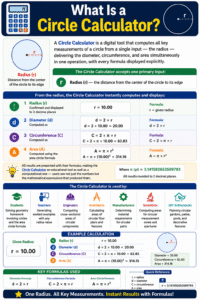
A Circle Calculator is a digital tool that computes all key measurements of a circle from a single input — the radius — delivering the diameter, circumference, and area simultaneously in one operation, with every formula displayed explicitly.
The Circle Calculator accepts one primary input:
- Radius (r) — the distance from the center of the circle to its edge
From the radius, the Circle Calculator instantly computes and displays:
- Radius (r) — confirmed and displayed to 2 decimal places
- Diameter (d) — computed as d = 2 × r
- Circumference (C) — computed as C = 2 × π × r
- Area (A) — computed using the area circle formula: A = π × r²
All results are presented with their formulas, making the Circle Calculator an educational tool as well as a computational one — users see not just the numbers but the mathematical expressions that produced them.
The Circle Calculator is used by:
- Students — solving geometry homework involving circles and the area circle formula
- Teachers — generating worked examples with any radius value
- Engineers — computing cross-sectional areas of circular components
- Architects — calculating areas of circular floor plans and features
- Manufacturers — determining material requirements for circular parts
- Scientists — computing areas for circular measurement zones and apertures
- DIY enthusiasts — planning circular gardens, patios, pools, and decorative features

Circle Area Formula
The area of a circle is the amount of space inside its boundary. The radius is the distance from the center of the circle to its edge.
A means area, r means radius, and π (pi) is approximately 3.14159. The final answer is written in square units, such as cm2 or in2.
Step-by-Step Example: Area from Diameter
Given: Diameter (d) = 14 cm
- Find the radius: r = d ÷ 2 = 14 ÷ 2 = 7 cm.
- Write the area formula: A = π × r2.
- Substitute the radius: A = π × 72 = π × 49.
- Calculate the result: A = 49 × 3.14159 ≈ 153.94 cm2.
If the radius is given directly, skip the first step and put that radius value into A = πr2.
The Area Circle Formula — Definition and Expression
The area circle formula expresses the total two-dimensional space enclosed within a circle as a function of its radius:
A = πr²
Where:
- A = area of the circle (in square units — cm², m², in², ft², etc.)
- π = pi ≈ 3.14159265…
- r = radius of the circle (the distance from center to edge)
- r² = the square of the radius (r multiplied by itself)
Alternative forms of the area circle formula (using diameter d = 2r):
A = π(d/2)² = πd²/4
Units: If the radius is in centimeters, the area is in square centimeters (cm²). If the radius is in meters, the area is in square meters (m²). The area circle formula always produces area in the square of whatever unit the radius is measured in.
Quick reference — area circle formula results for common radius values:
| Radius (r) | Area (A = πr²) |
|---|---|
| 1 cm | 3.14 cm² |
| 2 cm | 12.57 cm² |
| 5 cm | 78.54 cm² |
| 10 cm | 314.16 cm² |
| 1 m | 3.14 m² |
| 5 m | 78.54 m² |
| 10 m | 314.16 m² |
The area grows as the square of the radius — doubling the radius quadruples the area; tripling the radius multiplies the area by nine. This non-linear relationship is one of the most practically important properties of the area circle formula.
Deriving the Area Circle Formula
The area circle formula A = πr² is not arbitrary — it can be derived from first principles in several ways. Understanding the derivation deepens appreciation for why the formula takes the form it does.
Derivation 1 — Limit of Regular Polygons Inscribe a regular polygon inside the circle. As the number of sides increases (triangle → square → pentagon → hexagon → …), the polygon’s area approaches the circle’s area. Taking the limit as n → ∞ proves that A = πr². This is the classical Greek approach to the area circle formula.
Derivation 2 — Rearrangement Proof (Pizza Slices) Cut the circle into a large number of thin pizza-slice sectors. Rearrange the slices into a shape that approximates a rectangle:
- Width of the “rectangle” ≈ r (the radius = the height of each slice)
- Length of the “rectangle” ≈ πr (half the circumference)
- Area = width × length ≈ r × πr = πr²
This elegant proof shows visually and intuitively why the area circle formula equals πr² — and why π appears: it is the constant that relates a circle’s linear size to its boundary and area.
Derivation 3 — Integration (Calculus) In polar coordinates, A = ∫₀²π ∫₀ʳ ρ dρ dθ = ∫₀²π (r²/2) dθ = (r²/2)(2π) = πr². The calculus derivation confirms the area circle formula rigorously for all values of r.
Key Circle Measurements — Radius, Diameter, Circumference, and Area
The four key measurements of a circle are mathematically interrelated, and the Circle Calculator computes all four from the radius using their respective formulas.
Radius (r) The most fundamental measurement — the distance from the center to the boundary. All other circle properties derive from the radius.
r is the primary input to the Circle Calculator
Diameter (d) The width of the circle through its center — exactly twice the radius.
d = 2r Example: r = 5 → d = 10
Circumference (C) The perimeter of the circle — the total distance around the boundary.
C = 2πr (equivalently, C = πd) Example: r = 5 → C = 2 × 3.14159 × 5 = 31.42
Area (A) The total space enclosed within the circle — given by the area circle formula.
A = πr² Example: r = 5 → A = 3.14159 × 25 = 78.54
The Circle Calculator displays all four for any radius entered, making it possible to see the complete geometric profile of any circle at a glance.
Relationships Between Circle Formulas
The four circle measurements are all related through the radius and π, and understanding these relationships helps you solve any circle problem regardless of which measurement you are given.
From radius to everything:
d = 2r | C = 2πr | A = πr²
From diameter to everything:
r = d/2 | C = πd | A = π(d/2)² = πd²/4
From circumference to everything:
r = C/(2π) | d = C/π | A = C²/(4π)
From area to everything:
r = √(A/π) | d = 2√(A/π) | C = 2π√(A/π) = 2√(πA)
These relationships mean that knowing any single measurement of a circle — radius, diameter, circumference, or area — is sufficient to determine all the others. The Circle Calculator uses the radius as its starting point, applying each formula in turn.
The area circle formula expressed through circumference — A = C²/(4π) — is particularly useful in problems where the circumference is given and the area is needed, or vice versa.
How to Use the Circle Calculator Step by Step
The Circle Calculator is designed for effortless use. Here is the complete guide:
Step 1 — Enter the Radius Type the radius value into the “Radius (r)” field. The radius should be a positive number in whatever unit your problem uses (cm, m, inches, feet, etc.).
Step 2 — Click “Calculate” Press the Calculate button. The Circle Calculator instantly applies all four circle formulas and populates every field with the computed results.
Step 3 — Review All Results The results panel displays:
- Radius (r) — your input, confirmed to 2 decimal places
- Diameter (d) — 2 × r
- Circumference (C) — 2 × π × r
- Area (A) — π × r² (the area circle formula result)
All formulas are shown explicitly alongside each result.
Step 4 — Note the π Value Used The Circle Calculator uses π ≈ 3.14159 — the full precision float value of pi in JavaScript — ensuring results accurate to at least 5 significant figures.
Step 5 — Clear and Repeat Use the Clear button to reset all fields and compute the circle measurements for a new radius.
Understanding the Circle Calculator’s Output
The Circle Calculator’s output presents four results, each with its formula displayed. Here is how to read and use each:
Radius (r) = [value]: Your input radius, rounded to 2 decimal places. Confirms the value used in all subsequent calculations.
Diameter (d) = 2 × r = [value]: The full width of the circle. Useful when comparing circle size to available space or when a diameter specification is needed.
Circumference (C) = 2 × π × r = [value]: The total boundary length of the circle. Used for fencing, edging, tire calculations, belt lengths around circular pulleys, and any application involving the perimeter of a circle.
Area (A) = π × r² = [value]: The total enclosed area — computed by the area circle formula. Used for material coverage, cross-sectional flow calculations, land area, and all applications involving the internal space of a circle.
“Using π ≈ 3.14159”: Confirms the precision of π used in the calculation — the Circle Calculator uses full floating-point pi, providing results accurate to several decimal places.
Area Circle Formula in Education and Mathematics
The area circle formula is one of the most important formulas taught in geometry, introduced in middle school and revisited throughout secondary and university mathematics.
Middle School Introduction Students first encounter the area circle formula when learning about 2D shapes. The classic teaching approach uses the pizza-slice rearrangement proof — cutting circles into sectors and rearranging them to form a near-rectangle — to show intuitively why A = πr². The Circle Calculator lets students verify this formula for any radius they choose.
Secondary School Geometry At this level, students apply the area circle formula to:
- Composite shapes (rectangles with circular holes, semicircles, sectors)
- Comparing areas of circles with different radii
- Working backwards from area to find radius (r = √(A/π))
- Solving word problems involving circular regions
University Mathematics In calculus, the area circle formula appears as:
- The result of integrating the circumference from 0 to r: A = ∫₀ʳ 2πt dt = πr²
- The base case for volumes of revolution (cylinders, cones, spheres)
- The foundation for polar coordinate integration
The Circle Calculator supports learning at all levels — from simply confirming the formula to exploring how area scales with radius (A ∝ r², not A ∝ r).
Area Circle Formula in Engineering and Architecture
The area circle formula is an essential daily tool for engineers and architects who work with circular cross-sections, floor plans, and spatial planning.
Pipe and Duct Cross-Sections The flow rate through a pipe depends on its cross-sectional area — computed using the area circle formula: A = πr². A pipe with twice the radius has four times the cross-sectional area and therefore four times the flow capacity — a critical design consideration for plumbing, HVAC, and industrial piping systems.
Structural Column Design Round columns bear load through their cross-sectional area. Structural engineers use the area circle formula to compute the load-bearing area and determine the compressive stress: stress = Force / Area = Force / (πr²).
Circular Floor Plans Architects designing circular rooms, rotundas, towers, and amphitheaters use the area circle formula to compute usable floor space, determine material quantities (flooring, roofing), and assess compliance with building codes that specify minimum area requirements.
Gear and Wheel Design Mechanical engineers use the area circle formula to compute the face area of gears, pulleys, and wheels — relevant for material volume calculations, weight estimation, and moment of inertia computations.
Optical and Antenna Design The aperture (light-gathering area) of a lens or telescope mirror, and the capture area of a parabolic antenna dish, are computed using the area circle formula — larger aperture means more signal, and the relationship is quadratic (doubling the radius quadruples the area).
Area Circle Formula in Science and Physics
The area circle formula appears throughout physics and the natural sciences, wherever circular or spherical geometry arises.
Intensity and Power Distribution The intensity of light, sound, or radiation spreading from a point source falls off as 1/r² — because the energy spreads over the surface of a sphere of radius r, whose cross-sectional area is given by the area circle formula A = πr². This is the physical basis of the inverse square law.
Diffusion and Spreading The area covered by a circular diffusion front (e.g., a drop of ink spreading in water, a chemical plume spreading from a point source) is computed using the area circle formula as a function of the diffusion radius over time.
Cross-Sectional Area in Fluid Dynamics Fluid flow through pipes, nozzles, and channels involves the cross-sectional area computed by the area circle formula. The continuity equation A₁v₁ = A₂v₂ (where A is cross-sectional area) directly uses πr² for circular cross-sections.
Magnetic Flux The magnetic flux through a circular loop of wire is Φ = B × A = B × πr², where B is the magnetic field strength perpendicular to the loop. The area circle formula is directly embedded in this fundamental electromagnetic quantity.
Area Circle Formula in Everyday Life
The area circle formula has practical everyday applications that most people encounter without realizing they are applying geometry.
Pizza and Food Portions The area circle formula reveals that a 16-inch pizza has four times the area of an 8-inch pizza (not twice) — because area scales as r². Understanding the area circle formula makes it easy to evaluate whether a larger pizza represents better value per unit area.
Circular Gardens and Landscaping Planning a circular garden bed, lawn feature, or patio involves the area circle formula to determine how much soil, turf, paving material, or mulch is needed to cover the circular area.
Pools and Water Features The area of a circular swimming pool, pond, or water feature — computed using the area circle formula — determines the volume of water needed (volume = area × depth), the required pump capacity, and the amount of surface treatment (e.g., pool liner).
Sprinkler Coverage A garden sprinkler that reaches a radius of 5 meters covers an area of π × 5² ≈ 78.5 square meters — computed directly from the area circle formula. Planning sprinkler placement requires calculating overlapping circular coverage areas.
Dartboard and Target Areas The probability of hitting a circular target zone in a random throw is proportional to the zone’s area, computed by the area circle formula. Understanding this quantifies accuracy requirements in sports, testing, and games.
Area of a Sector — Partial Circle Area
A sector is a “pie slice” of a circle — a region bounded by two radii and the arc between them. The area of a sector is a fractional portion of the full area circle formula result, based on the central angle.
Sector Area Formula:
A_sector = (θ/360°) × πr² (for angle θ in degrees) A_sector = (θ/2) × r² (for angle θ in radians)
Where θ is the central angle of the sector.
Example: Area of a 90° sector of a circle with r = 10 cm:
A_sector = (90/360) × π × 10² = 0.25 × 314.16 = 78.54 cm²
The sector area formula is derived directly from the area circle formula — a full circle has a central angle of 360°, so a sector with angle θ covers the fraction θ/360 of the total area πr².
Applications of sector area:
- Engineering cams and rotating mechanism analysis
- Geographic sectors in circular area surveys
- Pie chart segment areas in data visualization
- Clock hand sweep areas in mechanical watchmaking
Area Circle Formula vs. Circumference Formula
Two of the most commonly confused circle formulas are the area and circumference. Understanding the difference is essential for applying the area circle formula correctly.
Area Circle Formula: A = πr²
- Measures the space inside the circle
- Units: square units (cm², m², ft²…)
- Used for: material coverage, cross-sections, enclosed regions, land area
Circumference Formula: C = 2πr
- Measures the boundary length of the circle
- Units: linear units (cm, m, ft…)
- Used for: perimeters, belt/rope lengths, wheel rotation distances, fencing
Key difference: The area circle formula contains r² (radius squared) because area is a two-dimensional measurement. The circumference formula contains r (to the first power) because circumference is a one-dimensional (length) measurement.
Dimensional check:
- A = πr² → [length²] → area ✓
- C = 2πr → [length] → perimeter ✓
This dimensional difference is the clearest way to remember which formula to use: if you need a length, use C = 2πr; if you need a space, use the area circle formula A = πr².
Area Circle Formula in Coordinate Geometry
In coordinate geometry, the circle and the area circle formula connect to the equation of a circle and to integration in polar coordinates.
Equation of a Circle A circle centered at the origin with radius r satisfies:
x² + y² = r²
This equation defines the boundary of the circle — the set of all points (x, y) at distance r from the origin. The area enclosed by this boundary is given by the area circle formula: A = πr².
Integration Proof in Cartesian Coordinates
A = ∫₋ᵣʳ 2√(r² − x²) dx = πr²
Integrating the width of horizontal slices across the circle gives exactly the area circle formula result.
Polar Coordinates In polar coordinates, the circle r = R (constant) encloses an area:
A = ½ ∫₀²π R² dθ = ½ × R² × 2π = πR²
This confirms the area circle formula through the polar integration formula, connecting classical geometry to calculus.
Common Mistakes with the Area Circle Formula
Even after learning the area circle formula, certain errors occur repeatedly:
- Squaring π instead of r — The formula is π × r², not (π × r)². Only r is squared; π is multiplied once. Writing πr² means π × (r × r), not (π × r) × (π × r)
- Using diameter instead of radius — The area circle formula requires the radius, not the diameter. If given a diameter d, first compute r = d/2, then apply A = πr². A common error is entering d directly as r, producing an area four times too large
- Forgetting to square the radius — Writing A = πr (instead of A = πr²) produces the circumference / 2, not the area. Always remember that the area circle formula uses r²
- Using the wrong value of π — For most calculations, π ≈ 3.14159 is sufficient. Using π ≈ 3.14 introduces a small but non-trivial error for large radii. The Circle Calculator uses full floating-point precision
- Mixing units — If the radius is in feet but the answer is expected in square meters, a unit conversion is required before or after applying the area circle formula. Always verify units before calculating
- Confusing area with circumference — Using the formula 2πr when the area circle formula A = πr² is needed (or vice versa) is one of the most common geometry errors in exams
Frequently Asked Questions (FAQs)
What is the area circle formula? The area circle formula is A = πr², where A is the area of the circle, π is approximately 3.14159, and r is the radius (the distance from the center to the edge of the circle).
What is a Circle Calculator? A Circle Calculator is a digital tool that computes all key circle measurements — radius, diameter, circumference, and area — from a single input (the radius), displaying each result alongside its formula.
What is π (pi) and why does it appear in the area circle formula? Pi (π) is the ratio of a circle’s circumference to its diameter — approximately 3.14159. It appears in the area circle formula because the area of a circle is fundamentally related to its boundary through this universal constant.
How do I find the area if I know the diameter? Divide the diameter by 2 to get the radius, then apply the area circle formula: A = π × (d/2)². Equivalently, A = πd²/4.
How do I find the radius from the area? Rearrange the area circle formula: r = √(A/π). For example, if A = 78.54, then r = √(78.54/3.14159) ≈ 5.
What units does the area circle formula use? The area is in square units of whatever unit the radius is measured in. If r is in centimeters, A is in cm². If r is in meters, A is in m².
Does doubling the radius double the area? No. The area circle formula shows that area scales as r² — doubling the radius multiplies the area by 4 (not 2). This quadratic scaling is one of the most important practical properties of the formula.
What is the area of a circle with radius 7? Using the area circle formula: A = π × 7² = π × 49 ≈ 153.94 square units.
What is the difference between area and circumference? Area (A = πr²) measures the enclosed space inside the circle in square units. Circumference (C = 2πr) measures the boundary length in linear units. The area circle formula gives space; the circumference formula gives perimeter.
Can the Circle Calculator work in reverse — from area to radius? The current Circle Calculator uses radius as input and computes all other values from it. To find the radius from a known area, compute r = √(A/π) first, then enter that radius into the Circle Calculator to verify all four measurements.
What is the difference between circle area and circumference?
Area measures the space inside a circle and uses A = πr2, so the answer is in square units. Circumference measures the distance around the circle and uses C = 2πr or C = πd, so the answer is in regular units.
Conclusion
The area circle formula — A = πr² — is one of the most important, most frequently used, and most elegant equations in all of geometry. In a single compact expression, it captures the complete two-dimensional essence of the circle: the total space enclosed within a perfect boundary defined by a single distance from the center. From the ancient Greeks who first proved it, to students today who apply it in geometry class, to engineers and scientists who use it daily in professional work, the area circle formula has endured as a fundamental tool of mathematical reasoning and practical calculation.
The Circle Calculator makes this formula — and all related circle measurements — instantly accessible. By computing radius, diameter, circumference, and area simultaneously from a single input, with all formulas displayed, the Circle Calculator serves both as a computational shortcut and as an educational resource that reinforces the mathematical relationships connecting every property of a circle.
Whether you are tiling a circular floor, sizing a pipe for a required flow rate, computing the aperture of a camera lens, planning a circular garden, solving a geometry exam problem, or simply exploring the beautiful mathematics of circles, the area circle formula and the Circle Calculator give you every answer you need — instantly, accurately, and with full formula transparency.
Bookmark this guide, practice with the Circle Calculator for circles of different sizes, and internalize the area circle formula — the elegant expression that has described the geometry of circles for over two thousand years and shows no sign of ever losing its relevance.