Ratio Calculator
Calculate Z-score instantly with our fast and accurate Z Score Calculator
Table of Contents
- Introduction
- What Is a Ratio?
- What Is a Ratio Calculator?
- How to Use a Ratio Calculator
- Types of Ratio Calculations
- Ratio Scaling – Shrink and Grow
- Real-Life Applications of a Ratio Calculator
- Ratio Calculator in Education
- Ratio Calculator in Business and Finance
- Ratio Calculator in Cooking and Recipes
- Ratio Calculator in Construction and Engineering
- Benefits of Using an Online Ratio Calculator
- Common Mistakes When Calculating Ratios
- Tips for Getting Accurate Ratio Results
- FAQs About Ratio Calculator
- Conclusion
Introduction
In our daily life, we constantly deal with numbers, proportions, and comparisons. Whether you are a student solving math problems, a chef scaling a recipe, a business analyst comparing financial data, or an engineer designing structures, ratios play a fundamental role in almost every calculation. But manual ratio calculations can be time-consuming, error-prone, and frustrating — especially when dealing with complex numbers.
That is exactly why a Ratio Calculator has become one of the most widely used and trusted online tools today. A Ratio Calculator helps you instantly find unknown values, scale ratios up or down, and understand proportional relationships — all in just a few seconds, without any complicated math. Whether you need to find a missing value in a proportion or scale an existing ratio by a specific factor, this powerful tool does the work for you accurately and effortlessly.
In this comprehensive guide, we will walk you through everything you need to know about ratios and how to use a Ratio Calculator efficiently. From basic concepts to real-world applications, this article covers it all. Read on to discover why this free online tool is a must-have for students, professionals, and everyday users alike.
What Is a Ratio?
A ratio is a mathematical expression that compares two or more quantities in relation to each other. It tells us how much of one thing there is compared to another. Ratios are written using a colon (:) or as a fraction.
For example:
- 3:4 means for every 3 units of one thing, there are 4 units of another.
- 1:2 means one unit compared to two units.
Ratios are dimensionless, meaning they do not have units. They simply represent a relationship between numbers. There are different types of ratios, including part-to-part ratios, part-to-whole ratios, and equivalent ratios.
Understanding ratios is a foundational skill in mathematics and is used across many fields including finance, science, cooking, art, and engineering. The ability to work with ratios quickly and correctly is a critical skill that can save time and reduce errors in many professional and academic scenarios.
What Is a Ratio Calculator?
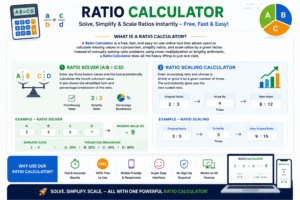
A Ratio Calculator is a free, fast, and easy-to-use online tool that allows users to calculate missing values in a proportion, simplify ratios, and scale ratios by a given factor. Instead of manually solving ratio problems using cross-multiplication or lengthy arithmetic, a Ratio Calculator does all the heavy lifting in just one click.
Our Ratio Calculator provides two key features:
- Ratio Solver (A:B = C:D): Enter any three known values and the tool automatically calculates the fourth unknown value. It also shows the simplified form and percentage breakdown of the ratio.
- Ratio Scaling Calculator: Enter an existing ratio and choose to shrink or grow it by a given number of times. The tool instantly gives you the new scaled ratio.
This Ratio Calculator is designed to be mobile-friendly, responsive, and extremely simple to use — even for users with no math background. It works on all devices including smartphones, tablets, and desktops.
How to Use a Ratio Calculator
Using our Ratio Calculator is incredibly simple. Follow these steps:
- Enter the value of A – the first number of the known ratio.
- Enter the value of B – the second number of the known ratio.
- Enter the value of C – the first number of the equivalent proportion.
- Leave D blank – the Ratio Calculator will automatically solve for D.
- Click “Calculate” – the result appears instantly on the right side.
The result panel will show:
- The full proportion (A:B = C:D)
- The simplified unit ratio (1:x or x:1)
- The percentage split of the ratio
- Enter the first value (S1) of your original ratio.
- Enter the second value (S2) of your original ratio.
- Select Shrink or Grow from the dropdown menu.
- Enter the times by which you want to scale (e.g., 2.5 for 2.5 times).
- Click “Calculate” – the new scaled ratio appears immediately.
You can also use the Clear button to reset all fields and start a fresh calculation.
Types of Ratio Calculations
There are several types of ratio problems that a Ratio Calculator can help solve:
This is the most common use. If A:B = C:D, and three values are known, the fourth can be found using cross-multiplication: D = (B × C) / A. Our tool does this instantly.
A ratio like 6:9 can be simplified to 2:3 by dividing both numbers by their Greatest Common Divisor (GCD). The Ratio Calculator presents results in both original and simplified form.
If a recipe ratio of 250:280 needs to be scaled up by 3 times, the new ratio becomes 750:840. The scaling feature in our Ratio Calculator handles this automatically.
Sometimes you need to know what percentage of the total each part represents. For example, in a ratio of 3:4, the first part is 42.86% and the second part is 57.14%. Our tool shows this breakdown clearly.
Ratio Scaling – Shrink and Grow
Ratio scaling is an extremely useful feature for anyone who needs to proportionally increase or decrease values while maintaining the same relationship between them.
- Shrink: If you have a large quantity and need to reduce it proportionally (e.g., making half a recipe), you divide both numbers by the scaling factor.
- Grow: If you need to scale up a ratio (e.g., doubling a batch of concrete mix), you multiply both numbers by the scaling factor.
Our Ratio Calculator‘s scaling tool handles both scenarios with ease. Simply enter your original ratio, select Shrink or Grow, enter the multiplication factor, and click Calculate. The result gives you the new, perfectly scaled ratio in seconds.
A Ratio Calculator is not just an academic tool. It has practical, real-world applications in many industries and everyday situations.
Ratio Calculator in Education
Students in middle school, high school, and college frequently encounter ratio and proportion problems in mathematics, physics, chemistry, and economics. A Ratio Calculator helps students:
- Verify their manual calculations for accuracy.
- Understand how proportions work by experimenting with different values.
- Complete homework assignments faster and with confidence.
- Learn the concept of equivalent ratios intuitively.
Teachers also use ratio tools to create example problems, demonstrate concepts on smartboards, and build worksheets. It makes teaching more interactive and visual.
Ratio Calculator in Business and Finance
In business and finance, ratios are used to analyze performance, compare data, and make strategic decisions. Financial professionals use ratios like:
- Debt-to-Equity Ratio – comparing a company’s total debt to its equity.
- Current Ratio – comparing current assets to current liabilities.
- Price-to-Earnings (P/E) Ratio – comparing share price to earnings per share.
A Ratio Calculator helps analysts, accountants, and investors quickly compute these values without manual arithmetic errors. It saves critical time in financial analysis and reporting.
Ratio Calculator in Cooking and Recipes
Chefs and home cooks use ratios to scale recipes up or down. For example:
- A recipe calls for a flour-to-water ratio of 3:2. If you want to make 2.5 times the amount, you need to scale both values by 2.5.
- A vinaigrette requires oil and vinegar in a 3:1 ratio. The Ratio Calculator tells you exactly how much of each to use for any serving size.
The Ratio Scaling Calculator feature is especially popular among bakers, bartenders, and professional chefs who need precise ingredient proportions.
Ratio Calculator in Construction and Engineering
In construction, ratios are critical for mixing materials correctly. For example:
- Concrete mix often requires sand, cement, and aggregate in a specific ratio (e.g., 1:2:3).
- Paint mixing relies on exact ratios to achieve the right color and consistency.
- Structural load calculations involve proportional relationships between forces and dimensions.
Engineers and contractors rely on a Ratio Calculator to ensure that their material ratios are accurate, which directly impacts the quality and safety of construction projects.
Benefits of Using an Online Ratio Calculator
Here is why thousands of users prefer using an online Ratio Calculator over manual calculation:
- Speed: Get answers in less than a second.
- Accuracy: Eliminates human arithmetic errors completely.
- Convenience: Available 24/7 on any device — no app download needed.
- Multi-purpose: Solves both proportion problems and scaling problems.
- Free to use: No subscription, no registration, no hidden fees.
- Mobile-friendly: Works perfectly on smartphones and tablets.
- Clean results: Shows simplified ratios, percentage breakdowns, and scaled values in a clear, readable format.
- Easy to reset: The Clear button lets you start fresh instantly.
Whether you are a professional, student, or casual user, the benefits of using a Ratio Calculator are clear and immediate.
Common Mistakes When Calculating Ratios
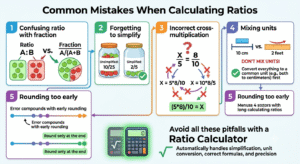
Even experienced users can make mistakes when working with ratios manually. Here are the most common errors to avoid:
- Confusing ratio with fraction: A ratio A:B is not the same as the fraction A/B in all contexts. A fraction represents a part of a whole, while a ratio compares two separate quantities.
- Forgetting to simplify: Always reduce a ratio to its simplest form for clarity.
- Incorrect cross-multiplication: When solving A:B = C:D for an unknown, the correct formula is D = (B × C) / A, not any other arrangement.
- Mixing units: Always ensure both values in a ratio use the same unit of measurement before comparing.
- Rounding too early: Round only at the final step to avoid compounding errors.
Using a Ratio Calculator automatically avoids all of these pitfalls because the calculations are done by the tool, not by hand.
Tips for Getting Accurate Ratio Results
To get the most out of your Ratio Calculator experience, keep these tips in mind:
- Always double-check your input values before clicking Calculate.
- Use decimal inputs when needed (e.g., 2.5, 0.75) — the tool handles them perfectly.
- Use the Clear button to reset all fields before starting a new problem.
- For scaling calculations, make sure you select the correct direction (Shrink or Grow) before entering the scaling factor.
- When finding a missing value (D), leave the D field blank and let the tool calculate it automatically.
FAQs About Ratio Calculator
A Ratio Calculator is used to find missing values in proportions, simplify ratios, compare two quantities, and scale ratios up or down by a given factor. It is useful for students, chefs, engineers, business analysts, and anyone who works with proportional data.
If you have A:B = C:D and D is unknown, use the formula D = (B × C) / A. Our Ratio Calculator does this automatically — just enter A, B, and C, leave D blank, and click Calculate.
Yes, absolutely. The Ratio Calculator supports decimal inputs for all fields including the scaling factor. For example, you can enter 2.5 as a scaling factor and the tool will compute the results correctly.
- Shrink divides both numbers of your ratio by the scaling factor (makes the ratio smaller).
- Grow multiplies both numbers of your ratio by the scaling factor (makes the ratio larger).
Both options maintain the same proportional relationship between the two values.
Yes, completely free. There are no charges, no registration, no subscriptions, and no limitations. You can use the Ratio Calculator as many times as you need, at any time.
Yes. The Ratio Calculator is fully responsive and mobile-optimized. It works seamlessly on all screen sizes — smartphones, tablets, and desktops — with a clean, touch-friendly interface.
The percentage result shows what share of the total each part represents. For a ratio of A:B, the percentage of A is (A ÷ (A+B)) × 100. This is helpful when you need to understand how a total quantity is divided.
Yes. While this tool is a general-purpose ratio solver, it can be used to compute any two-value comparison, including financial ratios like debt-to-equity, current ratio, or return on investment — as long as you know the two values.
The Ratio Calculator uses standard mathematical formulas and provides results rounded to up to 4 decimal places, ensuring highly accurate results for all use cases.
Yes. The scaling calculator accepts decimal values for the scaling factor. For example, entering 2.5 as the scaling factor will correctly multiply or divide both values of your ratio by 2.5.
Conclusion
Ratios are everywhere — in classrooms, kitchens, construction sites, financial reports, and laboratories. Understanding and computing ratios correctly is an essential skill that saves time, prevents costly errors, and supports better decision-making in both professional and personal contexts.
Our free online Ratio Calculator is designed to make this process as simple, fast, and accurate as possible. Whether you are solving a proportion problem with a missing value, scaling a recipe or material mix, or trying to understand the percentage breakdown of a comparison, this powerful tool handles everything in just a few clicks.
With its clean interface, mobile-friendly design, and instant results, the Ratio Calculator is the go-to tool for students, educators, professionals, and everyday users across the world. No more manual cross-multiplication. No more arithmetic mistakes. Just enter your values, click Calculate, and get your answer immediately.
Bookmark this page and come back whenever you need a reliable, fast, and free Ratio Calculator — it will always be here, ready to help you with accurate ratio calculations in seconds.
In conclusion, the Ratio Calculator and Ratio Scaling Calculator are powerful, fast, and user-friendly tools designed to simplify mathematical ratio problems for students, teachers, engineers, and everyday users. These calculators remove the complexity of manual calculations and provide instant, accurate, and reliable results with just a few inputs. Whether you are working on academic problems or real-world scaling applications, these tools save both time and effort while improving accuracy.
The Ratio Calculator helps you solve proportional relationships in a clear and structured way. By entering values in the form of A:B = C:D, users can instantly find missing values and understand how ratios behave in different scenarios. It also provides simplified ratio forms like 1:x and x:1, making it easier to interpret mathematical relationships. This is especially useful for students learning basic algebra, geometry, and proportion concepts.
On the other hand, the Ratio Scaling Calculator adds a practical dimension by applying scaling operations. Whether you need to shrink or grow values, this tool quickly adjusts numbers based on a given multiplier. This is highly valuable in fields like design, engineering, architecture, data modeling, and even financial analysis where proportional scaling is essential.
One of the biggest advantages of this tool is its simplicity. The interface is clean, mobile-friendly, and responsive, allowing users to perform calculations without confusion. The input fields are clearly labeled, and results are displayed instantly in a well-structured format. This ensures that even beginners can use the calculator without needing advanced mathematical knowledge.
Another important benefit is accuracy. Manual ratio calculations often lead to errors, especially when dealing with large numbers or scaling factors. This calculator eliminates human error and ensures precise results every time. The built-in JavaScript functions handle all computations instantly, making it both fast and dependable.
From an educational perspective, this tool enhances learning. Students can visually understand how ratios change when values are scaled or compared. Teachers can use it as a demonstration tool in classrooms to explain proportional relationships more effectively.
In real-life applications, ratios are everywhere. From recipes in cooking to map scaling, financial comparisons, business analytics, and scientific measurements, understanding ratios is essential. This calculator bridges the gap between theoretical knowledge and practical application.
Overall, the Ratio Calculator and Ratio Scaling Calculator are essential tools for anyone dealing with numbers and proportions. They are not just calculators but learning aids that improve understanding, speed, and accuracy.
To summarize, this tool provides:
- Fast & instant calculations
- Accurate ratio solving
- Easy scaling functionality
- Beginner-friendly interface
- Mobile responsiveness
- Educational value
In today’s fast-paced digital world, having a reliable tool like this makes mathematical tasks much easier and more efficient. Whether you are a student solving homework problems or a professional working on complex data, this calculator ensures that you always get quick, clear, and correct results.
Finally, the Ratio Calculator stands out as a simple yet powerful solution for all ratio-related problems, making mathematics more accessible, practical, and efficient for everyone.