Period Calculator
Track Your Ovulation Days with the Ovulation Calculator
Table of Contents
- Introduction
- What Is a Period Calculator?
- What Is a Pregnancy Term Calculator?
- The Menstrual Cycle – Four Phases Explained
- How Our Period Calculator Works Step by Step
- Understanding Every Result from the Period Calculator
- Next Period Due Date – How It Is Calculated
- Estimated Ovulation Date – The Heart of the Pregnancy Term Calculator
- The Fertile Window – Days 1 Through 6 of Peak Fertility
- Cycle Length and Its Impact on the Pregnancy Term Calculator
- Luteal Phase – The Two-Week Wait
- Follicular Phase and Hormonal Rebuilding
- Tracking Goal – Standard Tracking vs. Conceive Mode
- The Ovulation and Cycle Insights Table
- Using the Pregnancy Term Calculator to Estimate Your Due Date
- Irregular Cycles and the Pregnancy Term Calculator
- When to Seek Medical Guidance
- Frequently Asked Questions (FAQs)
- Conclusion
Introduction
Understanding your menstrual cycle is one of the most empowering things a woman can do for her reproductive health. Whether you are tracking periods for general wellness, avoiding or planning pregnancy, monitoring cycle regularity, or trying to conceive, knowing exactly where you are in your cycle — your next period date, your estimated ovulation, your fertile window — transforms vague reproductive awareness into precise, actionable knowledge. The Pregnancy Term Calculator and period tracking tool makes this precision available to every woman, instantly and for free.
A menstrual cycle is not simply a monthly event — it is a continuous four-phase hormonal programme that orchestrates follicle development, ovulation, uterine preparation, and menstruation in a rhythmic sequence that defines female reproductive biology from puberty through menopause. Each phase has distinct physiological characteristics, hormonal signatures, and fertility implications — and understanding all four phases is essential for using a Pregnancy Term Calculator or period tracking tool to its full potential.
Our free Period Calculator and Pregnancy Term Calculator accepts five inputs — last period date, average cycle length, period duration, luteal phase length, and tracking goal — and produces twelve detailed results covering next period date, estimated ovulation, fertile window, cycle phases, follicular phase length, cycle stage, upcoming phase, and a complete four-phase cycle insights table. Whether your goal is simply to track your cycle, understand your body better, or use the Pregnancy Term Calculator to plan conception and estimate your due date, this comprehensive tool and guide provide everything you need.
In this complete guide, you will learn how the menstrual cycle works, how each result from the calculator is calculated, how to use the Pregnancy Term Calculator to maximise your chances of conception, and how irregular cycles affect the accuracy of all estimates.
What Is a Period Calculator?
A Period Calculator is a reproductive health tool that uses the date of your last menstrual period (LMP), average cycle length, and other cycle parameters to calculate your next period date, estimated ovulation date, fertile window, and detailed cycle phase information. A period calculator takes the biological rules governing the human menstrual cycle and applies them to your personal cycle data, producing personalised predictions that are far more accurate than any generic reference chart.
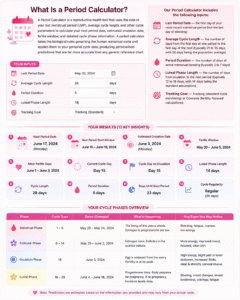
Our Period Calculator includes the following inputs:
- Last Period Date — the first day of your most recent menstrual period (not the last day of bleeding)
- Average Cycle Length — the number of days from the first day of one period to the first day of the next (typically 21 to 35 days, with 28 days being the population average)
- Period Duration — the number of days of active menstrual bleeding (typically 3 to 7 days)
- Luteal Phase Length — the number of days from ovulation to the next period (typically 12 to 16 days, with 14 days being the standard assumption)
- Tracking Goal — Tracking (standard cycle monitoring) or Conceive (fertility-focused calculations)
The period calculator produces twelve results and a four-row cycle phase table — giving you a complete, phase-by-phase picture of your current and upcoming cycle.
What Is a Pregnancy Term Calculator?
A Pregnancy Term Calculator is a reproductive planning tool that uses menstrual cycle data — particularly the last menstrual period date and cycle length — to estimate conception timing, predict the fertile window, calculate the estimated due date (EDD), and track pregnancy milestones. The Pregnancy Term Calculator builds directly on period tracking data — using the same inputs to serve both non-pregnant cycle tracking and conception-planning or pregnancy dating purposes.
The relationship between period tracking and the Pregnancy Term Calculator:
Standard obstetric practice dates pregnancy from the first day of the last menstrual period — not from the actual date of conception. A full-term pregnancy is therefore defined as 40 weeks (280 days) from LMP — even though conception typically occurs approximately 14 days into the cycle, making the actual gestational age at birth closer to 38 weeks from fertilisation. Our tool functions as both a period calculator and a Pregnancy Term Calculator — serving cycle tracking goals in standard mode and conception and due date planning in Conceive mode.
Due date estimation with the Pregnancy Term Calculator: Using Naegele’s Rule — the standard due date calculation formula used in obstetric practice — the estimated due date (EDD) is calculated as: EDD = LMP + 280 days (40 weeks)
For a cycle length other than 28 days, an adjusted Pregnancy Term Calculator applies a correction: Adjusted EDD = LMP + 280 + (Cycle Length − 28) days
For a woman with a 31-day cycle, the Pregnancy Term Calculator adds 3 additional days to the standard 280-day estimate — reflecting the fact that ovulation (and therefore conception) occurs later in a longer cycle.
The Menstrual Cycle – Four Phases Explained
The menstrual cycle is not a single event — it is a precisely orchestrated four-phase reproductive programme driven by the interplay of oestrogen, progesterone, FSH (follicle-stimulating hormone), and LH (luteinising hormone). Understanding all four phases is essential for accurate use of any Pregnancy Term Calculator or period tracking tool:
Phase One — Menstruation (Days 1 to 5, typically): Menstruation begins on Day 1 of the cycle — the day used as the “Last Period Date” input in both the period calculator and the Pregnancy Term Calculator. During menstruation, the uterine lining (endometrium) built during the previous cycle sheds in response to falling progesterone levels following an unfertilised ovulation cycle. Bleeding typically lasts 3 to 7 days. The Period Duration input in our calculator captures this individual variation — affecting the calculated Follicular Phase length.
Phase Two — Follicular Phase (Days 1 to Ovulation): The follicular phase begins simultaneously with menstruation and ends at ovulation. Rising FSH stimulates the development of 10 to 20 follicles in the ovaries, each containing a maturing egg. One dominant follicle typically outgrows the others — secreting increasing amounts of oestrogen, which thickens the endometrium and, at a critical threshold, triggers the LH surge that causes ovulation. The Follicular Phase length in the Pregnancy Term Calculator = Ovulation Day − Period Duration Days — and varies more than the luteal phase, which is why cycle length variability primarily reflects follicular phase variability.
Phase Three — Ovulation (One Day): Ovulation is the single most important event in the reproductive cycle for the Pregnancy Term Calculator — the moment at which the dominant follicle ruptures and releases a mature egg into the fallopian tube, where it can be fertilised by sperm for approximately 12 to 24 hours. The estimated ovulation date is calculated as: Last Period Date + (Cycle Length − Luteal Phase Length − 1) days. For a standard 28-day cycle with a 14-day luteal phase, this produces Day 14 (Day 13 in zero-indexed terms) — the commonly referenced mid-cycle ovulation.
Phase Four — Luteal Phase (Ovulation to Next Period): The luteal phase begins after ovulation — the ruptured follicle transforms into the corpus luteum, which secretes progesterone to maintain and prepare the endometrium for a potential fertilised egg. If fertilisation does not occur, the corpus luteum degenerates after approximately 14 days, progesterone falls, and menstruation begins — starting the next cycle. The luteal phase is the most consistent phase across cycles — typically 12 to 16 days regardless of overall cycle length — which is why the Pregnancy Term Calculator uses it as the anchor for ovulation date estimation.
How Our Period Calculator Works Step by Step
Using the period calculator and Pregnancy Term Calculator takes under two minutes:
Step One – Enter Last Period Date: Enter the first day of your most recent menstrual period. This is the single most important input for both the period calculator and the Pregnancy Term Calculator — all subsequent date calculations (next period, ovulation, fertile window, and due date) are anchored to this date. Always use the first day of bleeding, not the last day.
Step Two – Enter Average Cycle Length: Enter the number of days in your average cycle — from Day 1 of one period to Day 1 of the next. The default of 28 days reflects the population average, but individual cycles range widely from 21 to 35 days and beyond. For the most accurate Pregnancy Term Calculator results, use the average of your last three to six cycles rather than a single cycle measurement.
Step Three – Enter Period Duration: Enter how many days your period typically lasts. The default of 5 days covers the most common duration range. This input is used to calculate the Follicular Phase length — the gap between the end of menstruation and the onset of ovulation.
Step Four – Enter Luteal Phase Length: Enter your estimated luteal phase length — typically 14 days for most women, and the standard default. If you have confirmed your ovulation date through temperature charting or ovulation predictor kits (OPKs), you can calculate your exact luteal phase length (next period date minus confirmed ovulation date) and enter it for increased Pregnancy Term Calculator accuracy.
Step Five – Select Tracking Goal: Choose Tracking (standard cycle monitoring) or Conceive (fertility-focused mode). In Conceive mode, the Pregnancy Term Calculator adjusts its results emphasis — highlighting the fertile window, ovulation timing, and upcoming fertile phase rather than the standard luteal phase emphasis.
Step Six – Click Calculate: Receive twelve results and a four-phase cycle insights table instantly — covering all key dates, phase lengths, fertility indicators, and cycle characteristics.
Understanding Every Result from the Period Calculator
The calculator produces twelve labelled result rows, each providing distinct cycle or fertility information:
Next Period Due: The date your next menstrual period is expected to begin, calculated as Last Period Date + Cycle Length. This is the most immediately useful result from the Pregnancy Term Calculator — providing the planned date you should expect your next period and enabling planning around it.
Est. Ovulation: The estimated date of ovulation — calculated as Last Period Date + (Cycle Length − Luteal Phase Length − 1). This is the central date for the Pregnancy Term Calculator’s fertility calculations — the day from which the fertile window, conception probability, and due date estimation all derive.
Cycle Length: Your entered cycle length confirmed in the results panel — providing a reference for interpreting all subsequent phase length and date calculations.
Period Days: Your entered period duration — confirming the menstruation phase length used to calculate the follicular phase in the Pregnancy Term Calculator.
Luteal Phase: Your entered luteal phase length — confirming the anchor variable used to calculate the estimated ovulation date. A consistently short luteal phase (below 10 days) is a potential fertility concern worth discussing with a gynaecologist or fertility specialist.
Follicular Phase: Calculated as Ovulation Day − Period Duration Days. The follicular phase is the most variable component of the menstrual cycle — longer in women with longer cycles, shorter in women with shorter cycles. A long follicular phase does not indicate a fertility problem; it simply reflects that ovulation takes longer to occur.
Cycle Goal: Confirms your selected tracking goal — TRACKING or CONCEIVE — contextualising all subsequent results for your specific purpose.
Safety Status: Displayed as “Standard” for tracking mode or “Active” for Conceive mode. In Active mode, the Pregnancy Term Calculator is operating with fertility-focused calculation priorities — emphasising ovulation timing and fertile window accuracy.
Fertile Window: Displayed as a day range (e.g., “9-15”) representing the days of the cycle during which conception is most likely. The fertile window spans the five days before ovulation plus ovulation day itself — reflecting the 72 to 120-hour survival time of sperm in the female reproductive tract, combined with the 12 to 24-hour fertilisation window of the released egg.
Next Cycle Start: Confirms the next period due date — displayed again for convenient reference. Use this date in subsequent Pregnancy Term Calculator calculations as the new “Last Period Date” if conception does not occur in the current cycle.
Cycle Stage: Classified as Long (ovulation day > 14) or Standard (ovulation day ≤ 14). This classification reflects whether your calculated ovulation falls before or after the classical Day 14 benchmark — helping you understand whether your cycle is shorter, longer, or aligned with the standard 28-day reference model.
Upcoming Phase: Displays the phase you are currently entering — Fertile (in Conceive mode) or Luteal (in standard Tracking mode). In Conceive mode, the Pregnancy Term Calculator prioritises the Fertile phase as the upcoming event — directing your attention to the high-fertility window that immediately precedes and includes ovulation.
Next Period Due Date – How It Is Calculated
The next period due date calculation is the simplest and most widely used output of any period calculator or Pregnancy Term Calculator:
Formula: Next Period = Last Menstrual Period Date + Cycle Length (days)
For a last period on June 1 with a 28-day cycle: Next Period = June 29. For a last period on June 1 with a 31-day cycle: Next Period = July 2.
The accuracy of this calculation depends entirely on cycle regularity. For women with highly regular cycles, the predicted next period date is accurate to within one to two days in most cycles. For women with irregular cycles, the Pregnancy Term Calculator’s next period prediction is a statistical estimate based on the average cycle length entered — and the actual date may vary by several days or more.
Practical uses of the next period due date from the Pregnancy Term Calculator:
- Planning around anticipated menstruation days for events, travel, or activities
- Identifying whether a period is late (and potentially prompting a pregnancy test)
- Scheduling gynaecological appointments at optimal cycle points
- Planning the timing of fertility treatments or investigations
Estimated Ovulation Date – The Heart of the Pregnancy Term Calculator
The estimated ovulation date is the most fertility-critical result produced by the Pregnancy Term Calculator — and understanding how it is calculated helps you use the fertile window information most effectively:
Formula: Ovulation Day = Last Period Date + (Cycle Length − Luteal Phase − 1)
For a 28-day cycle with a 14-day luteal phase: Ovulation = LMP + 13 days (Day 14 of cycle). For a 31-day cycle with a 14-day luteal phase: Ovulation = LMP + 16 days (Day 17 of cycle). For a 25-day cycle with a 14-day luteal phase: Ovulation = LMP + 10 days (Day 11 of cycle).
This formula works because the luteal phase is constant — it is always approximately 14 days (in most women) regardless of overall cycle length. Cycle length variability comes entirely from the follicular phase — which may be 10 days in a short cycle or 20+ days in a long cycle. By anchoring the Pregnancy Term Calculator to the luteal phase rather than to the cycle midpoint, the estimated ovulation date remains accurate across cycles of different lengths.
Confirmation methods: The Pregnancy Term Calculator’s estimated ovulation date is a statistical prediction — not a guaranteed measurement. For confirmed ovulation timing, use:
- Ovulation Predictor Kits (OPKs): Detect the LH surge that occurs 24 to 36 hours before ovulation
- Basal Body Temperature (BBT) charting: Temperature rises 0.2°C to 0.5°C after ovulation — confirming that ovulation has occurred
- Cervical mucus monitoring: Egg-white consistency cervical mucus typically appears 1 to 3 days before ovulation
Using confirmed ovulation data to improve Pregnancy Term Calculator accuracy: If BBT or OPK data confirms that you consistently ovulate on Day 17 of a 30-day cycle (producing a 13-day luteal phase), enter 13 as your Luteal Phase in the Pregnancy Term Calculator — this will produce a personalised ovulation estimate more accurate than the 14-day default.
The Fertile Window – Days 1 Through 6 of Peak Fertility
The fertile window result from the Pregnancy Term Calculator — displayed as a day range relative to the cycle — is the period during which sexual intercourse has the highest probability of resulting in conception:
Why six days? Research by Dr. David Dunson and colleagues published in the journal Human Reproduction established that the probability of conception from a single act of intercourse is highest in the 1 to 2 days before ovulation and on ovulation day itself — but measurable conception probability exists from 5 days before ovulation through ovulation day, totalling a 6-day fertile window. This reflects the fact that sperm can survive in the female reproductive tract for up to 5 days, while the egg is viable for only 12 to 24 hours after release.
The Pregnancy Term Calculator’s fertile window is calculated as:
- Day range start: Ovulation Day − 5
- Day range end: Ovulation Day + 1
For maximum conception probability: The two days immediately before ovulation are the highest-probability days within the fertile window — when both sperm viability is high and the egg release is imminent. Using the Pregnancy Term Calculator to identify these peak days and timing intercourse accordingly is the single most evidence-based behavioural strategy for improving natural conception rates.
Cycle Length and Its Impact on the Pregnancy Term Calculator
Cycle length is the most influential variable in the Pregnancy Term Calculator — its accuracy depends fundamentally on the accuracy of this single input:
What constitutes a normal cycle length? The WHO defines a normal menstrual cycle as 21 to 35 days. Cycles shorter than 21 days or longer than 35 days consistently are classified as abnormal (polymenorrhoea and oligomenorrhoea respectively) and may warrant gynaecological investigation. However, within the 21 to 35-day range, all cycle lengths are physiologically normal — the Pregnancy Term Calculator adjusts all estimates accordingly.
How to calculate your average cycle length: Record the first day of your period for at least three to six consecutive cycles. Calculate the number of days between consecutive first days. Average these numbers. Enter this average as your Cycle Length in the Pregnancy Term Calculator for the most accurate ovulation and next period predictions.
Impact of cycle length variation on Pregnancy Term Calculator accuracy: If your cycles vary significantly from cycle to cycle (e.g., 25 days one month and 33 days the next), the Pregnancy Term Calculator’s predictions will have wider uncertainty margins. In this case, supplementing the Pregnancy Term Calculator with OPK testing allows you to confirm actual ovulation timing despite the variable predicted window.
Luteal Phase – The Two-Week Wait
The luteal phase — the period between ovulation and the next menstrual period — is known colloquially as the “two-week wait” (2WW) in fertility circles because it is the interval during which implantation either occurs or fails, and during which the earliest signs of pregnancy may appear:
What happens during the luteal phase: After ovulation, the ruptured follicle becomes the corpus luteum — a temporary endocrine gland that secretes progesterone. Progesterone thickens and prepares the endometrial lining for implantation of a fertilised egg. If a fertilised egg successfully implants in the endometrium (typically 6 to 10 days after ovulation), it begins secreting hCG (human chorionic gonadotropin) — the hormone detected by pregnancy tests — which signals the corpus luteum to continue progesterone production, preventing menstruation and maintaining the pregnancy.
If implantation does not occur: The corpus luteum degenerates after approximately 14 days, progesterone falls, and the endometrial lining sheds in menstruation — beginning the next cycle. The Pregnancy Term Calculator uses this 14-day luteal phase as the anchor for all ovulation date calculations because, unlike the variable follicular phase, the luteal phase length is consistent.
Luteal Phase Defect (LPD): A consistently short luteal phase (below 10 days) — known as Luteal Phase Defect — can prevent successful implantation even when fertilisation occurs. Women whose Pregnancy Term Calculator results show an unusually short follicular phase (and therefore early ovulation) should track luteal phase length through temperature charting to identify potential LPD, which is a treatable cause of recurrent early pregnancy loss.
Follicular Phase and Hormonal Rebuilding
The follicular phase is the rebuilding phase of the menstrual cycle — the period during which rising oestrogen orchestrates follicle development and endometrial regrowth in preparation for ovulation:
Hormonal dynamics of the follicular phase: Rising FSH (follicle-stimulating hormone) from the pituitary stimulates multiple follicles to develop in the ovaries. As follicles grow, they produce increasing amounts of oestrogen, which thickens the endometrium and provides positive feedback to the hypothalamus and pituitary. When oestrogen reaches a critical peak, it triggers the LH surge — the hormonal event that causes the dominant follicle to rupture and release the mature egg.
The follicular phase in the Pregnancy Term Calculator: The calculator displays Follicular Phase as Ovulation Day − Period Duration Days. For a woman with a 5-day period and ovulation on Day 14, the follicular phase is 9 days — the interval between the end of menstruation and ovulation. This is the phase during which a woman is typically least fertile (before the fertile window opens) and energy levels are often at their highest due to rising oestrogen.
Tracking Goal – Standard Tracking vs. Conceive Mode
The Tracking Goal input in the Pregnancy Term Calculator allows you to optimise the tool for your specific purpose:
Standard Tracking Mode: In standard mode, the Pregnancy Term Calculator presents results with a general cycle monitoring emphasis — next period date, ovulation estimate, phase lengths, and the luteal phase as the upcoming phase. This mode is appropriate for women who are tracking their cycles for general menstrual health awareness, understanding their cycle patterns, identifying irregularities, or planning around their period dates.
Conceive Mode: In Conceive mode, the Pregnancy Term Calculator shifts its results emphasis to fertility — highlighting the fertile window, identifying the upcoming fertile phase, and displaying Safety Status as “Active” to indicate that fertility-focused calculations are in use. This mode is appropriate for women who are actively trying to conceive and want the calculator to orient all results toward maximising conception probability rather than general cycle tracking.
The practical difference: In Conceive mode, the Upcoming Phase displays as “Fertile” — directing your attention to the approaching fertile window and encouraging timely intercourse planning. In standard mode, the Upcoming Phase displays as “Luteal” — the post-ovulation phase appropriate for general cycle stage awareness. The Pregnancy Term Calculator adapts its output framing to match your reproductive goal without changing the underlying calculations.
The Ovulation and Cycle Insights Table
The Pregnancy Term Calculator’s four-row cycle insights table provides a complete reference for the entire menstrual cycle in a single, readable format:
Menstruation (Days 1 to [Period Duration]) — Physiology: Shedding The endometrial lining sheds in response to falling progesterone. This phase is characterised by prostaglandin-driven uterine contractions, cramping, and blood flow. Iron and folate losses during menstruation make dietary adequacy important — particularly for women trying to conceive, who should maintain adequate iron and folate status throughout the cycle.
Follicular Phase ([End of Period] to [Ovulation − 1]) — Physiology: Rebuilding Rising oestrogen drives endometrial thickening and follicle development. This phase is typically associated with improving energy, mood, and libido as oestrogen rises — making it the cycle phase most women experience as their most physically and psychologically vigorous.
Ovulation (Day [Ovulation Day]) — Physiology: Peak Event The single most important day in the reproductive cycle from the Pregnancy Term Calculator’s perspective. Egg release, peak fertility, and highest conception probability occur on this day. Some women experience mittelschmerz — a mild one-sided lower abdominal pain — at ovulation, providing a natural physical cue to supplement the Pregnancy Term Calculator’s date prediction.
Luteal Phase ([Ovulation + 1] to End of Cycle) — Physiology: Supportive Progesterone dominates, preparing the endometrium for implantation. This phase is characterised by PMS symptoms in many women — bloating, breast tenderness, mood changes — driven by progesterone’s effects on fluid retention, neurotransmitter sensitivity, and inflammatory markers. The Pregnancy Term Calculator’s luteal phase calculation confirms the length of this phase and, by implication, the timing of symptom onset relative to the next period.
Using the Pregnancy Term Calculator to Estimate Your Due Date
When used as a Pregnancy Term Calculator specifically for due date estimation, the tool’s ovulation date and LMP data provide everything needed for standard obstetric due date calculation:
Naegele’s Rule (Standard Due Date Calculation): EDD = Last Menstrual Period Date + 280 days (40 weeks)
For a LMP of June 1, 2025: EDD = March 8, 2026.
Cycle-adjusted due date: For cycles longer or shorter than 28 days, the Pregnancy Term Calculator adjusts: EDD = LMP + 280 + (Cycle Length − 28) days.
For a 31-day cycle with LMP June 1: EDD = March 8 + 3 = March 11, 2026.
This adjustment is clinically important because first-trimester ultrasound (the gold standard for due date confirmation) often shifts the estimated due date by several days relative to the LMP-based estimate — particularly in women with irregular or non-28-day cycles. Using the cycle-adjusted Pregnancy Term Calculator estimate as your starting due date reduces the likelihood of clinically significant discordance with the ultrasound measurement.
Trimesters from the Pregnancy Term Calculator’s LMP date:
- First trimester: LMP to Week 12 (LMP + 84 days)
- Second trimester: Week 12 to Week 27 (LMP + 85 to 189 days)
- Third trimester: Week 28 to Week 40 (LMP + 190 to 280 days)
Irregular Cycles and the Pregnancy Term Calculator
The Pregnancy Term Calculator performs best with regular, predictable cycles — but irregular cycles are extremely common and do not prevent meaningful use of the tool:
Causes of cycle irregularity:
- Polycystic Ovary Syndrome (PCOS): The most common cause of irregular ovulation, affecting approximately 10% to 15% of women of reproductive age. Women with PCOS often have cycles of 35 to 90+ days, making the standard Pregnancy Term Calculator estimates less reliable without confirmatory OPK testing.
- Thyroid disorders: Both hypothyroidism and hyperthyroidism disrupt the hormonal regulation of the menstrual cycle — causing irregular, absent, or abnormally heavy periods.
- Stress and weight changes: Significant psychological stress, rapid weight loss, or very low body weight (BMI below 18.5) can suppress hypothalamic GnRH pulsatility — disrupting FSH and LH signalling and producing anovulatory cycles.
- Perimenopause: In the years approaching menopause, cycle length becomes increasingly variable as follicular reserve declines and FSH levels rise. The Pregnancy Term Calculator’s estimates become less reliable in perimenopause because the consistent luteal phase anchor begins to vary.
Using the Pregnancy Term Calculator with irregular cycles: Enter the average of your last six cycles as your Cycle Length — this provides the best statistical prediction even when individual cycles vary. Supplement the Pregnancy Term Calculator’s predictions with daily OPK testing starting from Day 8 or 9 of your cycle to detect the LH surge that confirms imminent ovulation.
When to Seek Medical Guidance
The Pregnancy Term Calculator is an educational and planning tool — not a substitute for medical evaluation. Seek professional guidance if you experience:
- Cycles shorter than 21 days or longer than 35 days consistently
- Period absence (amenorrhoea) for three or more consecutive cycles without a positive pregnancy test
- Very heavy bleeding (soaking more than one pad or tampon per hour for several hours) or bleeding between periods (intermenstrual bleeding)
- Severe menstrual pain (dysmenorrhoea) that disrupts daily activities or does not respond to standard pain relief
- Twelve or more months of regular, timed intercourse without conception (in women under 35) — or six months in women over 35 — which meets the clinical definition of infertility warranting specialist evaluation
- Consistently short luteal phase (below 10 days confirmed by BBT charting) — which may indicate a treatable fertility issue
The Pregnancy Term Calculator results are most valuable when interpreted alongside, not instead of, professional reproductive healthcare.
Frequently Asked Questions (FAQs)
What is a Pregnancy Term Calculator? A Pregnancy Term Calculator is a tool that uses your last menstrual period date, cycle length, and luteal phase to estimate your next period, ovulation date, fertile window, and estimated due date. It is used for both cycle tracking and conception planning.
What is a Period Calculator? A Period Calculator is a reproductive health tool that predicts your next menstrual period, ovulation date, cycle phases, and fertile window from your last period date, cycle length, period duration, and luteal phase length.
How accurate is the Pregnancy Term Calculator? For women with regular cycles, the Pregnancy Term Calculator predicts ovulation and next period to within one to three days. For women with irregular cycles, predictions are less precise and should be supplemented with OPK or BBT confirmation.
What does the Pregnancy Term Calculator use as the luteal phase default? The Pregnancy Term Calculator defaults to 14 days — the population average luteal phase length. If you know your personal luteal phase is longer or shorter, enter your actual value for more accurate ovulation and fertile window predictions.
Can the Pregnancy Term Calculator predict my due date? Yes — using the LMP date and cycle length, the Pregnancy Term Calculator supports Naegele’s Rule due date estimation (LMP + 280 days, adjusted for cycle length). All due dates calculated by the Pregnancy Term Calculator should be confirmed by a first-trimester ultrasound.
What is the fertile window in the Pregnancy Term Calculator? The fertile window is the six-day span (five days before ovulation plus ovulation day) during which intercourse can result in conception. The Pregnancy Term Calculator displays the fertile window as a cycle day range based on the estimated ovulation date and luteal phase length.
Can I use the Pregnancy Term Calculator if my cycles are irregular? Yes — enter the average of your last three to six cycles as your Cycle Length for the best estimate. Supplement the Pregnancy Term Calculator with OPK testing to detect the actual LH surge and confirm ovulation timing when cycle variability is high.
What is a luteal phase defect and can the Pregnancy Term Calculator identify it? Luteal Phase Defect (LPD) is a consistently short luteal phase (below 10 days) that can impair implantation. The Pregnancy Term Calculator does not diagnose LPD — but if your BBT data consistently shows ovulation followed by a period in fewer than 10 days, this finding should be discussed with a gynaecologist.
Conclusion
Your menstrual cycle is one of the most information-rich physiological systems in your body — and a Pregnancy Term Calculator transforms that information into clear, actionable knowledge. From predicting your next period date with days-level accuracy to identifying your exact fertile window for conception planning, from tracking your four cycle phases to estimating your due date — the Pregnancy Term Calculator brings reproductive clarity that was previously available only through costly fertility monitoring or lengthy medical consultations.
Our free Period Calculator and Pregnancy Term Calculator delivers twelve detailed results and a complete four-phase cycle insights table from just five inputs — covering every clinically relevant aspect of your reproductive cycle in a single, instant calculation. Whether your goal is simply to know when your next period is coming, to understand your body’s hormonal rhythms more deeply, or to use the Pregnancy Term Calculator to plan and achieve a healthy pregnancy, this tool provides the reproductive intelligence that supports every stage of your journey.
Use our Pregnancy Term Calculator today. Enter your details, understand your cycle, identify your fertile window, and take the next step toward the reproductive health knowledge that every woman deserves to have — clearly, accurately, and completely at her fingertips.