Ovulation Calculator
Calculate Your Daily Fat Needs with the Fat Intake Calculator
Table of Contents
- Introduction
- What Is an Ovulation Calculator?
- What Is an Ovulation Predictor Kit?
- How Ovulation Works – The Biology Behind the Fertile Window
- How Our Ovulation Calculator Works Step by Step
- Understanding Every Result from the Ovulation Calculator
- Ovulation Date – The Most Critical Result
- Fertile Start and Fertile End – Your Six-Day Conception Window
- Mode Action – Conceive vs. Avoid Settings
- Peak Window, Probability, and Safety Margin
- Next Ovulation and Next Period Predictions
- The Ovulation and Cycle Insights Table
- Using an Ovulation Predictor Kit Alongside the Calculator
- How to Read Ovulation Predictor Kit Results
- Combining BBT Charting, Cervical Mucus, and the Ovulation Predictor Kit
- Irregular Cycles and the Ovulation Predictor Kit
- Common Mistakes When Using an Ovulation Predictor Kit
- Frequently Asked Questions (FAQs)
- Conclusion
Introduction
For couples trying to conceive, timing is everything. The human egg is viable for fertilisation for only 12 to 24 hours after ovulation — a remarkably narrow biological window within a 28 to 35-day cycle. Identifying that window accurately — not guessing at it, not assuming it falls on Day 14 of every cycle — is the single most impactful thing a couple can do to maximise their natural conception chances each cycle. This is why the combination of a reliable ovulation calculator and an Ovulation Predictor Kit has become the gold-standard approach to fertility-timed conception for millions of couples worldwide.
An Ovulation Predictor Kit (OPK) is a hormonal test that detects the LH (luteinising hormone) surge that occurs 24 to 36 hours before ovulation — providing a biochemical confirmation of imminent egg release that no calendar or calculation alone can match. When used alongside our free Ovulation Calculator — which estimates your ovulation date, fertile window start and end, next ovulation, and next period from your cycle data — the Ovulation Predictor Kit transforms an informed estimate into a confirmed, day-of event notification.
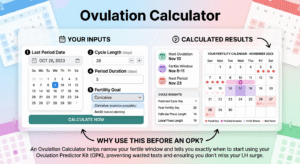
Our free Ovulation Calculator accepts five inputs — last period date, cycle length, luteal phase, period duration, and fertility goal — and produces twelve detailed results covering ovulation date, fertile window, next period, next ovulation, mode action, conception probability, safety margin, and a complete four-phase cycle insights table. Used together with an Ovulation Predictor Kit, this tool provides the most comprehensive and accurate free fertility tracking system available without a clinical appointment.
In this complete guide, you will learn how ovulation works biologically, how the Ovulation Calculator predicts your fertile window, how the Ovulation Predictor Kit confirms it in real time, how to use both tools together for maximum conception probability, and how to interpret every result your calculator produces. Whether you are new to cycle tracking or have been trying to conceive for several cycles, this guide gives you the complete fertility knowledge framework that changes vague hope into informed, targeted action.
What Is an Ovulation Calculator?
An Ovulation Calculator is a reproductive health tool that uses your last menstrual period date, cycle length, luteal phase, and period duration to predict your next ovulation date, fertile window, next period date, and subsequent ovulation — providing a personalised, calendar-based fertility planning framework derived from the biological rules governing the human menstrual cycle.
Our Ovulation Calculator includes five inputs:
- Last Period Date — the first day of your most recent menstrual period
- Cycle Length — the number of days from the first day of one period to the first day of the next (default: 28 days)
- Luteal Phase — the number of days from ovulation to the next period (default: 14 days)
- Period Duration — how many days your period lasts (default: 5 days)
- Fertility Goal — Conceive (maximise conception probability) or Avoid (natural family planning)
The Ovulation Calculator produces twelve result rows and a four-row cycle insights table — providing every clinically relevant fertility date and cycle characteristic from a single calculation.
Why use an Ovulation Calculator before an Ovulation Predictor Kit? The Ovulation Calculator narrows your predicted fertile window to a specific date range — typically a 6 to 10-day span within your cycle. This predicted window tells you exactly when to begin using your Ovulation Predictor Kit, preventing unnecessary test use in the early follicular phase (when the LH surge is biologically impossible) and ensuring you do not miss the surge by starting testing too late.
What Is an Ovulation Predictor Kit?
An Ovulation Predictor Kit is a hormonal detection test — available in urine-based strip or digital format — that identifies the LH (luteinising hormone) surge that precedes ovulation by 24 to 36 hours, providing a time-specific biochemical signal that egg release is imminent. The Ovulation Predictor Kit is the most widely recommended fertility timing tool for couples actively trying to conceive because it detects an actual hormonal event rather than estimating one from calendar data alone.
How the Ovulation Predictor Kit works biologically: LH is produced by the pituitary gland throughout the menstrual cycle at low baseline levels — but approximately 24 to 36 hours before ovulation, oestrogen reaches a critical peak that triggers a dramatic, brief surge of LH (the “LH surge”). This LH surge causes the dominant follicle to mature fully and rupture, releasing the egg into the fallopian tube. The Ovulation Predictor Kit detects when urine LH levels exceed the surge threshold — confirming that ovulation will occur within the next 24 to 36 hours.
Types of Ovulation Predictor Kit:
Standard LH Strip Tests: The most common and affordable Ovulation Predictor Kit format. A test line darker than the control line indicates a positive result — confirming the LH surge. Standard strips are typically 99% accurate at detecting the LH surge when used correctly and are the most cost-effective option for daily testing across the fertile window.
Digital Ovulation Predictor Kit: Digital devices display a smiley face or clear “Peak” / “High” reading rather than requiring line comparison. The digital Ovulation Predictor Kit is easier to read for users who find line-comparison tests ambiguous — particularly useful for beginners or users with variable hydration that can affect test line intensity.
Advanced Digital Ovulation Predictor Kit (Dual Hormone): Advanced devices (such as the Clearblue Advanced Digital) detect both LH and oestrogen — providing “High Fertility” readings (oestrogen rise, 1 to 4 days before ovulation) and “Peak Fertility” readings (LH surge, 24 to 36 hours before ovulation). This dual-hormone Ovulation Predictor Kit provides the widest fertility window identification — typically 4 to 5 days of “High” days plus 2 “Peak” days — giving couples the most days to time intercourse.
How Ovulation Works – The Biology Behind the Fertile Window
Understanding the biology of ovulation is essential for using both the Ovulation Calculator and the Ovulation Predictor Kit effectively:
The Follicular Phase — Building to Ovulation: From Day 1 of menstruation, rising FSH (follicle-stimulating hormone) stimulates 10 to 20 ovarian follicles to begin developing — each containing an immature egg. One dominant follicle outgrows the others over approximately 10 to 14 days, secreting increasing amounts of oestrogen. This oestrogen thickens the endometrial lining and, at a threshold level, triggers the LH surge that causes ovulation.
The LH Surge — What the Ovulation Predictor Kit Detects: When oestrogen reaches its peak, the hypothalamus triggers a burst of GnRH, which causes the pituitary to release a massive pulse of LH — the “LH surge” that the Ovulation Predictor Kit is designed to detect. The surge typically begins in the early morning hours, reaches its peak in the afternoon, and lasts 24 to 48 hours total. Most women ovulate 24 to 36 hours after the LH surge begins — making the Ovulation Predictor Kit’s positive result a 24 to 36-hour advance notice of egg release.
Ovulation — The Moment of Peak Fertility: The dominant follicle ruptures and releases the mature egg — which is swept into the fallopian tube where it can be fertilised. The egg is viable for only 12 to 24 hours after release. If sperm are already present in the fallopian tube (having survived from intercourse up to 5 days prior), fertilisation can occur. If not, the window closes and conception is impossible until the next cycle.
The Luteal Phase — After Ovulation: The ruptured follicle becomes the corpus luteum, secreting progesterone to support endometrial preparation for implantation. The luteal phase lasts a consistent 12 to 16 days in most women — the most stable phase of the cycle — which is why the Ovulation Calculator anchors its ovulation prediction to this fixed phase length rather than simply halving the cycle.
How Our Ovulation Calculator Works Step by Step
The Ovulation Calculator takes five inputs and produces a comprehensive fertility assessment in seconds:
Step One – Enter Last Period Date: Enter the first day of your most recent menstrual period. This is the anchor date for all subsequent calculations in the Ovulation Calculator — ovulation date, fertile window, next period, and next ovulation are all calculated relative to this single date. Always use the first day of bleeding, not the last.
Step Two – Enter Cycle Length: Enter your average cycle length in days. The default of 28 days is the population average, but individual cycles range from 21 to 35+ days. For the most accurate Ovulation Calculator results — and the most targeted Ovulation Predictor Kit testing window — use the average of your last three to six cycles rather than a single measurement.
Step Three – Enter Luteal Phase Length: Enter your luteal phase length (default: 14 days). If you have confirmed your ovulation date with an Ovulation Predictor Kit in a previous cycle, you can calculate your personal luteal phase (next period date minus confirmed ovulation date) and enter it for greater accuracy. A confirmed personal luteal phase shifts the ovulation date prediction by days — meaningful for tight fertile window timing.
Step Four – Enter Period Duration: Enter how many days your period typically lasts. This affects the follicular phase length calculation in the cycle insights table.
Step Five – Select Fertility Goal: Choose Conceive or Avoid. In Conceive mode, the Ovulation Calculator highlights the fertile window as a high-priority target and recommends “High Intimacy” as the Mode Action during peak days. In Avoid mode, the same window is labelled as “Danger” — the period to abstain or use contraception. The underlying calculations are identical; only the goal framing changes.
Understanding Every Result from the Ovulation Calculator
The twelve result rows produced by the Ovulation Calculator cover every clinically significant fertility data point:
Ovulation Date: The estimated date of egg release — calculated as Last Period Date + (Cycle Length − Luteal Phase − 1). This is the single most important date produced by the Ovulation Calculator — the day from which the fertile window, conception probability, and next ovulation are all derived. Use your Ovulation Predictor Kit results to confirm or adjust this date in real time as your cycle progresses.
Fertile Start: The first day of the fertile window — calculated as Ovulation Date − 5 days. This is the date to begin high-frequency intercourse if trying to conceive, and the date to begin daily Ovulation Predictor Kit testing to catch the approaching LH surge.
Fertile End: The last day of the fertile window — Ovulation Date + 1 day. After this date, the egg is no longer viable and conception probability drops to near zero until the next cycle. In Avoid mode, this date marks the return to the low-risk period.
Next Period: The expected start date of your next menstrual period — calculated as Last Period Date + Cycle Length. The absence of a period on or after this date, following a fertile window with unprotected intercourse, warrants a pregnancy test. The Ovulation Calculator’s next period prediction is accurate to within one to two days for regular cycles.
Mode Action: Displayed as “High Intimacy Recommended” (Conceive mode) or “Use Protection” (Avoid mode). This contextual guidance translates the Ovulation Calculator’s fertility assessment into a concrete behavioural recommendation for the upcoming fertile window.
Peak Window: Classified as “Critical” (Conceive mode) or “Safe/Avoid” (Avoid mode). The Peak Window designation marks the days immediately surrounding ovulation as the most fertility-significant period of the cycle — the days when the Ovulation Predictor Kit is most likely to show a positive result and when conception probability is highest.
Next Ovulation: The estimated ovulation date for the following cycle — calculated as current Ovulation Date + Cycle Length. This forward-planning date helps couples prepare Ovulation Predictor Kit supplies and plan intercourse timing for the next cycle if conception does not occur in the current one.
Luteal Phase: Your confirmed luteal phase length used in the calculation — providing a reference for the “two-week wait” interval and the expected timing of either implantation signs or the return of menstruation.
Period Days: Your confirmed period duration — showing the length of the menstruation phase as entered.
Cycle Status: Displays your selected mode — CONCEIVE or AVOID — confirming the goal framework applied to all results.
Probability: Classified as “High” (Conceive mode) or “Low” (Avoid mode). This probability indicator reflects the conception probability of targeted intercourse during the identified fertile window — with “High” indicating that peak fertile timing combined with regular intercourse gives conception a realistic chance in the current cycle.
Safety Margin: Calculated as Cycle Length − Ovulation Day. The Safety Margin represents the number of days between estimated ovulation and the end of the cycle — the post-ovulation “safe” period in natural family planning contexts, when conception probability is lowest.
Ovulation Date – The Most Critical Result
The Ovulation Date result from the Ovulation Calculator is the anchor for the entire fertility assessment — and understanding its calculation helps you use your Ovulation Predictor Kit most strategically:
Formula: Ovulation Date = Last Period Date + (Cycle Length − Luteal Phase − 1)
For a 28-day cycle with a 14-day luteal phase: Ovulation = LMP + 13 days = Day 14 of cycle. For a 32-day cycle with a 14-day luteal phase: Ovulation = LMP + 17 days = Day 18 of cycle. For a 25-day cycle with a 14-day luteal phase: Ovulation = LMP + 10 days = Day 11 of cycle.
Why the Ovulation Calculator does not simply divide cycle length by two: The common assumption that ovulation always occurs on “Day 14” or at the “cycle midpoint” is a 28-day-cycle approximation that is inaccurate for the majority of women. For a 32-day cycle, ovulation occurs approximately on Day 18 — not Day 16. For a 25-day cycle, it occurs on Day 11 — not Day 12 or 13. The Ovulation Calculator’s luteal phase anchoring method produces cycle-length-specific ovulation dates that are more accurate than midpoint assumptions — and that direct your Ovulation Predictor Kit testing to the correct window rather than an incorrectly assumed one.
The Ovulation Predictor Kit as confirmation: The Ovulation Calculator’s ovulation date is a statistical prediction based on average cycle parameters. Real-world ovulation can vary by two to three days from the prediction even in otherwise regular cycles — due to stress, illness, travel, hormonal fluctuations, or natural cycle-to-cycle variability. The Ovulation Predictor Kit eliminates this uncertainty by detecting the actual LH surge when it occurs, regardless of whether it aligns with the calculator’s prediction.
Fertile Start and Fertile End – Your Six-Day Conception Window
The fertile window — from Fertile Start to Fertile End in the Ovulation Calculator — is the clinically established period during which sexual intercourse can result in conception:
The biological basis of the six-day window: Sperm can survive in the optimal environment of fertile-quality cervical mucus for up to 5 days. Combined with the 12 to 24-hour viability of the released egg, this creates a maximum fertile window of 6 days — from 5 days before ovulation through ovulation day itself. The two days immediately before ovulation and ovulation day represent the peak of this window; the days five and four days before ovulation have lower but measurable conception probability.
Research data on cycle-day-specific conception probability (Dunson, 2003):
- Day −5 (5 days before ovulation): ~10% conception probability per act of intercourse
- Day −4: ~14%
- Day −3: ~16%
- Day −2: ~27% — approaching peak probability
- Day −1: ~31% — highest probability
- Day 0 (Ovulation): ~33% — peak day
- Day +1: ~8%
- Day +2: ~0%
This data shows that the Ovulation Predictor Kit’s positive result (typically Day −1 to Day 0) corresponds to the single highest-probability intercourse timing — making the positive OPK result the most actionable fertility signal available outside a clinical setting.
How to use the Fertile Start and Fertile End from the Ovulation Calculator: Begin daily Ovulation Predictor Kit testing on or a day before the Fertile Start date from the Ovulation Calculator. Continue testing daily until a positive Ovulation Predictor Kit result is obtained — confirming the LH surge and signalling that peak fertility (the next 12 to 36 hours) has arrived. Plan intercourse on the day of the positive Ovulation Predictor Kit result and the following day for maximum conception probability.
Mode Action – Conceive vs. Avoid Settings
The Fertility Goal selection in the Ovulation Calculator determines how every result is framed — producing either a conception-maximising or a natural family planning-oriented assessment:
Conceive Mode: All results orient toward identifying and acting on the fertile window:
- Mode Action: “High Intimacy Recommended”
- Peak Window: “Critical”
- Ovulation Day in the cycle table: “Target”
- Probability: “High”
In Conceive mode, the Ovulation Calculator functions as a conception timing guide — directing attention to the fertile window, recommending active intercourse during peak days, and framing the cycle stage table around target days for fertilisation.
Avoid Mode (Natural Family Planning): All results orient toward identifying and avoiding the fertile window:
- Mode Action: “Use Protection”
- Peak Window: “Safe/Avoid”
- Ovulation Day in the cycle table: “Danger”
- Probability: “Low”
In Avoid mode, the Ovulation Calculator supports natural family planning (NFP) methods — providing the same accurate fertility window data but framed as a risk-avoidance framework. It is critical to note that natural family planning using calendar methods alone is less reliable than hormonal contraception or barrier methods — the Ovulation Calculator is most effective as a conception tool; couples using it for contraception should understand its limitations and supplement with the Ovulation Predictor Kit for cycle-to-cycle variation management.
Peak Window, Probability, and Safety Margin
Three results from the Ovulation Calculator work together to provide a risk-stratified fertility assessment:
Peak Window: “Critical” in Conceive mode — identifying the 2 to 3-day period immediately surrounding the Ovulation Calculator’s estimated ovulation date as the highest-priority intercourse timing window. This is the window in which a positive Ovulation Predictor Kit result is most likely to be detected and in which intercourse carries the highest per-cycle conception probability.
Probability: “High” in Conceive mode — reflecting that targeted intercourse during the Ovulation Calculator’s identified fertile window, supported by Ovulation Predictor Kit confirmation of peak timing, gives healthy couples a realistic per-cycle conception probability of 20% to 35%. This matches the average per-cycle conception probability in couples with no fertility issues who time intercourse accurately — confirming that the Ovulation Calculator’s approach aligns with clinical fertility norms.
Safety Margin: Calculated as Cycle Length − Ovulation Day — the number of days between estimated ovulation and the expected next period. A standard Safety Margin of 14 days reflects the typical 14-day luteal phase and confirms that the ovulation estimate and next period prediction are internally consistent. A Safety Margin significantly different from 14 (e.g., 10 or 17 days) may indicate an unusual luteal phase length that affects the reliability of the Ovulation Calculator’s estimates.
The Ovulation and Cycle Insights Table
The four-row cycle insights table in the Ovulation Calculator provides a complete, goal-aligned reference for the entire menstrual cycle:
Menstruation (Days 1 to Period Duration) — Goal Impact: Low The menstrual phase carries the lowest fertility impact — conception is not possible during active menstruation. The Ovulation Calculator correctly assigns Low fertility impact to this phase in both Conceive and Avoid modes. Cervical mucus is absent or minimal, and oestrogen levels are at their cycle nadir.
Follicular Phase (End of Period to Ovulation − 1) — Goal Impact: Building As oestrogen rises through the follicular phase, fertility begins its gradual increase. The “Building” goal impact reflects the increasing conception probability as the fertile window approaches — progressing from very low probability in the early follicular phase to the peak probability of the fertile window as ovulation approaches. This is the phase during which Ovulation Predictor Kit testing should begin — typically 2 to 4 days before the Ovulation Calculator’s predicted fertile start date.
Ovulation (Calculated Day) — Goal Impact: Target / Danger The single highest-fertility day of the cycle — classified as “Target” in Conceive mode and “Danger” in Avoid mode. This is the day the Ovulation Predictor Kit is designed to identify — providing same-day or next-day confirmation of the biological event that the Ovulation Calculator has predicted from calendar data.
Luteal Phase (Ovulation + 1 to End of Cycle) — Goal Impact: Stability Post-ovulation progesterone dominance. After ovulation, conception probability drops rapidly — the egg has completed its viability window. The luteal phase is characterised by “Stability” in the cycle table because the dominant reproductive event of the cycle has occurred and the body is either supporting implantation or preparing for the next menstrual cycle.
Using an Ovulation Predictor Kit Alongside the Calculator
The combination of the Ovulation Calculator and Ovulation Predictor Kit produces a more powerful fertility tracking system than either tool alone:
The Ovulation Calculator’s role:
- Predicts the fertile window date range — telling you when to start Ovulation Predictor Kit testing
- Provides cycle context (phase lengths, next period, safety margin)
- Supports forward planning for the next cycle
- Eliminates the need for Ovulation Predictor Kit testing outside the fertile window
The Ovulation Predictor Kit’s role:
- Confirms the actual LH surge when it occurs
- Provides a 24 to 36-hour advance notice of ovulation — more precise than calendar prediction
- Accounts for cycle-to-cycle variability that the Ovulation Calculator cannot predict
- Catches earlier or later ovulation than predicted
The combined workflow:
- Enter your cycle data in the Ovulation Calculator — note the Fertile Start date
- Begin daily Ovulation Predictor Kit testing 1 to 2 days before Fertile Start
- Test at the same time each day (afternoon is optimal for most women) — using the Ovulation Predictor Kit with concentrated urine (reduce fluid intake 2 hours before testing)
- When the Ovulation Predictor Kit shows a positive result, plan intercourse that day and the following day
- After the positive Ovulation Predictor Kit, you can stop testing — the fertile window is in progress
- Use the Ovulation Calculator’s next period date to plan a pregnancy test if menstruation does not arrive
How to Read Ovulation Predictor Kit Results
Correct interpretation of Ovulation Predictor Kit results prevents the most common user errors:
Standard Strip Ovulation Predictor Kit:
- Positive result: Test line is as dark as or darker than the control line — indicating that LH has reached or exceeded the surge threshold. A positive Ovulation Predictor Kit result means ovulation will likely occur within 24 to 36 hours.
- Negative result: Test line is lighter than the control line — LH has not yet surged. Continue testing daily.
- Invalid result: No control line appears — the test has been used incorrectly or is defective. Repeat with a new test.
The critical distinction: An almost-positive line — slightly lighter than the control — is NOT a positive Ovulation Predictor Kit result. Many users misread nearly-positive strips as positive, missing their actual LH surge peak by beginning intercourse a day early. Only a line equal to or darker than the control line is a true positive Ovulation Predictor Kit result.
Digital Ovulation Predictor Kit:
- Positive (Peak): Smiley face or “Peak” display — unambiguous positive result, no line-comparison required
- Negative: Empty circle or “Low/High” reading — LH surge has not yet been detected
Advanced dual-hormone Ovulation Predictor Kit:
- High Fertility: Flashing smiley — oestrogen is rising; fertile window has begun (Days −4 to −2)
- Peak Fertility: Solid smiley — LH surge detected; ovulation within 24 to 36 hours (Days −1 to 0)
Combining BBT Charting, Cervical Mucus, and the Ovulation Predictor Kit
The most comprehensive fertility tracking approach combines three methods alongside the Ovulation Calculator:
Basal Body Temperature (BBT) Charting: After ovulation, progesterone causes a sustained temperature rise of 0.2°C to 0.5°C. BBT charting confirms that ovulation has occurred — but the temperature shift appears after ovulation, not before. BBT alone is therefore a retrospective confirmation, not a prospective warning. Combined with the Ovulation Predictor Kit, BBT confirms that the OPK-predicted ovulation did occur — building an accurate, data-supported picture of your personal cycle pattern over multiple months.
Cervical Mucus Monitoring: As oestrogen rises approaching ovulation, cervical mucus transitions from dry or sticky (infertile) to creamy, then to wet, slippery, and egg-white consistency (most fertile). The presence of egg-white cervical mucus (EWCM) confirms the fertile window is open — supporting the Ovulation Calculator’s prediction and providing a third independent signal alongside the Ovulation Predictor Kit.
The combined fertility awareness method:
- Ovulation Calculator: predicts fertile window from cycle data
- Ovulation Predictor Kit: confirms imminent ovulation from the LH surge
- BBT: confirms ovulation has occurred retrospectively
- Cervical mucus: confirms fertile quality environment in real time
Using all four together provides redundant confirmation across multiple biological signals — the most accurate non-clinical fertility tracking approach available.
Irregular Cycles and the Ovulation Predictor Kit
Irregular cycles are among the most common fertility challenges, and the Ovulation Predictor Kit is more valuable in this context than in regular cycles:
Why irregular cycles make calendar prediction less reliable: When cycle length varies significantly from month to month — a hallmark of PCOS, thyroid disorders, stress-related anovulation, or perimenopause — the Ovulation Calculator’s predicted fertile window may miss the actual ovulation by days or weeks. The Ovulation Predictor Kit compensates for this uncertainty by detecting the actual LH surge regardless of when it occurs, providing an accurate, real-time fertility signal that calendar estimation cannot.
Ovulation Predictor Kit strategy for irregular cycles: Begin testing earlier than the Ovulation Calculator predicts — approximately Day 8 or 9 of the cycle for women with cycles of 28 to 40 days, or Day 6 to 7 for shorter irregular cycles. Continue daily Ovulation Predictor Kit testing until a positive result appears or until the next menstruation begins. For women with very long or irregular cycles, multi-cycle Ovulation Predictor Kit testing may require 15 to 25 test strips per cycle — making strip-based tests more economical than digital devices in this context.
PCOS and the Ovulation Predictor Kit: Women with PCOS frequently have persistently elevated baseline LH levels — which can produce false-positive Ovulation Predictor Kit results. In PCOS, a positive Ovulation Predictor Kit does not always confirm that ovulation will follow, because the LH elevation may not be a true surge. Fertility monitoring with transvaginal ultrasound (follicle tracking) provides more reliable ovulation confirmation in suspected PCOS.
Common Mistakes When Using an Ovulation Predictor Kit
Avoid these errors for the most accurate Ovulation Predictor Kit results:
Testing at the Wrong Time of Day: LH surges typically begin in the early morning hours — but peak urine concentration occurs later. Testing between noon and 8 PM captures the highest urine LH concentration in most women, reducing the chance of a false-negative result from diluted early-morning urine.
Drinking Too Much Fluid Before Testing: Excessive fluid intake dilutes urine, reducing the concentration of LH and potentially producing a false-negative Ovulation Predictor Kit result. Avoid large fluid intake for two hours before testing for the most concentrated and reliable result.
Starting Testing Too Late: Waiting until the Ovulation Calculator’s predicted ovulation date to begin testing risks missing the LH surge entirely — particularly for women whose actual ovulation occurs earlier than predicted. Begin Ovulation Predictor Kit testing at least two to three days before the Ovulation Calculator’s Fertile Start date.
Stopping After the First Positive: The LH surge is a brief event — but the fertile window extends a day past ovulation. After the first positive Ovulation Predictor Kit result, plan intercourse that day and the following day to capture both the pre-ovulation peak and the ovulation day itself.
Using an Expired Ovulation Predictor Kit: Expired test strips may produce false-negative results due to degraded LH antibody reagents. Always check the expiry date on Ovulation Predictor Kit packaging before testing — particularly if you are using strips purchased in bulk months previously.
Frequently Asked Questions (FAQs)
What is an Ovulation Predictor Kit? An Ovulation Predictor Kit is a urine-based hormonal test that detects the LH surge occurring 24 to 36 hours before ovulation — providing a biochemical confirmation of imminent egg release that enables precisely timed intercourse for maximum conception probability.
What is an Ovulation Calculator? An Ovulation Calculator is a fertility planning tool that uses your last period date, cycle length, and luteal phase to predict your ovulation date, fertile window, next period, and next ovulation. It tells you when to begin using your Ovulation Predictor Kit and provides cycle-phase context for all fertility dates.
How accurate is the Ovulation Predictor Kit? Standard Ovulation Predictor Kit strips are approximately 99% accurate at detecting the LH surge when used correctly. However, detecting the LH surge does not guarantee that ovulation will follow — in rare cases (particularly in PCOS), the LH level may rise without triggering ovulation.
When should I start using the Ovulation Predictor Kit? Begin Ovulation Predictor Kit testing 1 to 2 days before the Fertile Start date from the Ovulation Calculator. For a 28-day cycle with predicted ovulation on Day 14, start testing on Day 11 or 12.
How many days will I test before getting a positive Ovulation Predictor Kit result? For women with regular cycles, most positive Ovulation Predictor Kit results occur within 2 to 5 days of beginning testing. For women with irregular cycles, testing may continue for 7 to 15 days before a positive result appears.
Can the Ovulation Predictor Kit be used as contraception? No. The Ovulation Predictor Kit is designed to maximise conception probability, not prevent it. While it can identify the fertile window for avoidance purposes, using the OPK as a contraceptive tool is not reliable and is not recommended by any major health organisation.
Does the Ovulation Predictor Kit work for women with PCOS? With caution — women with PCOS often have elevated baseline LH levels that can produce misleading Ovulation Predictor Kit results. Fertility monitoring by transvaginal ultrasound provides more reliable ovulation confirmation in PCOS.
How do I interpret a faint line on the Ovulation Predictor Kit? A faint test line — lighter than the control line — is a negative result. Only a test line equal to or darker than the control line represents a positive Ovulation Predictor Kit result. Do not interpret near-positives as positives; continue testing daily until a clear positive is confirmed.
Conclusion
Every woman’s cycle is unique — and the difference between a month of missed conception opportunity and a month of perfectly timed action often comes down to a single day. The combination of our free Ovulation Calculator and the Ovulation Predictor Kit bridges the gap between calendar estimation and biological confirmation — giving you both the predicted fertile window and the real-time hormonal signal that confirms it.
Our Ovulation Calculator delivers twelve detailed fertility results and a complete four-phase cycle insights table from just five inputs — covering ovulation date, fertile window, next period, next ovulation, mode action, conception probability, safety margin, and cycle stage context for both Conceive and Avoid goals. The Ovulation Predictor Kit then confirms the most critical of those results — the LH surge — in real time, with biochemical precision that no algorithm can replicate.
Used together, these two tools give couples the most complete, accurate, and actionable fertility timing system available without a clinical appointment. The Ovulation Calculator tells you when to test; the Ovulation Predictor Kit tells you when to act. Together, they transform the uncertainty of “when will I ovulate?” into the confidence of “I know exactly when — and I am ready.”
Use our Ovulation Calculator today. Identify your fertile window, plan your Ovulation Predictor Kit testing schedule, and take control of your conception journey with the precision, knowledge, and confidence that every couple trying to conceive deserves.