Pregnancy Weight Calculator
Find Your Perfect Body Weight with the Ideal Weight Calculator
Table of Contents
- Introduction
- What Is a Pregnancy Weight Calculator?
- Why Tracking Gestational Weight Gain Matters
- How Our Pregnancy Weight Calculator Works
- Understanding BMI Before and During Pregnancy
- The Three Trimesters and Weight Gain by Week
- Weight Gain Breakdown – Where the Extra Weight Goes
- Baby Weight Estimation by Gestational Week
- Twins Pregnancy – How Weight Gain Differs
- Recommended Daily Calories During Pregnancy
- Protein Requirements Week by Week
- Blood Volume Increase, Amniotic Fluid, and Maternal Fat
- Healthy vs. High Weight Gain Status
- US Units vs. Metric in the Pregnancy Weight Calculator
- Nutrition Tips to Support Healthy Weight Gain
- When to Consult a Healthcare Provider
- Frequently Asked Questions (FAQs)
- Conclusion
Introduction
Pregnancy is one of the most physically transformative experiences in a woman’s life — and healthy weight gain is at the heart of that transformation. Gaining the right amount of weight during pregnancy supports your baby’s growth, prepares your body for labour and breastfeeding, and reduces the risk of complications for both mother and child. But “the right amount” is not a single number — it depends on your pre-pregnancy BMI, your gestational week, whether you are carrying one baby or twins, and your individual body and health profile.
A Pregnancy Weight Calculator takes all of these variables into account and gives you a personalised, week-by-week picture of your gestational weight gain — including how much weight you have gained so far, how it breaks down across baby, placenta, amniotic fluid, blood volume, and maternal fat, your estimated daily caloric needs, and your weight gain status. Rather than relying on generic guidelines that cannot account for your individual starting point, a Pregnancy Weight Calculator provides data specific to you and your pregnancy.
In this comprehensive guide, you will learn what a Pregnancy Weight Calculator is, how our tool’s inputs and outputs work, what healthy gestational weight gain looks like trimester by trimester, where the extra weight actually goes during pregnancy, and how to use your results to make informed nutritional and lifestyle decisions throughout all forty weeks. Whether you are in your first trimester establishing a healthy foundation, mid-pregnancy monitoring your progress, or in the third trimester preparing for birth, our free Pregnancy Weight Calculator is your essential companion for evidence-based gestational weight management.
What Is a Pregnancy Weight Calculator?
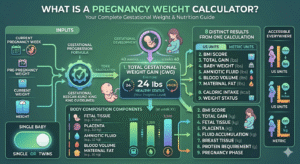
A Pregnancy Weight Calculator is a maternal health tool that estimates key metrics of gestational weight gain and body composition based on your current week of pregnancy, pre-pregnancy weight, current weight, height, and whether you are carrying one baby or twins. By processing these inputs, the Pregnancy Weight Calculator produces a personalised set of results that contextualises your weight gain within medically recommended guidelines and breaks it down into its physiological components.
Our Pregnancy Weight Calculator produces eight distinct results depending on your input unit system (US or Metric):
In US Units:
- BMI score (based on current weight and height)
- Total weight gain so far (in pounds)
- Estimated baby weight (in pounds) at current gestational week
- Estimated amniotic fluid contribution (in pounds)
- Blood volume increase contribution (in pounds)
- Maternal fat contribution (in pounds)
- Recommended daily caloric intake (in kcal)
- Weight gain status (Healthy or High)
In Metric:
- BMI score (based on current weight and height in cm/kg)
- Total weight gain so far (in kilograms)
- Estimated fetal tissue weight (in kilograms)
- Estimated placenta weight (in kilograms)
- Fluid accumulation (in kilograms)
- Breast tissue increase (in kilograms)
- Daily protein requirement (in grams)
- Pregnancy phase (1st, 2nd, or 3rd trimester)
The Pregnancy Weight Calculator supports both US Units (height in feet and inches, weight in pounds) and Metric (height in centimetres, weight in kilograms), and includes a twin pregnancy toggle that adjusts estimated fetal weight accordingly.
Why Tracking Gestational Weight Gain Matters
Tracking your weight gain throughout pregnancy with a Pregnancy Weight Calculator is not about aesthetics — it is about evidence-based health management for both you and your baby. Here is why it matters:
For Baby’s Development: Adequate gestational weight gain is directly associated with healthy fetal growth, appropriate birth weight, full-term delivery, and optimal neurodevelopment. Babies born to mothers who gain insufficient weight during pregnancy are at significantly higher risk of low birth weight, preterm birth, intrauterine growth restriction, and developmental delays.
For Maternal Health: Both insufficient and excessive gestational weight gain carry maternal health risks. Insufficient gain is associated with maternal malnutrition, anaemia, fatigue, and inadequate preparation for labour demands. Excessive gain is associated with gestational diabetes, pre-eclampsia, caesarean section risk, postpartum weight retention, and long-term obesity. The Pregnancy Weight Calculator helps you navigate between these two extremes by tracking your progress against personalised benchmarks.
For Postpartum Recovery: Research consistently shows that women who gain within the recommended gestational weight range return to pre-pregnancy weight more easily postpartum — with less retained weight at 6 and 12 months after birth. Using a Pregnancy Weight Calculator to stay within evidence-based gain targets reduces postpartum weight retention risk.
For Breastfeeding: Adequate gestational weight gain — including the appropriate accumulation of maternal fat stores — is necessary for successful breastfeeding. The fat reserves tracked by our Pregnancy Weight Calculator are not cosmetic; they are physiological preparation for the energy demands of lactation.
How Our Pregnancy Weight Calculator Works
Our Pregnancy Weight Calculator uses a straightforward set of inputs to produce comprehensive gestational weight gain analysis:
Current Gestational Week (1 to 40): The week of pregnancy is the primary temporal variable in the Pregnancy Weight Calculator. It determines the estimated baby weight (which increases proportionally with gestational age), adjusts the recommended daily caloric intake (which increases by approximately 10 kcal per week of pregnancy), and identifies which trimester you are in (first: weeks 1 to 12; second: weeks 13 to 26; third: weeks 27 to 40).
Twin Pregnancy Toggle: When the twin pregnancy option is selected in the Pregnancy Weight Calculator, estimated fetal tissue weight is multiplied by 1.5 — reflecting the greater combined fetal mass of a twin pregnancy at equivalent gestational weeks. Twin pregnancies have different overall weight gain guidelines than singleton pregnancies, and the twin toggle adjusts the tool’s estimates accordingly.
Pre-Pregnancy Weight: The weight before pregnancy is used to calculate total gestational weight gain so far (current weight minus pre-pregnancy weight) — the core metric of the Pregnancy Weight Calculator. Pre-pregnancy weight is also the basis for BMI calculation alongside height.
Current Weight: Your weight at the current gestational week. The difference between current and pre-pregnancy weight is your gestational gain to date — the number the Pregnancy Weight Calculator breaks down into its physiological components.
Height: Used alongside current weight to calculate your BMI in the Pregnancy Weight Calculator. BMI before and during pregnancy determines which gestational weight gain range is medically appropriate for your body.
Understanding BMI Before and During Pregnancy
The BMI displayed in your Pregnancy Weight Calculator results contextualises your weight gain within your pre-pregnancy body composition and guides the recommended total gestational gain range:
The Institute of Medicine (IOM) / National Academy of Medicine (NAM) published guidelines link pre-pregnancy BMI to recommended total gestational weight gain ranges for singleton pregnancies:
Underweight (BMI below 18.5): Recommended gain: 28 to 40 pounds / 12.7 to 18.1 kg. Women who enter pregnancy underweight need to gain more to support fetal growth and maternal stores, as they begin with fewer nutritional reserves.
Normal Weight (BMI 18.5 to 24.9): Recommended gain: 25 to 35 pounds / 11.3 to 15.9 kg. The standard range for women starting pregnancy at a healthy weight. The Pregnancy Weight Calculator tracks whether your gain is progressing within this window.
Overweight (BMI 25 to 29.9): Recommended gain: 15 to 25 pounds / 6.8 to 11.3 kg. Women who enter pregnancy overweight have additional caloric reserves and should gain less total weight. Monitoring with the Pregnancy Weight Calculator helps avoid excess accumulation.
Obese (BMI 30 and above): Recommended gain: 11 to 20 pounds / 5 to 9.1 kg. Women with pre-pregnancy obesity are advised to gain the least — though weight loss during pregnancy is not recommended, as it can deprive the developing baby of necessary nutrients.
For twin pregnancies, all ranges increase substantially:
- Normal weight with twins: 37 to 54 pounds / 16.8 to 24.5 kg
- Overweight with twins: 31 to 50 pounds / 14.1 to 22.7 kg
The BMI score in your Pregnancy Weight Calculator results helps you identify which of these ranges applies to your pregnancy and contextualise whether your current weight gain status is Healthy or High.
The Three Trimesters and Weight Gain by Week
Healthy gestational weight gain is not linear — it follows a characteristic pattern that the Pregnancy Weight Calculator tracks against your current week:
First Trimester (Weeks 1 to 12): Total recommended gain: approximately 1 to 4.5 pounds (0.5 to 2 kg). Weight gain in the first trimester is minimal and erratic — often complicated by morning sickness and food aversions. Many women lose weight in the first trimester due to nausea and vomiting before regaining it. The Pregnancy Weight Calculator phase indicator (“1st”) confirms you are in this early, low-gain phase. The priority is maintaining adequate nutrition rather than hitting a specific gain target.
Second Trimester (Weeks 13 to 26): Recommended gain rate: approximately 1 pound (0.45 kg) per week for normal-weight women. The second trimester is typically the most comfortable period of pregnancy — nausea subsides, energy returns, and appetite increases. Weight gain accelerates as the baby grows rapidly, blood volume expands significantly, and maternal fat stores begin accumulating. The Pregnancy Weight Calculator’s phase indicator (“2nd”) signals that the 1 pound/week gain rate is the benchmark.
Third Trimester (Weeks 27 to 40): Recommended gain rate: approximately 1 pound (0.45 kg) per week continuing through to delivery. The third trimester sees continued rapid fetal growth — particularly in the final 6 to 8 weeks — combined with significant increases in amniotic fluid volume. The Pregnancy Weight Calculator’s “3rd” phase indicator signals the final stretch, where monitoring gain against the total target range becomes most important for birth preparation.
Weight Gain Breakdown – Where the Extra Weight Goes
One of the most valuable features of our Pregnancy Weight Calculator is the breakdown of total weight gain into its physiological components — showing you that pregnancy weight is not simply “fat” but a complex of essential biological developments:
Baby (Fetal Weight): At term (40 weeks), a typical baby weighs approximately 7 to 8 pounds (3.2 to 3.6 kg). The Pregnancy Weight Calculator estimates fetal weight by week using a proportional model — showing how your baby contributes progressively more to your total gestational gain as pregnancy progresses.
Placenta: The placenta — the organ that supplies the baby with oxygen and nutrients — typically weighs 1 to 1.5 pounds (approximately 0.6 kg) at term. The Pregnancy Weight Calculator’s placenta weight estimate (in Metric mode) gives you a sense of this essential organ’s physical contribution to your total weight.
Amniotic Fluid: The fluid surrounding and protecting the baby typically reaches a volume of approximately 1.5 to 2 pounds (0.7 to 0.9 kg) by mid-pregnancy. The Pregnancy Weight Calculator estimates amniotic fluid contribution based on your total gain — reflecting the fluid’s proportional role in gestational weight.
Blood Volume Increase: Maternal blood volume increases by approximately 40% to 50% during pregnancy — adding roughly 3 to 4 pounds (1.4 to 1.8 kg) of additional circulating blood. This blood volume expansion is critical for delivering oxygen and nutrients to the developing fetus and preparing for the blood loss of delivery.
Maternal Fat Stores: Approximately 6 to 8 pounds (2.7 to 3.6 kg) of gestational weight gain consists of maternal fat accumulation — physiological energy reserves specifically stored to support breastfeeding after birth. The Pregnancy Weight Calculator’s maternal fat estimate reassures women that this fat gain is purposeful and temporary.
Breast Tissue: Breast tissue growth during pregnancy — typically 1 to 3 pounds (0.45 to 1.4 kg) — prepares the mammary glands for lactation. The Pregnancy Weight Calculator (Metric mode) estimates this breast tissue contribution as part of the comprehensive weight breakdown.
Baby Weight Estimation by Gestational Week
Our Pregnancy Weight Calculator estimates your baby’s weight at any gestational week using a proportional growth model based on average fetal growth curves:
- Week 12: Approximately 0.5 oz / 14g — barely visible on a scan but developing rapidly
- Week 20: Approximately 10 oz / 280g — the halfway point; anatomy scan typically performed around this week
- Week 28: Approximately 2.2 lbs / 1 kg — entering the third trimester
- Week 32: Approximately 3.75 lbs / 1.7 kg — gaining approximately 0.5 lbs per week
- Week 36: Approximately 5.8 lbs / 2.6 kg — nearly full term
- Week 40: Approximately 7.5 lbs / 3.4 kg — typical birth weight
For twin pregnancies, the Pregnancy Weight Calculator applies a 1.5× multiplier to the fetal weight estimate — reflecting the combined weight of two fetuses developing simultaneously. Note that individual twin weights are typically lower than singleton weights at equivalent gestational ages, but combined fetal mass is substantially higher.
These are statistical estimates based on population growth curves; individual babies vary significantly. Your obstetric provider’s ultrasound measurements provide the most accurate individual fetal weight estimates.
Twins Pregnancy – How Weight Gain Differs
Twin pregnancy fundamentally changes gestational weight gain recommendations, and our Pregnancy Weight Calculator accounts for this through the twin toggle:
Higher Total Gain Required: Women carrying twins need to gain more total weight than singleton pregnancies — typically 10 to 20 pounds more depending on pre-pregnancy BMI. The Pregnancy Weight Calculator adjusts fetal estimates for twin pregnancies, reflecting the greater combined biological mass.
Faster Second Trimester Gain: In twin pregnancies, the second trimester gain rate is typically 1.5 pounds per week rather than 1 pound — reflecting accelerated growth demands. Monitoring this rate with the Pregnancy Weight Calculator helps women carrying twins ensure they are meeting (not exceeding) the elevated requirements.
Higher Caloric Needs: Twin pregnancies require approximately 300 to 500 additional calories per day compared to singleton pregnancies. The Pregnancy Weight Calculator’s recommended daily caloric output provides a starting reference that should be refined with an obstetric dietitian for twin pregnancies.
Earlier Delivery Considerations: Most twin pregnancies deliver between weeks 36 and 38 rather than 40 — meaning the Pregnancy Weight Calculator’s week 40 target ranges are adjusted in practice for twin mothers. Consult your obstetric team for trimester-by-trimester milestones specific to your twin pregnancy.
Recommended Daily Calories During Pregnancy
One of the most practically useful outputs of our Pregnancy Weight Calculator is the recommended daily caloric intake — calibrated to your current gestational week:
The formula: Base daily calories of 2,000 kcal + (10 kcal × current week of pregnancy)
This produces:
- Week 12: 2,120 kcal
- Week 20: 2,200 kcal
- Week 28: 2,280 kcal
- Week 36: 2,360 kcal
The rationale: During the first trimester, additional caloric requirements are minimal — approximately 0 to 100 kcal/day above pre-pregnancy needs for most women. In the second trimester, requirements increase by approximately 340 kcal/day. In the third trimester, they increase further to approximately 450 kcal/day above pre-pregnancy baseline.
The Pregnancy Weight Calculator’s progressive caloric target reflects this trimester-based increase, providing a week-specific calorie goal that rises appropriately as fetal and maternal energy demands grow.
Important context: The 2,000 kcal base in the Pregnancy Weight Calculator is a reference starting point, not a universal prescription. Women with higher or lower pre-pregnancy caloric needs, or those carrying twins, should use this output as a directional guide and work with a registered dietitian or obstetrician for individualised caloric targets.
Protein Requirements Week by Week
In Metric mode, our Pregnancy Weight Calculator provides a gestational week-specific daily protein target:
The formula: 60g base protein + (current week ÷ 5)
This produces:
- Week 10: 62g per day
- Week 20: 64g per day
- Week 30: 66g per day
- Week 40: 68g per day
Why protein increases with gestational week: Protein is the primary building material for fetal tissue growth, placental development, and the expansion of maternal blood volume. As fetal growth accelerates in the second and third trimesters, protein demands increase proportionally. The Pregnancy Weight Calculator’s progressive protein target reflects this escalating demand.
General guidance from the Academy of Nutrition and Dietetics recommends 71g of protein per day during pregnancy — somewhat higher than the Pregnancy Weight Calculator’s week-specific estimates at early stages, but aligned in later weeks. Individual protein requirements may be higher for women carrying twins, women with higher pre-pregnancy lean mass, or women engaged in regular exercise during pregnancy.
High-quality protein sources during pregnancy:
- Lean poultry (chicken, turkey) — 25 to 30g protein per 100g serving
- Fish (salmon, cod, sardines) — 20 to 25g protein per 100g serving (choose low-mercury options)
- Eggs — 6g protein per egg, plus choline essential for fetal brain development
- Legumes (lentils, chickpeas, black beans) — 15 to 18g protein per cup cooked
- Greek yoghurt — 15 to 20g protein per 200g serving
- Dairy (milk, cheese, cottage cheese) — 8 to 25g protein depending on variety
Blood Volume Increase, Amniotic Fluid, and Maternal Fat
Three of the least understood components of gestational weight gain are blood volume increase, amniotic fluid, and maternal fat stores — all of which are estimated in your Pregnancy Weight Calculator results:
Blood Volume Increase: Maternal blood volume increases by approximately 45% during pregnancy — from roughly 5 litres pre-pregnancy to approximately 7.5 litres near term. This substantial increase in circulating blood serves multiple critical functions: supplying the placenta with oxygenated blood, compensating for the blood loss of delivery (typically 500 to 1,000 ml), and meeting the increased oxygen demands of maternal organs supporting the pregnancy. The Pregnancy Weight Calculator estimates blood volume weight contribution at 25% of total gestational gain — reflecting its major role in the weight increase.
Amniotic Fluid: Amniotic fluid surrounds, cushions, and protects the baby throughout pregnancy. It peaks in volume at approximately 34 weeks (around 800 ml to 1 litre) before slightly declining toward term. The Pregnancy Weight Calculator estimates amniotic fluid contribution at 20% of total gain — acknowledging that fluid changes can cause significant week-to-week weight fluctuations that are not related to fat mass changes.
Maternal Fat Stores: This is the component of gestational weight gain that women most frequently misunderstand. Maternal fat stores — accumulated primarily in the second and third trimesters — are not cosmetic weight gain but purposeful physiological reserves. Fat stored during pregnancy is the primary caloric source for breastfeeding, which requires approximately 300 to 500 additional kcal/day from a mother’s body for the first 6 months postpartum. Without adequate maternal fat accumulation tracked by the Pregnancy Weight Calculator, breastfeeding capacity is compromised.
Healthy vs. High Weight Gain Status
Our Pregnancy Weight Calculator (US mode) classifies your current weight gain status as either Healthy or High based on the relationship between your total gain so far and the 30-pound threshold used in the tool:
Healthy Status: A gain of 30 pounds or less at any point in the pregnancy is classified as Healthy in the Pregnancy Weight Calculator. This covers the recommended total gain ranges for most normal-weight women (25 to 35 lbs) and overweight women (15 to 25 lbs), and represents a gain trajectory associated with low complication risk.
High Status: A gain above 30 pounds total is flagged as High in the Pregnancy Weight Calculator — signalling that total gain has reached or exceeded the upper boundary of recommended ranges and warrants monitoring and potentially consultation with a healthcare provider.
Important context: The Pregnancy Weight Calculator’s threshold is a simple screening indicator, not a clinical diagnosis. Women who are underweight pre-pregnancy may have a recommended gain of up to 40 pounds — making 30+ pounds entirely appropriate. Always interpret the status result in the context of your pre-pregnancy BMI and discuss your specific target range with your obstetrician or midwife.
US Units vs. Metric in the Pregnancy Weight Calculator
Our Pregnancy Weight Calculator supports two unit systems to accommodate users globally:
US Units: Height in feet and inches, weight in pounds. Results are displayed in pounds and kcal. The US Units mode provides: BMI score, weight gain in lbs, baby weight estimate in lbs, amniotic fluid estimate in lbs, blood volume contribution in lbs, maternal fat estimate in lbs, recommended daily kcal, and gain status.
Metric: Height in centimetres, weight in kilograms. Results are displayed in kilograms and grams. The Metric mode provides: BMI score, weight gain in kg, fetal tissue estimate in kg, placenta weight in kg, fluid accumulation in kg, breast tissue estimate in kg, daily protein requirement in grams, and trimester phase.
Both modes use the same underlying BMI formula (adapted for unit system) and the same gestational week-based growth and caloric models. The two modes present slightly different result sets — US mode emphasising caloric guidance and weight breakdown, Metric mode emphasising protein guidance and trimester phase — reflecting the different informational priorities common in each system.
Nutrition Tips to Support Healthy Weight Gain
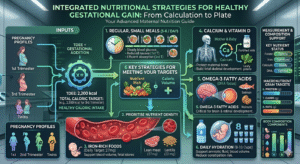
The Pregnancy Weight Calculator provides targets — meeting them requires practical nutritional strategies:
Eat Regular, Small Meals: During pregnancy — particularly in the first trimester when nausea is common and in the third trimester when the growing uterus compresses the stomach — five to six small meals are more comfortable and more nutritionally effective than three large ones. This approach maintains steady blood glucose, reduces nausea, and ensures consistent caloric and protein intake.
Prioritise Nutrient Density Over Caloric Volume: The additional calories required during pregnancy are modest (100 to 450 kcal/day depending on trimester). Every additional calorie should deliver nutritional value — iron, calcium, folate, omega-3 fatty acids, and protein — not empty calories from processed foods. The Pregnancy Weight Calculator’s daily caloric target should be met through whole, nutrient-rich foods.
Iron-Rich Foods: Pregnancy dramatically increases iron requirements (from 18mg to 27mg daily) to support the expansion of maternal blood volume and fetal iron storage. Include lean red meat, fortified cereals, spinach, lentils, and pumpkin seeds in your daily intake. Pair plant iron sources with vitamin C (lemon juice, peppers, strawberries) to maximise absorption.
Calcium and Vitamin D: Fetal bone development requires adequate maternal calcium — if insufficient dietary calcium is consumed, the fetus draws from maternal bone stores. Dairy products, fortified plant milks, tofu, and leafy greens are key calcium sources. Vitamin D supports calcium absorption and fetal immune development.
Omega-3 Fatty Acids: DHA (an omega-3 fatty acid) is critical for fetal brain and retinal development. Fatty fish (salmon, sardines, mackerel — choosing low-mercury options), walnuts, and algae-based DHA supplements are the primary sources. Many prenatal vitamins include DHA supplementation specifically for this reason.
Hydration: Blood volume expansion and amniotic fluid production increase fluid requirements significantly during pregnancy. Aim for 8 to 10 cups of water daily, increasing further in hot weather or with exercise. Adequate hydration also reduces constipation risk — one of the most common pregnancy discomforts.
When to Consult a Healthcare Provider
The Pregnancy Weight Calculator is an educational and monitoring tool — it is not a substitute for professional obstetric care. Seek medical guidance if:
You are gaining significantly more than recommended: Rapid or excessive weight gain may indicate fluid retention, pre-eclampsia, or gestational diabetes — all conditions requiring clinical assessment. If your Pregnancy Weight Calculator status consistently shows High, discuss with your obstetrician.
You are gaining significantly less than recommended: Insufficient weight gain may indicate inadequate nutritional intake, hyperemesis gravidarum (severe pregnancy nausea), or fetal growth restriction. A Pregnancy Weight Calculator result showing minimal or no gain despite advancing gestational weeks warrants clinical review.
You are carrying twins: Twin pregnancies carry higher complication risk and require more intensive monitoring than the Pregnancy Weight Calculator alone can provide. Work with a maternal-fetal medicine specialist alongside using the tool.
Your BMI places you in the obese range: Obesity during pregnancy is associated with significantly elevated risks of gestational diabetes, pre-eclampsia, and caesarean section. A Pregnancy Weight Calculator result showing a high BMI should prompt enhanced surveillance by your obstetric team.
Frequently Asked Questions (FAQs)
What is a Pregnancy Weight Calculator? A Pregnancy Weight Calculator is a maternal health tool that estimates gestational weight gain components — baby weight, amniotic fluid, blood volume, maternal fat, placenta — based on your gestational week, pre-pregnancy weight, current weight, height, and twin status.
How much weight should I gain during pregnancy? The recommended range depends on pre-pregnancy BMI. For normal-weight women (BMI 18.5 to 24.9), the recommended range is 25 to 35 pounds / 11.3 to 15.9 kg. Our Pregnancy Weight Calculator helps you track your gain against this range week by week.
Is the Pregnancy Weight Calculator accurate? The Pregnancy Weight Calculator uses evidence-based formulas for component estimation and provides clinically informed caloric and protein targets. Component weight estimates are population averages — individual pregnancies vary. Use the tool as a monitoring guide alongside regular obstetric appointments.
Does the Pregnancy Weight Calculator work for twins? Yes. Select the twin toggle in the Pregnancy Weight Calculator to adjust fetal weight estimates. Twin pregnancies have different total gain recommendations — work with your obstetric team for twin-specific guidance.
What does the BMI in the Pregnancy Weight Calculator mean? The BMI calculated by the Pregnancy Weight Calculator (based on current weight and height) contextualises your weight gain within standard BMI categories and helps identify which total gestational gain range applies to your pregnancy.
How often should I use the Pregnancy Weight Calculator? Weekly or bi-weekly tracking with the Pregnancy Weight Calculator provides the most useful picture of your weight gain trajectory — enough frequency to identify significant deviations from your target range while avoiding the anxiety of daily fluctuations.
Is it normal to gain a lot of weight in the second trimester? Yes. The second trimester typically involves the fastest gestational weight gain — approximately 1 pound per week for normal-weight women — as the baby grows rapidly and maternal blood volume, amniotic fluid, and fat stores increase significantly. The Pregnancy Weight Calculator tracks this acceleration against expected rates.
What if I am not gaining enough weight during pregnancy? Consult your obstetrician or midwife. Insufficient weight gain can restrict fetal growth. The Pregnancy Weight Calculator can help you identify insufficient gain early — but clinical assessment and dietary support from a registered dietitian are essential for appropriate intervention.
Can I use the Pregnancy Weight Calculator if I was overweight before pregnancy? Yes. Women of all pre-pregnancy BMI categories can use the Pregnancy Weight Calculator to monitor gestational gain. Women who were overweight or obese before pregnancy have lower recommended total gain ranges — typically 15 to 25 pounds and 11 to 20 pounds respectively.
Does the Pregnancy Weight Calculator replace my doctor or midwife? No. The Pregnancy Weight Calculator is an educational monitoring tool — a valuable complement to, not a replacement for, professional obstetric care. All significant findings from the tool should be discussed with your healthcare provider.
Conclusion
Pregnancy is a time of profound physical change, and healthy gestational weight gain is one of the most powerful factors within your influence for supporting your baby’s development and your own wellbeing. Gaining too little deprives your baby of essential growth support; gaining too much increases complication risk and postpartum health challenges. The middle path — evidence-based, monitored, personalised weight gain — is exactly what our free Pregnancy Weight Calculator helps you navigate.
From your BMI score and total gain so far to estimated baby weight, amniotic fluid, blood volume, maternal fat, daily caloric needs, and protein targets, our Pregnancy Weight Calculator provides the most comprehensive free gestational weight analysis available in a single tool — across both US Units and Metric, with twin pregnancy support and week-by-week phase identification across all forty weeks of pregnancy.
Every week of your pregnancy matters. Every pound gained has a purpose. Whether that purpose is building your baby’s brain and bones, expanding your blood supply for delivery, storing the energy reserves that will fuel months of breastfeeding, or growing the placenta that has sustained your baby’s entire existence — your gestational weight gain is working for you and for the new life you are nurturing.
Use our Pregnancy Weight Calculator today. Track your progress. Understand your numbers. And carry the confidence that comes from knowing your pregnancy weight gain is exactly where it needs to be.