Conception Calculator
Calculate Your True Calorie Burn with the TDEE Calculator
Table of Contents
- Introduction
- What Is a Conception Calculator?
- Why Tracking Your Cycle Matters for Conception
- The Science of Ovulation and the Fertile Window
- How Our Conception Calculator Works Step by Step
- Understanding the Eight Summary Results
- Ovulation Date – The Most Critical Output
- Next Period Date and Cycle Tracking
- Due Date Estimation from the Conception Calculator
- The Fertile Window – Six Days That Define Your Cycle
- Cycle Detail Table – Ten Key Dates at a Glance
- Trimester Milestones in the Conception Calculator
- Conception Odds and the Luteal Phase
- Pregnancy Testing Timing from Your Calculator Results
- Irregular Cycles and the Conception Calculator
- Lifestyle Factors That Improve Conception Outcomes
- Frequently Asked Questions (FAQs)
- Conclusion
Introduction
For couples trying to conceive, timing is everything. The human reproductive window within any given menstrual cycle is remarkably narrow — typically just six days, ending on the day of ovulation itself. Missing that window by even a day or two dramatically reduces the probability of conception in that cycle. Understanding exactly when ovulation occurs, when the fertile window opens, and what the calendar of your cycle looks like is the foundational knowledge every couple trying to get pregnant needs — and that is precisely what a Conception Calculator provides.
A Conception Calculator uses the first day of your last menstrual period and your average cycle length to calculate a complete reproductive calendar — from ovulation date and fertile window to next period, pregnancy due date, trimester milestones, and optimal testing date. Rather than relying on generic advice like “have intercourse around day 14,” a Conception Calculator personalises the entire reproductive timeline to your actual cycle, accounting for the fact that cycle length varies significantly from woman to woman and month to month.
This guide covers everything you need to know about the Conception Calculator — how it works, what each result means, the science behind ovulation and fertile windows, how to use the output to maximise your chances of conceiving, how irregular cycles affect your results, and what lifestyle factors most meaningfully improve conception outcomes. Whether you are beginning your conception journey or have been trying for several months, our free Conception Calculator and this complete guide give you the knowledge and tools to approach family planning with confidence, precision, and clarity.
What Is a Conception Calculator?
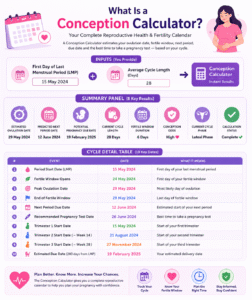
A Conception Calculator is a reproductive health tool that estimates the key dates in your menstrual and reproductive cycle — most importantly your ovulation date and fertile window — based on two inputs: the first day of your last menstrual period (LMP) and your average cycle length. From these two data points, the Conception Calculator builds a complete ten-date reproductive calendar that maps your most fertile days, predicts your next period, estimates a potential due date, and identifies when to take a pregnancy test.
Our Conception Calculator produces two output sections:
Summary Panel — eight result points:
- Estimated ovulation date
- Predicted next period date
- Potential pregnancy due date
- Current cycle length (confirmed from your input)
- Fertile window duration (6 days)
- Conception odds indicator
- Current cycle phase (Luteal)
- Calculation status confirmation
Cycle Detail Table — ten key dates:
- Period start date
- Fertile window opening date
- Peak ovulation date
- End of fertile window
- Next period due date
- Recommended pregnancy test date
- Trimester 1 start date
- Trimester 2 start date (approximately week 14)
- Trimester 3 start date (approximately week 28)
- Estimated due date (280 days from LMP)
The Conception Calculator is designed for any woman with regular or approximately regular cycles, providing the most complete free reproductive planning calendar available in a single, instant calculation.
Why Tracking Your Cycle Matters for Conception
Most couples underestimate how important cycle tracking is for conception — and how significantly timing intercourse to the fertile window improves success rates. Here is the evidence:
The Fertile Window Is Narrow: Research published in the New England Journal of Medicine established that conception is only possible during a six-day window each cycle — the five days before ovulation and the day of ovulation itself. Intercourse outside this six-day window results in zero chance of conception in that cycle, regardless of frequency. The Conception Calculator identifies this window precisely so that effort is directed where it can actually result in pregnancy.
Ovulation Day Varies More Than Most Women Realise: The common assumption that ovulation occurs on “day 14” of the cycle is only accurate for women with a perfect 28-day cycle. In reality, cycle lengths — and therefore ovulation timing — vary enormously. A woman with a 24-day cycle ovulates around day 10; a woman with a 35-day cycle ovulates around day 21. Using a fixed “day 14” assumption for either of these women results in consistently missing the actual fertile window — which is exactly the problem the Conception Calculator solves.
Timing Intercourse Correctly Doubles Conception Rates: Studies consistently show that couples who time intercourse to the fertile window identified by cycle tracking tools conceive at significantly higher rates per cycle than couples using random timing. The peak fertile day — the day before and day of ovulation — is associated with conception probabilities of 25% to 30% per cycle in young, healthy couples with no fertility issues.
Early Pregnancy Awareness Supports Better Outcomes: Knowing your likely due date, trimester milestones, and pregnancy test timing from the Conception Calculator — even before you have confirmed a pregnancy — helps couples make informed decisions about prenatal vitamin initiation, folic acid supplementation, and lifestyle adjustments that should ideally begin before conception rather than after it is confirmed.
The Science of Ovulation and the Fertile Window
Understanding the biology that powers the Conception Calculator makes it far easier to use the results effectively:
The Menstrual Cycle — Two Phases: Every menstrual cycle is divided into two phases by the moment of ovulation:
Follicular Phase (Day 1 to Ovulation): The follicular phase begins on the first day of menstruation and ends at ovulation. During this phase, rising oestrogen levels trigger the development of ovarian follicles, one of which (the dominant follicle) matures to release an egg. The length of the follicular phase is the variable that determines ovulation timing — and it differs between women and between cycles. This is why the Conception Calculator uses your actual cycle length rather than a fixed 14-day assumption.
Luteal Phase (Ovulation to Next Period): The luteal phase begins after ovulation and ends when the next period starts. The luteal phase is remarkably consistent — almost always lasting 14 days (range 12 to 16 days) regardless of total cycle length. This consistency is the mathematical foundation of the Conception Calculator: by subtracting 14 days from your cycle length, the tool identifies your ovulation day.
Ovulation — The Moment of Fertility: Ovulation occurs when a surge in luteinising hormone (LH) triggers the dominant follicle to release a mature egg. The released egg is viable for fertilisation for only 12 to 24 hours — but sperm can survive in the female reproductive tract for up to five days. This sperm survival window is why the fertile period extends five days before ovulation: sperm deposited five days earlier can still be alive and capable of fertilising the egg when it is released.
The Six-Day Fertile Window: The five days of sperm survival plus the single day of egg viability create the six-day fertile window that defines conception possibility. The two most fertile days — the day before ovulation and the day of ovulation itself — carry the highest individual probability of conception and are prominently displayed in the Cycle Detail table of the Conception Calculator.
How Our Conception Calculator Works Step by Step
Using our Conception Calculator takes under one minute and requires only two inputs:
Step One — Enter the First Day of Your Last Period: Select the exact date that your most recent period began — the first day of full menstrual flow (not spotting). This date is the anchor for every calculation in the Conception Calculator — all other dates are calculated forward from this reference point. If you are uncertain of the exact date, use the closest estimate available; even a one or two day approximation produces clinically useful results.
Step Two — Enter Your Average Cycle Length: Enter the number of days in your typical menstrual cycle. Cycle length is measured from the first day of one period to the first day of the next — not from the end of one period to the start of the next. A typical cycle ranges from 21 to 35 days; 28 days is the default in our Conception Calculator but should be changed to your individual average for accurate results.
To find your average cycle length: Track the start dates of your last three to six periods and calculate the average number of days between them. The more accurately you enter your cycle length, the more precisely the Conception Calculator estimates your ovulation date and fertile window.
Step Three — Click Calculate: Instantly receive your complete reproductive calendar — eight summary results and a ten-date cycle detail table — all calculated from your two inputs.
Step Four — Use the Clear Button to Reset: The Clear button resets all inputs to defaults (empty date field, 28-day cycle) and hides the output area for a fresh calculation.
Understanding the Eight Summary Results
Our Conception Calculator summary panel provides eight data points:
Ovulation: Your estimated ovulation date — calculated as LMP date + (cycle length − 14 days). This is the single most important date in your Conception Calculator results — the reproductive target around which your fertile window is built.
Next Period: The predicted first day of your next menstrual period — calculated as LMP date + cycle length. If conception occurs, this period will not arrive — making this date the earliest milestone at which a missed period can be identified as a potential pregnancy sign.
Due Date: A potential pregnancy due date calculated as LMP date + 280 days (Naegele’s Rule — the standard obstetric due date calculation). This is the date displayed in your Conception Calculator results if conception occurs in the current cycle. Your actual clinical due date will be confirmed by your obstetric provider using ultrasound.
Cycle: Your cycle length as entered — confirmed back to you in the results. Verify this number is accurate before interpreting your Conception Calculator output, as an incorrect cycle length shifts every other date accordingly.
Window: The fertile window duration — always 6 days in our Conception Calculator, consistent with the evidence that conception is only possible in the five days before and the day of ovulation.
Odds: Displayed as High — reflecting the elevated conception probability when intercourse is timed to the fertile window identified by the Conception Calculator, as opposed to untimed intercourse.
Phase: Displayed as Luteal — the post-ovulation phase of the cycle. This phase indicator contextualises where you are in your reproductive cycle at the time of calculation.
Status: Displayed as Calculated — confirming that all results have been successfully computed from your inputs.
Ovulation Date – The Most Critical Output
The ovulation date produced by the Conception Calculator is the cornerstone of your entire reproductive calendar. Every other date — the fertile window, the next period, the due date — is calculated relative to ovulation.
How to Use Your Ovulation Date:
Begin intercourse five days before: The fertile window opens five days before ovulation. The Conception Calculator’s fertile window start date (listed as “Window” in the Cycle Detail table) is the earliest date from which timed intercourse is beneficial. Starting intercourse from this date ensures that viable sperm are present throughout the entire fertile period.
Peak fertility on the day before ovulation: Research consistently identifies the day before ovulation as the highest-probability conception day — with individual cycle conception probabilities of 27% to 33% in young couples. Plan for intercourse on the day before and the day of your Conception Calculator ovulation date to target peak fertility.
Confirming ovulation with additional methods: The Conception Calculator provides a statistically estimated ovulation date — accurate for most women with regular cycles. You can confirm ovulation timing with:
- Ovulation predictor kits (OPKs): Detect the LH surge that occurs 24 to 36 hours before ovulation
- Basal body temperature (BBT) charting: Temperature rises 0.2°C to 0.5°C after ovulation — confirms ovulation has occurred
- Cervical mucus observation: Fertile-quality cervical mucus (clear, stretchy, egg-white consistency) peaks in the two to three days before ovulation
Using these confirmation methods alongside the Conception Calculator date combines the forward-looking predictive accuracy of cycle length calculation with the real-time physiological signals your body produces.
Next Period Date and Cycle Tracking
The next period date in your Conception Calculator results serves two important functions:
As a Conception Milestone: If you have timed intercourse to your fertile window, the absence of your period on the predicted date is the first objective sign of possible pregnancy. Most home pregnancy tests are sensitive enough to detect the pregnancy hormone hCG from the day of the expected period — making your Conception Calculator next period date your earliest reliable pregnancy test date.
As a Cycle Tracking Reference: If your period arrives as predicted, the next period date becomes the new LMP for your following cycle calculation. Simply re-enter this date as your new “First Day of Last Period” in the Conception Calculator and run the calculation again for your next cycle’s fertile window.
Tracking consecutive cycles allows you to verify whether your average cycle length is accurate — if periods consistently arrive earlier or later than predicted, adjusting your cycle length input in the Conception Calculator will produce more accurate fertile window estimates.
Due Date Estimation from the Conception Calculator
The due date displayed in your Conception Calculator results is calculated using Naegele’s Rule — the international obstetric standard:
Due Date = First Day of Last Menstrual Period + 280 Days (40 weeks)
This calculation assumes: A 28-day cycle with ovulation on day 14. For women with longer or shorter cycles, the true due date may differ by the number of days your cycle differs from 28. Your Conception Calculator result shows the Naegele’s Rule due date as a reference point — your clinical provider will confirm or adjust this using ultrasound dating during your first trimester.
The due date is not a fixed delivery date — it is the midpoint of a normal delivery window. Approximately 80% of births occur within two weeks before or after the estimated due date. Use the due date from your Conception Calculator for planning purposes, understanding that actual delivery timing is influenced by many biological factors beyond cycle calculation.
The Fertile Window – Six Days That Define Your Cycle
The six-day fertile window is the reproductive reality that every conception planning strategy must be built around — and our Conception Calculator maps this window precisely for your individual cycle.
Day 1 of the Window (Five Days Before Ovulation): Conception probability is lowest but non-zero — approximately 4% to 8%. The Conception Calculator marks this as “Window Start” in the Cycle Detail table.
Days 2 and 3 of the Window (Three to Four Days Before Ovulation): Conception probability rises to approximately 12% to 17%.
Days 4 and 5 of the Window (One to Two Days Before Ovulation): Peak fertile days — conception probability of 25% to 33%. These are the highest-priority intercourse days identified by your Conception Calculator output.
Day 6 of the Window (Ovulation Day): Conception probability approximately 12% to 20% — somewhat lower than the day before because the egg’s viability window is already underway by the time intercourse occurs. Marked as “Peak” in the Conception Calculator’s Cycle Detail table.
Day 7 and Beyond: Post-ovulation — egg viability ends approximately 12 to 24 hours after ovulation. Intercourse after the fertile window has zero probability of resulting in conception in that cycle.
Cycle Detail Table – Ten Key Dates at a Glance
The Cycle Detail table in your Conception Calculator provides a complete ten-date reproductive calendar:
Start: The first day of your last menstrual period — the anchor date entered into the Conception Calculator.
Window: The opening of the fertile window — five days before ovulation. Begin timed intercourse from this date.
Peak: The ovulation date — the single most fertile day of your cycle. This is the primary target of the Conception Calculator’s calculation.
End: The day after ovulation — the technical end of the fertile window. After this date, the current cycle’s conception opportunity is closed.
Due (Next Period): The predicted start date of your next menstrual period, if conception does not occur.
Test: The recommended pregnancy test date — two days after the next period due date, when hCG levels will be detectable even in earlier-than-average implantation timelines.
Trimester 1: Begins on the LMP date — the first trimester spans weeks 1 to 13 of pregnancy.
Trimester 2: Begins approximately 98 days (14 weeks) after the LMP — the second trimester spans weeks 14 to 27.
Trimester 3: Begins approximately 196 days (28 weeks) after the LMP — the third trimester spans weeks 28 to 40.
Due Date: The estimated delivery date — 280 days from the LMP, completing the reproductive timeline in the Conception Calculator’s Cycle Detail output.
Trimester Milestones in the Conception Calculator
One of the uniquely forward-looking features of our Conception Calculator is the inclusion of trimester milestone dates — allowing couples to visualise the entire pregnancy journey even before conception is confirmed:
First Trimester (Weeks 1 to 13): Begins on the LMP date. The most critical period for fetal organ development — highlighting why pre-conception supplementation (folic acid, vitamin D, iron) is recommended to begin before trying to conceive rather than after confirming pregnancy. Having the trimester 1 start date from the Conception Calculator before conception prompts earlier supplement initiation.
Second Trimester (Weeks 14 to 27): Typically the most comfortable trimester — morning sickness subsides, energy improves, and the baby’s growth accelerates. The anatomy scan is usually performed around week 20. The Conception Calculator’s second trimester date gives couples a forward timeline for when major prenatal milestones will occur.
Third Trimester (Weeks 28 to 40): The final stretch — characterised by rapid fetal weight gain and birth preparation. Knowing the third trimester start date from the Conception Calculator helps couples plan for parental leave, baby preparations, and the logistical demands of late pregnancy.
Conception Odds and the Luteal Phase
Two of the summary results from the Conception Calculator — Odds and Phase — provide important contextual information:
Conception Odds (High): The “High” odds indicator reflects the elevated conception probability associated with intercourse timed to the fertile window. Research consistently shows that couples who target the fertile window identified by cycle tracking tools conceive faster than those using untimed intercourse. For young couples (under 35) with no known fertility issues, the per-cycle conception probability during the fertile window is approximately 20% to 30% — compared to 3% to 8% for intercourse on randomly chosen days outside the window.
Over six cycles of properly timed intercourse, cumulative conception probability exceeds 80% for fertile couples — which is why conception planning tools are recommended before seeking specialist fertility evaluation.
Phase (Luteal): The luteal phase indicator in the Conception Calculator results shows that results are calculated in the context of the post-ovulation phase of the cycle. The luteal phase — the 14 days between ovulation and the next period — is also the implantation window: if fertilisation occurs, the embryo travels from the fallopian tube to the uterus and implants in the uterine wall approximately 6 to 10 days after ovulation. Implantation triggers hCG production — the hormone detected by pregnancy tests — which is why testing before the next expected period date is generally too early for reliable results.
Pregnancy Testing Timing from Your Calculator Results
The “Test” date in your Conception Calculator’s Cycle Detail table — two days after the predicted next period — is the recommended earliest date for reliable pregnancy test results. Here is the reasoning:
hCG Doubling Pattern: After implantation (approximately day 20 to 24 of a 28-day cycle), hCG levels double every 48 to 72 hours. By the time the next period is due (day 28), hCG levels are typically high enough for sensitive home pregnancy tests to detect — usually 25 to 50 mIU/mL.
Testing Two Days After Expected Period: If your period has not arrived on the date predicted by the Conception Calculator and you want to confirm with a test, waiting two additional days ensures hCG levels are well above the detection threshold of most standard home tests — reducing the risk of a false negative from testing too early.
Sensitive Early Detection Tests: Some pregnancy tests claim sensitivity at 10 to 15 mIU/mL — capable of detecting pregnancy as early as 3 to 4 days before the expected period. If using an early-detection test, the “Next Period” date from your Conception Calculator rather than the “Test” date may be used as the earliest reliable test point.
Irregular Cycles and the Conception Calculator
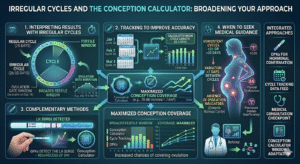
The Conception Calculator is most accurate for women with regular, consistent cycle lengths. If your cycles are irregular — varying by five or more days between cycles — the calculated ovulation date carries greater uncertainty:
Interpreting Results with Irregular Cycles: Use the Conception Calculator’s fertile window as a broader target rather than a precise prediction. If your cycle length varies between 26 and 32 days, your ovulation date could range from day 12 to day 18. In this scenario, extending the period of timed intercourse to cover the entire possible ovulation range — roughly days 10 to 20 — maximises coverage.
Tracking to Improve Accuracy: Tracking your cycle for three to six months before relying heavily on the Conception Calculator allows you to calculate a meaningful average cycle length. Even for irregular cycles, identifying whether your cycles tend to be longer or shorter than average improves the precision of the tool’s ovulation estimate.
Complementary Methods for Irregular Cycles: OPKs (ovulation predictor kits) are particularly valuable for women with irregular cycles — detecting the LH surge regardless of which day it occurs, without requiring an accurate cycle length input. Use OPKs alongside the Conception Calculator for the most comprehensive fertile window tracking when cycles are unpredictable.
When to Seek Medical Guidance: Cycles consistently shorter than 21 days or longer than 35 days, cycles that vary by more than seven days between cycles, or absence of ovulation indicators despite normal cycle length may indicate conditions (PCOS, thyroid dysfunction, premature ovarian insufficiency) that a healthcare provider should evaluate.
Lifestyle Factors That Improve Conception Outcomes
Beyond timing intercourse to the fertile window identified by the Conception Calculator, these evidence-based lifestyle factors meaningfully improve conception probability and early pregnancy health:
Folic Acid Supplementation: Begin taking 400 to 800 mcg of folic acid daily at least one month before trying to conceive. Folic acid dramatically reduces the risk of neural tube defects (spina bifida, anencephaly) — conditions that develop in the first 28 days of pregnancy, often before women know they are pregnant. Starting supplementation in anticipation of the conception date identified by your Conception Calculator ensures coverage during the critical early developmental window.
Healthy Body Weight: Both underweight (BMI below 18.5) and overweight (BMI above 25) are associated with reduced fertility — through impacts on ovulation regularity, hormone levels, and embryo implantation quality. Achieving a healthy BMI before attempting conception improves both the probability of getting pregnant and the likelihood of a healthy pregnancy outcome.
Smoking Cessation: Smoking reduces egg quality, impairs uterine receptivity, and accelerates ovarian ageing. Women who smoke take significantly longer to conceive than non-smokers, and smoking is associated with higher miscarriage rates. Stopping smoking before attempting conception is one of the single most impactful fertility decisions a woman can make.
Alcohol Moderation: Evidence suggests that even moderate alcohol consumption may reduce fertility and increase miscarriage risk. Most reproductive medicine guidelines recommend avoiding alcohol entirely from the time of trying to conceive, given that conception may occur before pregnancy is confirmed and early embryonic development is sensitive to alcohol exposure.
Stress Management: Chronic psychological stress can suppress LH release, delay ovulation, and shorten the luteal phase — potentially reducing both conception probability and early pregnancy viability. Regular moderate exercise, adequate sleep, mindfulness practices, and social support all contribute to the hormonal environment that supports conception.
Prenatal Vitamin Initiation: A complete prenatal vitamin — including folic acid, iodine, vitamin D, iron, and omega-3 DHA — provides comprehensive nutritional support for conception and early pregnancy. Begin prenatal vitamins in the cycle during which you start trying to conceive, using your Conception Calculator fertile window dates as the timeline prompt.
Frequently Asked Questions (FAQs)
What is a Conception Calculator? A Conception Calculator is a reproductive planning tool that estimates your ovulation date, fertile window, next period, and potential due date based on the first day of your last period and your average cycle length.
How accurate is the Conception Calculator? The Conception Calculator is most accurate for women with regular cycles. For a 28-day cycle, ovulation date accuracy is typically within one to two days. Accuracy decreases with irregular cycles — using OPKs alongside the tool improves real-time accuracy.
What cycle length should I enter in the Conception Calculator? Enter your personal average cycle length — measured from the first day of one period to the first day of the next. Track three to six cycles and average the lengths for the most accurate input.
When is the best time to have intercourse based on the Conception Calculator results? The highest probability days are the one to two days before your ovulation date as shown in the Conception Calculator. Beginning intercourse from the fertile window start date and continuing every one to two days through ovulation day provides optimal coverage.
Can I use the Conception Calculator to avoid pregnancy? The Conception Calculator is designed as a conception planning tool, not a contraceptive method. Cycle-based approaches to contraception require specialist training and carry significant failure rates — consult a healthcare provider for contraception guidance.
What if my period doesn’t arrive on the predicted date? A missed period is a potential sign of pregnancy. Wait two days after the predicted next period date from your Conception Calculator and take a home pregnancy test. Confirm positive results with a healthcare provider.
Does the Conception Calculator work for PCOS or irregular cycles? The Conception Calculator provides useful estimates even for somewhat irregular cycles, but accuracy is reduced. Women with PCOS or significantly irregular cycles should use OPKs and consult a gynaecologist for personalised ovulation tracking support.
How many cycles does it typically take to conceive when using a Conception Calculator? For fertile couples under 35 timing intercourse correctly, approximately 30% conceive in cycle 1, 60% within three cycles, and 80% to 85% within six cycles. If conception has not occurred after 12 months of timed intercourse (or 6 months if over 35), seek specialist fertility evaluation.
Can the Conception Calculator tell me the sex of my baby? No — the sex of a baby is determined at fertilisation and cannot be predicted by cycle timing or any consumer-level tool. Gender selection requires specialised clinical procedures (PGT-A during IVF) and is subject to ethical and legal regulations.
Conclusion
Conception is one of the most profound experiences in human life — and like all profound experiences, it benefits from preparation, knowledge, and the right tools. Knowing your ovulation date, mapping your fertile window, understanding your cycle, and visualising the pregnancy journey ahead are not just clinical data points — they are the foundation of informed, empowered family planning.
Our free Conception Calculator translates two simple inputs — your last period date and cycle length — into a complete ten-date reproductive calendar that tells you exactly when your fertile window opens, when your peak ovulation day arrives, when your next period is expected, when to take a pregnancy test, and — if conception occurs — when your due date falls and when each trimester begins.
Whether you are in your first cycle of trying, working to understand a pattern across several months, or simply wanting to time intercourse more deliberately, the Conception Calculator is the fastest, most comprehensive, and most accessible reproductive planning tool available. Use it every cycle, verify your inputs as your cycle data accumulates, combine it with OPKs for maximum precision, and approach each fertility window with the confidence of knowing exactly when it is.
Your reproductive journey deserves accurate, personalised, evidence-based guidance. Start with the Conception Calculator — and let precision planning work for you.