Protein Calculator
Calculate Your Maximum Lift with the One Rep Max Calculator
Table of Contents
- Introduction
- What Is a Protein Calculator?
- Why Protein Is the Most Important Macronutrient
- How the Protein Calculator Works
- Understanding the Three Unit Systems – Metric, US, and Others
- Gender and Age – Why They Affect Your Protein Goal
- Activity Level – The Most Powerful Variable in Your Protein Calculator
- Reading Your Results – Daily Protein Goal vs. Minimum Intake
- The Best Protein Sources – Whey, Plant, and Casein Explained
- Protein Requirements by Goal – Weight Loss, Muscle Gain, and Maintenance
- Timing Your Protein Intake for Maximum Benefit
- Protein Calculator Results for Different Body Types
- Common Protein Myths Debunked
- How to Hit Your Protein Goal Every Day
- How to Use Our Protein Calculator Step-by-Step
- Frequently Asked Questions (FAQs)
- Conclusion
Introduction
Protein is the foundation of every cell, tissue, muscle, enzyme, and hormone in the human body. Without adequate daily protein intake, your body cannot build lean muscle, recover from exercise, maintain a healthy immune system, or sustain the metabolic processes that keep every organ functioning at its best. And yet, the vast majority of people — from sedentary office workers to dedicated gym-goers — have no accurate idea how much protein their body actually needs each day.
A Protein Calculator solves that problem in seconds. By processing your gender, age, height, weight, and physical activity level, it produces a precise, personalised daily protein target — calibrated to your body’s specific requirements rather than based on generalised one-size-fits-all guidelines. Whether your goal is fat loss, muscle gain, athletic performance, or general health maintenance, knowing your exact protein target is the first and most important step.
In this comprehensive guide, you will learn everything about daily protein requirements — how the Protein Calculator computes your goal, what every input means, how activity level transforms your protein needs, which protein sources best meet those needs, and how to consistently hit your target every single day. Whether you are new to nutritional planning or a seasoned athlete refining your diet, this guide and our free Protein Calculator give you the precise foundation your health and fitness goals demand.
What Is a Protein Calculator?
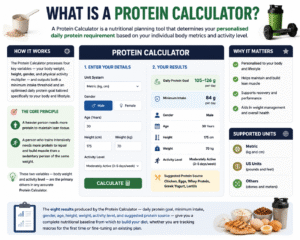
A Protein Calculator is a nutritional planning tool that determines your personalised daily protein requirement based on your individual body metrics and activity level. Rather than relying on generic population averages, a Protein Calculator processes four key variables — your body weight, height, gender, and physical activity multiplier — and outputs both a minimum intake threshold and an optimised daily protein goal tailored specifically to your body and lifestyle.
The core principle behind every Protein Calculator is that protein needs scale with body weight and activity demand. A heavier person needs more protein to maintain lean tissue. A person who trains intensively needs more protein to repair and build muscle than a sedentary person of the same weight. These two variables — body weight and activity level — are the primary drivers in any accurate Protein Calculator.
Our Protein Calculator goes further by accommodating three different measurement unit systems — Metric (kg and cm), US Units (pounds and feet), and Others (stones and meters) — ensuring users worldwide can enter their measurements in the format most natural to them without any manual conversion.
The eight results produced by the Protein Calculator — daily protein goal, minimum intake, gender, age, height, weight, activity level, and suggested protein source — give you a complete nutritional baseline from which to build your diet, whether you are tracking macros for the first time or fine-tuning an existing plan.
Why Protein Is the Most Important Macronutrient
Of the three macronutrients — protein, carbohydrates, and fat — protein is the only one your body cannot survive without in functional form. While carbohydrates and fats serve primarily as energy sources (functions that can partially substitute for each other), protein performs structural and functional roles that no other macronutrient can replicate.
Here is why protein deserves the central place in your nutritional plan — and why using a Protein Calculator is the most effective way to ensure you are getting enough:
Muscle Building and Repair: Protein provides the amino acids your muscles use to repair micro-tears caused by exercise and to build new contractile tissue. Without sufficient protein — determined accurately by a Protein Calculator — muscle protein synthesis cannot keep pace with muscle protein breakdown, and your training produces little or no measurable muscle gain.
Satiety and Weight Management: Protein is the most satiating macronutrient. High-protein diets reduce hunger hormones and increase feelings of fullness, making caloric deficit more tolerable and sustainable during fat loss phases. Hitting the goal your Protein Calculator sets for you is one of the most effective strategies for long-term weight management.
Metabolic Rate: Protein has the highest thermic effect of any macronutrient — the body burns approximately 20% to 30% of protein’s caloric value simply digesting it, compared to 5% to 10% for carbohydrates and 0% to 3% for fat. Adequate protein intake, as calculated by your Protein Calculator, meaningfully supports metabolic health.
Immune Function: Antibodies, immune system signalling molecules, and defensive enzymes are all proteins. Chronic protein insufficiency compromises immune response and increases susceptibility to illness and infection.
Hormonal Balance: Growth hormone, insulin, glucagon, and many other hormones are protein-based. Adequate daily protein intake — consistent with your Protein Calculator results — supports hormonal health and endocrine function throughout every stage of life.
How the Protein Calculator Works
Our Protein Calculator uses a weight-based formula scaled by an activity multiplier to produce personalised protein targets. Here is the underlying methodology:
Base Protein Calculation:
Minimum Intake = Body Weight (kg) × 1.6
This establishes the foundational daily requirement — the minimum amount of protein needed to prevent deficiency, maintain lean tissue, and support basic bodily functions at rest.
Activity-Adjusted Daily Goal:
Daily Protein Goal = Minimum Intake × Activity Multiplier
The activity multiplier scales the base requirement upward to account for the increased protein demand created by exercise, physical labour, sport, and training. The more physically active you are, the more protein your body requires — a relationship that every accurate Protein Calculator must incorporate.
Unit Conversion: When US Units (pounds) are entered, the Protein Calculator converts weight to kilograms using the factor 0.453592. When Others (stones) are entered, it converts using 6.35029 kg per stone. Height is recorded for context and reference, not used in the protein formula directly — but its presence in the results panel ensures the full anthropometric profile is captured.
The final output — your Daily Protein Goal and Minimum Intake in grams — is calibrated to your exact body weight and activity level, making it a genuinely personalised recommendation rather than a population-average estimate.
Understanding the Three Unit Systems – Metric, US, and Others
One of the most user-friendly features of our Protein Calculator is its support for three distinct measurement unit systems, making it accessible to users across every region and measurement convention:
Metric System (Default): Accepts weight in kilograms and height in centimetres — the standard system used in most of the world, including Europe, Asia, Africa, and Australia. Metric is the most straightforward input for the Protein Calculator’s underlying formula, which works natively in kilograms.
US Units: Accepts weight in pounds and height in feet and inches — the system most familiar to users in the United States. The Protein Calculator automatically converts pounds to kilograms (multiply by 0.453592) before applying the protein formula, ensuring accuracy without requiring any manual conversion from the user.
Others: Accepts weight in stones and height in meters — a combination commonly used in the United Kingdom and Ireland, where body weight is traditionally measured in stones while height is increasingly reported in meters. The Protein Calculator converts stones to kilograms (multiply by 6.35029) automatically.
Switching between units is instant — select your preferred tab and the input fields update immediately, showing only the relevant fields for your chosen system. This three-system approach ensures the Protein Calculator delivers accurate results regardless of where you are or which measurement convention you use.
Gender and Age – Why They Affect Your Protein Goal
While gender and age are not direct multipliers in the protein formula itself, they are important contextual inputs in the Protein Calculator that influence how results should be interpreted and applied:
Gender: Men and women have different body composition baselines — men typically carry a higher proportion of lean muscle mass and a lower proportion of body fat at equivalent body weights. Because protein requirements scale primarily with lean mass rather than total mass, men generally require slightly higher absolute protein intakes than women of the same weight. Gender is also an important variable for interpreting activity level — what constitutes “moderately active” differs between a male competitive athlete and a female recreational exerciser.
Age: Protein requirements change meaningfully across the lifespan. Children and adolescents need relatively high protein per kilogram of body weight to support growth. Young adults (18 to 35) need protein primarily for muscle maintenance and repair. Older adults (50+) face age-related muscle loss (sarcopenia) and benefit from higher protein intakes — often 1.8 to 2.5g per kg — to preserve lean mass and function. The Protein Calculator captures your age to provide context for interpreting your results within your life stage.
Practical implications:
- Teenage athletes: Higher protein needs due to simultaneous growth demands and training load.
- Adults in caloric deficit: Protein needs increase during weight loss to preserve muscle mass.
- Adults over 50: Higher protein intakes and strength training together are the most effective strategy for maintaining muscle and independence.
Activity Level – The Most Powerful Variable in Your Protein Calculator
Of all the inputs in the Protein Calculator, physical activity level has the greatest influence on your daily protein goal. The activity multiplier can increase your protein target by up to 44% compared to a sedentary baseline — a difference of tens of grams per day that profoundly affects muscle building, recovery, and performance outcomes.
Here are the four activity levels and their multipliers used in our Protein Calculator:
Sedentary (No Exercise) — Multiplier 1.2: Applies to individuals with desk-based jobs and minimal planned physical activity. The 1.2 multiplier is applied to the base protein calculation, producing the minimum protein target for basic health maintenance without the elevated demands of exercise-driven tissue repair.
Lightly Active — Multiplier 1.375: Applies to individuals who exercise 1 to 3 days per week at low to moderate intensity — casual walks, gentle gym sessions, recreational sport. The Protein Calculator’s 1.375 multiplier reflects the modest additional protein demand of light regular activity.
Moderately Active — Multiplier 1.55: Applies to individuals exercising 3 to 5 days per week at moderate intensity — regular gym training, running, cycling, swimming, or team sports. This is the most common activity level among people actively managing their fitness, and the 1.55 multiplier produces a meaningfully elevated protein target that supports consistent training adaptation.
Very Active — Multiplier 1.725: Applies to individuals exercising 6 to 7 days per week at high intensity — competitive athletes, manual labourers, or individuals pursuing aggressive fitness goals. The Protein Calculator’s 1.725 multiplier at this level produces the highest daily protein goal, reflecting the substantial tissue repair and adaptation demand of near-daily intensive training.
Reading Your Results – Daily Protein Goal vs. Minimum Intake
Our Protein Calculator produces eight results, but the two most important are the Daily Protein Goal and the Minimum Intake:
Minimum Intake (grams): This is your baseline protein floor — the minimum amount of protein per day your body needs to prevent deficiency, maintain existing lean tissue, and support essential bodily functions. Falling below this level consistently leads to muscle loss, reduced immune function, poor recovery, and hormonal disruption. Treat this figure as a non-negotiable daily floor.
Daily Protein Goal (grams): This is your optimised target — the amount of protein your body needs to thrive at your specific activity level. For active individuals, this is the amount that enables muscle building, effective recovery, sustained energy, and peak performance. Use this figure as your daily tracking target. The Daily Protein Goal is higher than the Minimum Intake by a factor equal to your activity multiplier — reflecting the enhanced protein demand created by your exercise and physical activity.
The gap between the two figures is meaningful. If your Minimum Intake is 112g and your Daily Protein Goal is 174g (Very Active multiplier), consistently hitting the goal rather than just the minimum can make a substantial difference to body composition, recovery speed, and long-term health outcomes.
The Best Protein Sources – Whey, Plant, and Casein Explained
Our Protein Calculator suggests three primary protein source categories: Whey, Plant, and Casein. Understanding the unique profile of each helps you build a practical, effective daily protein strategy:
Whey Protein: Derived from milk during the cheese-making process, whey is a complete protein containing all essential amino acids in high concentrations, with an especially high leucine content — the key amino acid that triggers muscle protein synthesis. Whey is fast-digesting, making it ideal immediately post-workout when rapid amino acid delivery to recovering muscles maximises the repair and growth response. Available as whey concentrate, isolate, and hydrolysate — isolate and hydrolysate are preferred for those with lactose sensitivity.
Plant Protein: Derived from pea, rice, hemp, soy, or mixed plant sources, plant proteins are the choice for vegans, vegetarians, and those with dairy intolerance. Individually, most plant proteins are incomplete (lacking one or more essential amino acids), but blended plant proteins — combining pea and rice, for example — achieve a complete amino acid profile comparable to animal sources. Plant protein digests more slowly than whey, making it suitable at any time of day.
Casein Protein: Also dairy-derived, casein is a slow-digesting protein that forms a gel in the stomach, releasing amino acids steadily over 5 to 7 hours. Casein is the ideal bedtime protein source, sustaining overnight muscle protein synthesis during the longest daily fasting period and preventing the overnight muscle breakdown that would otherwise occur.
Practical strategy: Use whey post-workout for rapid muscle repair, plant protein throughout the day for flexible protein top-ups, and casein before sleep for overnight recovery. The Protein Calculator gives you your daily target — these three sources give you the toolkit to hit it.
Protein Requirements by Goal – Weight Loss, Muscle Gain, and Maintenance
Your Protein Calculator result is your personalised baseline, but your specific body composition goal should inform how you apply it:
Weight Loss: During a caloric deficit, protein needs are at their highest. Without sufficient protein — typically 2.0 to 2.4g per kg — the body breaks down muscle tissue alongside fat to meet energy needs. High protein intake during weight loss preserves lean mass, maintains metabolic rate, and increases diet satisfaction. Enter your goal weight into the Protein Calculator and use the Very Active multiplier even if you are moderately active — the additional protein acts as a protective buffer during caloric restriction.
Muscle Gain: Building muscle requires both a caloric surplus and sufficient protein to provide the raw materials for new tissue synthesis. The Protein Calculator’s moderately to very active targets (1.375 to 1.725 multiplier) are well-matched to muscle gain goals, providing the amino acid availability needed for consistent hypertrophy alongside progressive training.
Maintenance: For individuals at their goal weight seeking to maintain body composition without significant change, the Moderately Active target from the Protein Calculator is typically appropriate — enough to maintain lean mass and support regular exercise without excessive protein intake.
Timing Your Protein Intake for Maximum Benefit
Knowing your daily protein target from the Protein Calculator is only half the equation — when you distribute that protein across the day matters significantly for maximising its benefits:
Distribute Across Multiple Meals: Research consistently shows that spreading protein intake across 3 to 5 meals or snacks optimises muscle protein synthesis compared to consuming the same total in 1 or 2 large meals. Aim for approximately 30 to 40 grams of protein per meal — the dose at which muscle protein synthesis is maximally stimulated in most adults.
Post-Workout Window: Consuming 25 to 40 grams of fast-digesting protein (whey is ideal) within 30 to 90 minutes of training takes advantage of the anabolic window — the period of heightened muscle protein synthesis sensitivity immediately following exercise.
Pre-Sleep Protein: 40 grams of casein protein consumed 30 minutes before sleep has been shown in multiple studies to increase overnight muscle protein synthesis and improve next-day recovery and performance.
Morning Protein: Beginning the day with a high-protein breakfast — eggs, Greek yoghurt, protein shake — breaks the overnight fast and initiates the first daily stimulus for muscle protein synthesis. Many people fall short of their Protein Calculator target simply because their morning meal is protein-poor. Starting strong sets the pace for the entire day.
Protein Calculator Results for Different Body Types
Your Protein Calculator result will vary significantly depending on your body weight and activity level. Here are representative examples to contextualise what the calculator produces for different individuals:
70kg Sedentary Adult: Minimum Intake: 112g | Daily Protein Goal: 134g Achievable with: 2 eggs at breakfast (12g), Greek yoghurt snack (15g), chicken breast lunch (40g), protein shake (25g), salmon dinner (45g).
85kg Moderately Active Adult: Minimum Intake: 136g | Daily Protein Goal: 211g Requires consistent protein focus across all meals — lean meat, dairy, eggs, and supplementation typically needed to hit this target reliably.
60kg Very Active Female Athlete: Minimum Intake: 96g | Daily Protein Goal: 166g Higher per-kilogram target relative to body weight — whey post-training plus casein at night are particularly valuable for this profile to reach the Protein Calculator goal.
100kg Strength Athlete: Minimum Intake: 160g | Daily Protein Goal: 276g At this level, whole-food protein alone is often insufficient — structured supplementation is typically required to achieve the target the Protein Calculator sets.
Common Protein Myths Debunked
Several persistent myths prevent people from using their Protein Calculator results effectively:
Myth: High protein intake damages kidneys. Fact: Extensive research confirms that high protein diets are safe for healthy individuals with no pre-existing kidney disease.** The myth originates from studies on patients with existing renal impairment, where protein restriction is clinically appropriate. For healthy people, hitting the target your Protein Calculator recommends poses no kidney risk.
Myth: Plant proteins are inferior. Fact: Complete plant protein blends — pea plus rice, for example — achieve amino acid profiles comparable to whey. Vegans and vegetarians can fully meet their Protein Calculator goal using plant sources alone.
Myth: You can only absorb 30g of protein per meal. Fact: The body does not have a 30g absorption cap. Larger protein doses are absorbed and utilised — they simply digest more slowly. The 30g-per-meal guidance is about optimising muscle protein synthesis frequency, not a hard biological limit.
Myth: Protein makes you bulky. Fact: Muscle growth requires both adequate protein AND a caloric surplus AND progressive resistance training. Hitting your Protein Calculator goal without these additional factors will not produce unwanted bulk — it will support lean muscle maintenance and healthy body composition.
How to Hit Your Protein Goal Every Day
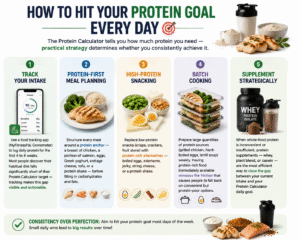
The Protein Calculator tells you how much protein you need — practical strategy determines whether you consistently achieve it. Here are the most effective approaches:
Track Your Intake: Use a food tracking app (MyFitnessPal, Cronometer) to log daily protein for the first 4 to 6 weeks. Most people discover their habitual diet falls significantly short of their Protein Calculator target — tracking makes this gap visible and actionable.
Protein-First Meal Planning: Structure every meal around a protein anchor — a breast of chicken, a portion of salmon, eggs, Greek yoghurt, cottage cheese, tofu, or a protein shake — before filling in carbohydrates and fats.
High-Protein Snacking: Replace low-protein snacks (crisps, crackers, fruit alone) with protein-rich alternatives — boiled eggs, edamame, jerky, string cheese, or a protein shake.
Batch Cooking: Prepare large quantities of protein sources (grilled chicken, hard-boiled eggs, lentil soup) weekly. Having protein-rich food immediately available removes the friction that causes people to fall back on convenient but protein-poor options.
Supplement Strategically: When whole-food protein is inconvenient or insufficient, protein supplements — whey, plant blend, or casein — are the most efficient way to close the gap between your current intake and your Protein Calculator daily goal.
How to Use Our Protein Calculator Step-by-Step
Our free Protein Calculator is simple to use and produces personalised results in seconds. Here is the complete process:
Step One – Select Your Unit System: Choose Metric (kg/cm), US Units (lbs/ft), or Others (stones/meters) depending on which measurement system you use most naturally.
Step Two – Select Your Gender: Choose Male or Female. Gender is captured for context and result reporting.
Step Three – Enter Your Age: Input your current age in years. Age provides context for interpreting your protein needs across different life stages.
Step Four – Enter Your Height and Weight: Input your height and weight in the fields corresponding to your selected unit system. Accuracy here directly determines the quality of your Protein Calculator output, as body weight is the primary input to the protein formula.
Step Five – Select Your Activity Level: Choose the option that best describes your weekly physical activity — Sedentary, Lightly Active, Moderately Active, or Very Active. If in doubt, select the level that matches your average week, not your best week or your planned future activity.
Step Six – Click Calculate: Instantly view your eight results — Daily Protein Goal, Minimum Intake, gender, age, height, weight in kilograms, activity level, and suggested protein source type.
Step Seven – Apply Your Results: Set your Daily Protein Goal as your daily tracking target. Use the Minimum Intake as your absolute floor on lower-activity or recovery days.
Step Eight – Revisit Regularly: Recalculate using the Protein Calculator whenever your weight changes significantly, your activity level shifts, or your body composition goal changes.
Frequently Asked Questions (FAQs)
What is a Protein Calculator? A Protein Calculator is a nutritional tool that calculates your personalised daily protein requirement based on your body weight, height, gender, age, and activity level. It produces both a minimum intake floor and an optimised daily protein goal.
How does the Protein Calculator determine my daily protein goal? The Protein Calculator multiplies your body weight in kilograms by 1.6 to establish the base requirement, then multiplies this by your activity multiplier (1.2 to 1.725) to produce your personalised daily goal.
Is the Protein Calculator free? Yes. Our Protein Calculator is completely free with no account or registration required. Enter your details and receive instant personalised results.
How much protein do I need per day? It depends on your body weight and activity level — which is exactly why using a Protein Calculator is more effective than applying a generic recommendation. A sedentary 70kg adult needs approximately 134g per day; a very active 85kg athlete may need 230g or more.
Does the Protein Calculator work for weight loss? Yes. Enter your current body weight and select your activity level. During caloric deficit, erring toward the higher end of the Protein Calculator’s range helps preserve muscle mass throughout the weight loss process.
What protein sources does the Protein Calculator recommend? The Protein Calculator recommends Whey (fast-digesting, ideal post-workout), Plant (vegan-friendly, suitable any time), and Casein (slow-releasing, ideal pre-sleep) as the three primary sources.
Can vegetarians and vegans use the Protein Calculator? Absolutely. The Protein Calculator generates your daily protein target regardless of dietary preference. Vegans and vegetarians can meet their target through plant-based sources — legumes, tofu, tempeh, seitan, and blended plant protein supplements.
How often should I recalculate using the Protein Calculator? Recalculate whenever your body weight changes by more than 5kg, your activity level changes significantly, or your body composition goal shifts. Regular use of the Protein Calculator keeps your target current and accurate.
Is it safe to eat as much protein as the Protein Calculator recommends? Yes, for healthy adults. The Protein Calculator’s targets are within the scientifically validated range for active individuals and are safe for people with healthy kidney function. If you have pre-existing kidney or liver conditions, consult your doctor before significantly increasing protein intake.
What is the difference between Daily Protein Goal and Minimum Intake? Minimum Intake is the floor — the amount needed to prevent deficiency and maintain basic function. Daily Protein Goal is your optimised target — the amount needed to support your activity level’s recovery, adaptation, and performance demands. The Protein Calculator calculates both so you understand both your floor and your optimal target.
Conclusion
Protein is not a supplement for bodybuilders — it is a daily essential for every person who wants to maintain muscle, manage weight, support immune health, sustain hormonal balance, and recover effectively from the physical demands of everyday life. Knowing your exact daily protein requirement is no longer guesswork — it is a precise, personalised calculation available to anyone in seconds.
Our free Protein Calculator makes that calculation instant and accessible. By entering your gender, age, height, weight, and activity level in your preferred measurement system, you receive a complete nutritional profile: your Daily Protein Goal, your Minimum Intake floor, your full anthropometric summary, and a suggested protein source strategy — all calibrated to your unique body and lifestyle.
Whether your goal is to build lean muscle, lose fat while preserving strength, support athletic performance, or simply maintain the health and vitality of an active life, the Protein Calculator gives you the objective, data-driven foundation that every effective nutrition plan requires. It removes the guesswork, eliminates the reliance on generic population averages, and puts a precise, actionable target in your hands.
Use our Protein Calculator today. Know your number. Hit your target. Transform your results.