Macro Calculator
Discover Your Body Composition with the Body Fat Calculator
Table of Contents
- Introduction
- What Is a Macro Calculator?
- Why Macros Matter More Than Calories Alone
- The Three Macronutrients Explained
- How Our Macro Calculator Works – The Full Formula
- BMR and TDEE – The Energy Foundation
- Activity Level – The Most Impactful Variable in Your Macro Calculator
- Understanding Your Seven Macro Calculator Results
- Cutting Phase vs. Bulking Phase – What Your Status Means
- The Macronutrient Visual Meter Explained
- Protein – Why It Is Set at 2g Per Kg
- Carbohydrates – The Flexible Fuel Macro
- Dietary Fats – Essential, Not Optional
- Three Unit Systems – Metric, US, and Other
- How to Hit Your Macro Calculator Targets Every Day
- Adjusting Your Macro Calculator for Different Goals
- Frequently Asked Questions (FAQs)
- Conclusion
Introduction
Counting calories is a starting point — but it is not the complete picture. Two diets can contain identical calorie totals yet produce dramatically different outcomes: one builds muscle and sustains energy; the other causes muscle loss, fatigue, and constant hunger. The difference is not the total energy consumed — it is the distribution of that energy across the three macronutrients: protein, carbohydrates, and dietary fat.
A macro calculator solves the distribution problem. By processing your age, gender, height, weight, activity level, and goal weight, it calculates your personalised daily macronutrient targets — exactly how many grams of protein, carbohydrates, and fat you need each day to support your specific body and goals. Whether you are trying to lose fat, build muscle, or maintain current body composition, a macro calculator gives you the precise nutritional blueprint that generic calorie counting cannot.
In this comprehensive guide, you will learn exactly what a macro calculator is, how it processes your data using BMR and TDEE formulas, what each of the seven results means, why specific macronutrient ratios are recommended, and how to consistently hit your daily targets. Whether you are new to nutrition tracking or an experienced athlete refining your diet, our free macro calculator gives you the complete, personalised foundation your nutritional plan needs.
What Is a Macro Calculator?
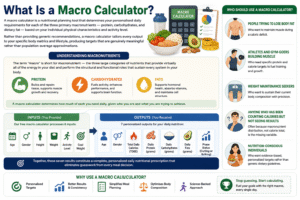
A macro calculator is a nutritional planning tool that determines your personalised daily requirements for each of the three primary macronutrients — protein, carbohydrates, and dietary fat — based on your individual physical characteristics and activity level. Rather than providing generic recommendations, a macro calculator tailors every output to your specific body metrics and lifestyle, producing targets that are genuinely meaningful rather than population-average approximations.
The term “macro” is short for macronutrient — the three large categories of nutrients that provide virtually all of the energy in your diet and perform the structural and functional roles that sustain every system in your body. Protein builds and repairs tissue. Carbohydrates fuel activity and brain function. Fats support hormonal health and cellular structure. A macro calculator determines how much of each you need daily, given who you are and what you are trying to achieve.
Our free macro calculator processes six inputs — age, gender, height, weight, activity level, and goal weight — and produces seven outputs: age, gender, total daily calories (TDEE), daily protein in grams, daily carbohydrates in grams, daily fats in grams, and a phase status (Cutting or Bulking). Together, these seven results constitute a complete, personalised daily nutritional prescription that eliminates guesswork from every meal decision.
Who should use a macro calculator?
- People trying to lose body fat who want to maintain muscle during a caloric deficit
- Athletes and gym-goers building muscle who need specific protein and calorie targets to fuel training and growth
- Weight maintenance seekers who want to sustain their current body composition with precision
- Anyone who has been counting calories but not seeing results — often because macronutrient distribution, not calorie total, is the missing variable
- Nutrition-conscious individuals who want evidence-based, personalised targets rather than generic dietary guidelines

Why Macros Matter More Than Calories Alone
The “calories in, calories out” model is true but incomplete. Understanding why macros matter beyond total calorie counts is essential for appreciating what a macro calculator provides and why it produces better results than simple calorie tracking.
Protein’s Unique Role: Protein cannot be stored in the way carbohydrates (as glycogen) and fat (in adipose tissue) can be stored. Dietary protein must be consumed consistently and in adequate amounts every day to meet ongoing demands for muscle repair, enzyme production, immune function, and hormone synthesis. A macro calculator ensures your protein target is set specifically for your body weight — not a generic recommendation that may be dramatically under or over your actual need.
The Thermic Effect of Food: Different macronutrients require different amounts of energy to digest. Protein has a thermic effect of 20% to 30% — meaning your body burns 20 to 30 calories of every 100 protein calories consumed simply processing it. Carbohydrates and fats have thermic effects of 5% to 10% and 0% to 3% respectively. By optimising your macro distribution through a macro calculator, you can effectively increase your metabolic rate without changing total calorie intake.
Body Composition, Not Just Weight: A caloric deficit without adequate protein leads to muscle loss alongside fat loss — reducing your metabolism and producing the “skinny fat” outcome that frustrates so many dieters. A macro calculator sets protein high enough to preserve lean mass during deficit, ensuring fat is the primary tissue lost rather than muscle.
Carbohydrate Management: Performance, mood, and energy levels are more sensitive to carbohydrate availability than to total calorie intake for most active individuals. Setting carbohydrate targets through a macro calculator ensures you have sufficient fuel for training sessions while maintaining a caloric balance appropriate for your goal.
The Three Macronutrients Explained
Our macro calculator allocates your total daily calories across three macronutrients, each with a distinct caloric density and physiological role:
Protein – 4 calories per gram: The structural macronutrient. Protein provides the amino acids needed for muscle protein synthesis, enzyme production, immune function, and hormonal signalling. For active individuals seeking to maintain or build lean mass, protein is the most critical macronutrient to get right — and it is the one most commonly under-consumed. Our macro calculator sets protein at 2 grams per kilogram of body weight — the upper end of the evidence-based range for maximising muscle protein synthesis.
Carbohydrates – 4 calories per gram: The performance macronutrient. Carbohydrates are the body’s preferred fuel source for high-intensity exercise, brain function, and glycogen storage. Our macro calculator allocates remaining calories (after protein and fat allocations) to carbohydrates — meaning carb intake flexes up or down based on total calorie needs, ensuring both performance fuel and caloric balance are maintained simultaneously.
Dietary Fat – 9 calories per gram: The hormonal and structural macronutrient. Dietary fats are essential for testosterone and oestrogen production, fat-soluble vitamin absorption (A, D, E, K), and cellular membrane integrity. Fat cannot be eliminated without hormonal consequences. Our macro calculator sets fat at 0.9 grams per kilogram of body weight — a level that supports hormonal health and essential fat-dependent functions.
How Our Macro Calculator Works – The Full Formula
Our macro calculator uses a two-stage calculation: first computing Total Daily Energy Expenditure (TDEE) from your personal metrics, then allocating that energy across the three macronutrients according to evidence-based target ratios.
Stage 1 – BMR Calculation (Mifflin-St Jeor Equation):
The Mifflin-St Jeor equation — the most accurate validated BMR formula for general use — computes your resting metabolic rate:
Males: BMR = (10 × Weight kg) + (6.25 × Height cm) − (5 × Age) + 5
Females: BMR = (10 × Weight kg) + (6.25 × Height cm) − (5 × Age) − 161
This gives the number of calories your body burns at complete rest — maintaining basic organ function, temperature regulation, and cellular processes.
Stage 2 – TDEE Calculation:
TDEE = BMR × Activity Multiplier
The activity multiplier scales your resting energy needs up to reflect actual daily energy expenditure including movement, exercise, and non-exercise activity. The TDEE is the total calorie target displayed in your macro calculator results.
Stage 3 – Macronutrient Allocation:
- Protein: Weight (kg) × 2 = daily protein grams. Calories from protein = protein grams × 4
- Fat: Weight (kg) × 0.9 = daily fat grams. Calories from fat = fat grams × 9
- Carbohydrates: Remaining calories after protein and fat = (TDEE − protein calories − fat calories) ÷ 4 = daily carbohydrate grams
This bottom-up allocation system — setting protein and fat first as fixed priorities, then allocating remaining calories to carbohydrates — ensures that the most critical macronutrients are always met regardless of total calorie level.
BMR and TDEE – The Energy Foundation
The Basal Metabolic Rate (BMR) and Total Daily Energy Expenditure (TDEE) are the two foundational energy concepts that underpin every macro calculator calculation.
BMR – Your Metabolic Floor: BMR is the number of calories your body needs to sustain life at complete rest — lying still, not digesting food, maintaining body temperature, keeping your heart beating and lungs breathing. It is your energy floor — you burn at least this many calories every day regardless of activity level. For most adults, BMR accounts for 60% to 70% of total daily energy expenditure.
BMR is primarily driven by lean body mass (muscle tissue is metabolically active; fat tissue is relatively inert) and is influenced by age (BMR declines approximately 1% to 2% per decade after 30) and gender (males typically have higher BMR due to greater lean mass). These variables are all captured in our macro calculator’s Mifflin-St Jeor formula.
TDEE – Your Real Daily Need: TDEE multiplies your BMR by an activity factor to account for the energy you actually expend moving, exercising, digesting food, and maintaining thermal regulation throughout the day. TDEE is the calorie target in your macro calculator — the amount of food energy needed to maintain your current weight at your current activity level.
Eating below TDEE creates a caloric deficit (fat loss context). Eating above TDEE creates a surplus (muscle gain context). Our macro calculator displays TDEE as the baseline; your phase status (Cutting or Bulking) tells you how your current weight compares to your goal, indicating whether adjusting intake up or down from TDEE is appropriate.
Activity Level – The Most Impactful Variable in Your Macro Calculator
Of all the inputs in the macro calculator, activity level has the greatest influence on TDEE — and therefore on carbohydrate allocation, which flexes to fill remaining calories. Here are the four activity multipliers:
Sedentary (Multiplier 1.2): Desk job, minimal structured exercise, predominantly sitting. At 1.2×, the macro calculator produces the lowest TDEE and the smallest carbohydrate allocation — appropriate for individuals with genuinely low daily energy expenditure.
Lightly Active (Multiplier 1.375): Light exercise 1 to 3 days per week — casual walks, recreational sport, light gym sessions. The macro calculator scales TDEE up modestly to reflect the additional energy demand of light regular activity.
Moderately Active (Multiplier 1.55): Exercise 3 to 5 days per week at moderate intensity — regular gym training, cycling, running, swimming. This is the most common activity level among individuals actively managing their fitness, and the macro calculator produces meaningfully elevated carbohydrate and calorie targets at this level.
Very Active (Multiplier 1.725): Exercise 6 to 7 days per week at high intensity, or physically demanding manual work. The macro calculator produces its highest TDEE and carbohydrate allocation at this multiplier — reflecting the substantial energy demands of near-daily intensive physical activity.
Choosing the correct activity level is critical. Overestimating your activity level causes the macro calculator to set a TDEE above your actual expenditure — producing a caloric surplus when you expect maintenance. Be honest and conservative — you can always increase later if you are losing weight faster than intended.
Understanding Your Seven Macro Calculator Results
Our macro calculator produces seven result points, each providing a specific piece of your personalised nutritional profile:
User Age: Confirms the age input used in the BMR calculation. Age directly affects the BMR formula — each year adds an adjustment that reflects the gradual metabolic rate decline that occurs from the late 20s onward.
Gender Type: Confirms whether the male or female BMR formula was applied. The formulas differ by a fixed offset (males +5; females −161) reflecting the systematic difference in lean mass and metabolic rate between sexes.
Total Calories (TDEE): Your complete daily energy expenditure — the caloric foundation of your nutrition plan. This is the number around which your macro calculator distributes macronutrients, and the benchmark against which you set your dietary surplus or deficit.
Daily Protein: Your protein target in grams — calculated at 2g per kg of body weight. This is the most critical result in your macro calculator — meet this target every day regardless of how other aspects of your diet flex.
Daily Carbohydrates: The grams of carbohydrates allocated from your remaining calories after protein and fat are accounted for. This number flexes with your activity level and total TDEE — higher activity means more remaining calories and therefore more carbohydrates.
Daily Fats: Your fat target in grams — calculated at 0.9g per kg of body weight. This ensures sufficient dietary fat for hormonal and cellular function regardless of your total calorie level.
Status (Cutting or Bulking): Compares your current weight to your goal weight. If current weight exceeds goal weight, the macro calculator displays “Cutting Phase” — indicating you should aim to eat below TDEE. If current weight is below goal weight, it displays “Bulking Phase” — indicating a surplus above TDEE is appropriate.
Cutting Phase vs. Bulking Phase – What Your Status Means
The phase status from the macro calculator is one of its most practically actionable outputs — contextualising your macro targets within your specific body composition goal:
Cutting Phase: When your current weight is above your goal weight, your macro calculator assigns Cutting Phase status. In a cut, the objective is to lose body fat while preserving as much lean muscle as possible. This is achieved by eating in a caloric deficit (typically 300 to 500 kcal below TDEE), maintaining high protein intake (to protect muscle during the deficit), and sustaining training intensity to send the muscle-preservation signal.
The macro calculator’s protein target of 2g/kg is especially important during cutting — research consistently shows that higher protein intake during deficit produces significantly better body composition outcomes than lower protein at the same caloric restriction.
Bulking Phase: When your current weight is below your goal weight, your macro calculator assigns Bulking Phase status. In a bulk, the objective is to build lean muscle mass, which requires both a caloric surplus and sufficient protein. Eating 300 to 500 kcal above TDEE provides the energy needed for muscle protein synthesis; the macro calculator’s protein target provides the raw material.
“Lean bulking” — maintaining a modest surplus of 200 to 300 kcal — produces the best ratio of muscle gain to fat gain and is the approach most evidence-based coaches recommend for natural athletes without extreme performance demands.
The Macronutrient Visual Meter Explained
Our macro calculator includes a colour-coded visual meter divided into three zones — Protein (green), Carbohydrates (amber), and Fats (red) — with a pointer that moves to indicate where your carbohydrate allocation sits within the overall distribution.
The meter provides an immediate visual reference for how your macronutrient distribution is balanced — a quick-glance confirmation that carbohydrate allocation is neither excessively low (which can impair training performance) nor unrealistically high (which may indicate an overly high activity multiplier).
The pointer moves based on your carbohydrate grams — calculated proportionally within the meter range. A pointer in the centre of the amber zone indicates a balanced, moderate carbohydrate allocation appropriate for most active adults. A pointer closer to the protein zone indicates a lower-carb, higher-protein distribution (common in aggressive cutting protocols); a pointer toward the fats zone indicates higher relative carbohydrate dominance (common in very high-activity or endurance-sport contexts).
Protein – Why It Is Set at 2g Per Kg
The protein target in our macro calculator — 2 grams per kilogram of body weight — is grounded in a comprehensive body of scientific research on muscle protein synthesis, body composition, and dietary protein requirements for active individuals.
The research basis:
- The American College of Sports Medicine recommends 1.6 to 2.2g/kg for individuals engaged in regular resistance training
- A 2017 meta-analysis (Morton et al., British Journal of Sports Medicine) identified 1.62g/kg as the protein intake beyond which additional protein produces no further muscle gain in resistance-trained individuals — but noted that 2.2g/kg provides a safety margin accounting for individual variability
- During caloric restriction, protein needs increase above maintenance levels because amino acids are diverted toward gluconeogenesis; 2.0 to 2.4g/kg is the recommended range during cutting phases
The 2g/kg target from our macro calculator sits at the upper-middle of the evidence-based range — high enough to maximise muscle protein synthesis and provide a generous safety margin, without being excessively high to the point of displacing necessary carbohydrates and fats from the diet.
Practical perspective: For a 75kg person, 2g/kg means 150 grams of protein per day — achievable through a combination of whole-food sources (meat, fish, eggs, dairy, legumes) and supplementation if needed. The macro calculator makes this target concrete and trackable.
Carbohydrates – The Flexible Fuel Macro
Carbohydrate allocation in our macro calculator is deliberately flexible — calculated as the remainder of calories after protein and fat allocations. This design reflects carbohydrates’ primary role as fuel rather than structural material: carbohydrate needs are activity-driven, and should scale up as training volume and intensity increase.
Why carbohydrates flex in the macro calculator:
When you increase your activity level input, TDEE rises but protein and fat targets remain anchored to body weight. All additional calories therefore flow into carbohydrates — appropriately, because the primary reason higher activity raises energy needs is the demand for glycogen replenishment and exercise fuel.
Carbohydrate intake and performance are closely linked:
- Low carbohydrate availability reduces high-intensity exercise performance, impairs concentration, causes irritability, and reduces training quality — all of which undermine the adaptation that makes the diet worthwhile
- Adequate carbohydrate availability maintains glycogen stores, sustains training quality, supports recovery, and preserves the anabolic hormonal environment needed for muscle maintenance and growth
Carbohydrate quality matters beyond quantity. Prioritise complex, fibre-rich sources — oats, rice, sweet potato, legumes, whole grain bread — over refined carbohydrates. The macro calculator gives you the gram target; food quality determines how well that target serves your health and performance.
Dietary Fats – Essential, Not Optional
Dietary fat targets in our macro calculator are set at 0.9 grams per kilogram of body weight — a level that ensures all essential fat-dependent physiological functions are supported while leaving the majority of calorie space for protein and carbohydrates.
Why fat cannot go to zero:
Fat-soluble vitamins (A, D, E, K) require dietary fat for absorption. Without adequate fat intake, these essential micronutrients pass through the digestive system without being absorbed — regardless of how much you consume in food or supplements.
Sex hormone production (testosterone, oestrogen, progesterone) depends on dietary cholesterol and fat as precursor molecules. Chronically low fat intake suppresses testosterone and oestrogen — reducing muscle-building capacity, impairing recovery, and disrupting menstrual function in women.
Cell membrane integrity: Every cell membrane in the body is a phospholipid bilayer. Dietary fat quality directly influences membrane fluidity, receptor function, and cellular signalling.
The 0.9g/kg target from the macro calculator is above the minimum required for hormonal health (approximately 0.5g/kg) but modest enough to leave ample calorie room for carbohydrates and protein — a balance that supports both health and performance.
Three Unit Systems – Metric, US, and Other
Our macro calculator supports three measurement unit systems to accommodate users across all regions:
Metric Units: Age in years, height in centimetres, weight in kilograms. The Mifflin-St Jeor formula works natively in metric units — no conversion required. The recommended default for the most straightforward calculation.
US Units: Height in inches and weight in pounds. The macro calculator converts these internally to metric (1 inch = 0.0254m; 1 pound = 0.453592 kg) before applying the formula — ensuring identical mathematical accuracy regardless of input unit.
Other Units: Height in centimetres and weight in stones (1 stone = 6.35029 kg). This hybrid system reflects the common UK and Irish convention of measuring height in metric but body weight in stones. The macro calculator converts stones to kilograms automatically before calculation.
All three systems produce the same results format — confirming the unit system used and displaying macro targets in grams rather than unit-dependent measurements.
How to Hit Your Macro Calculator Targets Every Day
Knowing your macro targets is the starting point — consistently hitting them is where results are produced. Here are the most effective practical strategies:
Track Daily with a Food App: Use MyFitnessPal, Cronometer, or a similar tracking app to log every meal. In the first 4 to 6 weeks of using your macro calculator targets, daily tracking builds the food knowledge and portion accuracy needed to eventually hit targets intuitively.
Protein First at Every Meal: Structure each meal around a protein anchor — chicken, fish, eggs, Greek yoghurt, cottage cheese, tofu, or a protein shake — before adding carbohydrates and fats. Starting with protein ensures the most critical macro calculator target is met even if total intake falls short on lower-appetite days.
Meal Prep for the Week: Prepare large batches of protein sources (grilled chicken, hard-boiled eggs, cooked legumes), complex carbohydrates (rice, sweet potato, oats), and healthy fats (avocado, olive oil, nuts) to have macro-balanced components readily available throughout the week.
Use the Macro Calculator’s Status as a Daily Prompt: The Cutting Phase or Bulking Phase status reminds you whether to aim slightly below or above your TDEE for the day. This phase context prevents the common mistake of eating at TDEE when you should be in a deficit, or restricting when you should be in a surplus.
Recalculate Regularly: Update your macro calculator inputs every 4 to 6 weeks as your weight changes. Since protein and fat targets are anchored to body weight, they shift as you lose or gain mass — keeping your macro targets current ensures continued accuracy as your body evolves.

Adjusting Your Macro Calculator for Different Goals
The macro calculator provides your maintenance baseline — adjusting caloric intake up or down around this baseline targets different body composition outcomes:
Fat Loss (Cutting): Eat 300 to 500 kcal below your macro calculator’s TDEE. Maintain protein at the full 2g/kg target — and if anything, increase slightly to 2.2g/kg to maximise muscle preservation during the deficit. Reduce carbohydrates first (rather than protein or fat) to create the deficit.
Muscle Gain (Bulking): Eat 200 to 400 kcal above your macro calculator’s TDEE. Maintain the protein and fat targets; add additional calories through carbohydrates. A lean bulk at 200 to 300 kcal surplus produces the most favourable muscle-to-fat gain ratio and avoids the excessive fat gain that comes from aggressive surplus approaches.
Body Recomposition (simultaneous fat loss and muscle gain): Eat at or near the macro calculator’s TDEE (maintenance). Body recomposition is most effective in beginners or individuals returning to training after a break — experienced, trained lifters typically need a distinct cutting or bulking phase to make progress. Maintain the protein target strictly — it is the critical variable in recomposition success.
Frequently Asked Questions (FAQs)
What is a macro calculator? A macro calculator is a nutritional tool that determines your personalised daily targets for protein, carbohydrates, and dietary fat based on your age, gender, height, weight, activity level, and goal weight.
How does the macro calculator calculate total calories? The macro calculator uses the Mifflin-St Jeor BMR formula to calculate your resting metabolic rate, then multiplies by your activity level multiplier to produce your Total Daily Energy Expenditure (TDEE) — your total calorie target.
Is the macro calculator free? Yes. Our macro calculator is completely free with no account or registration required. Enter your six inputs and receive seven personalised results instantly.
Why does the macro calculator set protein at 2g per kg? The 2g/kg protein target sits within the evidence-based range (1.6 to 2.2g/kg) validated by sports nutrition research for maximising muscle protein synthesis and preserving lean mass during caloric restriction. This level from the macro calculator is appropriate for active adults with body composition goals.
What is the difference between Cutting and Bulking Phase in the macro calculator? Cutting Phase means your current weight exceeds your goal weight — eat in a caloric deficit to lose fat. Bulking Phase means your current weight is below goal weight — eat in a caloric surplus to gain muscle. The macro calculator determines your phase by comparing current to goal weight.
How often should I recalculate using the macro calculator? Recalculate every 4 to 6 weeks or whenever your weight changes by 3 to 5 kg. Since the macro calculator’s protein and fat targets are weight-dependent, they become less accurate as your body weight changes, making regular recalculation important for continued precision.
Can women use the same macro calculator? Yes. The macro calculator applies the female-specific BMR formula (Mifflin-St Jeor with −161 offset) when Female is selected — producing appropriately adjusted results. The macronutrient allocation formulas apply equally to both sexes.
What if my carbohydrate target from the macro calculator is very low? If TDEE is low (sedentary lifestyle) and protein and fat allocations consume most available calories, carbohydrate allocation may be modest. In this case, prioritise increasing physical activity to raise TDEE and therefore carbohydrate space, rather than reducing protein or fat below their targets.
Does the macro calculator work for vegetarians and vegans? Yes. The macro calculator provides gram targets for each macronutrient — the food sources used to meet those targets are entirely up to the individual. Plant-based protein sources (tofu, tempeh, legumes, seitan, plant protein supplements) can fully meet the protein target.
How accurate is the macro calculator? The macro calculator is highly accurate for its inputs, using validated formulas. Population-level formula accuracy (Mifflin-St Jeor) is approximately ±10% for most individuals. The most common source of inaccuracy is an incorrect activity level input — choose conservatively and adjust based on observed results.
Conclusion
Nutrition without precision is guesswork. And guesswork rarely produces the consistent, measurable body composition changes that disciplined training and intentional eating deserve. A macro calculator transforms nutritional planning from subjective estimation into objective, personalised, data-driven practice — giving you exact daily targets for the three macronutrients that determine body composition, performance, recovery, and health.
Our free macro calculator processes your age, gender, height, weight, activity level, and goal weight through validated BMR and TDEE formulas and delivers seven clear results: your calorie target, daily protein grams, daily carbohydrates grams, daily fat grams, phase status, and unit system — together with a visual macronutrient meter that makes your distribution immediately visible.
Whether you are in a Cutting Phase working toward a leaner physique, a Bulking Phase building lean muscle mass, or a maintenance phase sustaining hard-won body composition, the macro calculator provides the precise nutritional foundation that makes your efforts count. It removes the largest variable in most people’s nutrition plans — not knowing what to eat — and replaces it with clear, personalised, actionable daily targets.
Use our macro calculator today. Know your numbers. Hit your targets. Transform your body composition.