| Year | Invested Capital | Gains Earned | End Balance |
|---|
| Year | Initial Principal | Interest Earned | Gross End Balance |
|---|
| Year | Capital Contributed | Capital Appreciation | Net Portfolio Value |
|---|
| Year | Asset Appreciation | Cumulative Net Rent | Total Asset Worth |
|---|
| Year | Principal Value | Annual Cash Yield | Cumulative Return |
|---|
Find out how much you need to retire comfortably with our smart Retirement Calculator
Table of Contents
- Introduction
- What Is an Investment Calculator?
- Why Every Investor Needs an Investment Calculator
- How an Investment Calculator Works
- Mutual Funds Growth Forecasting
- Lump-Sum Investment Planning
- Stocks and Crypto Investment Projections
- Real Estate Investment Analysis
- Fixed Income Investment Planning
- How to Use an Investment Calculator Effectively
- Key Investment Terms You Must Understand
- Expert Strategies to Maximize Your Investment Returns
- Common Investment Mistakes to Avoid
- The Power of Starting Early
- FAQs
- Conclusion
Introduction
Making your money work for you is the foundation of financial independence. Yet millions of people save diligently for years without ever truly understanding whether their money is growing fast enough to meet their goals. An Investment Calculator is the most powerful free tool available to bridge that gap. It gives you instant, data-driven projections of how your investments will grow across mutual funds, lump-sum investments, stocks, crypto, real estate, and fixed-income instruments. In this comprehensive guide, we will cover everything you need to know — how an Investment Calculator works, which investment types it covers, how to use it effectively, and the smartest strategies to maximize your returns. Whether you are a first-time investor or a seasoned portfolio builder, this guide will transform the way you think about growing your wealth.
What Is an Investment Calculator?
An Investment Calculator is a digital financial tool that allows individuals to estimate the future value of their investments based on inputs such as initial capital, regular contributions, expected rate of return, contribution frequency, and investment duration. It uses compound growth formulas and time-value-of-money principles to generate accurate projections of how wealth accumulates over time.
Unlike vague financial advice or rough guesses, an Investment Calculator delivers precise, scenario-specific projections that reflect the actual mechanics of how different investment types grow. Whether you are investing in mutual funds with monthly SIPs, making a one-time lump-sum deposit, buying stocks or cryptocurrency, investing in rental property, or locking money into fixed-income instruments — a dedicated Investment Calculator gives you a customized projection for each situation.
What makes a high-quality Investment Calculator stand out is its versatility. A single tool that covers all major investment categories eliminates the need to use five different calculators and then try to make sense of conflicting results. Everything you need is in one place, producing consistent and comparable outputs.
At its core, every Investment Calculator answers three essential questions:
- How much will my investment be worth at the end of my investment horizon?
- How much of my final wealth comes from my own contributions versus compound growth?
- Am I on track to reach my specific financial goal?


Why Every Investor Needs an Investment Calculator
Most people begin investing with good intentions but without a clear roadmap. They know saving is important, but they rarely quantify exactly how much their savings will generate over 10, 20, or 30 years. This lack of clarity leads to underinvesting, poor asset allocation, and missed financial goals.
An Investment Calculator solves this problem directly. Here is why using one is essential for every type of investor:
- Eliminates financial guesswork: Instead of hoping your investments will “be enough,” an Investment Calculator shows you exactly what your money will grow to under different scenarios.
- Motivates consistent investing: Seeing the dramatic difference between investing $200/month versus $300/month over 15 years provides powerful motivation to increase contributions.
- Enables smart comparison: You can compare the projected returns of mutual funds versus fixed deposits versus real estate side by side — something nearly impossible to do accurately without a calculator.
- Reveals the true cost of delay: An Investment Calculator makes it painfully clear how much wealth you lose by delaying investment by even one or two years.
- Supports goal-based investing: Whether your goal is a child’s education, a home purchase, or financial independence, an Investment Calculator tells you exactly what monthly investment is required to get there.
The investor who runs the numbers regularly will always outperform the investor who relies on instinct. An Investment Calculator is the tool that makes that possible.
How an Investment Calculator Works
Understanding the mathematics behind an Investment Calculator helps you use it more confidently and interpret results more accurately. The tool is built on one of the most powerful forces in finance: compound interest.
Compound interest means your investment earns returns not just on your initial principal but also on all previously accumulated returns. This creates an exponential growth curve that becomes increasingly powerful as time passes. The longer your money stays invested, the faster it grows — and the greater the share of your final wealth that comes from returns rather than your own contributions.
The fundamental formula used in most Investment Calculator modules is the Future Value formula:
FV = P × (1 + r/n)^(n×t) + PMT × [((1 + r/n)^(n×t) − 1) / (r/n)]
Where:
- FV = Future Value (your investment at the end of the period)
- P = Principal (your initial investment)
- r = Annual interest rate (as a decimal)
- n = Number of compounding periods per year
- t = Number of years
- PMT = Regular contribution per period
An Investment Calculator runs this formula instantly for any inputs you provide. The result is a complete projection of your investment’s growth — including a year-by-year table that shows your total deposited capital, total wealth gains, and ending balance at every stage.
Mutual Funds Growth Forecasting
Mutual funds are among the most popular investment vehicles for everyday investors, and for good reason — they offer diversification, professional management, and historically strong long-term returns. The mutual funds module of an Investment Calculator is specifically designed to model the SIP (Systematic Investment Plan) and lump-seed growth patterns typical of mutual fund investing.
You enter your initial lump seed amount, your regular contribution, the contribution frequency (monthly, quarterly, weekly, etc.), your expected CAGR (Compound Annual Growth Rate), and your investment horizon in years. The Investment Calculator then produces a full accumulation report showing your total capital deposited versus your total wealth gains — along with a visual bar graph that makes the power of compounding immediately visible.
For example: An investor who starts with $5,000 and contributes $200 per month at a 12% CAGR over 10 years will accumulate approximately $50,000+ in total wealth — of which only around $29,000 represents actual deposits. The rest is pure compound growth.
Key insight for mutual fund investors: The contribution frequency matters significantly. Weekly or semi-monthly contributions tend to generate slightly higher returns than monthly contributions at the same annual rate, because more frequent deposits mean more compounding cycles.
Lump-Sum Investment Planning
A lump-sum investment is when you deploy a large amount of capital all at once, rather than spreading contributions over time. This strategy is common when an investor receives a bonus, inheritance, property sale proceeds, or any other large cash windfall. The lump-sum module of an Investment Calculator is essential for modeling how a one-time investment will grow over time.
The mechanics are straightforward: you enter your initial investment amount, your expected annual return rate, and your investment duration. The Investment Calculator applies the compound growth formula and shows you the projected final value, the total gain in dollar terms, and a year-by-year breakdown of your balance.
Lump-sum investing has a powerful advantage over periodic contributions: every dollar is invested and compounding from day one. There is no dollar sitting in a bank account waiting to be deployed. This makes lump-sum investing particularly powerful in strong bull markets.
However, it also comes with timing risk — if markets drop shortly after you invest, your portfolio can suffer significant short-term losses. This is why using an Investment Calculator with conservative, realistic, and optimistic return scenarios is critical before committing a large lump sum.

Stocks and Crypto Investment Projections
Stocks and cryptocurrencies represent the highest-risk, highest-potential-reward segment of any investment portfolio. The volatility of these assets makes projection more complex — but no less important. The stocks and crypto module of an Investment Calculator helps you model growth scenarios based on your expected CAGR, while making the risk-reward tradeoff explicit.
Critical considerations when using an Investment Calculator for stocks and crypto:
- Use multiple return scenarios. Unlike bonds or fixed deposits, stock and crypto returns are highly variable. Run projections at 5%, 10%, 15%, and 20% to understand the full range of possible outcomes.
- Account for volatility drag. In volatile asset classes, the average return overstates actual compound growth. A proper Investment Calculator helps you understand the difference between arithmetic and geometric mean returns.
- Do not extrapolate recent performance. The fact that a cryptocurrency returned 300% last year does not mean it will return 300% next year. Use conservative, long-term average estimates in your Investment Calculator to avoid dangerous overconfidence.
- Factor in taxes on gains. Short-term capital gains from stocks and crypto are taxed differently than long-term gains. Adjust your net expected return accordingly before entering it into the calculator.
Despite the complexity, running the numbers through an Investment Calculator before allocating capital to stocks or crypto is non-negotiable for responsible investors.
Real Estate Investment Analysis
Real estate is a unique asset class because it generates returns through two channels simultaneously: property appreciation and rental income. The real estate module of an Investment Calculator captures both dimensions, giving you a holistic view of your total investment return.
You enter your property purchase price, your down payment, your expected annual appreciation rate, your monthly rental income, and your estimated annual expenses (maintenance, taxes, insurance). The Investment Calculator then projects your total equity growth, cumulative rental income, and overall return on investment across your chosen holding period.
Real estate investing is often misunderstood because investors focus only on one return channel. A property that appreciates modestly but generates strong rental yield can outperform a high-appreciation property with poor rental income. An Investment Calculator that models both makes this comparison transparent and quantitative.
Key real estate investment metrics to track:
- Total Equity Buildup: Property value appreciation minus remaining mortgage balance
- Gross Rental Yield: Annual rental income divided by property purchase price
- Cash-on-Cash Return: Annual pre-tax cash flow divided by total cash invested
- Total Return on Investment: Combined appreciation gains plus net rental income, divided by total investment
Fixed Income Investment Planning
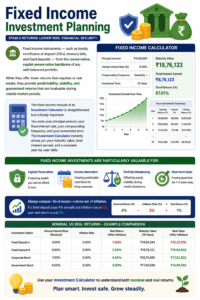
Fixed income instruments — such as bonds, certificates of deposit (CDs), treasury bills, and fixed deposits — form the conservative, capital-preservation backbone of any well-balanced portfolio. While they offer lower returns than equities or real estate, they provide predictability, stability, and guaranteed returns that are invaluable during volatile market periods.
The fixed income module of an Investment Calculator is straightforward but critically important. You enter your principal amount, your fixed interest rate, your compounding frequency, and your investment term. The Investment Calculator instantly shows you your maturity value, total interest earned, and a complete year-by-year table.
Fixed income investments are particularly valuable for:
- Capital preservation: Protecting wealth you cannot afford to lose
- Income generation: Creating predictable cash flows for living expenses
- Portfolio rebalancing: Offsetting equity volatility during market downturns
- Short-term goals: Funding goals that are 1–3 years away
Always compare fixed income returns net of inflation. If a fixed deposit pays 4% annually but inflation runs at 3%, your real return is only 1%. Use your Investment Calculator to understand both nominal and real returns.
How to Use an Investment Calculator Effectively
Getting maximum value from an Investment Calculator requires a strategic approach. Here is a step-by-step framework:
Use honest, accurate inputs. The quality of your results depends entirely on the quality of your inputs. Use your actual current savings, realistic contribution amounts, and honest expected return rates.
Always run three scenarios. For every investment type, run calculations using a conservative return rate (e.g., 5–6%), a realistic return rate (e.g., 8–10%), and an optimistic return rate (e.g., 12–15%). This gives you a proper range of outcomes rather than a single point estimate.
Study the year-by-year table. Do not just focus on the final projected value. The annual breakdown reveals critical patterns — particularly the point at which investment gains begin to exceed your own contributions. This crossover point is one of the most motivating milestones in long-term investing.
Compare investment types side by side. Use the different modules to run equivalent projections for mutual funds, lump-sum, and fixed income with the same capital. This head-to-head comparison reveals which allocation strategy is most likely to meet your goals.
Update your inputs regularly. Markets change, your income grows, and your goals evolve. Revisit your Investment Calculator at least once every six months to ensure your projections remain accurate and your plan remains relevant.
Use the calculator to set contribution targets. Instead of deciding how much to invest based on what feels comfortable, decide how much you need to invest to reach your goal — and use the Investment Calculator to work backward from the target to the required monthly contribution.
Key Investment Terms You Must Understand
Before using any Investment Calculator to its full potential, you must be comfortable with the following terms:
CAGR (Compound Annual Growth Rate): The annualized rate at which an investment grows, accounting for compounding. This is the most important single input in any Investment Calculator.
Principal: Your initial investment amount. The base from which all compound growth begins.
Investment Horizon: The total number of years you plan to stay invested. Longer horizons generate exponentially larger returns due to compound growth.
Contribution Frequency: How often you add new money to your investment. More frequent contributions (weekly vs. monthly) generate modestly higher returns at the same annual rate.
Wealth Gains: The total return generated by your investment beyond your original principal and contributions. In a well-constructed portfolio over a long horizon, wealth gains should significantly exceed total contributions.
Net Return: Your gross investment return minus inflation, taxes, and fees. This is the number that actually reflects your real purchasing power growth.
Expert Strategies to Maximize Your Investment Returns
The projections produced by your Investment Calculator are only achievable if you follow disciplined investment practices. Here are the strategies that top investors use:
Every investment should be tied to a specific financial goal — retirement at 55, a child’s college education in 18 years, a down payment in 5 years. Enter that goal into your Investment Calculator and work backward to determine the required monthly contribution. Goal-based investing produces dramatically better outcomes than vague, undirected saving.
Never concentrate all your capital in a single investment type. A balanced portfolio across mutual funds, equities, real estate, and fixed income reduces overall risk while maintaining strong growth potential. Use each module of your Investment Calculator to model your target allocation and ensure the blended return meets your requirements.
Never withdraw investment returns prematurely. The power of compounding depends on returns being reinvested and generating their own returns. Even a single large withdrawal resets the compounding clock significantly. Run a comparison in your Investment Calculator between a reinvestment strategy and a withdrawal strategy — the difference over 20 years will be staggering.
Every 1% in annual fees reduces your ending balance by 20–25% over a 30-year investment horizon. Low-cost index funds and ETFs consistently outperform higher-fee actively managed funds on an after-cost basis. Always factor fees into the return rate you enter into your Investment Calculator.
As different asset classes grow at different rates, your portfolio allocation drifts from its target. Annual rebalancing restores your target allocation and systematically enforces the discipline of selling high and buying low. Use your Investment Calculator to model the impact of rebalancing versus letting allocations drift.
Common Investment Mistakes to Avoid
Even experienced investors make costly errors. Being aware of these pitfalls dramatically reduces the chance of making them:
Investing without a plan: Randomly allocating money without a strategy is the most common and costly mistake. Always define your goal, time horizon, and acceptable risk level before investing a single dollar.
Chasing past performance: Last year’s best-performing mutual fund or hottest stock is rarely next year’s winner. Use your Investment Calculator with realistic long-term average returns rather than extrapolating recent exceptional performance.
Panic selling during downturns: Markets will always experience downturns. Investors who sell during market crashes lock in losses and miss the recovery. Stay invested, stay diversified, and revisit your Investment Calculator to confirm your long-term plan is still intact.
Ignoring inflation: A 6% nominal return becomes a 3% real return after inflation. Always think in real returns, not nominal returns, and use your Investment Calculator to model inflation-adjusted projections.
Over-concentrating in familiar assets: Many investors over-allocate to their employer’s stock, their home country’s market, or assets they understand emotionally. Diversification is the only free lunch in investing — use your Investment Calculator to ensure your portfolio is truly diversified.
Delaying the start: There is no investment mistake more costly than waiting to start. Even a one-year delay in beginning your investment plan can cost you tens of thousands of dollars in long-term returns. Enter your current numbers into an Investment Calculator right now — do not wait another day.
The Power of Starting Early
The single most impactful variable in any Investment Calculator is not the return rate or the contribution amount — it is time. The mathematics of compound interest reward early starters with wealth that late starters simply cannot replicate through higher contributions alone.
Consider this powerful comparison:
Investor A begins investing at age 23, contributing $300/month at a 9% annual return. By age 60, they accumulate approximately $1,180,000.
Investor B waits until age 33, then contributes $600/month at the same 9% return. By age 60, they accumulate approximately $900,000 — despite depositing twice as much per month.
Investor A accumulates $280,000 more — while contributing half as much. The only difference is a 10-year head start. Verify this yourself by entering both scenarios into an Investment Calculator — the results are genuinely striking.
The compounding advantage of early investing creates three additional benefits:
- Lower monthly burden: Early investors reach the same wealth target with smaller contributions, freeing cash flow for other goals.
- Greater financial flexibility: Reaching your target number sooner opens the option of retiring early, working part-time, or pursuing passion projects.
- Reduced financial anxiety: Knowing your investment plan is solidly on track — confirmed by your Investment Calculator — provides a level of peace and confidence that money cannot buy after the fact.
The best time to start investing was yesterday. The second-best time is right now.
Frequently Asked Questions
1. What does this calculator do?
It helps estimate how different types of investments may grow over time based on inputs like amount, duration, and return rate.
2. Can I use it for different types of investments?
Yes, it includes multiple sections for different financial scenarios such as savings growth, one-time investments, and asset-based planning.
3. Is the calculation exact or estimated?
The results are estimates based on mathematical models. Real-world outcomes may vary due to market changes and other factors.
4. Do I need financial knowledge to use it?
No, it is designed to be simple and user-friendly, so anyone can use it without technical knowledge.
5. Can I change values and see instant results?
Yes, you can adjust inputs and recalculate to see updated projections immediately.
6. Does it consider taxes or fees?
Some sections allow optional inputs for deductions, but overall results are still simplified projections.
7. Is my data stored anywhere?
No, all calculations happen in your browser and nothing is saved or sent anywhere.
8. Can I use it on mobile devices?
Yes, the layout is responsive and works on phones, tablets, and desktops.
9. Why do results differ from real financial returns?
Because real markets fluctuate, while this tool uses fixed mathematical assumptions for projections.
10. Can I reset everything and start again?
Yes, each section includes a clear option to reset all inputs instantly.
Conclusion
Investing is not a mystery reserved for the wealthy or the financially sophisticated. It is a disciplined, systematic process that anyone can master — and an Investment Calculator is the tool that makes it accessible, transparent, and actionable for everyone.
Whether you are allocating capital to mutual funds, making a strategic lump-sum investment, building a stock and crypto portfolio, purchasing rental property, or locking in fixed-income returns — the same principle applies: run the numbers before you commit. An Investment Calculator gives you the clarity to invest with confidence, the insight to compare options intelligently, and the motivation to stay consistent over the long term.
Use it every time you consider a new investment. Use it when your income changes. Use it when markets shift. Let the data guide your decisions, not emotion or guesswork. The gap between investors who build lasting wealth and those who struggle financially often comes down to one simple habit: the habit of knowing their numbers.
Your financial future is built one smart investment decision at a time. Start with an Investment Calculator, build a plan rooted in data, and commit to executing that plan with discipline and patience. The wealth you want is entirely achievable — and it starts the moment you decide to take it seriously.