| Period | Payment | Interest | Remaining |
|---|
Your quick solution for fast, accurate, and real-time Currency Calculator
Table of Contents
- Introduction
- What Is a Loan Calculator?
- How Does a Loan Calculator Work?
- Types of Loans You Can Calculate
- Key Terms You Must Know
- Simple Interest Loan Calculation Explained
- Amortization Loan Calculation Explained
- Auto Loan Calculation Explained
- Understanding Maximum Loan Capacity
- Benefits of Using a Loan Calculator
- Tips for Getting the Best Loan Deal
- Common Mistakes to Avoid When Borrowing
- Frequently Asked Questions
- Conclusion
Introduction
Whether you are planning to buy a car, fund your education, renovate your home, or handle an emergency expense, taking a loan is often a part of life. But before you sign any agreement with a lender, it is absolutely essential to understand exactly how much you will be paying back — and that is where a Loan Calculator becomes your most powerful financial tool. A Loan Calculator helps you estimate your monthly payments, understand the total interest you will pay over the life of the loan, and compare different borrowing options side by side. In this comprehensive guide, we will walk you through everything you need to know about using a Loan Calculator effectively — from understanding the basic inputs to reading an amortization schedule. By the end of this article, you will be fully equipped to make smarter, more confident borrowing decisions.
What Is a Loan Calculator?
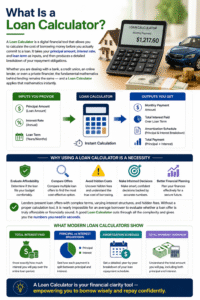
A Loan Calculator is a digital financial tool that allows you to calculate the cost of borrowing money before you actually commit to a loan. It takes your principal amount, interest rate, and loan term as inputs, and then produces a detailed breakdown of your repayment obligations. Whether you are dealing with a bank, a credit union, an online lender, or even a private financier, the fundamental mathematics behind lending remains the same — and a Loan Calculator applies that mathematics instantly.
In today’s financial landscape, using a reliable Loan Calculator is not just a convenience — it is a necessity. Lenders present loan offers with complex terms, varying interest structures, and hidden fees. Without a proper calculation tool, it is nearly impossible for an average borrower to evaluate whether a loan offer is truly affordable or financially sound. A good Loan Calculator cuts through all the complexity and gives you the numbers you need in seconds.
Modern calculators go beyond just monthly payment estimates. They show you the total interest paid over the entire loan period, the split between principal and interest in each payment, and a full amortization schedule — all of which are incredibly valuable for financial planning.
How Does a Loan Calculator Work?
At its core, a Loan Calculator uses established mathematical formulas to determine repayment figures. The three primary inputs that drive every loan calculation are:
- Principal Amount: The total sum of money you are borrowing.
- Interest Rate (APR): The annual percentage rate charged by the lender for providing the loan.
- Loan Term: The total duration over which you agree to repay the loan — expressed in years or months.
Once these values are entered, the calculator applies the appropriate formula. For a standard amortizing loan, the formula determines a fixed monthly payment (EMI — Equated Monthly Installment) such that by the end of the loan term, both the principal and all accrued interest are fully paid off. The calculator also displays how much of each payment goes toward the principal and how much goes toward interest — a concept known as loan amortization.
Additionally, modern versions of the Loan Calculator support multiple repayment frequencies — monthly, bi-weekly, weekly, quarterly, and more. This flexibility is important because different repayment frequencies affect the total interest paid. For example, switching from monthly to bi-weekly payments can meaningfully reduce the total interest cost on a long-term loan.
Important: The Annual Percentage Rate (APR) used in a Loan Calculator may or may not include fees depending on the lender. Always clarify with your lender whether the APR shown is the true all-in cost or just the base interest rate.
Types of Loans You Can Calculate
A well-built Loan Calculator handles multiple types of loan products. Understanding the type of loan you are applying for is the first step toward an accurate calculation. Here are the most common loan types supported:
| Loan Type | Best For | Key Feature |
|---|---|---|
| Simple Interest Loan | Short-term personal loans | Interest calculated only on principal |
| Amortization Loan | Mortgages, long-term loans | Fixed payments; interest-heavy at start |
| Auto Loan | Vehicle financing | Accounts for trade-in and down payment |
| Max Loan Capacity | Pre-qualification planning | Tells you max loan based on your budget |
Each of these loan types has its own structure, and a Loan Calculator tailored to each type will give you the most precise results. Never try to use a simple interest calculator for an amortizing loan — the results will be completely wrong.
Key Terms You Must Know
Before you start using any Loan Calculator, it helps to be familiar with the following terms. Understanding these concepts will make your calculations far more meaningful:
The original loan amount you borrow. This is the base on which interest is calculated. Every payment you make reduces the outstanding principal balance.
APR is the yearly cost of borrowing money, expressed as a percentage. A lower APR means less interest paid over time. When comparing loan offers, always compare APRs — not just monthly payments.
The length of time you have to repay the loan. Longer terms mean lower monthly payments but significantly more total interest paid. Shorter terms cost more per month but save money overall.
The fixed amount you pay each month toward your loan. It includes a portion of principal repayment and a portion of interest payment. As the loan matures, the interest portion decreases and the principal portion increases.
A complete table showing each payment over the entire loan term. It details how much of each payment goes to principal versus interest, and what the remaining balance is after each payment.
An upfront payment made at the time of borrowing — especially common in auto and home loans. A larger down payment reduces the loan principal, which in turn reduces your monthly payment and total interest.
Simple Interest Loan Calculation Explained
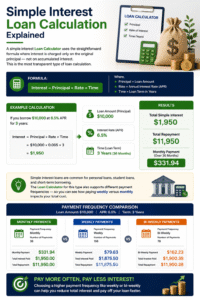
A simple interest Loan Calculator uses the straightforward formula where interest is charged only on the original principal — not on accumulated interest. This is the most transparent type of loan calculation.
Formula: Interest = Principal × Rate × Time
For example, if you borrow $10,000 at 6.5% APR for 3 years, the total simple interest would be:
$10,000 × 0.065 × 3 = $1,950
Your total repayment would be $11,950, and if repaid monthly over 36 months, your monthly payment would be approximately $331.94.
Simple interest loans are common for personal loans, student loans, and short-term borrowing. The Loan Calculator for this type also supports different payment frequencies — so you can see how paying weekly versus monthly impacts your total cost.
Amortization Loan Calculation Explained
An amortization Loan Calculator is used for loans where the payments are fixed but the internal split between principal and interest changes with each payment. This is the most common structure for mortgages, car loans, and installment loans.
In the early months of an amortizing loan, the majority of your payment goes toward interest. As the principal reduces with each payment, more and more of your payment begins going toward the actual principal balance. By the final payment, almost all of it is principal.
The formula used is:
M = P × [r(1+r)^n] / [(1+r)^n – 1]
Where: M = Monthly Payment, P = Principal, r = Monthly Interest Rate, n = Number of Payments
For instance, a $25,000 loan at 7.2% APR over 5 years would generate a monthly payment of approximately $497.63. Over 60 months, you would pay a total of $29,857.80 — meaning $4,857.80 in interest.
The amortization schedule provided by the Loan Calculator is especially useful here, as it shows you exactly where your money is going with each payment.
Auto Loan Calculation Explained
Buying a vehicle is one of the most common reasons people use a Loan Calculator. An auto loan calculation accounts for additional factors specific to vehicle financing, including:
- Vehicle Price: The total cost of the car you want to purchase.
- Down Payment: The amount you pay upfront at the dealership.
- Trade-In Value: The value of your existing vehicle that reduces the financed amount.
- Sales Tax: Tax levied on the vehicle purchase.
- Fees: Registration, documentation, and dealer fees.
- Loan Term and Interest Rate: Standard inputs for any loan calculation.
After deducting your down payment and trade-in value from the vehicle price and adding applicable taxes and fees, the calculator determines your actual financed amount. It then applies the amortization formula to produce your monthly payment.
For example, if a car costs $30,000, you put down $5,000, your trade-in is worth $3,000, and the APR is 5.9% over 60 months, your financed amount would be $22,000, and your monthly payment would be approximately $424.
Using a Loan Calculator before visiting a dealership puts you in a much stronger negotiating position — you know exactly what monthly payment is realistic for your budget.
Understanding Maximum Loan Capacity
One of the most powerful features of a smart Loan Calculator is the ability to calculate your maximum loan capacity — the largest loan amount you can afford given your budget, interest rate, and desired term.
Instead of entering a loan amount and calculating a payment, you enter the maximum monthly payment you can afford, and the calculator works backwards to tell you the maximum loan size.
This feature is extremely useful for:
- Home buyers who want to know how much mortgage they qualify for based on their income.
- Car shoppers who want to stay within a specific monthly budget.
- Business owners planning to take a commercial loan and managing cash flow.
Example: If you can afford $500 per month, the interest rate is 6%, and the term is 5 years, the maximum loan capacity calculator will tell you that you can borrow approximately $25,862.
Knowing your capacity before you apply also helps you avoid over-borrowing — one of the most common financial mistakes borrowers make.
Benefits of Using a Loan Calculator
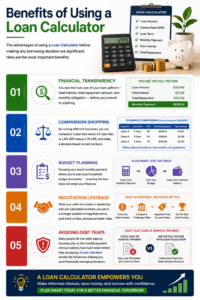
The advantages of using a Loan Calculator before making any borrowing decision are significant. Here are the most important benefits:
You see the true cost of your loan upfront — total interest, total repayment amount, and monthly obligation — before you commit to anything.
By running different scenarios, you can compare a 3-year loan versus a 5-year loan, or a 6% APR versus a 7% APR, and make a decision based on real numbers.
Knowing your exact monthly payment allows you to plan your household budget accurately — ensuring the loan does not strain your finances.
When you walk into a bank or dealership with pre-calculated numbers, you are in a stronger position to negotiate terms, push back on fees, and secure better rates.
Many people fall into debt traps by focusing only on the monthly payment without realizing how much total interest they are paying. A Loan Calculator reveals the full picture, helping you avoid financially damaging decisions.
Tips for Getting the Best Loan Deal
Using a Loan Calculator is just the starting point. Here are proven strategies to secure the best possible loan terms:
- Improve Your Credit Score First: A higher credit score translates directly into a lower interest rate. Even a 0.5% reduction in APR saves hundreds of dollars over a multi-year loan.
- Make a Larger Down Payment: Reducing the principal you borrow reduces your monthly payment and total interest.
- Choose a Shorter Loan Term: While this increases your monthly payment, it significantly reduces total interest paid.
- Compare Multiple Lenders: Never accept the first offer. Get quotes from at least 3–4 lenders and compare apples-to-apples.
- Avoid Unnecessary Add-Ons: Extended warranties, gap insurance, and credit life insurance often get rolled into loans, inflating both the principal and your payments.
- Consider Making Extra Payments: Even one extra payment per year on an amortizing loan can shave months off the term and save significant interest.
Common Mistakes to Avoid When Borrowing
Many borrowers make avoidable mistakes that cost them thousands of dollars. Being aware of these pitfalls can protect your financial health:
Lenders sometimes advertise an attractively low monthly payment by simply extending the loan term — which means you pay far more in total interest. Always check the total repayment cost, not just the monthly figure.
Prepayment penalties, origination fees, and variable rate clauses can dramatically change the true cost of a loan. Always read the full loan agreement.
Just because a lender approves you for a large amount does not mean you should take it all. Borrow only what you need and can comfortably repay.
The amortization schedule is one of the most informative outputs of any calculation — yet many borrowers never look at it. It reveals the true cost structure of your loan over time.
Your Debt-to-Income (DTI) ratio — total monthly debt payments divided by gross monthly income — should ideally stay below 36%. A high DTI signals over-leveraging and makes future borrowing more expensive.
Frequently Asked Questions
A Loan Calculator is highly accurate for standard loan products when you input correct values. However, actual loan offers may include additional fees, taxes, or insurance that are not always reflected in basic calculations. Always verify final figures with your lender.
Simple interest is calculated only on the original principal, while amortized interest is calculated on the outstanding balance after each payment. In practice, most long-term loans use amortization.
Extending the loan term lowers your monthly payment but increases total interest paid. Shortening the term raises the monthly payment but saves money over the life of the loan — the calculator makes it easy to compare these trade-offs instantly.
Absolutely. You can compare your current loan’s remaining cost against the projected cost of a refinanced loan — helping you determine whether refinancing actually saves money after accounting for closing costs and fees.
Bi-weekly payments are often the most cost-effective frequency for long-term loans because they result in one extra full payment per year — reducing both the term and total interest.
Conclusion
Managing debt wisely is one of the most important financial skills you can develop — and a Loan Calculator is the single most practical tool to help you do that. Whether you are taking out a simple personal loan, financing a new car, planning a major home renovation, or trying to determine how much you can realistically borrow, the Loan Calculator puts the power of informed decision-making in your hands.
We have covered the fundamentals of how a Loan Calculator works, the different types of loans it supports, key financial terms you need to understand, and smart strategies for getting the best loan deal possible. The most important takeaway is this: never borrow blind. Before signing any loan agreement, run the numbers, understand the total repayment cost, and make sure the payments comfortably fit within your budget.
Use the Loan Calculator above — it is free, fast, and designed to give you complete financial clarity on any borrowing decision. Take control of your financial future by understanding exactly what you owe before you commit to anything.