Currency Pair Rate (1 USD) Converted Value
Find your exact discount and final price instantly using our Percent Off Calculator
Table of Contents
- Introduction
- How Currency Exchange Works
- What Is an Exchange Currency Converter?
- How Exchange Rates Are Determined
- How to Use an Exchange Currency Converter Step by Step
- Understanding Markup Fees and Hidden Costs
- The World’s Most Traded Currencies
- Major Currency Pairs Explained
- Exchange Currency Converter for Travelers
- Exchange Currency Converter for Businesses
- Real-Life Conversion Examples
- Benefits of Using an Exchange Currency Converter
- How to Get the Best Exchange Rate
- Common Currency Conversion Mistakes
- Frequently Asked Questions
- Conclusion
Introduction
Whether you are booking an international flight, sending money to family abroad, comparing prices on a foreign e-commerce website, or planning a business transaction across borders — the single most important tool you need is a fast, reliable Exchange Currency Converter. Without it, you are left guessing at exchange rates, risking costly miscalculations, and potentially losing significant money on unfavorable conversions.
An Exchange Currency Converter does more than just multiply one number by another. It gives you real-time rates, shows you how markup fees affect your final amount, and lets you compare values across dozens of global currencies simultaneously. In a world where global commerce is the norm, this tool is no longer a luxury — it is a necessity.
In this comprehensive guide, you will learn how currency exchange works, how to use our tool step by step, how to understand and avoid hidden conversion fees, which currencies are most traded globally, how exchange rates are determined, and how smart travelers and businesses use a reliable Exchange Currency Converter to protect their money every day.
By the time you finish reading, you will have a complete understanding of global currency conversion — and the confidence to make every international transaction with clarity and control.
How Currency Exchange Works
Currency exchange is the process of converting one country’s currency into another at an agreed rate called the exchange rate. Every country (or economic union) issues its own currency, and when money moves between countries — through trade, travel, remittances, or investment — it must be converted at the prevailing market rate.
The foreign exchange market, commonly known as Forex, is the largest financial market in the world. With over $7 trillion traded every single day, it operates 24 hours a day, five days a week, across financial centers in New York, London, Tokyo, Sydney, and dozens of other cities.
Key Participants in the Currency Market:
- Central banks — set monetary policy and influence exchange rates through interest rate decisions and interventions
- Commercial banks — facilitate currency conversion for businesses and individuals, often adding a markup fee
- Forex brokers — provide retail traders access to the currency market
- Multinational corporations — convert currencies when receiving international payments or paying foreign suppliers
- Individual consumers — exchange currency for travel, online shopping, or remittances
Understanding how this market operates is the first step to making smart currency decisions — and using an effective conversion tool to navigate it.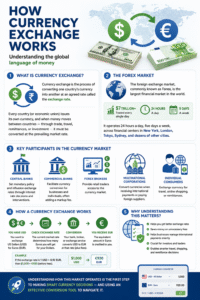
What Is an Exchange Currency Converter?
An Exchange Currency Converter is a digital tool that calculates the converted value of one currency into another based on current or fixed exchange rates. You enter an amount, select your source currency, choose your target currency, and the tool instantly shows you how much you will receive.
Our Exchange Currency Converter covers 55 global currencies — from major pairs like USD/EUR and GBP/JPY to regional currencies like the Pakistani Rupee, Kuwaiti Dinar, and Vietnamese Dong. It also includes a markup fee field that simulates the real-world cost banks and brokers charge above the interbank rate — so you see the true amount you will receive, not just the theoretical mid-market rate.
What sets a powerful tool apart from a basic one:
- Covers a wide range of global currencies (not just the top 10)
- Accounts for markup fees and conversion charges
- Shows a live multi-currency comparison table
- Displays both the conversion rate and the converted value
- Delivers results instantly without needing an account or login
Our tool is built for everyone — from the tourist converting $200 to local currency at the airport, to the importer calculating a $500,000 payment to an overseas supplier.
How Exchange Rates Are Determined
Exchange rates are not fixed — they fluctuate constantly based on a complex web of economic, political, and market forces. Understanding what drives these movements helps you time your conversions more intelligently.
Key Factors That Influence Exchange Rates:
Interest Rates When a country’s central bank raises interest rates, its currency typically strengthens. Higher rates attract foreign investment seeking better returns, increasing demand for that currency.
Inflation Countries with lower inflation rates tend to see their currency appreciate over time. High inflation erodes purchasing power and weakens a currency relative to more stable economies.
Economic Performance Strong GDP growth, low unemployment, and positive trade balances signal a healthy economy — which attracts investment and strengthens the currency. Weak economic data has the opposite effect.
Political Stability Currencies of politically stable countries tend to hold their value better than those of countries experiencing instability, elections, or geopolitical conflict.
Market Sentiment and Speculation In the short term, Forex markets are heavily driven by trader psychology — expectations, rumors, and large institutional moves can cause rapid rate swings that are unrelated to fundamentals.
Central Bank Interventions Some central banks actively buy or sell their own currency to control exchange rates — either to prevent excessive appreciation that hurts exports, or to halt rapid depreciation.
The practical implication: Exchange rates can move significantly in hours or days. Using an accurate, up-to-date tool ensures you are always working with relevant data — not a rate you looked up a week ago.
How to Use an Exchange Currency Converter Step by Step
Our tool is designed for instant, intuitive use. Here is a complete walkthrough:
Step 1: Enter the Amount to Convert Type the amount of money you want to convert. You can enter any value — from small amounts like $1 to large sums like $1,000,000.
Step 2: Select the From Currency Choose the currency you are converting from — the currency you currently hold. For example, select USD (US Dollar) if you are converting from dollars.
Step 3: Select the To Currency Choose the currency you want to convert into — the currency you want to receive. For example, select EUR (Euro) if you are converting to euros.
Step 4: Enter a Markup Fee (Optional) Banks, exchange offices, and money transfer services add a percentage above the base rate called a markup. Enter the markup percentage to see the real converted amount after fees. This field is critical for realistic planning.
Step 5: Click Convert Currency Our tool instantly generates a complete conversion breakdown:
- The base exchange rate used
- The markup fee applied
- The effective rate after markup
- The exact converted amount you will receive
Step 6: Check the Live Multi-Currency Table Below the result, a dynamic comparison table shows the equivalent value of your amount across all 55 currencies simultaneously. This is ideal for comparing costs across multiple countries at once.
Step 7: Clear and Recalculate Use the Clear button to reset all fields and run a new conversion. Adjust the amount, change currencies, or modify the markup fee to model different scenarios.
Understanding Markup Fees and Hidden Costs
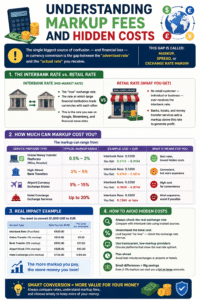
The single biggest source of confusion — and financial loss — in convertor conversion is the gap between the “advertised rate” and the “actual rate” you receive. This gap is known as the markup, spread, or exchange rate margin.
The Interbank Rate vs. Retail Rate:
The interbank rate (also called the mid-market rate) is the “true” exchange rate — the rate at which large financial institutions trade currencies with each other. This is the rate you see quoted on Google, Bloomberg, and financial news sites.
However, no retail customer — individual or business — ever receives the interbank rate. Banks, airport kiosks, and money transfer services add a markup above this rate to generate profit. The markup can range from:
- 0.5–2% for online money transfer platforms (Wise, Revolut)
- 2–5% for high-street bank transfers
- 5–15% for airport currency exchange kiosks
- Up to 20% for hotel concierge exchange services

Impact of Markup on Real Amounts:
| Markup | Converting $1,000 USD to EUR (rate: 0.92) |
|---|---|
| 0% (interbank) | €920.00 |
| 1% markup | €910.80 |
| 3% markup | €892.40 |
| 5% markup | €874.00 |
| 10% markup | €828.00 |
A 10% markup on a $1,000 conversion costs you $92 in hidden fees — money that appears nowhere on the receipt. Use our Exchange Currency Converter with the markup fee field filled in to see your real converted amount, not the theoretical ideal.
The World’s Most Traded Currencies
Understanding which currencies dominate global trade helps you recognize why certain exchange currency converter rates are more stable and liquid than others.
Top 10 Most Traded Currencies (2025):
| Rank | Currency | Code | Share of Daily Forex Volume |
|---|---|---|---|
| 1 | US Dollar | USD | ~88% of all trades |
| 2 | Euro | EUR | ~31% |
| 3 | Japanese Yen | JPY | ~17% |
| 4 | British Pound | GBP | ~13% |
| 5 | Chinese Yuan | CNY | ~7% |
| 6 | Australian Dollar | AUD | ~6% |
| 7 | Canadian Dollar | CAD | ~6% |
| 8 | Swiss Franc | CHF | ~5% |
| 9 | Hong Kong Dollar | HKD | ~3% |
| 10 | Singapore Dollar | SGD | ~2% |
(Note: Percentages exceed 100% because every trade involves two currencies)
The US Dollar is involved in nearly 88% of all Forex transactions — making it the world’s primary reserve currency and the benchmark against which all other currencies are measured.
Our tool covers all of these major currencies plus dozens of emerging market and regional currencies, giving you complete global coverage in one place.
Major Currency Pairs Explained
In Forex and Exchange Currency Converter conversion, currencies are always traded in pairs. Understanding the major pairs helps you make sense of the rates shown in our tool.
Major Pairs (USD-Based):
- EUR/USD — Euro vs. US Dollar — the most traded pair in the world
- USD/JPY — US Dollar vs. Japanese Yen — heavily influenced by Bank of Japan policy
- GBP/USD — British Pound vs. US Dollar — known as “Cable” in trading circles
- USD/CHF — US Dollar vs. Swiss Franc — the “safe haven” pair
- USD/CAD — US Dollar vs. Canadian Dollar — heavily correlated with oil prices
- AUD/USD — Australian Dollar vs. US Dollar — tracks commodity prices, especially iron ore and gold
- NZD/USD — New Zealand Dollar vs. US Dollar — linked to agricultural commodity exports
Cross Pairs (Non-USD):
- EUR/GBP — Euro vs. British Pound
- EUR/JPY — Euro vs. Japanese Yen
- GBP/JPY — British Pound vs. Japanese Yen (known as “The Dragon” — highly volatile)
Understanding currency pairs helps you select the right conversion direction in our tool — and interpret the rates you see in the results table.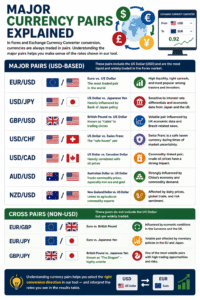
Exchange Currency Converter for Travelers
For international travelers, currency conversion is one of the most financially impactful decisions of the entire trip — yet most people handle it without any planning or comparison. Our Exchange Currency Converter changes that.
How Travelers Use the Tool:
Before the Trip — Budget Planning Enter your travel budget in your home currency and convert it to the destination currency to know exactly how much local money you will have to spend. Adjust for different markup rates to compare airport exchange vs. ATM withdrawal vs. online pre-order.
At the Destination — Real-Time Price Comparison You see a hotel room priced at 15,000 Thai Baht. Is that expensive or cheap? Use our tool on your phone to instantly see the equivalent in your home currency.
For Multiple Destinations — Side-by-Side Comparison The live multi-currency table shows your home currency amount converted to all 55 currencies at once. Perfect for multi-country trips across Europe, Asia, or the Middle East.
Traveler Tips for Getting the Best Rate:
- Avoid airport kiosks — markups of 8–15% are standard, costing you significantly on every conversion
- Use ATMs at your destination — local bank ATMs typically offer rates close to the interbank rate
- Notify your bank before travel — prevents fraud flags on international transactions
- Use multi-currency travel cards — load money at the interbank rate before your trip
- Always pay in local currency — when a foreign merchant offers to charge you in your home currency (Dynamic Currency Conversion), decline — their rate is always worse
Exchange Currency Converter for Businesses
For businesses that operate internationally, Exchange Currency Converter conversion is not a travel convenience — it is a core financial operation that affects pricing, profit margins, supplier payments, and financial reporting.
Our tool supports business users across a range of critical scenarios:
Supplier Payments You owe a Chinese supplier CNY 500,000. How many US Dollars do you need to transfer? What will that cost after your bank’s 2% markup? Enter the values and get the exact answer immediately.
International Pricing You sell software at $99 USD. What is the equivalent price in British Pounds, Euros, and Japanese Yen? The multi-currency table gives you all values at once — ideal for setting up localized pricing pages.
Financial Reporting Convert foreign revenue into your reporting currency for accurate P&L statements. Enter the amount, select the currencies, and use the result in your accounting system.
Margin Protection If exchange rates move 3% against you, how does that affect your margin on an international sale? Use the markup field to model different rate scenarios and build appropriate pricing buffers.
Budget Forecasting Planning international travel expenses, conference budgets, or overseas office costs? Convert all line items consistently using the same exchange rate assumption to ensure accurate total budget projections.
Real-Life Conversion Examples
Example 1: Tourist Converting USD to PKR
- Amount: $500 USD
- Rate: 278.50 PKR per USD
- Markup: 3% (bank fee)
- Result: 134,957 PKR received (vs. 139,250 at interbank rate)
- Hidden cost of markup: PKR 4,293 (~$15.43)
Example 2: UK Business Paying a European Supplier
- Amount: £50,000 GBP to EUR
- Rate: 1 GBP = 1.163 EUR (derived from GBP → USD → EUR)
- Markup: 1.5%
- Result: €57,324 received by supplier
- Cost of markup: £750 in fees
Example 3: Expat Sending Remittance (USD to INR)
- Amount: $300 USD
- Rate: 83.40 INR per USD
- Markup: 0% (using a zero-fee transfer platform)
- Result: ₹25,020 received
Example 4: Traveler Checking Price of Hotel
- Hotel rate: 120,000 IDR (Indonesian Rupiah) per night
- Traveler’s home currency: CAD
- Rate: 16,050 IDR = 1 USD | 1 USD = 1.37 CAD
- Result: Approximately CAD $10.24 per night — an excellent rate
Running all four of these scenarios with our Exchange Currency Converter takes under two minutes total — and gives you the exact information you need to make the right financial decision.
Benefits of Using an Exchange Currency Converter
1. Instant Multi-Currency Results Convert your amount to 55 currencies simultaneously with the live comparison table — ideal for travelers visiting multiple countries or businesses operating across several markets.
2. Real-World Accuracy with Markup Fees Unlike tools that only show the theoretical mid-market rate, our Exchange Currency Converter includes a markup fee field so you see the amount you will actually receive.
3. Zero Registration Required No account, no subscription, no personal data needed. Open the tool and start converting immediately.
4. Financial Planning Precision Whether you are budgeting a vacation or planning a $1M import payment, the tool gives you consistent, formula-based results you can rely on for financial decisions.
5. Global Currency Coverage With 55 currencies covering every major region — Americas, Europe, Middle East, Asia-Pacific, and Africa — you are never missing a currency you need.
6. Mobile Friendly Use our Exchange Currency Converter on any device — phone, tablet, or desktop — without downloading an app or compromising on accuracy.
How to Get the Best Exchange Rate
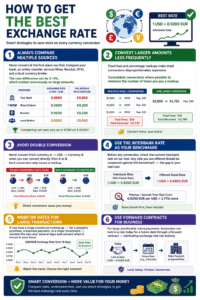
Getting the best exchange rate is about knowing where to convert, when to convert, and what fees are involved. Here is a practical guide:
1. Always Compare Multiple Sources Never convert at the first place you find. Compare your bank, an online transfer service (Wise, Revolut, OFX), and a local currency broker. The rate difference can be 2–5%, which matters enormously on large amounts.
2. Convert Larger Amounts Less Frequently Fixed fees and percentage markups make small conversions disproportionately expensive. Consolidate conversions where possible to minimize the number of times you pay a markup.
3. Avoid Double Conversion Never convert from Currency A → USD → Currency B when you can convert directly from A to B. Each conversion step incurs a markup.
4. Use the Interbank Rate as Your Benchmark Before any conversion, check the current interbank rate on our tool. Any rate you are offered should be compared against this benchmark — the gap is your real cost.
5. Monitor Rates for Large Transactions If you have a large conversion coming up — for a property purchase, a business payment, or a major investment — monitor the rate over several days and convert when it moves in your favor.
6. Use Forward Contracts for Business For large, predictable future payments, businesses can lock in a rate today for a future date through a forward contract — eliminating exchange rate risk entirely.
Common Currency Conversion Mistakes
Mistake 1: Using an Outdated Rate Exchange rates change every minute. Using a rate you looked up yesterday — or last week — can result in significant under- or over-estimation of conversion amounts.
Mistake 2: Forgetting the Markup Fee The mid-market rate you see online is not what you receive. Always factor in the markup when calculating real conversion amounts for financial planning.
Mistake 3: Confusing the Direction of Conversion “USD to EUR” vs. “EUR to USD” gives completely different results. Always verify you have selected the correct From and To currencies before relying on the output.
Mistake 4: Accepting Dynamic Currency Conversion Abroad When a foreign merchant or ATM asks if you want to pay in your home currency, always choose the local currency. The DCC rate offered is always worse than your bank’s rate.
Mistake 5: Ignoring Transfer Fees Some services show a “zero markup” rate but charge a flat transfer fee on top. Always calculate the total cost — markup percentage plus any fixed fees — to find the truly cheapest option.
Mistake 6: Not Checking Receiving Fees Recipient banks sometimes charge a fee to receive an international wire transfer. This reduces the amount your recipient actually gets — factor it in when calculating how much to send.
Frequently Asked Questions
Q: What is the difference between the mid-market rate and the rate I receive? The mid-market rate (interbank rate) is the “real” exchange rate between two currencies, shown without any fees. The rate you receive from a bank or exchange service is lower because a markup is added. The difference is their profit.
Q: How often do exchange rates change? Exchange rates change continuously during market hours — sometimes multiple times per minute for major pairs. For practical planning purposes, rates are typically quoted as a daily average.
Q: Is it better to exchange currency before or after traveling? In most cases, exchanging before travel at a bank or online service gives better rates than airport kiosks. However, using local ATMs at your destination often provides the most competitive rate.
Q: What does “markup fee” mean in the calculator? The markup fee is the percentage added above the base exchange rate by the bank or service provider. Enter your provider’s markup to see the real converted amount you will receive after their charges.
Q: Why does the tool show 55 currencies in the comparison table? The live table converts your amount simultaneously into all 55 supported currencies, allowing instant side-by-side comparison — useful for travelers, businesses, and anyone making multi-currency decisions.
Q: Can I use this tool for business financial planning? Absolutely. The tool is precise, formula-based, and handles any amount — from small personal transfers to large business payments. Enter your amount, select your currencies, add your bank’s markup, and use the result for budgeting or invoicing.
Conclusion
In a globalized world where money crosses borders every second, having a fast, accurate, and honest Exchange Currency Converter is not optional — it is essential. From solo travelers checking hotel prices in Bali to multinational businesses reconciling quarterly financials, accurate currency conversion underpins every international financial decision.
We covered everything: how exchange rates are set by global market forces, the hidden cost of markup fees, the world’s most traded currencies, how travelers and businesses use currency tools differently, and the common mistakes that cost people real money on every conversion.
Our Exchange Currency Converter brings together 55 currencies, transparent markup fee simulation, a live multi-currency comparison table, and instant results — all in one clean, free, no-registration tool that works on any device.
The next time you are about to convert money — whether it is $100 for a weekend trip or $100,000 for a business payment — use our Exchange Currency Converter first. Know the rate. Know the fee. Know the true amount. Make every currency conversion with complete confidence.