Get fast mortgage payment estimates with Canadian Mortgage Calculator
Table of Contents
- Introduction
- What Is a Percent Off Discount?
- What Is a Percent Off Calculator?
- The Percent Off Formula Explained
- How to Use a Percent Off Calculator Step by Step
- Single Discount vs. Stacked Discounts
- How Coupon Stacking Works
- Cash Rebates and Their Impact on Final Price
- Tax, Shipping, and the True Final Price
- Percent Off Calculator for Bulk Purchases
- Real-Life Shopping Examples
- Benefits of Using a Percent Off Calculator
- Real-life Examples
- Quick Formula
- How Retailers Use Percentage Discounts
- How to Spot Fake Discounts
- Frequently Asked Questions
- Calculate Your Discount and Final Price
- Conclusion
Introduction
Every shopper, every business owner, and every bargain hunter has faced the same mental challenge: you see a product marked “20% off” but your brain cannot instantly compute what that means in real dollars. Is it worth buying? How much will you actually save? What is the final price after tax and shipping? These questions get even trickier when multiple discounts, coupons, and rebates are stacked on top of each other.
That is exactly where a Percent Off Calculator becomes your most powerful shopping companion. Instead of squinting at price tags and mentally wrestling with percentages, you enter the numbers and get the complete picture instantly — the amount saved, the discounted price, the tax added, and the true final cost at checkout.
In this comprehensive guide, you will learn everything about percentage discounts — how the math works, how to use our tool step by step, how stacked discounts and coupon calculations work, how to spot genuine deals versus inflated markdowns, and how smart shoppers use a Percent Off Calculator to save hundreds of dollars every single month.
Whether you are shopping at a mall, buying online, comparing sale prices across stores, or running a business that needs to calculate customer discounts precisely — this guide will turn you into a discount calculation expert.
What Is a Percent Off Discount?
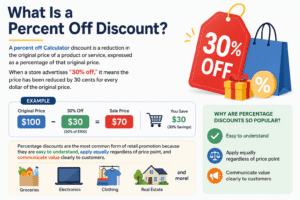
A percent off Calculator discount is a reduction in the original price of a product or service, expressed as a percentage of that original price. When a store advertises “30% off,” it means the price has been reduced by 30 cents for every dollar of the original price.
Percentage discounts are the most common form of retail promotion because they are easy to understand, apply equally regardless of price point, and communicate value clearly to customers. Whether you are shopping for groceries, electronics, clothing, or real estate, percentage discounts appear everywhere.
Why Percent Off Matters More Than Dollar Discounts:
- Scales with price — 20% off a $500 item ($100 saved) is far more valuable than 20% off a $10 item ($2 saved)
- Easy to compare — comparing “30% off” vs. “$40 off” on different items is difficult; percentages standardize the comparison
- Reveals true value — a “$50 off” deal sounds great until you realize the item was originally $55
Understanding percent off is a fundamental financial literacy skill that affects every purchase you make. And with the right tool, you never have to calculate it manually again.
What Is a Percent Off Calculator?
A Percent Off Calculator is a digital tool that computes the discounted price of an item based on its original price and the percentage discount applied — instantly, accurately, and with full transparency on every component of the final cost.
Our Percent Off Calculator goes far beyond the basics. It handles:
- Primary percentage discount — the main sale or markdown
- Additional coupon percentage — a second discount applied on top of the first
- Coupon stacking mode — choose between stacked (consecutive) or added (combined) application
- Fixed cash rebate — a flat dollar amount deducted from the price
- Tax rate calculation — applies your local tax rate to the discounted price
- Shipping and fees — adds delivery costs to arrive at the true checkout total
- Quantity adjustment — calculates the total for multiple units purchased
The result is a complete price summary — not just the discounted amount, but the total you will actually pay when you reach the checkout page, including every cost and saving along the way.
The Percent Off Formula Explained
Understanding the math behind this tool helps you verify results and apply the logic manually when needed.
Basic Percent Off Formula:
Discounted Price = Original Price × (1 − Discount % ÷ 100)
Or expressed differently:
Savings Amount = Original Price × (Discount % ÷ 100)
Example — 20% off a $150 item:
- Savings = $150 × (20 ÷ 100) = $150 × 0.20 = $30 saved
- Discounted Price = $150 − $30 = $120
Finding What Percent Off Was Applied:
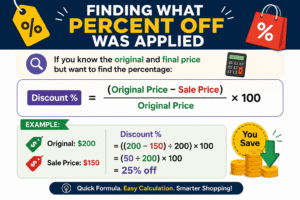
If you know the original and final price but want to find the percentage:
Discount % = ((Original Price − Sale Price) ÷ Original Price) × 100
Example:
- Original: $200 | Sale Price: $150
- Discount % = ((200 − 150) ÷ 200) × 100 = (50 ÷ 200) × 100 = 25% off

Reverse Calculation — Finding Original Price from Discounted Price:
Original Price = Sale Price ÷ (1 − Discount % ÷ 100)
Example: Sale price is $80 after 20% off — what was the original?
- Original = $80 ÷ (1 − 0.20) = $80 ÷ 0.80 = $100
Our tool handles all three of these calculation directions automatically, so you always have the number you need.
How to Use a Percent Off Calculator Step by Step
Using our tool is completely straightforward. Here is a detailed walkthrough of every input:
Step 1: Enter the Original Price Type in the full retail price of the item — before any discounts are applied. This is the “was” price or the MSRP (Manufacturer’s Suggested Retail Price).
Step 2: Enter the Primary Percent Off Input the main discount percentage. For example, if the item is “20% off,” enter 20. This is the primary markdown.
Step 3: Enter an Additional Coupon (Optional) If you have a coupon code or membership discount on top of the sale price, enter it here. For example, an extra 5% off for newsletter subscribers.
Step 4: Choose Coupon Calculation Mode
- Stacked (Consecutive): The coupon is applied to the price after the primary discount. This is how most legitimate coupons work.
- Added Directly: The two percentages are simply added together (20% + 5% = 25% off the original price).
Step 5: Enter a Fixed Cash Rebate (Optional) If there is a flat dollar amount off (like a “$10 off” coupon or mail-in rebate), enter it here. It is deducted after percentage discounts.
Step 6: Enter the Tax Rate Input your local sales tax rate. The tool applies tax to the discounted price — not the original price — giving you the accurate taxable amount.
Step 7: Enter Shipping and Fees Add any flat shipping charge or platform fee. This completes the true total cost of your purchase.
Step 8: Enter Quantity If you are buying more than one unit, enter the quantity. The tool scales all calculations proportionally.
Step 9: Click Calculate Price Your Percent Off Calculator instantly displays a complete breakdown: savings per item, total savings for all units, subtotal before tax, tax applied, shipping added, and the true final checkout total.
Single Discount vs. Stacked Discounts
One of the most important — and most misunderstood — concepts in discount shopping is the difference between a single discount and stacked discounts.
Single Discount
A single percentage is applied to the original price. Simple and straightforward.
Example: 25% off a $200 item
- Savings: $50
- Final Price: $150
Stacked Discounts (Consecutive)
Two discounts are applied one after the other. The second discount applies to the price after the first discount has already been taken.
Example: 20% off, then 5% off with a coupon on a $200 item
- After 20% off: $200 × 0.80 = $160
- After 5% off $160: $160 × 0.95 = $152
- Total Savings: $48 (not $50)
Why Stacked Discounts Are NOT the Same as Adding Percentages
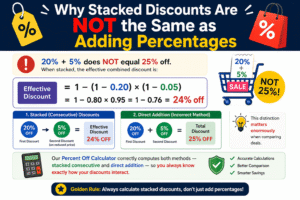
20% + 5% does NOT equal 25% off. When stacked, the effective combined discount is:
Effective Discount = 1 − (1 − 0.20) × (1 − 0.05) = 1 − 0.80 × 0.95 = 1 − 0.76 = 24% off
This distinction matters enormously when comparing deals. Our Percent Off Calculator correctly computes both methods — stacked consecutive and direct addition — so you always know exactly how your discounts interact.
How Coupon Stacking Works
Coupon stacking is the art of combining multiple discounts to maximize your savings on a single purchase. Retail stores handle stacking in different ways, and understanding the rules helps you get the best deal possible.
How Stores Apply Stacked Coupons:
Scenario 1: Store Sale + Brand Coupon The item is on sale at 30% off. You have a brand coupon for an additional 10% off. Both apply — the brand coupon reduces the already-discounted sale price.
Scenario 2: Store Loyalty Points + Promo Code Your loyalty reward gives 15% off. An online promo code gives another 10% off. These stack consecutively.
Scenario 3: Credit Card Cashback + Sale Your credit card offers 5% cashback on purchases. Combined with a 20% store sale, your effective savings are calculated sequentially.
Real Example:
- Original price: $300
- Primary discount: 20% → Price becomes $240
- Loyalty coupon: 10% stacked → Price becomes $216
- Cash rebate: $10 → Final price: $206
- Total savings: $94 (31.3% effective discount)
Without a Percent Off Calculator, most shoppers underestimate or overestimate the combined savings — and sometimes pay more than they need to because they do not know the most favorable stacking order.
Cash Rebates and Their Impact on Final Price
Cash rebates are flat dollar amounts deducted from the price after percentage discounts have been applied. They are subtracted from the post-discount price to give you the final base price before tax and shipping.
Types of Rebates:
- Instant rebate — deducted at the point of sale (e.g., “$20 off” sticker at the register)
- Mail-in rebate — you pay full price, then submit a claim and receive a check later
- Digital cashback — credited to your account after purchase (e.g., through cashback apps)
How Rebates Work in the Calculation:
Example:
- Original: $150
- Primary Discount: 20% off → $120
- Cash Rebate: $10 → $110
- Tax (13%): $14.30
- Shipping: $5
- True Final Total: $129.30
The key insight: Always apply percentage discounts first, then deduct flat cash rebates. Applying the rebate before the percentage actually gives you a slightly lower saving than the correct order.
Our tool follows the mathematically correct order automatically — so your results are always accurate.
Tax, Shipping, and the True Final Price
The biggest mistake most shoppers make is comparing prices before tax and shipping. Two items with the same discounted price can end up at very different totals once tax rates and delivery costs are factored in.
Why Tax Rate Matters:
Tax is calculated on the discounted price — not the original price. This means a larger discount reduces not just the item cost but also the tax you pay.
Example: $150 item, 20% off, 13% tax
- Without discount: Tax = $150 × 0.13 = $19.50
- With 20% discount: Tax = $120 × 0.13 = $15.60
- Tax savings from the discount: $3.90
The Full True-Cost Comparison:
| Scenario | Item Price | Tax (13%) | Shipping | Final Total |
|---|---|---|---|---|
| No discount | $150.00 | $19.50 | $5.00 | $174.50 |
| 20% off | $120.00 | $15.60 | $5.00 | $140.60 |
| 20% + 5% coupon | $114.00 | $14.82 | $5.00 | $133.82 |
The difference between no discount and a combined discount is $40.68 — nearly 23% savings on your final checkout total. Our Percent Off Calculator computes this full comparison automatically.
Percent Off Calculator for Bulk Purchases
When buying multiple units of the same item, the quantity multiplier makes the savings even more dramatic — and makes accurate calculation even more critical.
How Bulk Calculation Works:
All per-unit calculations (original price, discounts, rebates) are multiplied by the quantity first. Tax is then applied to the bulk subtotal, and shipping is added as a flat fee for the entire order.
Example — 3 units at $150 each, 20% off:
- Per unit discounted price: $120
- Subtotal (×3): $360
- Tax at 13%: $46.80
- Shipping: $5.00
- Final Total: $411.80
- Total Savings on 3 Units: $90.00
The more units you buy, the more important it is to percent off calculate accurately — a $5 error per unit becomes a $50 error at 10 units. Use our Percent Off Calculator to verify bulk order totals before confirming any large purchase.
Real-Life Shopping Examples
Example 1: Black Friday Electronics Deal
- Original Price: $799 (laptop)
- Primary Discount: 25% off Black Friday sale
- Coupon Code: 5% additional off (stacked)
- Tax Rate: 8%
- Shipping: $0 (free)
Results:
- After 25% off: $599.25
- After 5% stacked: $569.29
- Tax (8%): $45.54
- Final Price: $614.83
- Total Saved: $229.71 (28.7% effective discount)
Example 2: Clothing Store with Loyalty Rewards
- Original Price: $80 (jacket)
- Primary Discount: 30% off seasonal sale
- Loyalty Coupon: 10% stacked
- Cash Rebate: $5
- Tax Rate: 10%
- Quantity: 2
Results:
- After 30% off: $56.00
- After 10% stacked: $50.40
- After $5 rebate: $45.40
- Subtotal (×2): $90.80
- Tax: $9.08
- Final Total: $99.88
- Total Saved: $70.12 (41.2% off)
Example 3: Online Grocery with Cashback
- Original Price: $45 (grocery bundle)
- Discount: 15% off app promo
- Cashback: $3 flat rebate
- Tax: 5%
- Shipping: $3.99
- Quantity: 1
Results:
- After 15% off: $38.25
- After $3 rebate: $35.25
- Tax: $1.76
- Shipping: $3.99
- Final Total: $41.00
- Total Saved: $7.50 (14.3% off total checkout)
Benefits of Using a Percent Off Calculator
1. Instant and Accurate Results No mental math, no rounding errors, no second-guessing. Enter the numbers and get the precise final price every time.
2. Handles Complex Discount Stacking Manually computing consecutive percentage discounts plus a cash rebate plus tax is error-prone. Our Percent Off Calculator handles the entire chain correctly in one step.
3. Reveals the True Total Most shoppers focus only on the “sale price” — completely forgetting tax and shipping. Our tool shows the real cost you will pay at checkout.
4. Enables Comparison Shopping Use it to compare two products with different discount structures side by side. Enter each scenario separately to see which truly costs less at the end.
5. Bulk Order Verification For businesses and power shoppers buying in quantity, the tool scales all calculations to your exact order size, preventing costly quantity errors.
6. Completely Free Our Percent Off Calculator is available online with no registration, no subscription, and no limits — use it as many times as you need.
Real-life Examples
Quick Formula
Discount amount = Original Price × (Discount % ÷ 100)
Price after discount = Original Price − Discount amount
For a stacked coupon, apply the second percentage to the reduced price—not the original price.
How Retailers Use Percentage Discounts
Understanding the retailer’s perspective helps you shop smarter and recognize genuine deals from marketing tactics.
The Psychology of Percentage Discounts:
Retailers know that “30% off” triggers a stronger emotional response than “$15 off” — even when the dollar amount is identical. Percentage framing makes the discount feel proportional and significant, regardless of the absolute value.
Common Retailer Tactics:
The Inflated Original Price Some retailers artificially mark up the “original” price before applying a percentage discount — making a 30% discount look impressive when the true savings relative to fair market value is only 5%.
The Decoy Pricing Strategy A store places three items at different price points. The most expensive item exists purely to make the middle item look like a reasonable bargain — even without any stated discount.
The Bundle Discount “Buy 2, get 30% off” sounds great — but only if you actually need 2. Buying 2 units of something you do not need costs more than buying 1 at full price.
How to protect yourself: Always use a Percent Off Calculator to verify the true price and compare it against market prices before assuming a deal is genuine.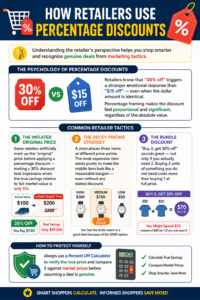
How to Spot Fake Discounts
Not every discount is what it appears to be. Here are the warning signs of a manipulated markdown and how to protect yourself:
Warning Sign 1: Reference Price That Never Existed Some retailers list a “Was: $299” price that the product was never actually sold at. Use price history tools alongside a Percent Off Calculator to verify the reference price is legitimate.
Warning Sign 2: Very Short Sale Windows “Today Only!” creates urgency that bypasses rational thinking. Never rush a purchase because of an artificial deadline.
Warning Sign 3: Rounding That Benefits the Seller A product priced at $99.99 marked “50% off” should be $49.995 — but many retailers round up to $50.00. Small rounding errors add up across millions of transactions.
Warning Sign 4: The “Up to X% Off” Trap “Up to 70% off” means only a tiny fraction of items carry the maximum discount. Most products may only be 10–15% off — the headline percentage applies to one or two loss-leader items.
Warning Sign 5: Ignoring Tax and Shipping A product advertised at “50% off” with $25 shipping and high tax might cost more than a less-discounted alternative with free shipping. Always compare final totals, not just sale prices.
Frequently Asked Questions
Q: How do I calculate percent off without a calculator? Multiply the original price by the discount percentage divided by 100. For a quick estimate: move the decimal point of the percentage one place left, then multiply. For 20% off $150: 0.20 × $150 = $30 off, leaving $120.
Q: What is the difference between stacked and combined discounts? Stacked (consecutive) means the second discount applies to the already-discounted price. Combined (added) means both percentages are summed and applied to the original price at once. Stacked discounts always result in a slightly lower effective discount.
Q: Does tax apply to the original or discounted price? In most jurisdictions, tax is calculated on the final discounted price — not the original price. This means your discount also reduces the tax you pay.
Q: How does a cash rebate differ from a percentage discount? A cash rebate is a fixed flat amount deducted from the price. A percentage discount scales with the price. Rebates are most powerful on lower-priced items; percentage discounts deliver more savings on higher-priced items.
Q: Can I use this tool for business pricing? Absolutely. Enter your selling price as the “original price,” your planned discount as the percentage off, and your applicable tax rate. The tool shows the price your customer pays — making it ideal for quote generation and pricing decisions.
Q: What is an effective discount percentage? When multiple discounts are stacked, the effective discount is the overall percentage reduction from the original price to the final discounted price, expressed as a single number. Our tool calculates and displays this for you automatically.
Q : How do I calculate what percentage I saved?
Divide the total amount saved by the original price, then multiply by 100: (Savings ÷ Original Price) × 100.
Q : Are two discounts added together?
Not always. With stacked discounts, each percentage is applied one after another. “Added directly” combines the percentages and applies the total to the original price.
Q : Do tax and shipping change the discount?
The discount is applied first. This calculator then estimates tax on the discounted subtotal and adds shipping or fees to show the final checkout price.
Calculate Your Discount and Final Price
Use this free percent off calculator to quickly find the discount amount, sale price, total savings, and estimated final checkout cost. Enter the original price and discount percentage to see how much you save and how much you pay.
How to calculate a percentage discount
The discount amount is calculated by multiplying the original price by the discount percentage divided by 100. For example, a $100 item with 20% off gives a $20 discount, so the sale price is $80 before tax and shipping.
Calculate stacked discounts and coupons
When a store offers an additional coupon, you can choose between a stacked discount and an added discount. A stacked coupon is applied to the already-reduced price, while an added discount combines both percentages and applies them to the original price.
Estimate the final checkout price
This discount calculator can also include a fixed cash rebate, tax rate, shipping or fees, and the quantity purchased. Discounts and rebates are applied before estimated tax, then shipping and fees are added to show the final checkout price.
Conclusion
A Percent Off Calculator is not just a convenience — it is a tool that puts the power of accurate, transparent financial information directly in your hands every time you shop. From simple single discounts to complex stacked coupon scenarios with rebates, tax, and bulk quantities, our tool handles every situation with precision and clarity.
We covered the complete math behind percentage discounts, how stacked and consecutive discounts differ from simple addition, why cash rebates must be applied in the correct order, how tax and shipping change the true total, and how retailers use psychological pricing tactics to make discounts appear more valuable than they are.
The bottom line is simple: never rely on the “sale price” label alone. Always check the true final cost — including tax, shipping, stacked coupons, and any rebates — before deciding whether a deal is worth taking. Our Percent Off Calculator makes that process take seconds rather than minutes.
Smart shopping starts with accurate numbers. Enter your deal into our tool before you buy, and you will never overpay for a “discount” again.